

TL;DR:
- Many UK property owners overlook the substantial impact of always-on electrical loads, which can account for 20 to 30 percent of annual energy consumption. Reducing base load through targeted measures can significantly improve energy performance ratings and compliance with new regulations under the Home Energy Model. Regular audits, appliance upgrades, and smart device management are essential strategies to minimize unnecessary energy wastage and future-proof property investments.
Many property owners in the UK focus almost entirely on heating and lighting when reviewing energy bills, yet the electricity their buildings consume around the clock, even when quiet and empty, can account for a surprisingly large share of annual costs. Base load in energy consumption refers to the minimum, constant electricity demand that persists regardless of time of day or activity levels. With the Home Energy Model (HEM) set to reshape how Energy Performance Certificates are calculated and assessed, understanding base load is no longer optional for landlords and property investors. This guide explains what base load is, how to measure it, and what practical steps can reduce it.
Table of Contents
- What is base load and why does it matter?
- How base load appears in UK homes
- How the Home Energy Model addresses base load
- Why reducing base load matters: benefits and proven strategies
- Our take: The hidden cost of ignoring base load in UK property
- Get expert help improving your property’s base load and EPC
- Frequently asked questions
Key Takeaways
| Point | Details |
|---|---|
| Base load basics | Base load is the lowest, constant energy demand of a property, independent of activity or time. |
| Regulatory impact | Upcoming Home Energy Model rules assess efficiency using dynamic simulation, not static base load values. |
| Cost and compliance | Lowering base load directly reduces bills and helps properties meet minimum EPC standards. |
| Practical strategies | Smart plugs, audits, and addressing standby losses are proven ways to cut base load. |
| Missed opportunities | Ignoring base load risks both higher costs and failing new landlord compliance thresholds. |
What is base load and why does it matter?
Before exploring strategies, it helps to be precise about what base load means in a residential or commercial property context. This is distinct from the grid-level term, where “baseload” refers to power stations that run continuously to meet minimum national demand. In a building, the concept is much more immediate.
“Base load” is the minimum, constant electricity demand in a building for essentials like fridges, security lights, or standby electronics.
Base load in UK households can be seen as the lowest point of daily smart meter readings, typically overnight. This is the power the property draws even when no one is actively using anything. It never switches off.
Common sources of base load in UK properties include:
- Fridge-freezers and wine coolers running continuously
- Broadband routers and network switches left permanently on
- Smart thermostats, alarm systems, and security cameras
- Boiler controls and motorised valves in standby mode
- Television set-top boxes and games consoles on standby
- Small plug-in chargers drawing phantom power
Understanding energy terminology like this matters because base load is not a spike you can manage by switching off a light. It is structural. It runs 24 hours a day, 7 days a week, 365 days a year. Reducing it even modestly produces compounded savings over time. With EPC standards tightening under the HEM framework, a high base load can silently drag down a property’s energy rating and create compliance headaches that heating upgrades alone will not solve.
How base load appears in UK homes
Now that the concept is clear, it is worth examining how base load actually shows up in real electricity data from UK properties. Smart meters have made this far easier to track than it was a decade ago.
In UK homes, base load appears as the minimum overnight smart meter reading. Properties may average between 0.1 and 0.5 kW, which equates to 2.4 to 12 kWh per day, purely as base load. That lower end of the range sounds modest, but at 0.5 kW continuously, a property is consuming roughly 4,380 kWh per year before anyone boils a kettle or turns on a lamp.
Residential benchmarks show UK homes average 8 to 10 kWh per day in total electricity consumption. Base load forms a significant proportion of this, particularly in smaller properties where the ratio of always-on demand to total use is higher.
The table below gives a rough guide to typical base load profiles across different property types:
| Property type | Typical base load (kW) | Daily base load (kWh) | Annual base load estimate (kWh) |
|---|---|---|---|
| Small flat (1 bed) | 0.1–0.2 | 2.4–4.8 | 876–1,752 |
| Mid-terrace house (3 bed) | 0.2–0.35 | 4.8–8.4 | 1,752–3,066 |
| Larger detached (4+ bed) | 0.3–0.5 | 7.2–12 | 2,628–4,380 |
| HMO or multi-let | 0.4–0.8 | 9.6–19.2 | 3,504–7,008 |
Not all profiles are equal. Properties with electric vehicle chargers left on standby, large chest freezers, or heat pump systems with active controls can sit at the higher end of this scale consistently. Understanding domestic energy use in this granular way helps landlords identify where to target improvements.
To calculate your own approximate base load, follow these steps:
- Access your smart meter in-home display or your energy supplier’s app
- Find the overnight readings between midnight and 5am over several days
- Average the lowest readings across that period
- Multiply the result (in kW) by 24 to get your daily base load in kWh
Pro Tip: If your smart meter app shows half-hour intervals, look for the floor value, not the average. The floor is your true base load. Comparing energy usage patterns across different seasons will also reveal whether heating controls or immersion heaters are inflating overnight demand.
How the Home Energy Model addresses base load
Understanding your property’s actual usage is important, but the formal regulatory picture matters just as much. The Home Energy Model is the methodology that will replace SAP (Standard Assessment Procedure) for producing Energy Performance Certificates, with the transition expected to be fully implemented for new EPCs from 2026 onwards.
SAP relied heavily on fixed, static values. Base load was effectively assumed rather than dynamically assessed. The HEM changes this significantly.
HEM regulations model base load indirectly via half-hour simulations, not as a standalone metric.
What this means practically is that HEM explained in simple terms is a dynamic simulation engine. It models a property’s energy behaviour across every half-hour of the year, accounting for occupancy patterns, fabric performance, heating controls, and minimum always-on demand. Base load is captured implicitly within those calculations rather than assigned a fixed figure.
The comparison below illustrates the key differences between SAP and HEM in how they handle base load:
| Feature | SAP (current) | HEM (from 2026) |
|---|---|---|
| Base load treatment | Fixed assumed values | Implicit in half-hourly simulations |
| Occupancy modelling | Standardised schedules | Dynamic, more realistic patterns |
| Always-on appliances | Generic allowance | Informed by property-specific data |
| EPC performance band sensitivity | Lower resolution | Higher resolution, more granular |
| Impact of reducing base load | Minimal effect on EPC band | Can shift EPC band with sustained reduction |
For property investors watching the Minimum Energy Efficiency Standards (MEES) trajectory, this distinction matters. The Government has signalled its intention to require rental properties to meet EPC Band C as a minimum. Under HEM’s more granular calculations, a property that accumulates significant base load waste could fall short of Band C even after installing cavity wall insulation or a new boiler. Reviewing modelled energy consumption under the new framework will therefore require more attention to always-on electrical demand than assessors and landlords have been accustomed to examining under SAP.
Why reducing base load matters: benefits and proven strategies
With measurement and regulatory context in place, the logical next question is what property owners can actually do to reduce base load and what genuine benefit they will see from doing so.
Reducing base load via audits and smart plugs cuts energy bills and helps with compliance. Elevated base load signals inefficiency, and that inefficiency carries real financial weight. At current electricity prices, an unnecessary 0.2 kW of always-on demand costs approximately £175 to £200 per year. For landlords managing a portfolio of five or ten properties, this compounds quickly.
The following steps represent a practical, proven sequence for reducing base load in UK rental and owner-occupied properties:
- Commission an energy audit. A professional energy audit identifies every always-on load in the building, cross-references it against smart meter data, and produces a ranked list of opportunities. This removes guesswork entirely.
- Replace ageing fridge-freezers. A fridge-freezer from the early 2000s may consume three times the electricity of a modern A-rated equivalent. This single swap often produces the largest single base load reduction in older properties.
- Install smart plugs with scheduling. Smart plugs allow remote monitoring and timed switching for devices that do not genuinely need 24-hour power, including televisions, set-top boxes, and desktop computers.
- Audit network and IT equipment. Broadband routers, network switches, and smart home hubs are frequent culprits. Where multiple devices serve the same function, consolidation reduces always-on demand immediately.
- Review boiler and heating controls. Older boiler control systems can maintain constant low-level power draws through motorised valves, pump overruns, and poorly programmed timers. Upgrading controls alongside base load reduction is highly efficient.
- Check for solar or battery system standby loads. Properties with solar PV or battery storage systems often carry inverter and monitoring equipment that draws power continuously. Reviewing energy saving steps specific to generation systems can uncover hidden base load that persists even when panels are producing nothing overnight.
A common and costly mistake is assuming that low activity in a property equals low energy use. Vacant buy-to-let properties between tenancies still draw base load from alarm systems, emergency lighting, and fridge-freezers that landlords forget to switch off. Checking smart meter readings during void periods frequently reveals surprisingly high floors.
Pro Tip: Use the void period between tenancies as a base load audit opportunity. If the meter is still running at 0.3 kW or above with the property empty and appliances unplugged, there is a hidden load somewhere worth investigating before the next tenancy begins. Using a tool to calculate savings before and after interventions helps quantify the financial return on investment and supports decision-making for portfolio-wide upgrades.

Our take: The hidden cost of ignoring base load in UK property
There is a recurring pattern visible across the UK landlord and investor community. When energy efficiency conversations arise, the discussion almost immediately moves to insulation, heat pumps, or solar panels. These are visible, tangible upgrades. They appear in surveys, attract grant funding, and make compelling arguments in property listings. Base load reduction, by contrast, happens quietly and involves unglamorous decisions like replacing a fridge or scheduling a router to switch off at night.
The uncomfortable truth is that many landlords who have spent significant sums on visible fabric upgrades are still failing to reach EPC Band C because their properties carry a structural always-on electrical load that SAP largely overlooked. Under HEM, that oversight will become visible in the numbers.
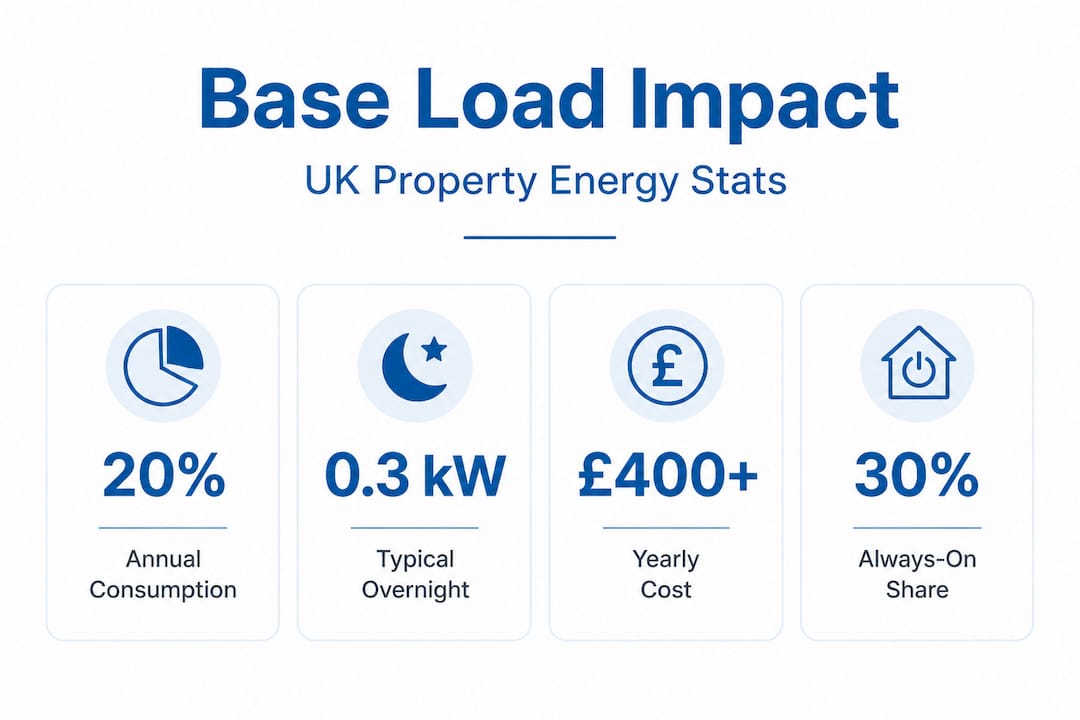
The energy consumption facts for UK homes show that always-on demand often accounts for 20 to 30 percent of total annual electricity use. In smaller properties with relatively low heating demand, that proportion can exceed 40 percent. Investors who ignore this are effectively leaving a significant compliance risk unaddressed, regardless of how well-insulated their building fabric is.
The mindset shift required is not large. It simply involves treating base load as a first-order consideration rather than an afterthought. Regular audits, even informal ones using smart meter apps, create a baseline. From that baseline, targeted action becomes straightforward. The landlords and property managers who build this habit now will face considerably fewer regulatory surprises when the new EPC regime takes full effect.
Get expert help improving your property’s base load and EPC
Understanding base load is the first step. Translating that understanding into measurable EPC improvements and genuine compliance under the Home Energy Model requires access to the right expertise and resources.
Homeenergymodel.co.uk provides detailed, practical guidance on energy models for landlords, covering the different frameworks available and how each affects EPC outcomes for residential and commercial properties. For property owners looking to understand the full implications of the transition from SAP, the Home Energy Model explained resource outlines the methodology, its impact on assessments, and the steps landlords should be taking now. From identifying hidden base load to planning fabric upgrades that genuinely shift performance bands, specialist support ensures that investment in energy efficiency delivers measurable results rather than assumptions.
Frequently asked questions
What appliances contribute most to a household’s base load?
Fridges, freezers, IT and network equipment, and standby power for electronics are the most consistent base load sources, as these represent “always-on” power for essential systems that run continuously regardless of occupancy or activity.
How can I quickly estimate my home’s base load?
Review your smart meter data for the lowest overnight reading across several nights, or check a 24-hour average during a period when the property is fully unoccupied and non-essential appliances are switched off.
Does the Home Energy Model require a separate base load value?
No. Under the HEM framework, energy use is simulated dynamically, which means base load is captured implicitly within the half-hourly heat balance calculations rather than entered as a fixed standalone figure.
What is a good base load target for efficient UK homes?
Efficient UK homes commonly achieve 0.1 to 0.3 kW overnight, equating to roughly 2.4 to 7 kWh per day as base load, which represents a well-managed level of always-on electrical demand for most residential property types.