

Unexpectedly high electricity bills often stem from a hidden culprit: standby power. Appliances left on standby can account for 9-16% of UK household electricity consumption, quietly draining your wallet whilst devices sit idle. This practical guide reveals targeted strategies homeowners and landlords can implement immediately to minimise standby consumption, lower costs, and align with evolving UK energy regulations.
Table of Contents
- Understanding Standby Power And Its Impact
- Preparing To Reduce Standby Power: Tools And Assessment
- Practical Steps To Reduce Standby Power Consumption
- Verifying Savings And Maintaining Low Standby Power
- Improve Home Energy Compliance With Expert Modelling
- Frequently Asked Questions
Key takeaways
| Point | Details |
|---|---|
| Hidden costs | Standby power represents 5-16% of UK household electricity use, costing households £100-400 annually. |
| Simple solutions | Smart plugs and power strips provide straightforward, effective control over standby consumption. |
| Equipment age matters | Older appliances consume significantly more standby power; upgrading improves efficiency and compliance. |
| Regular action required | Consistent unplugging, switching off devices, and routine checks maintain low standby consumption. |
| Regulatory alignment | Reducing standby power helps landlords meet upcoming UK energy standards and improve EPC ratings. |
Understanding standby power and its impact
Standby power refers to electricity devices consume when switched off but still plugged in or in idle mode. Often called vampire load or phantom load, this consumption occurs because many appliances maintain displays, timers, or instant-on capabilities. A standby power primer explains how modern electronics continuously draw small amounts of electricity to enable quick activation.
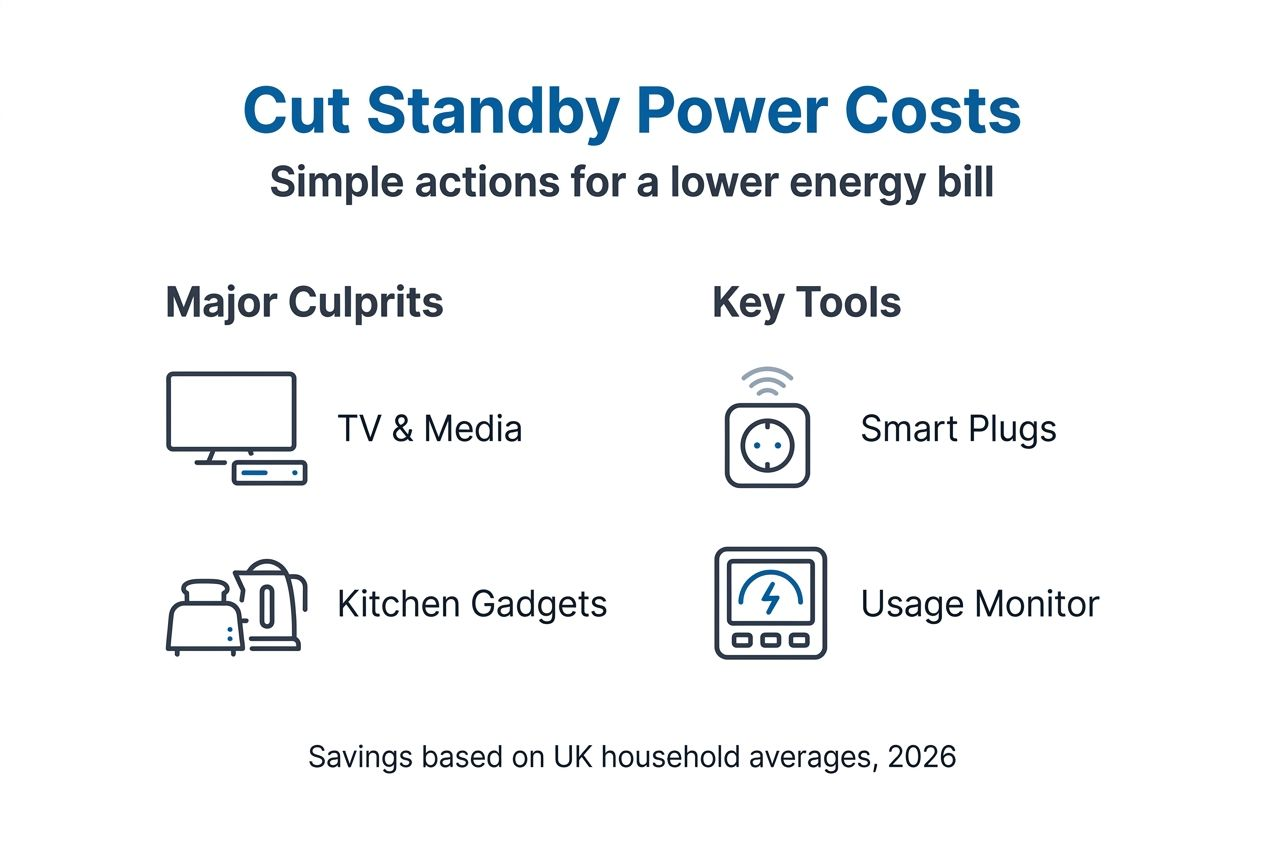
Common culprits include televisions maintaining screen displays, gaming consoles in rest mode, microwaves powering digital clocks, and phone chargers left in sockets. Desktop computers, printers, and audio systems also contribute significantly. Even when you believe devices are off, they quietly consume power, collectively creating substantial waste.
The monetary impact proves considerable. Standby power accounts for 5-10% of household electricity consumption in typical UK homes. Multiply this across millions of households, and the environmental cost becomes staggering. Higher energy consumption in UK homes translates directly to increased carbon emissions and larger utility bills.
Older appliances present particular challenges. Equipment manufactured before 2010 often lacks modern energy-saving features, consuming two to three times more standby power than contemporary models. A television from 2008 might use 15 watts on standby, whilst a 2024 equivalent uses only 0.5 watts.
“Most households underestimate standby consumption by 50-70%. The cumulative effect across all devices creates a persistent energy drain equivalent to leaving multiple light bulbs burning 24 hours daily. Awareness and targeted action can recover hundreds of pounds annually.”
Pro tip: Prioritise high-usage rooms first. Living rooms typically contain the most standby-consuming devices: televisions, consoles, sound systems, and set-top boxes. Addressing these spaces delivers the quickest savings.
Preparing to reduce standby power: tools and assessment
Effective standby power reduction begins with proper tools and assessment. You need visibility into actual consumption patterns before implementing changes. Three essential tools transform guesswork into data-driven action.
Smart plugs provide real-time monitoring and remote control capabilities. Energy-monitoring smart plugs help audit home standby power usage effectively by displaying wattage consumption through smartphone apps. These devices cost £10-30 each and pay for themselves within months.

Smart power strips offer similar functionality for multiple devices simultaneously. A single strip can monitor and control four to eight outlets, ideal for entertainment centres or home offices where numerous devices cluster together.
Electricity usage monitors measure consumption at the socket level. These portable devices cost £15-40 and provide instant feedback on standby draw, helping identify which appliances waste the most energy.
| Tool type | Primary benefit | Limitation |
|---|---|---|
| Smart plugs | Individual device control with scheduling | Requires one plug per device, can become costly |
| Smart power strips | Controls multiple devices simultaneously | Fixed location, all outlets switch together |
| Usage monitors | Portable, measures any device | Manual monitoring required, no automation |
Begin by measuring standby power across your most-used devices. Plug each appliance into a monitor for 24 hours to capture idle consumption. Record the readings in a simple spreadsheet, noting device type, location, and average watts.
Check manufacturer specifications for rated standby consumption. Modern appliances should list this information in technical documentation. Compare actual measurements against specifications to identify malfunctioning devices consuming excessive standby power.
Verify appliance compatibility before automating. Using smart plugs completely disconnects idle devices, removing hidden energy waste. However, some equipment requires constant power for memory retention or scheduled tasks.
Pro tip: Start with devices consuming over 5 watts on standby. These deliver the fastest return on investment. A television using 15 watts on standby costs approximately £25 annually at current UK electricity rates. Eliminating this waste through a £15 smart plug pays for itself in seven months.
Prioritise rooms by ways to use less electricity at home potential. Living rooms, home offices, and kitchens typically offer the greatest savings opportunities due to device concentration.
Practical steps to reduce standby power consumption
Implementing standby power reduction follows a straightforward sequence. Each step builds on the previous, creating cumulative savings whilst requiring minimal ongoing effort.
-
Unplug infrequently used devices completely. Coffee makers, toasters, phone chargers, and decorative lighting need no standby power. Simply disconnecting these items eliminates waste without inconvenience.
-
Install smart plugs on high-consumption devices. Position these on televisions, gaming consoles, desktop computers, and audio systems. Configure scheduling to cut power automatically during typical sleep hours and work absences.
-
Deploy smart power strips in clustered device locations. Entertainment centres benefit enormously from single-switch control over multiple components. Switch off the entire strip when leaving home or retiring for the evening.
-
Replace older appliances strategically. Focus on devices manufactured before 2015 showing high standby consumption. Older devices consume significantly more standby power; upgrading proves beneficial for both efficiency and performance.
-
Enable built-in energy-saving modes. Modern televisions, computers, and appliances include deep sleep settings that minimise standby consumption. Activate these features in system menus.
Common devices wasting the most standby power include:
- Gaming consoles in rest mode (8-15 watts)
- Desktop computers and monitors (5-20 watts combined)
- Laser printers with instant-on capability (5-12 watts)
- Older televisions and set-top boxes (8-25 watts)
- Microwave ovens with digital displays (3-5 watts)
- Phone and laptop chargers left plugged in (0.5-3 watts each)
Smart power strips can save £30-50 annually by cutting standby power across multiple devices simultaneously. This represents 10-15% reduction in typical household electricity costs.
Consider upgrading to energy-saving appliances when replacing worn equipment. Modern televisions consume under 1 watt on standby compared to 10-25 watts for models from 2010. The efficiency gain extends beyond standby power to active use as well.
Certain devices require constant power for safety or functionality. Never automate space heaters, medical equipment, security systems, or freezers through smart plugs. These appliances need uninterrupted electricity to function properly. Similarly, avoid disconnecting devices with important memory functions like digital video recorders unless prepared to reprogram settings.
Pro tip: Schedule smart plugs to activate 30 minutes before you typically wake or return home. This ensures devices are ready when needed whilst eliminating overnight waste. A television scheduled to power on at 6:30 AM and off at 11:00 PM saves 7.5 hours of standby consumption daily. At 15 watts standby draw, this prevents 41 kWh annual waste worth approximately £12.
Review home appliance efficiency tips to complement standby power reductions with broader energy-saving practices. Combined strategies multiply savings potential.
Verifying savings and maintaining low standby power
Measurement confirms whether your efforts deliver promised savings. Without verification, you cannot know if strategies work effectively or if standby power creeps back through new devices or changed habits.
Use smart plugs or electricity monitors to measure consumption monthly. Compare readings against your initial baseline audit. Properly implemented strategies should show 40-70% reduction in standby power across targeted devices. Document results in your tracking spreadsheet to maintain accountability.
Calculate actual savings using measured wattage and current electricity tariffs. The formula is straightforward: (standby watts × hours per day × days per year) ÷ 1,000 = annual kWh consumed. Multiply kWh by your per-unit electricity rate to determine cost.
| Device | Standby watts | Hours idle daily | Annual kWh | Cost at £0.29/kWh |
|---|---|---|---|---|
| Gaming console | 12 | 20 | 87.6 | £25.40 |
| Desktop computer | 8 | 16 | 46.7 | £13.54 |
| Television | 15 | 18 | 98.6 | £28.59 |
| Microwave | 4 | 23.5 | 34.3 | £9.95 |
| Total savings | – | – | 267.2 | £77.48 |
This example demonstrates how four common devices waste nearly £80 annually through standby power alone. Eliminating this consumption through smart plugs costing £60 total achieves payback in under 10 months.
Routine appliance maintenance prevents excess standby power use by ensuring devices operate within specifications. Clean ventilation ports, update firmware, and replace worn components before efficiency degrades. Annual maintenance checks identify problems early.
Watch for signs of malfunctioning appliances that increase standby consumption:
- Unusual warmth when supposedly off
- Displays flickering or remaining partially lit
- Devices activating spontaneously
- Dramatically increased standby wattage readings
- Unusual buzzing or humming sounds when idle
These symptoms indicate electrical faults requiring professional attention or replacement. Faulty electronics can consume 2-5 times normal standby power, erasing savings from other devices.
Average UK homes can save £200-400 annually through strategic standby reductions combined with broader efficiency improvements. This represents 15-25% decrease in total household electricity costs for typical properties.
Schedule quarterly reviews of your standby power strategy. New devices inevitably enter homes, potentially introducing fresh sources of waste. Repeat your initial audit process annually to maintain awareness. Calculate energy savings systematically to track progress and identify opportunities for further improvement.
Pro tip: Create a household energy checklist reviewed monthly. Include items like “verify smart plug schedules remain appropriate”, “check for new devices needing control”, and “measure standby power in one room”. Consistent attention prevents backsliding and maintains momentum.
Improve home energy compliance with expert modelling
Whilst reducing standby power delivers immediate savings, professional home energy modelling provides comprehensive optimisation across all efficiency dimensions. Landlords particularly benefit from expert assessment ensuring properties meet evolving UK regulations whilst maximising tenant comfort and minimising operational costs.
Professional home energy models for landlords identify opportunities beyond standby power reduction. These assessments evaluate insulation, heating systems, ventilation, and lighting to create holistic improvement plans. The upcoming Home Energy Model methodology offers unprecedented accuracy in predicting energy performance and guiding cost-effective upgrades.
Landlords managing multiple properties gain particular advantage from systematic energy modelling. Understanding exactly where energy waste occurs across a portfolio enables prioritised investment in improvements delivering the strongest returns. Enhanced EPC ratings increase property values whilst reducing void periods.
Explore comprehensive guides on home energy models to understand how professional assessment complements your standby power reduction efforts. Combined strategies create synergistic savings exceeding the sum of individual measures. Review proven energy-saving tips to build on the foundation you have established through standby power management.
Frequently asked questions
What is standby power and why does it matter?
Standby power is electricity devices consume when switched off but still plugged in, maintaining displays, timers, or instant-on capabilities. It matters because this hidden consumption represents 9-16% of typical UK household electricity use, costing £100-400 annually whilst contributing unnecessarily to carbon emissions.
Are smart plugs safe for all devices?
Smart plugs safely control most consumer electronics like televisions, computers, and audio systems. However, never use them with space heaters, medical equipment, security systems, freezers, or devices requiring constant power for safety or memory retention. Always verify appliance compatibility before automation.
How often should I check for standby power?
Conduct comprehensive standby power audits annually to identify new devices and verify existing controls remain effective. Perform quarterly spot checks on high-consumption devices to detect malfunctions early. Monthly reviews of smart plug data ensure schedules remain appropriate for current usage patterns.
Do older appliances cost more in standby energy?
Yes, significantly. Older devices consume substantially more standby power than modern equivalents. Televisions from before 2010 may use 10-25 watts on standby versus under 1 watt for current models. Upgrading worn appliances delivers both standby and active energy savings.
Can landlords benefit from reducing standby power across multiple properties?
Landlords benefit considerably through reduced electricity costs in common areas and improved EPC ratings. Installing smart power management in multiple properties delivers economies of scale on equipment purchases. Demonstrating energy efficiency attracts quality tenants and supports compliance with strengthening UK regulations. Follow proven energy-saving steps systematically across your portfolio.
How much can I save by reducing standby power?
Typical savings range from £100-400 annually depending on household devices and consumption habits. Homes with numerous electronics, older appliances, and inconsistent switching-off practices achieve the highest savings. Strategic smart plug deployment targeting high-consumption devices delivers fastest returns, often paying for equipment within 6-12 months.