

TL;DR:
- Effective property energy conservation now combines physical upgrades, system controls, and regulatory compliance in a continuous process.
- Landlords must proactively manage EPC ratings, upgrade strategies, and operational controls to meet tightening UK standards and reduce energy use.
Many property owners believe that energy conservation is simply about fitting better insulation or replacing an old boiler. In reality, effective conservation now combines physical upgrades, system controls, and regulatory compliance into one continuous process. For landlords and property managers, rental eligibility depends on EPC ratings under Minimum Energy Efficiency Standards (MEES), making compliance a direct and practical part of any conservation plan. This article covers the full picture: fabric improvements, operational controls, and portfolio-level management, so you can reduce energy use and stay ahead of regulation.
Table of Contents
- Understanding energy conservation in UK homes
- Fabric upgrades and efficient equipment: The familiar foundation
- Operational controls and system commissioning: Unlocking sustained savings
- Portfolio management and compliance: Meeting new UK standards
- Our perspective: Why energy conservation is shifting from upgrades to operations
- Next steps: Get expert help for energy compliance and savings
- Frequently asked questions
Key Takeaways
| Point | Details |
|---|---|
| Compliance is critical | Energy conservation must meet UK regulatory standards such as MEES and EPCs for rental eligibility. |
| Upgrade and manage | Combine fabric improvements and operational controls for meaningful, sustained reductions in energy use. |
| Monitoring drives savings | Adapting building systems based on occupancy and weather yields measurable, ongoing benefits. |
| Treat upgrades as programmes | Energy improvements should be part of continuous compliance and portfolio management, not isolated projects. |
Understanding energy conservation in UK homes
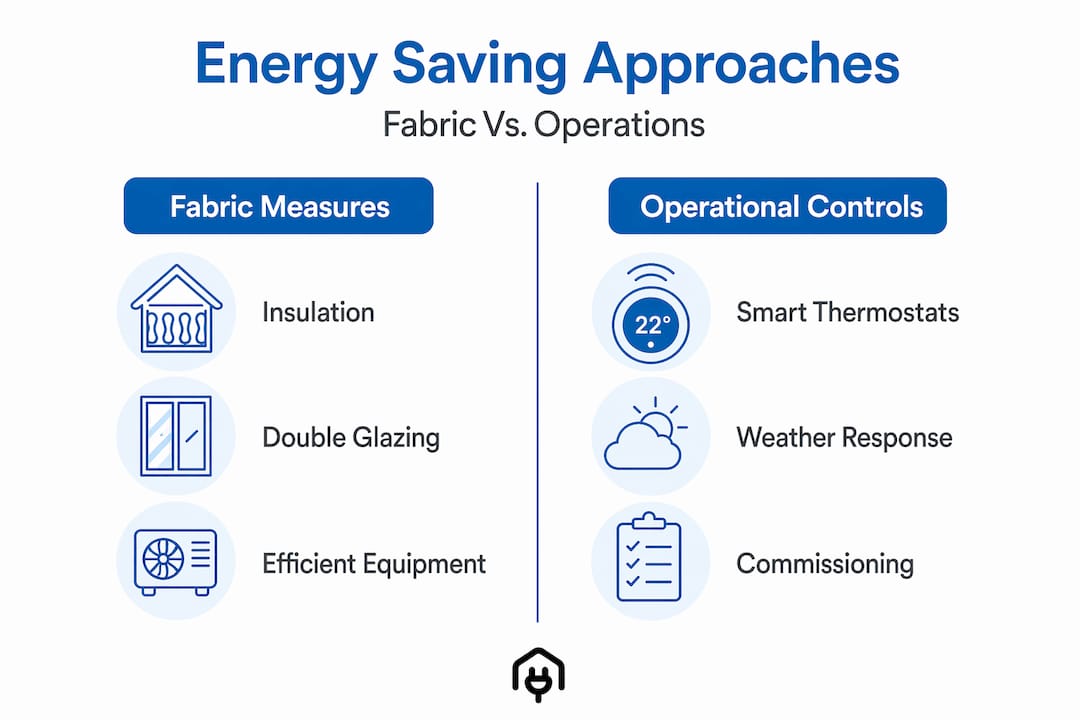
Energy conservation, in a property management context, means reducing the amount of energy a building consumes without sacrificing comfort or function. It covers two broad categories: fabric measures and operational practices. Fabric measures include upgrades to walls, roofs, floors, glazing, and heating equipment. Operational practices include how systems are controlled, scheduled, and monitored day to day.
Both categories matter. A well-insulated property with poorly calibrated controls can still waste significant energy. Equally, an efficiently managed building with inadequate insulation will struggle to meet modern standards.
For UK landlords, MEES regulations for landlords set a legal floor. Properties must currently achieve at least an EPC band E to be legally rented, and proposed reforms would tighten this to band C by 2030. As the government’s EPC/MEES reform consultation confirms, rental eligibility depends on EPC ratings, not just voluntary improvements. This shifts energy conservation from a desirable activity to a core compliance obligation.
Understanding this regulatory landscape is the starting point for any conservation strategy. To explore how energy conservation in property applies practically across different building types, it helps to look at both approaches side by side.
| Approach | Examples | Impact on EPC | Ongoing effort required |
|---|---|---|---|
| Fabric measures | Cavity wall insulation, loft insulation, double glazing | High: directly improves SAP/HEM score | Low: once installed, benefits are long-lasting |
| Operational strategies | Programmable controls, BMS scheduling, occupancy sensors | Moderate: affects actual energy use | High: requires active monitoring and adjustment |
| Equipment upgrades | Heat pumps, LED lighting, efficient boilers | High: improves rated efficiency | Low to moderate: needs periodic servicing |
| Behavioural changes | Heating schedules, reducing standby, tenant awareness | Low to moderate: not always captured in EPC | High: depends on occupant engagement |
Key areas to address in any conservation plan include:
- Thermal envelope: walls, roofs, floors, and windows account for the majority of heat loss in older UK stock
- Heating systems: inefficient boilers or storage heaters are a primary source of excess energy consumption
- Hot water: poorly insulated cylinders and inefficient immersion heaters add unnecessary cost
- Lighting: still a significant share of electricity use, particularly in common areas of HMOs and blocks
- Controls: timers, thermostats, and smart controls determine how efficiently all installed equipment actually operates
Fabric upgrades and efficient equipment: The familiar foundation
Fabric upgrades are the first thing most property owners think of when conservation comes up, and with good reason. They deliver measurable reductions in heat loss and often produce the largest single improvements to an EPC rating. But the order and method of delivery matters as much as the measures themselves.
When prioritising energy upgrades, the most cost-effective sequence generally follows this structure:
- Assess the current EPC and identify the largest sources of heat loss. An EPC assessor will identify specific recommended improvements and their projected impact on the rating.
- Address insulation first. Loft insulation is typically the lowest-cost option with a strong return. Cavity wall insulation follows closely where applicable.
- Upgrade heating systems once the envelope is improved. Installing a heat pump or new boiler in a poorly insulated property reduces its effectiveness.
- Replace lighting with LED alternatives throughout. This applies especially to common areas, which landlords control directly.
- Install smart or programmable controls to ensure the upgraded equipment operates efficiently in practice.
- Commission and test all systems after installation to confirm they perform as designed.
The table below shows typical performance improvements from common efficient insulation strategies across different building elements:
| Element | Typical U-value (unimproved) | Typical U-value (improved) | Annual saving potential |
|---|---|---|---|
| Loft insulation (0 to 270mm) | 2.3 W/m²K | 0.16 W/m²K | £150 to £300 per year |
| Cavity wall insulation | 1.6 W/m²K | 0.32 W/m²K | £100 to £200 per year |
| Solid wall insulation (external) | 2.1 W/m²K | 0.30 W/m²K | £200 to £400 per year |
| Double glazing (replacing single) | 5.0 W/m²K | 1.6 W/m²K | £75 to £150 per year |
These figures vary by property size, location, and energy tariff, but they illustrate why energy-saving technologies in the fabric deliver reliable long-term benefits. For lighting specifically, the lighting energy saving guide provides practical guidance tailored to rental properties with shared spaces.

Pro Tip: Treat fabric upgrades as a compliance programme, not a series of one-off projects. The government’s EPC/MEES reforms signal that standards will continue to tighten. Planning upgrades in phases now avoids costly reactive spending later when deadlines arrive.
Operational controls and system commissioning: Unlocking sustained savings
Many property owners stop at fabric upgrades and equipment replacement, assuming the work is done. But operational controls and commissioning represent a significant and often overlooked source of real-world energy savings. A building that is properly upgraded but poorly controlled will still consume more energy than necessary.
Commissioning refers to the process of verifying that all building services, heating, ventilation, lighting controls, and hot water systems, operate according to their design specification. Recommissioning means repeating this process periodically, especially after tenancy changes, system modifications, or seasonal shifts.
The difference this makes is measurable. At 20 Fenchurch Street in London, building performance monitoring through commissioning and recommissioning delivered documented reductions in energy use across the occupied building. This is not a one-off example. Properties across the UK are finding that operational adjustments produce sustained savings without major capital expenditure.
“Moving from set-and-forget schedules to occupancy and weather-responsive management can produce sustained reductions in energy consumption across a property portfolio.”
A facility management case study from the commercial real estate sector documented £2 million in energy savings achieved primarily through operational changes rather than large-scale physical upgrades. The core methodology involved replacing fixed schedules with dynamic controls that respond to actual occupancy, outdoor temperature, and system load.
This approach is now increasingly accessible for residential landlords as well, through smart thermostats, zoned heating controls, and energy monitoring dashboards. For policy context and how operational standards are shaping energy policy and compliance requirements, the link between controls and compliance is growing more direct.
Common operational strategies that deliver measurable savings include:
- Occupancy-based heating schedules: Programming heating to activate only when properties are occupied, rather than running fixed daily cycles regardless of use
- Weather compensation controls: Adjusting boiler or heat pump output based on outdoor temperature rather than fixed flow temperatures
- Zoned heating management: Separating heating zones so that common areas and individual units are controlled independently
- Energy monitoring dashboards: Installing sub-metering or smart meters to track consumption at appliance or circuit level, identifying waste in real time
- Fault detection alerts: Using building management system (BMS) data to flag anomalies such as heating running outside scheduled hours or unusual consumption spikes
- Tenant engagement tools: Providing occupants with clear guidance and accessible controls encourages energy-conscious behaviour without requiring enforcement
For further detail on measuring and monitoring energy savings, operational controls are increasingly recognised as the bridge between rated energy performance and actual energy use.
Portfolio management and compliance: Meeting new UK standards
For landlords managing multiple properties, energy conservation cannot be handled property by property in isolation. A portfolio-level approach is essential for tracking compliance status, planning upgrade timescales, and ensuring that operational changes deliver consistent results across different building types.
The starting point is a clear audit of the portfolio. Landlords need to know the current EPC rating of every property, the date each certificate expires, the recommended improvements listed on each EPC, and the estimated cost and impact of those improvements. This creates the basis for a rolling compliance programme.
The government’s EPC/MEES reform programme confirms that standards are expected to tighten significantly. Property managers who treat each upgrade as a standalone project will face repeated disruption. Those who plan as a programme, scheduling work across void periods, accessing grant funding at scale, and aligning commissioning with tenancy changes, will manage costs and timelines far more effectively.
Steps to transition from a reactive to a portfolio-level approach:
- Compile a central register of all properties with EPC ratings, expiry dates, and current compliance status
- Segment properties by risk: those already at band C or above, those requiring moderate improvement, and those requiring significant investment
- Map out upgrade timescales against tenancy schedules to minimise disruption and cost
- Identify funding opportunities including the Great British Insulation Scheme, ECO4, and local authority grants
- Introduce operational monitoring across the portfolio, starting with the highest-consuming properties
- Review and update the plan annually in response to regulatory announcements and actual energy performance data
Key compliance milestones that portfolio landlords should track include:
- Current MEES minimum: EPC band E for all new tenancies and renewals
- Proposed 2028 target: EPC band C for new tenancies (subject to final legislation)
- Proposed 2030 target: EPC band C for all existing tenancies
- EPC validity: certificates expire after 10 years and must be renewed before re-letting
- HEM introduction: the Home Energy Model will replace SAP as the assessment methodology, potentially changing how ratings are calculated for some property types
Understanding EPC change guidance is essential preparation. Changes to the assessment methodology may affect how existing measures are scored, which means properties close to a rating boundary should be reassessed after HEM is adopted. The energy efficiency benefits of early action extend beyond compliance, including improved tenant retention, lower void periods, and reduced running costs.
Important: Properties that fail to meet the minimum EPC rating by the applicable deadline face civil penalties of up to £30,000 per property. Proactive portfolio planning is not just good practice; it is financial risk management.
Our perspective: Why energy conservation is shifting from upgrades to operations
The prevailing assumption in the UK property sector has long been that energy conservation is fundamentally about bricks and mortar. Fit the insulation. Replace the boiler. Tick the box. This view made sense when EPC ratings were the only measure that mattered and when regulation moved slowly.
That picture is changing. The gap between rated energy performance and actual energy use, often called the performance gap, is now well-documented in UK commercial and residential buildings. A property can achieve a good EPC rating based on its physical fabric whilst still consuming significantly more energy than the rating implies, because controls are poorly calibrated, systems are not commissioned properly, or occupancy patterns differ from the standard assumptions used in the assessment.
Operational controls are closing that gap. Moving from fixed schedules to occupancy-responsive and weather-responsive management is no longer the preserve of large commercial buildings. Smart thermostats, occupancy sensors, and energy monitoring are all accessible at residential scale. The question is whether landlords and property managers are treating operations as seriously as they treat fabric.
The honest answer, in most cases, is no. Controls are often an afterthought. Commissioning is rarely revisited after installation. Monitoring dashboards are set up and then ignored. This is where real savings are being left on the table.
The future of energy conservation in property belongs to those who integrate physical upgrades with active operational management. Fabric improvements set the ceiling for performance. Controls and monitoring determine how close you actually get to it. Both are necessary. Neither alone is sufficient.
Treating conservation as a continuous programme, rather than a series of projects, is the mindset shift that distinguishes property managers who will stay ahead of tightening regulations from those who will be caught out by each new deadline.
Next steps: Get expert help for energy compliance and savings
Understanding the theory is valuable. Translating it into action across real properties requires the right tools and expert support. Homeenergymodel.co.uk provides practical guidance on the full range of compliance and conservation challenges facing UK landlords and property managers in 2026 and beyond.
For landlords assessing their position, the guide to energy models for landlords explains the different assessment methodologies available, including how the Home Energy Model will change EPC calculations. If your properties are in London, the EPC guide for London covers local market considerations and what ratings mean for rental eligibility and property value. For a broader look at building sustainable, compliant property management practices, the guide on sustainable home practices sets out what landlords and homeowners should be doing now to meet 2026 and 2030 standards.
Frequently asked questions
What are the quickest ways to conserve energy in my UK home?
The fastest improvements are upgrading to LED lighting, adding loft insulation, and fitting a programmable thermostat, as insulation and efficient lighting are foundational in reducing energy waste at low upfront cost.
Do I need to upgrade my property to comply with MEES or EPC regulations?
Yes. MEES and EPC compliance is a legal requirement for rental properties, and achieving the minimum rating will typically require insulation, heating, or controls upgrades before the 2028 and 2030 deadlines.
How do operational controls help conserve energy?
Commissioning heating and ventilation systems to respond to occupancy and weather, rather than running on fixed schedules, delivers ongoing reductions in gas and electricity use, as documented at 20 Fenchurch Street and other UK buildings.
What is the difference between fabric measures and operational strategies?
Fabric measures such as insulation and double glazing improve a building’s physical ability to retain heat, while operational strategies adjust how and when systems run to match real-world occupancy and conditions.
What is portfolio energy management for landlords?
Portfolio energy management means tracking EPC ratings, upgrade timescales, and energy consumption across all properties in a landlord’s ownership, using that data to ensure compliance with tightening standards and to prioritise investment where it delivers the greatest impact.