

UK property owners face mounting pressure to meet stricter energy efficiency standards, yet many remain uncertain about which technologies to prioritise and how to navigate the new EPC C requirements arriving in 2030. With dozens of upgrade options, competing advice, and cost caps to consider, choosing the right improvements can feel overwhelming. This guide cuts through the confusion by explaining the most effective energy saving technologies, comparing their benefits, and offering practical steps to help you comply with upcoming regulations whilst maximising financial support and long-term savings.
Table of Contents
- Key takeaways
- Understanding the new EPC regulations and their impact
- Key energy-saving technologies: fabric-first approach
- Renewable and smart technologies for secondary EPC metrics
- Navigating costs, grants and exemptions for energy improvements
- Explore expert home energy modelling solutions
- Frequently asked questions
Key Takeaways
| Point | Details |
|---|---|
| EPC C by 2030 | From October 2030 landlords must reach EPC C using a dual metric framework and a £10,000 per property cap, subject to exemptions such as off gas properties and tenant protections. |
| Fabric first upgrades | Prioritising insulation and other fabric improvements delivers the largest savings and supports all heating technologies. |
| Heat pumps versus hydrogen | Compared with hydrogen boilers, heat pumps typically deliver greater energy savings and better overall performance. |
| Costs and grants | Costs vary but government grants are available to help cover improvements within the cap. |
Understanding the new EPC regulations and their impact
The government has introduced updated energy performance standards that reshape how landlords and homeowners approach property improvements. UK landlords must achieve EPC C equivalent by October 2030 using new metrics and cost cap limits, marking a significant shift from previous regulations. These changes affect millions of rental properties across England and Wales.
The new framework introduces two distinct performance metrics. The primary metric focuses on fabric performance, measuring how well your property retains heat through insulation quality, window glazing efficiency, and airtightness. The secondary metric evaluates either heating system efficiency or smart readiness, including features like solar PV panels and intelligent thermostats. Both metrics work together to determine overall compliance.
Financial parameters provide important safeguards for property owners. The government caps spending at £10,000 per property, though this limit may be lower depending on property value. This cap prevents excessive financial burden whilst still encouraging meaningful improvements. Several exemptions recognise practical constraints:
- Tenant consent refusal allows landlords to defer upgrades when occupants decline proposed works
- Cost cap exceeded exemption applies when required improvements surpass the spending limit
- Special provisions exist for off-gas properties where mains gas connection is unavailable
- Low-income tenant protections prevent displacement through unaffordable rent increases
These regulations create a balanced approach that drives energy efficiency whilst acknowledging real-world limitations. Understanding these parameters helps you plan prioritising energy upgrades strategically, focusing resources on improvements that deliver the greatest compliance benefit within your budget. The dual-metric system encourages comprehensive upgrades rather than single-technology fixes, ensuring properties achieve genuine efficiency gains.
Key energy-saving technologies: fabric-first approach
Fabric improvements form the foundation of any successful energy upgrade strategy because they address heat loss at its source. Loft insulation, cavity wall insulation, and solid wall insulation provide the largest fabric performance improvements, directly tackling the primary EPC metric. These upgrades reduce the amount of energy your heating system must generate, creating savings regardless of which fuel or technology you use.
Current adoption rates reveal significant opportunities. Loft insulation covers 42% of UK homes with ≥200mm thickness; cavity wall insulation covers 71%; double glazing is at 89%. These statistics show that whilst double glazing has achieved near-universal coverage, substantial gaps remain in wall and loft insulation, particularly at the higher thicknesses that deliver optimal performance.
| Technology | Typical cost | Coverage area | Annual saving | EPC impact |
|---|---|---|---|---|
| Loft insulation (270mm) | £400-900 | Full loft space | £200-350 | +1 to +2 bands |
| Cavity wall insulation | £750-1,200 | External walls | £180-280 | +1 band |
| Solid wall insulation | £4,000-8,000 | External walls | £350-450 | +2 bands |
| Double glazing (A-rated) | £4,000-6,000 | All windows | £120-180 | +1 band |
Pro Tip: Complete fabric upgrades before installing renewable heating systems. Poor insulation forces heat pumps and other efficient technologies to work harder, undermining their performance and increasing running costs.
The fabric-first sequence prevents common pitfalls. Installing a heat pump in a poorly insulated property creates a performance gap where the system struggles to maintain comfortable temperatures. This leads to higher electricity consumption, disappointed occupants, and wasted investment. Conversely, improving insulation first allows smaller, more affordable heating systems to operate efficiently.

Thermal bridging and moisture management require careful attention during fabric upgrades. Incomplete insulation creates cold spots where condensation forms, potentially causing damp and mould. Professional installation ensures continuous insulation coverage, proper ventilation, and appropriate vapour barriers. These details separate successful energy efficient home upgrades from problematic ones.
Mean upgrade costs to reach EPC C average around £7,480, with fabric improvements typically consuming the majority of this budget. This investment delivers immediate comfort benefits alongside regulatory compliance. Warmer rooms, reduced draughts, and lower heating bills create tangible value that occupants notice daily. For landlords, these improvements reduce void periods and support premium rents in increasingly competitive markets where energy performance influences tenant decisions. Simple measures like draught-proofing and upgrading heating controls complement major fabric works, offering quick wins detailed in home energy quick wins guides.
Renewable and smart technologies for secondary EPC metrics
Once fabric performance reaches acceptable levels, renewable and smart technologies address the secondary EPC metrics whilst delivering substantial running cost reductions. Heat pumps stand out as the most effective heating upgrade for most UK properties. Heat pumps reduce energy use by 53%, outperform hydrogen boilers which increase energy use by 42% and offer six times the economic benefit, making them the clear choice for both environmental and financial performance.
Air source heat pumps suit the vast majority of UK homes. Most UK homes on gas are suitable for air source heat pumps, with 93% off-gas homes also suitable. This high compatibility extends across property types, from modern builds to Victorian terraces, provided fabric improvements have been completed first. Ground source heat pumps offer slightly higher efficiency but require significant garden space and installation costs, limiting their practical application.
| Technology | Installation cost | Annual running cost | Carbon saving | Smart readiness |
|---|---|---|---|---|
| Air source heat pump | £8,000-12,000 | £800-1,100 | 3-4 tonnes CO₂ | Medium |
| Solar PV (4kW) | £5,000-7,000 | £0 (generates income) | 1.5 tonnes CO₂ | High |
| Smart thermostat | £200-400 | Saves 10-15% heating | 0.3 tonnes CO₂ | High |
| Battery storage (5kWh) | £3,000-5,000 | Maximises solar value | 0.5 tonnes CO₂ | Very high |
Solar PV systems contribute to both energy saving and smart readiness metrics. Modern intelligent inverters enable demand flexibility, allowing you to shift electricity consumption to periods when your panels generate power. Combined with battery storage, solar PV can cover 60-80% of annual electricity needs in well-designed systems. Feed-in tariffs have been replaced by the Smart Export Guarantee, which pays for surplus generation exported to the grid.
Smart controls and thermostats enable precise heating management that reduces waste without sacrificing comfort. These devices learn occupancy patterns, adjust temperatures by room, and integrate with weather forecasts to optimise heating schedules. For properties with time-of-use electricity tariffs, smart controls shift consumption to cheaper periods, compounding savings. However, implementation requires consideration for vulnerable households and prepayment customers who may face barriers to accessing smart tariff benefits.
Pro Tip: Install solar PV before heat pumps when budget allows. Solar generation offsets the electricity consumption of heat pumps, reducing running costs and improving the economic case for both technologies together.
Renewable technology sequencing matters. The most cost-effective approach starts with fabric improvements, adds solar PV to reduce electricity costs, then installs a heat pump sized appropriately for the improved building. This sequence minimises the heat pump capacity needed, reducing both installation and running costs. It also ensures maximum benefit from solar generation by creating daytime electricity demand through heat pump operation.
Integration challenges emerge when combining multiple technologies. Electrical capacity may need upgrading to support heat pumps and EV chargers simultaneously. Smart controls require reliable broadband connectivity and regular software updates. Professional system design ensures all components work together efficiently, avoiding the performance gaps that plague poorly planned installations. Resources like energy saving tips and lighting energy saving guide complement major technology upgrades with behavioural and operational improvements.
Navigating costs, grants and exemptions for energy improvements
Financial planning determines whether energy upgrades proceed smoothly or stall due to budget constraints. The government caps spending at £10,000 per property or less depending on property value, creating a clear upper limit for compliance costs. This cap applies to landlord-funded improvements required to meet EPC C standards, protecting property owners from unlimited financial exposure whilst maintaining regulatory pressure for efficiency gains.
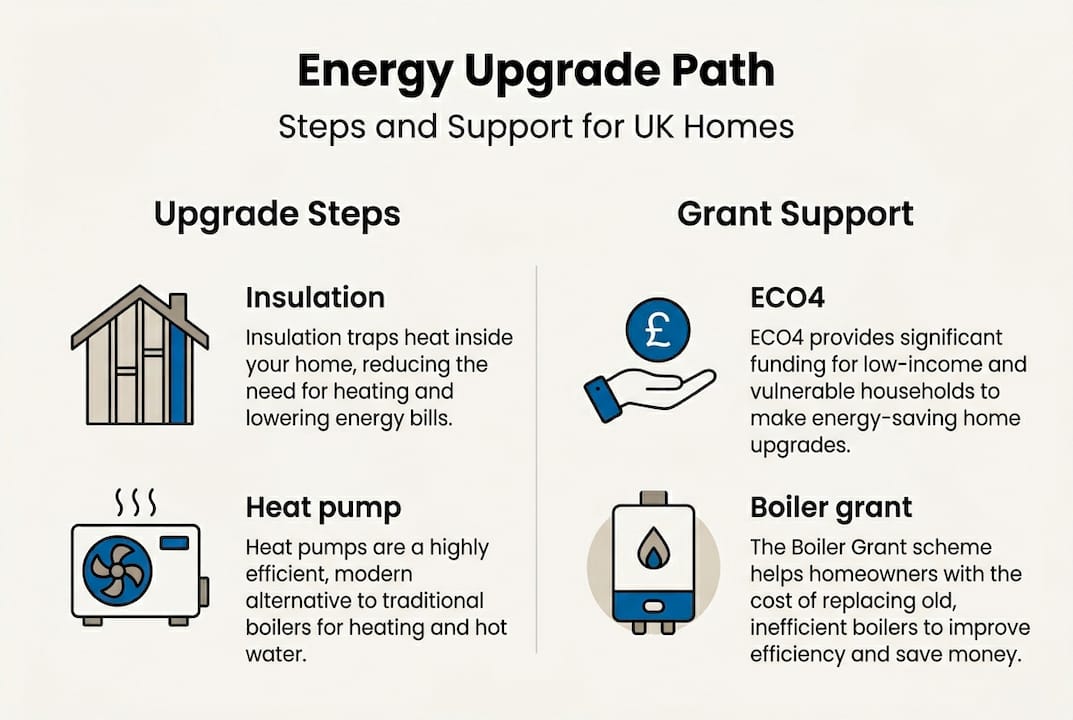
Government grants substantially reduce out-of-pocket costs for eligible properties. Government grants like ECO4 and boiler upgrade schemes provide up to £7,500 support; 0% VAT on improvements available to 2027. ECO4 targets lower-income households and properties with poor energy ratings, offering fully funded or heavily subsidised insulation and heating upgrades. The Boiler Upgrade Scheme provides £7,500 grants for heat pump installations, making these systems cost-competitive with gas boiler replacements.
VAT relief creates additional savings on approved improvements. The temporary 0% VAT rate applies to energy-saving materials and installation labour for qualifying technologies including insulation, solar panels, heat pumps, and smart controls. This relief runs until 2027, creating a time-limited opportunity to maximise grant funding and tax savings together. Combined with ECO4 or Boiler Upgrade Scheme grants, the effective cost of major upgrades can drop by 60-80% for eligible properties.
Prioritising upgrades strategically ensures spending counts towards cost caps whilst delivering maximum benefit:
- Obtain a detailed EPC assessment identifying specific improvements needed for EPC C compliance and their estimated costs
- Apply for all eligible grants before starting work, as retrospective applications are rarely accepted
- Complete fabric improvements first using ECO4 funding if available, establishing a solid foundation for later renewable installations
- Install renewable technologies using Boiler Upgrade Scheme grants, sizing systems appropriately for the improved building fabric
- Document all expenditure carefully, retaining invoices and certificates to demonstrate compliance with cost caps if needed
- Claim VAT relief at point of purchase by confirming eligibility with installers before work begins
Exemptions provide important escape routes when compliance proves impractical. Exemptions exist for tenants refusing consent, homes exceeding cost caps, and some off-gas or vulnerable cases. Tenant refusal requires written evidence that proposed improvements were offered and declined. Cost cap exemptions apply when the cheapest route to EPC C exceeds the spending limit, though landlords must obtain quotes demonstrating this. These exemptions typically last five years before reassessment.
Financial planning tools help model different upgrade scenarios. Comparing fabric-only routes against combined fabric and renewable approaches reveals which delivers better value within your budget. Some properties achieve EPC C through insulation alone at £5,000-7,000, whilst others require heat pumps pushing total costs to £12,000-15,000 before grants. Understanding these pathways early prevents wasted spending on improvements that don’t contribute to compliance. Guidance on role of energy upgrades and prioritising energy upgrades helps landlords develop cost-effective compliance strategies tailored to their property portfolios.
Explore expert home energy modelling solutions
Professional energy modelling transforms complex regulatory requirements into clear, actionable upgrade plans tailored to your specific property. Expert assessments evaluate your building’s current performance, identify the most cost-effective improvements, and predict post-upgrade EPC ratings with precision. This eliminates guesswork, ensuring every pound spent contributes to compliance whilst maximising comfort and running cost savings.
Custom energy models align with your property’s unique characteristics, from construction type and orientation to existing systems and occupancy patterns. These models account for interactions between different technologies, preventing the performance gaps that plague generic advice. Understanding types of home energy models helps you select the right assessment level for your needs, whether managing a single property or a large portfolio.
The upcoming Home Energy Model methodology will replace SAP in 2025, introducing more accurate performance predictions and aligning with Future Homes Standard requirements. Getting familiar with home energy model explained concepts now prepares you for this transition, ensuring your upgrade plans remain valid under new assessment rules. Professional modelling services provide forward-looking advice that anticipates regulatory changes, protecting your investment from premature obsolescence. Comprehensive energy performance guide resources support informed decision-making throughout your improvement journey.
Frequently asked questions
What are energy saving technologies?
Energy saving technologies are systems and materials that reduce the amount of energy needed to heat, power, and operate buildings whilst maintaining or improving comfort levels. They include fabric improvements like insulation and glazing that prevent heat loss, renewable systems like heat pumps and solar panels that generate or use energy more efficiently, and smart controls that optimise energy consumption through intelligent management. These technologies work together to lower energy bills, reduce carbon emissions, and improve EPC ratings for regulatory compliance.
How do heat pumps compare to traditional boilers in energy efficiency?
Heat pumps reduce energy use by 53%, outperform hydrogen boilers with increased use and lower economic outcomes, making them significantly more efficient than conventional heating systems. They achieve this by moving heat rather than generating it through combustion, delivering three to four units of heat for every unit of electricity consumed. Traditional gas boilers convert fuel to heat at roughly 90% efficiency, but heat pumps exceed 300% efficiency in moderate conditions. This efficiency advantage translates to lower running costs and substantially reduced carbon emissions over the system’s lifetime.
What grants and financial support are available for energy-saving home improvements?
Government grants like ECO4 and boiler upgrade schemes provide up to £7,500 support; 0% VAT until 2027 for qualifying energy efficiency improvements. ECO4 targets properties with poor energy ratings and lower-income households, offering fully funded or heavily subsidised insulation and heating upgrades. The Boiler Upgrade Scheme provides £7,500 grants specifically for heat pump installations, making these systems cost-competitive with traditional boilers. Combined with temporary 0% VAT on materials and labour for approved technologies, total savings can reach 60-80% of project costs for eligible properties.
Can all UK homes install air source heat pumps?
About 93% of off-gas homes and 99% of on-gas homes are suitable for air source heat pumps, demonstrating very high compatibility across UK housing stock. Suitability depends primarily on adequate outdoor space for the external unit, sufficient electrical supply capacity, and reasonable fabric performance to ensure efficient operation. Properties with poor insulation can still accommodate heat pumps but require fabric improvements first to prevent excessive running costs and undersized system performance. Listed buildings and conservation areas may face planning restrictions, though permitted development rights cover most standard installations without requiring formal planning permission.