

TL;DR:
- UK property owners must meet EPC C standards by 2030, with reforms in 2026 introducing multi-metric assessments.
- Solar PV offers low-cost, high-ROI renewable energy suitable for most properties, especially when paired with heat pumps.
- Larger rural or off-grid properties may benefit from ground source heat pumps or biomass, requiring careful feasibility evaluation.
UK property owners face mounting pressure to cut energy costs and meet tightening government regulations. The deadline for residential rentals to achieve an EPC C equivalent rating by October 2030 is fast approaching, and with EPC reforms due in October 2026 introducing a multi-metric assessment approach, the stakes have never been higher. Choosing the right renewable energy solution is not straightforward. Upfront costs, payback periods, grant availability, and property-specific constraints all vary considerably. This guide cuts through the complexity, comparing the leading renewable options available to UK residential and commercial property owners, with compliance and long-term savings firmly in focus.
Table of Contents
- How to evaluate renewable energy options for your property
- Solar PV panels: Low cost, high impact
- Air source heat pumps: Efficient heating with government support
- Ground source and biomass options: Niche solutions for specific situations
- Summary comparison and expert recommendations
- Why the best renewable energy choice isn’t always obvious
- Take the next step to a greener, compliant property
- Frequently asked questions
Key Takeaways
| Point | Details |
|---|---|
| Solar leads on ROI | Solar PV panels provide the highest return and fastest payback for most UK properties. |
| Heat pumps cut heating emissions | Air source and ground source heat pumps are best for decarbonising heating, especially with available grants. |
| Check new EPC rules | Upcoming EPC regulations require more than just renewables—building efficiency matters. |
| Match tech to property | Not every renewable suits all homes; off-grid and rural sites need tailored solutions. |
| Expert help pays off | Professional advice ensures you maximise savings and compliance with UK standards. |
How to evaluate renewable energy options for your property
With the compliance challenge clear, it is vital to understand how to weigh each renewable energy solution before committing to any investment. The starting point is always the legal landscape. Residential rentals must reach EPC C equivalent by October 2030, and EPC reforms arriving in October 2026 will shift assessments to a multi-metric model, meaning a single technology fix may no longer be sufficient.
Beyond compliance, several practical factors should drive the decision:
- Upfront cost and available grants: Some technologies attract government support, significantly reducing net outlay.
- Payback period: How many years before savings cover the investment? Residential and commercial timelines differ.
- Annual savings: Estimate realistic bill reductions based on property size and usage.
- Property suitability: Roof orientation and area, available land, and whether the property is on or off the grid all matter.
- Compatibility with existing systems: Some renewables work best when layered with others.
For commercial properties, the business case often centres on faster payback and enhanced asset value. For residential landlords, compliance with minimum energy standards (MEES) is the primary driver. Either way, understanding the full picture of costs and incentives is essential before choosing. Reviewing the energy-saving technologies guide can help property owners map out the most appropriate combination of measures.
Pro Tip: Review the upcoming EPC reforms due in October 2026. The shift to a multi-metric approach means properties will be assessed on fabric efficiency, energy use intensity, and carbon emissions, not just a single SAP score. A technology that boosts one metric may not be enough on its own.
Solar PV panels: Low cost, high impact
With selection criteria established, solar PV stands out as the go-to renewable for many UK property owners. The numbers are compelling. A standard residential solar PV system costs between £5,000 and £8,000 installed, and solar PV delivers top ROI for both residential and commercial UK properties, with returns reaching 350% over the system’s lifetime.
Typical annual savings range from £400 to £700 for a home, while commercial installations often achieve payback within just three to five years due to higher daytime energy consumption. The impact of solar PV on energy ratings is also significant, with EPC scores frequently improving by one or two bands following installation.
Key advantages of solar PV include:
- Low maintenance: Panels require minimal upkeep, typically just an annual clean and occasional inverter checks.
- Increased property value: Studies consistently show solar-equipped properties command higher sale and rental prices.
- Scalability: Systems can be expanded as budgets allow, or paired with battery storage to increase self-consumption.
- Compatibility: Works well alongside heat pumps, reducing electricity bills from heating.
- Payback period: Typically six to twelve years for residential, three to five for commercial.
Stat to note: Solar PV can deliver a return on investment of up to 350% over its operational life, making it one of the most financially sound renewable investments available to UK property owners.
For most properties with adequate south or south-west facing roof space, solar PV should be the first renewable considered. It is the foundation on which other technologies can be layered effectively.
Air source heat pumps: Efficient heating with government support
While solar leads for power generation, heating needs are best served by solutions like air source heat pumps (ASHPs). These devices extract heat from outdoor air and transfer it indoors, operating efficiently even in cold UK winters. ASHPs are a leading heating solution, particularly when combined with solar PV to offset running costs.
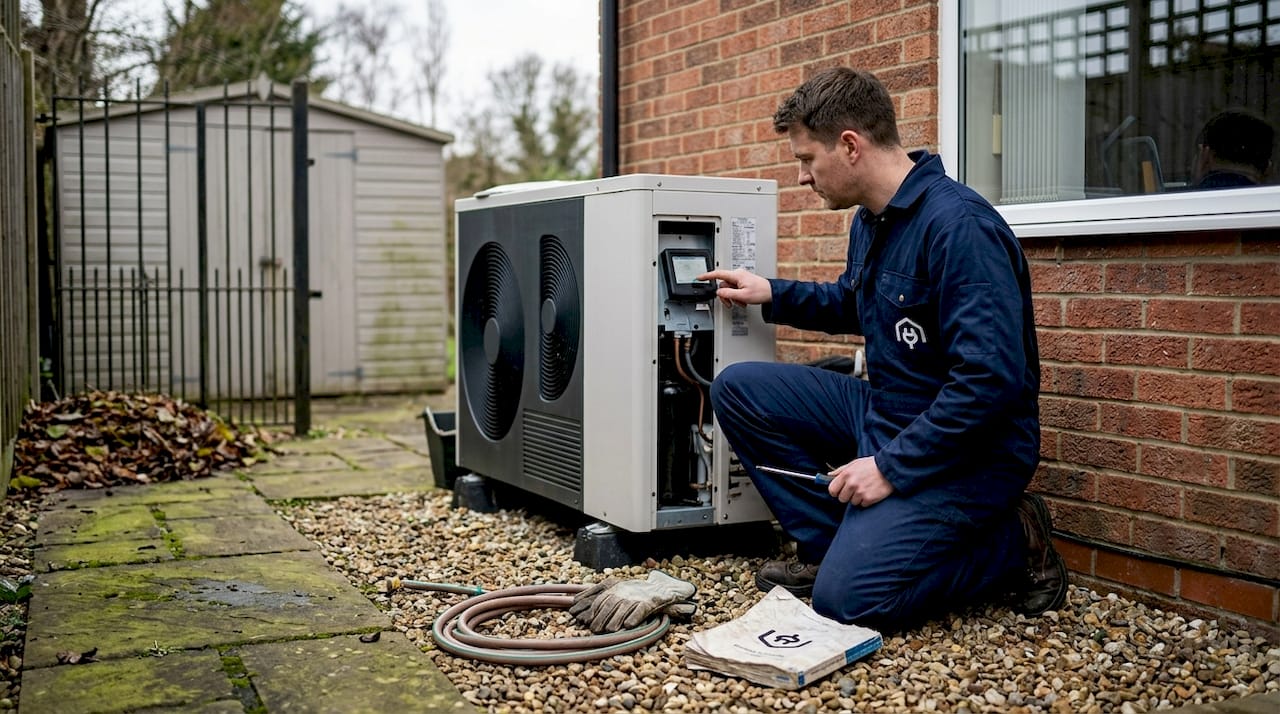
The financials stack up well. ASHPs cost between £8,000 and £14,000 to install, but the government’s Boiler Upgrade Scheme (BUS) grant of £7,500 reduces the net outlay to as little as £500 to £6,500. Annual savings versus a gas boiler typically range from £200 to £500, with a payback period of ten to fifteen years. The coefficient of performance (COP), which measures heating output per unit of electricity consumed, sits between 2.5 and 3.8 for most modern ASHPs.
Installing and pairing an ASHP with solar PV involves these steps:
- Commission a heat loss survey to confirm the property is suitable and identify any insulation upgrades needed.
- Apply for the BUS grant before installation begins.
- Install the ASHP and upgrade radiators or underfloor heating if required.
- Install solar PV panels to generate electricity that powers the heat pump during daylight hours.
- Consider a battery storage system to extend solar self-consumption into evening heating periods.
For more detail on performance in UK conditions, the air source heating efficiency resource covers real-world data. Landlords and property investors can also explore available renewable energy incentives to maximise grant support.
Pro Tip: Pairing an ASHP with solar PV is the most effective combination for most UK properties. Solar generates cheap electricity during the day, which the heat pump uses to heat water and spaces, cutting running costs substantially.
Ground source and biomass options: Niche solutions for specific situations
Not every property suits mainstream options. Ground source heat pumps (GSHPs) and biomass systems offer solutions for unique needs, particularly for large rural or off-grid properties.
GSHPs deliver a higher COP of 3.5 to 4.5 compared to ASHPs, but at a significantly higher cost of £15,000 to £35,000. They require substantial land for ground loops or a suitable borehole, making them impractical for most urban or suburban sites. Biomass boilers, which burn wood pellets or chips, are best suited to rural properties with reliable fuel supply chains and adequate storage space.
| Technology | Typical cost | COP / efficiency | Best use case |
|---|---|---|---|
| GSHP | £15,000 to £35,000 | COP 3.5 to 4.5 | Large rural properties with land |
| Biomass boiler | £10,000 to £20,000 | 85 to 92% efficient | Off-grid rural, fuel available locally |
| ASHP | £8,000 to £14,000 | COP 2.5 to 3.8 | Most UK residential and commercial |
| Solar PV | £5,000 to £8,000 | 15 to 22% panel efficiency | Majority of UK properties with roof space |
Key limitations of GSHPs and biomass include:
- High upfront costs that extend payback periods considerably.
- Significant installation disruption, particularly for ground loop excavation.
- Ongoing fuel management and storage requirements for biomass.
- Both technologies are less effective in poorly insulated buildings, as poor insulation reduces heat pump efficiency considerably.
“Ground source and biomass systems are powerful tools in the right context, but they demand careful feasibility assessment before investment.”
For a thorough assessment of whether a GSHP suits a specific property, the GSHPs explained resource provides detailed guidance. Understanding heat pumps and UK standards is also advisable before proceeding.
Summary comparison and expert recommendations
With individual pros and cons clear, a head-to-head comparison and synthesised advice bring clarity to the decision-making process.
| Technology | Upfront cost | Annual savings | Payback period | EPC impact | Best fit |
|---|---|---|---|---|---|
| Solar PV | £5,000 to £8,000 | £400 to £700 | 6 to 12 years | High | Most properties |
| ASHP | £500 to £6,500 net | £200 to £500 | 10 to 15 years | High | Most UK homes |
| GSHP | £15,000 to £35,000 | £300 to £600 | 15 to 25 years | High | Large rural sites |
| Biomass | £10,000 to £20,000 | £200 to £500 | 12 to 20 years | Moderate | Off-grid rural |
To decide which technology suits a specific property, follow this structured approach:
- Assess insulation first. No renewable technology performs well in a poorly insulated building.
- Check roof suitability for solar PV. If viable, this should be the first investment.
- Evaluate heating system needs. If replacing a gas boiler, consider an ASHP with the BUS grant.
- Consider land availability. Only then does a GSHP become a realistic option.
- Review compliance requirements. With EPC reforms due October 2026 introducing multi-metric scoring, a combined approach is increasingly necessary.
The expert recommendation is clear: start with solar PV unless the property is genuinely unsuitable, then layer in an ASHP for heating. For landlords prioritising compliance, reviewing guidance on prioritising energy upgrades is a practical next step.
Why the best renewable energy choice isn’t always obvious
Conventional wisdom suggests that solar PV and an ASHP are the answer for virtually every UK property. In many cases, that is correct. But the data and the tables only tell part of the story. Many properties would benefit more from addressing insulation and air leakage before any renewable technology is installed. A heat pump running in a draughty Victorian terrace will underperform significantly compared to one installed in a well-insulated modern home.
Off-grid and rural properties face a genuinely different set of constraints. Grid connection costs, fuel availability, and land size all shift the calculus. For these owners, the GSHP real-world impact data is more relevant than national averages. The new EPC multi-metric framework also changes the picture. Efficiency is no longer just about which technology is installed, but how the building is actually used and managed. Combining renewable technologies intelligently, based on real building performance data rather than generic recommendations, is where the greatest gains lie.
Take the next step to a greener, compliant property
Understanding which renewable technology suits a property is only the beginning. Translating that knowledge into a compliant, cost-effective upgrade plan requires accurate energy modelling and up-to-date EPC assessment. Home Energy Model provides authoritative guidance on types of home energy models available to landlords and property owners, helping identify the most effective path to compliance. For a deeper understanding of how assessments work, the home energy model explained resource is an excellent starting point. Property owners seeking to optimise system performance can also benefit from the energy simulation guide, which covers practical modelling approaches for UK housing.
Frequently asked questions
What is the most cost-effective renewable energy for UK homes?
Solar PV offers the best balance of affordability and return for most UK homes, combining low upfront costs, meaningful annual savings, and a payback period shorter than most other renewables.
How do EPC regulations in 2026 affect renewable choices?
The EPC multi-metric reforms in 2026 mean properties will be assessed across several performance indicators, so a single renewable technology is unlikely to be sufficient on its own for full compliance.
Are heat pumps or biomass better for rural properties?
GSHPs and biomass both suit off-grid or rural sites well, though both require more space and carry higher upfront costs than mainstream alternatives.
Is it worth pairing heat pumps with solar panels?
Yes. Pairing solar with ASHPs maximises efficiency and reduces running costs, particularly under the government’s BUS grant scheme, which brings net ASHP costs down significantly.
Do renewables always improve EPC ratings?
Not automatically. Poor insulation reduces heat pump efficiency and limits EPC score improvements, which is why a whole-property approach combining fabric upgrades with renewable technology delivers the best results.