
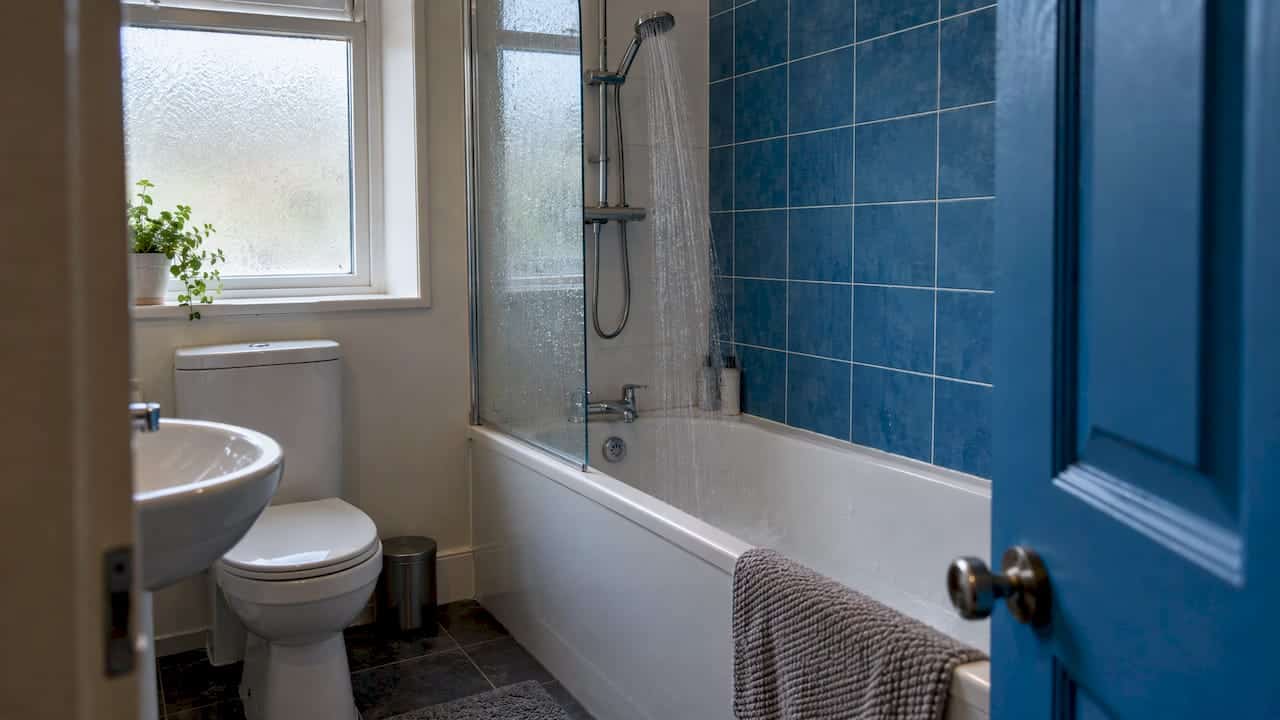
The most effective energy saving tips target heating and hot water first, because that is where most of a home’s energy goes. Lower the thermostat, shorten showers, wash colder, switch off standby, draught-proof gaps and then plan insulation. Quick habit changes cost nothing. Fabric improvements cost more but keep working for years.
The Energy Saving Trust says its ten quick tips could save up to £313 a year in Great Britain. Actual savings depend on the size of the home, how it is heated and how many people live in it. The sections below set out the tips in order of impact, so the biggest wins come first.
TL;DR
- Heating and hot water are the main targets: more than 80% of home energy use goes on them.
- Turning the thermostat down by 1°C could save as much as 10% on heating bills, according to nidirect.
- Free habits (standby, shorter showers, colder washes, full dishwashers) come before paid upgrades.
- Draught-proofing and insulation reduce heat loss for years, and an EPC shows which upgrades suit a particular property.
- Check the current price cap and grant rules on official pages, because both change.
Table of Contents
- Where the energy goes
- Quick habit changes that cost nothing
- Heating: the biggest single saving
- Draught-proofing and insulation
- Appliances and upgrades that pay back
- A simple order of action
- Our perspective
- Getting the property assessed
- Common mistakes
- FAQ
- Sources
Where the energy goes
Energy saving works best when it starts with the biggest uses. In a typical UK home, nidirect states that more than 80% of energy use is for heating and hot water. Lighting, appliances and electronics make up the rest.
That split decides the order of the tips:
- Reduce the heat the home needs (thermostat, controls, draughts, insulation).
- Reduce hot water use (showers, taps, washing temperatures, cylinder insulation).
- Reduce electricity waste (standby, lighting, appliance choices).
The cost of energy also matters. Ofgem’s price cap for a typical household paying by Direct Debit was announced at £1,723 a year for 1 October to 31 December 2026. The cap is reviewed every quarter and the figure describes typical use, not a guaranteed bill. Every unit saved is worth more when unit prices are high.
For a deeper look at the cost side, the guide on how to reduce your electric bill walks through usage and tariffs step by step.
Quick habit changes that cost nothing
These changes need no installer and no budget. The Energy Saving Trust’s quick tips focus on everyday wins such as using appliances efficiently, cutting hot water use and switching off devices.
Switch off standby
TVs, games consoles, chargers and set-top boxes draw power while idle. Turning appliances off at the wall removes that standby load, a point the US Department of Energy’s household guide also makes. A single multi-socket extension with a switch makes this a one-click habit for a TV area or a home office.
Wash colder and fill the machine
Fewer, colder washes and a full dishwasher use less energy than frequent part loads. The same US guidance lists running washing machines on cold cycles among its easy electricity savers. Skipping the tumble dryer when the weather allows is another of the Energy Saving Trust’s quick tips.
Shorten showers and swap baths
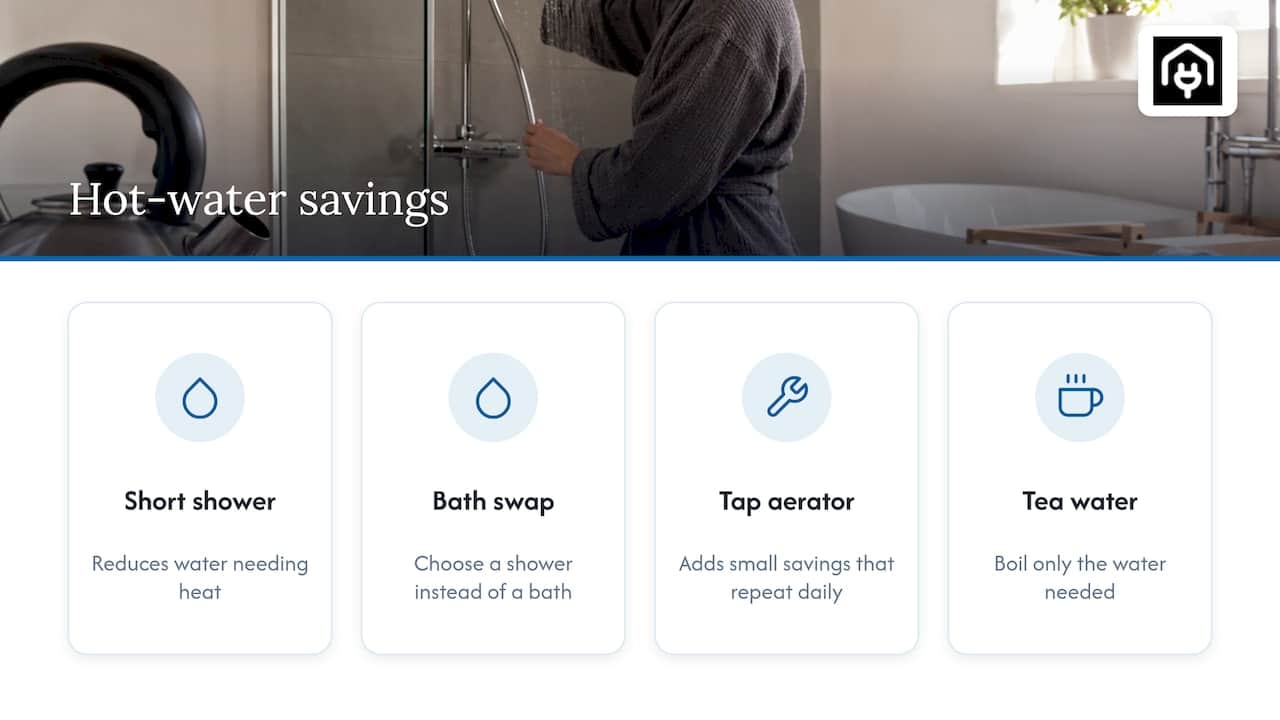
Heating water is a large part of the 80% mentioned above. A shorter shower, or a shower instead of a bath, cuts the amount of water that has to be heated. Fitting a tap aerator and boiling only the water needed for a cup of tea add small savings that repeat daily.
Turn off lights and use better bulbs
Switching to LED lighting is among the simplest electricity savers. The US Department of Energy guide also suggests task lights instead of overhead lighting, plus timers or sensors, so lights are not left on in empty rooms. Start with the bulbs used most often, such as the kitchen, living room and hallway.
Keep radiators clear
Furniture and drying clothes in front of a radiator block warm air from moving across the room. Moving a sofa a few inches away costs nothing and lets the same heat reach more of the space.
More low-effort ideas are collected in 7 practical ways to use less electricity at home or work and 7 smart home energy saving habits.
Heating: the biggest single saving
Heating is the largest controllable cost, so small adjustments pay back quickly.
Turn the thermostat down
nidirect states that turning the thermostat down by 1°C could save as much as 10% on heating bills. Australia’s government energy site suggests a heating setting of 18°C to 20°C, with each degree of change worth roughly 5% to 10% on heating costs. Those ranges come from Australian and Northern Irish guidance, so UK households should treat them as a guide and find the lowest setting that still feels comfortable.
What the “30 minute heating rule” means
Searchers often ask about a 30-minute heating rule. It is a popular rule of thumb, not a regulation, and no official source in this guide sets it. What matters in practice is a heating schedule that matches when the home is occupied. Set the timer to bring the home up to temperature shortly before waking or returning, and let it switch off when the house is empty or everyone is asleep. A programmer, room thermostat and thermostatic radiator valves give that control.
Heat the rooms in use
Thermostatic radiator valves let each room settle at its own temperature. A rarely used spare room can run cooler than the living room. Keep internal doors closed so the heat stays where it is wanted.
Does leaving air conditioning on save electricity?
Another common question is whether leaving air conditioning running all day saves energy. The cooling guidance cited above suggests a cooling setting of 25°C to 27°C, which saves energy compared with a lower target. Running a system continuously to hold a low temperature uses more power than cooling only when needed. Commercial buildings with larger air conditioning systems have separate legal requirements, covered in the section on inspections below.
Hot water settings
Hot water cylinders lose heat if poorly insulated. The US Department of Energy notes that an insulating blanket for a water heater pays for itself in one year or less, and that a lower water heater setting saves energy and reduces scalding risk. The US figure is stated in Fahrenheit for American tanks. In the UK, a cylinder jacket or a properly insulated cylinder is the equivalent step, and the Energy Saving Trust lists topping up cylinder insulation among its quick tips. Anyone changing the stored water temperature on a UK system should follow the installer’s guidance, because water that is stored too cool carries a hygiene risk.
Draught-proofing and insulation
Heat that escapes has to be paid for twice: once to generate it and again to replace it. Insulation and draught-proofing stop the loss.
Draught-proofing
The Surrey Home Energy Improvement Guide explains that draught-proofing with seals or excluders prevents heat escaping through gaps. Typical places to check:
- Windows and external doors
- Letterboxes and keyholes
- Chimneys not in use
- Gaps between floorboards and skirting boards
- Loft hatches
Thick curtains also help. The same guide notes that curtains trap heat in winter and shade rooms in summer.
Roof, wall and floor insulation
Insulation in roofs, walls and floors slows the transfer of heat through the building fabric. Australian government guidance says effective insulation can reduce heating and cooling costs by up to 45%. That is an upper figure for Australian homes, so a UK home will see a different result depending on its starting point. A loft that already has a deep layer gains less than one with none.
The University of Maryland Extension describes the whole-house approach: reducing air leakage and heat transfer is more cost-effective in the long term than relying on large heating and cooling systems. Fix the building first, then size the heating system to the smaller load.
Keep ventilation and damp in check
A tighter home needs managed ventilation. Cambridge City Council’s retrofit guidance stresses good ventilation and attention to condensation, damp and mould when insulating. Extractor fans, trickle vents and opening windows briefly all help. A home with existing damp should have the cause diagnosed before insulation goes in.
Insulation also ages. Guidance from Australia’s energy site notes that insulation can deteriorate and lose effectiveness over time, so periodic checks keep the benefit.
Finding the worst leaks
The US Department of Energy points out that an energy auditor with a blower door can find the worst air leaks. In the UK, an EPC assessment is the more familiar starting point, and it lists recommended improvements for the property.
Appliances and upgrades that pay back
Quick habits and fabric work come first. Appliance and system upgrades come next.
| Upgrade | Main benefit | Best for |
|---|---|---|
| LED bulbs | Less electricity for the same light | Every home, starting with the most-used rooms |
| Smart thermostat or programmer | Heating matched to occupancy | Homes with irregular routines |
| Thermostatic radiator valves | Room-by-room control | Multi-room homes with unused rooms |
| Loft and wall insulation | Lower heat loss all year | Homes with thin or no insulation |
| Efficient boiler or heat pump | Less fuel for the same heat | Systems at the end of their life |
| Efficient appliances | Lower running cost | Replacing worn-out fridges, washers, dishwashers |
When choosing a boiler, nidirect advises looking for the Energy Saving Recommended label, used only on the most efficient products, usually the top 20% available. Compare appliance energy labels too, and pick the size that matches real need, since an oversized fridge or washer wastes energy.
Heat pumps and grants
Heat pumps can reduce the fuel needed for heating, and government support exists. Ofgem lists the Boiler Upgrade Scheme as offering £7,500 off the cost and installation of air-to-water, ground source and water source heat pumps, with a higher amount for some off-gas-grid properties. Grant values, eligibility and end dates change, so confirm the current terms on the Ofgem page before booking an installer. A heat pump also works best in a well-insulated home, which is another reason to do the fabric work first.
For the cost side of heating choices, how to save money on gas and electricity bills compares the options in more detail.
A simple order of action
- This week: switch off standby, wash colder, shorten showers, clear radiators.
- This month: lower the thermostat by a degree, set heating schedules, add draught strips.
- This year: top up loft insulation, insulate the cylinder, replace remaining halogen bulbs with LEDs.
- At the next replacement: choose an efficient boiler or heat pump and A-rated appliances.
- Before major work: get an EPC to see which improvements suit the property.
For a broader plan, the practical UK guide to reducing home energy use and best ways to save energy at home in the UK go room by room.
Our perspective
Most advice on saving energy stops at switching off lights. That helps, but it skips the question of how the building performs. A home that leaks heat will keep leaking it however careful the occupants are.
We start with measurement. An Energy Performance Certificate rates a property, lists recommended improvements and gives a baseline. Landlords can use it to plan works against upcoming standards. Homeowners can use it to rank upgrades by what they are likely to deliver.
The UK is moving towards the Home Energy Model, which is designed to replace SAP as the method for assessing a building’s energy performance in line with the Future Homes Standard. For new builds and major refurbishments, accurate calculations such as SAP, SBEM and water calculations are part of getting a design through compliance. For commercial premises with air conditioning, TM44 inspections cover the legal side.
Tips are a good start. A measured assessment makes them specific to one property.
Danny
Getting the property assessed
An assessment turns general advice into a ranked list for one building. Homeowners and landlords can request a quote for a domestic EPC, and businesses can do the same for a commercial EPC. Buildings with air conditioning above the relevant size threshold may need a TM44 inspection. Developers working on new homes can ask about SAP calculations and water calculations for Part G. Quotes are requested through the online forms on each page.
To understand the certificate itself, see the guide to what an EPC rating means.
Common mistakes
- Insulating without ventilating. Damp and mould can follow if moisture has nowhere to go.
- Buying gadgets before fixing gaps. A smart device cannot fix a draughty hallway.
- Setting the heating very high to warm up faster. Most systems do not heat a room quicker at a higher setting; they only overshoot.
- Ignoring hot water. It is a large share of the 80% heating-and-hot-water total.
- Relying on old figures. Prices, caps and grants are reviewed regularly, so use current official pages.
FAQ
What is the most effective way to save energy at home?
Reducing heating demand is the biggest lever, because heating and hot water account for more than 80% of home energy use. Lower the thermostat, draught-proof and insulate. For the long term, fixing air leakage and heat loss is more cost-effective than relying on larger heating systems.
How can I save electricity at home?
Switch appliances off at the wall, move to LED lighting, use timers or sensors, and wash on cold cycles. These steps come from the US Department of Energy’s household guidance. Replace worn-out appliances with efficient models when the time comes.
What runs up an electricity bill the most?
Heating and cooling are usually the largest users. The US Department of Energy puts space heating and cooling at about 32% of a typical American home’s energy use. UK homes differ because many heat with gas, so the electricity share depends on the heating system, but hot water, cooking and appliances all add up.
Does keeping the air conditioning on all day save electricity?
No. Cooling only when needed and setting a moderate target, such as the 25°C to 27°C range suggested by Australian government guidance, uses less power than holding a low temperature continuously. Shading windows and closing curtains in the day reduces the load further.
Is there a 30-minute heating rule?
There is no official rule. The idea is a rule of thumb about how heating is scheduled. The reliable approach is to use a programmer or smart thermostat to match heating times to when people are home, and to turn the thermostat down a degree where comfort allows.
Sources
- Quick tips to save energy at home from the experts, Energy Saving Trust
- Insulation, nidirect
- Ofgem’s energy price cap explained, E.ON Next
- Energy Saver: Tips on Saving Money and Energy in Your Home, US Department of Energy
- Quick wins to save energy, energy.gov.au
- Home Energy Checklist, US Department of Energy
- The Surrey Home Energy Improvement Guide
- Seasonal tips to save energy, energy.gov.au
- Understanding Home Energy, University of Maryland Extension
- Retrofitting your home, Cambridge City Council
- Winter energy savings, energy.gov.au
- Boiler Upgrade Scheme, Ofgem