
TL;DR:
- Effective energy savings require an integrated approach that addresses insulation, air sealing, smart controls, and occupant behavior simultaneously. Proper building envelope preparation enhances the performance of smart systems and renewable technologies, leading to significant cost reductions and improved comfort. Adopting a holistic strategy based on professional assessments and automation maximizes long-term savings and property value.
Most homeowners assume that swapping in a new boiler or fitting solar panels will deliver the dramatic bill reductions they expect. The reality is more nuanced. A genuine energy saving system works across multiple layers of a property simultaneously, coordinating insulation performance, heating controls, smart devices, and occupant behaviour into a single coherent strategy. Treating these elements in isolation is the single biggest reason why energy upgrades underperform. This article explains how to build and manage an integrated approach that genuinely reduces costs and improves comfort.
Table of Contents
- Key takeaways
- Building the right energy efficiency foundation
- What a smart energy saving system actually does
- Practical steps to adopt and optimise your system
- Behaviour and habits that amplify the technology
- My perspective on integrated energy management
- How Homeenergymodel can support your energy strategy
- FAQ
Key takeaways
| Point | Details |
|---|---|
| Fix the building envelope first | Air sealing and insulation must be addressed before smart systems can perform at their best. |
| Smart systems automate savings | Intelligent home energy management uses IoT and AI to adjust energy use in real time without manual input. |
| Holistic upgrades outperform isolated ones | Combined home upgrades deliver 2 to 3 times more savings than single equipment changes. |
| Behaviour amplifies technology | Timing appliance use, eliminating standby loads, and using smart thermostats compounds the gains from hardware upgrades. |
| Professional modelling adds precision | Energy performance assessments help prioritise investments and support compliance with UK regulations such as EPC requirements. |
Building the right energy efficiency foundation
Before any smart device or renewable technology delivers its full potential, the property itself must be able to retain the energy it generates and conditions. This is the principle that separates properties achieving 40% bill reductions from those that see barely 10%.
Air sealing: the upgrade most homeowners skip
Air sealing stops 25 to 40% of energy waste and has a payback period of just one to three years, making it the single highest return upgrade available. Gaps around windows, loft hatches, pipework penetrations, and electrical sockets all allow conditioned air to escape and cold air to enter. The result is that heating and cooling systems work continuously to compensate for losses the building should not have in the first place.
Air sealing alone accounts for an 11% reduction in heating and cooling costs before any other measure is applied. The important sequence is to seal first, then insulate. Adding insulation over unsealed gaps traps moisture and reduces the effectiveness of both measures.
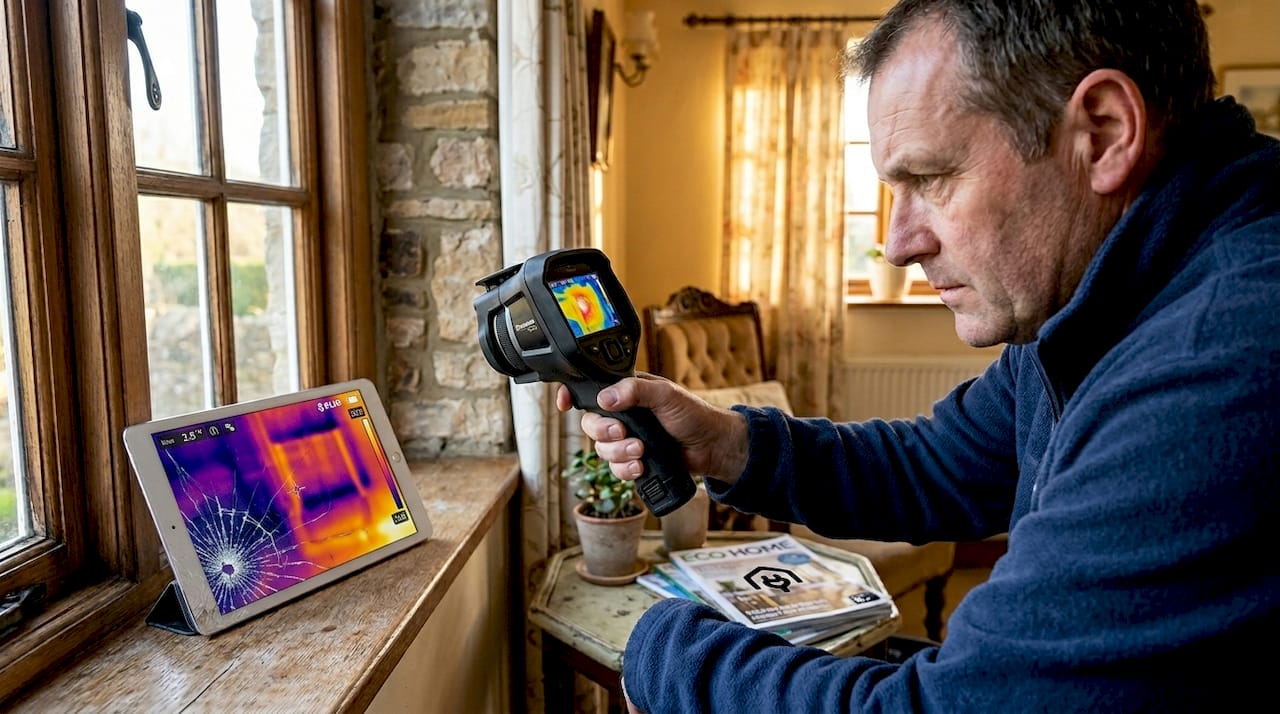
Pro Tip: Use a thermal imaging inspection before starting work. Thermal imaging technology reveals hidden air leaks and insulation gaps that a visual inspection will miss entirely, saving significant time and money on remedial work.
Insulation and HVAC working together
Once air sealing is in place, proper insulation in the loft, walls, and floors reduces the heating and cooling load the HVAC system must meet. A reduced load means smaller equipment runs for shorter periods, extending its service life and cutting fuel use. Duct sealing on older systems prevents conditioned air from leaking into unconditioned roof spaces or wall cavities before it reaches living areas.
Combining insulation, air sealing, HVAC optimisation, and smart controls can reduce heating and cooling costs by 20 to 40% in total. Without a properly sealed building envelope, even the most advanced controls underperform, because conditioned air simply escapes and renders equipment upgrades less effective.
- Loft insulation: aim for 270mm of mineral wool as a minimum in UK properties
- Cavity wall insulation: suitable for most post-1920s properties with unfilled cavities
- Solid wall insulation: internal or external, higher cost but necessary for Victorian and Edwardian stock
- Duct sealing: mastic sealant or metallic tape rather than standard duct tape, which degrades rapidly
- HVAC servicing: annual checks maintain rated efficiency and identify failing components early
What a smart energy saving system actually does
The term “smart energy management” is used loosely in the market, but there is a precise technical meaning worth understanding. A true smart energy management system, often referred to as an intelligent Home Energy Management System (iHEMS), is not simply a dashboard that shows usage data. Smart energy management systems automate energy use through IoT connectivity, predictive analytics, and automatic decision-making, optimising power flows without any manual intervention.
The shift from passive to active energy management is significant. A passive system records what is happening. A smart system responds to what is happening and anticipates what will happen next.
“Most AI-driven building energy systems fail if they stop at dashboards. True savings require closed-loop sensing, intelligence, and actuation, automatically adjusting operations based on real-time conditions.”
The components that make it work
- Sensors and smart meters monitor energy generation, consumption, and storage at appliance and circuit level in real time.
- IoT-connected devices allow the system to communicate with heating controls, EV chargers, battery storage, and white goods simultaneously.
- AI algorithms learn usage patterns, forecast demand, and predict solar generation based on weather data.
- Automated actuation shifts loads, adjusts thermostat setpoints, and charges or discharges batteries without any action from the occupant.
- Grid integration enables peak shaving and participation in demand-response programmes, turning the home’s energy hardware into a financial asset.
Intelligent home energy management systems can increase household green electricity self-consumption from around 60% to over 90%, and reduce annual electricity costs by 50 to 60%. Those are not marginal improvements. They represent a fundamental change in the economics of residential energy.
Energy optimisation strategies such as load shifting and battery storage bridge the gap between when solar panels generate electricity and when the household actually needs it, capturing value that would otherwise be exported to the grid at a low rate.
Practical steps to adopt and optimise your system
Selecting and installing an energy saving system is straightforward when approached in the right order. The following comparison outlines the typical investment, savings, and payback for the core components most UK homeowners and property managers should consider.
| Upgrade | Typical cost (UK) | Annual saving | Payback period |
|---|---|---|---|
| Air sealing | £300 to £800 | 11% on heating bills | 1 to 3 years |
| Loft insulation | £300 to £600 | £150 to £250 per year | 2 to 4 years |
| Smart heating controls | £1,430 average | 20% to 30% heating bills | Months to 2.5 years |
| Full iHEMS with solar and battery | £8,000 to £15,000 | 50% to 60% electricity costs | 7 to 12 years |
Start with a baseline energy audit. Before committing to any purchase, understand where the property currently loses the most energy. An EPC assessment provides a standardised starting point, and a more detailed air pressure test reveals infiltration levels. Properties with outdated controls see the fastest return on upgrading, because the gap between current performance and optimised performance is widest.
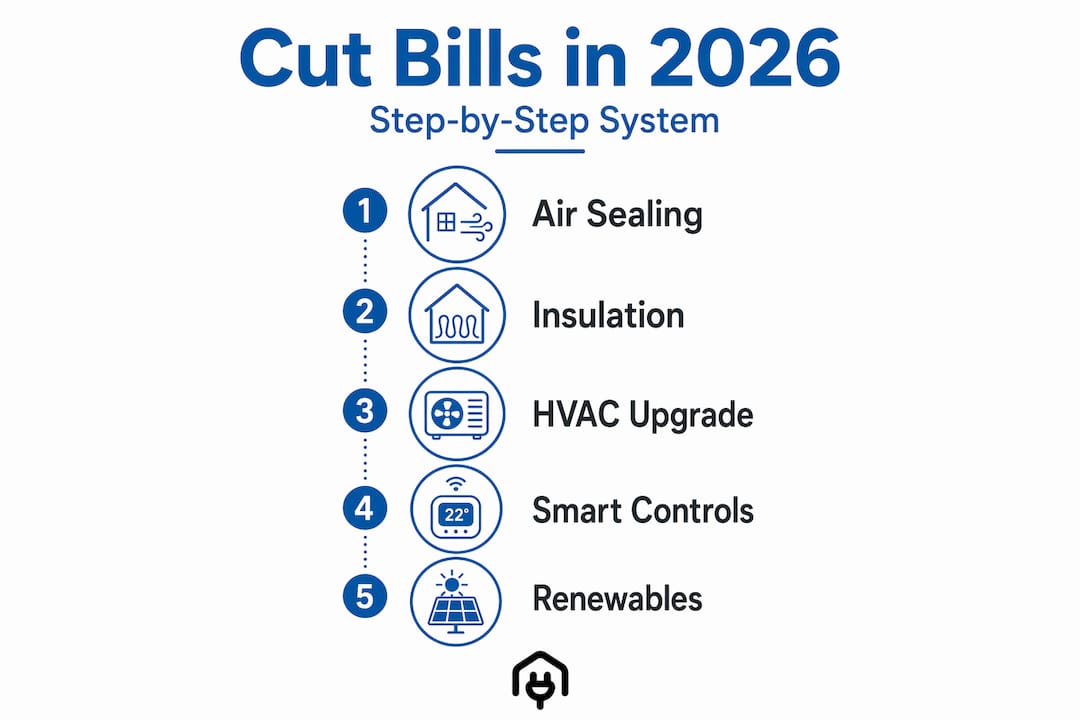
Prioritise in this sequence: air sealing, insulation, HVAC optimisation, then smart controls and renewables. This order is not arbitrary. It reflects the compounding nature of energy upgrades. Each foundational measure reduces the load that subsequent technologies must manage, making every downstream investment more cost-effective.
When selecting a smart energy management platform, look for open standards such as Matter or OCPP for EV charging. Proprietary systems that lock you into one manufacturer create long-term inflexibility. Interoperability between solar inverters, batteries, heating systems, and appliances is what enables genuine home energy optimisation at scale.
Time-of-use tariffs from suppliers such as Octopus Energy’s Agile or Go tariffs reward households that shift demand to off-peak periods. A smart system can do this automatically, charging batteries overnight at lower rates and discharging during peak periods.
Pro Tip: Check eligibility for the UK government’s ECO4 scheme and the Great British Insulation Scheme before paying full price for insulation. Many owner-occupiers and landlords qualify for subsidised or fully funded measures depending on property type and EPC rating.
Behaviour and habits that amplify the technology
Even the most sophisticated energy saving system performs better when the occupants support it with consistent habits. Technology and behaviour are not competing approaches. They compound each other.
Smart thermostats are only effective when programmed with accurate schedules. A thermostat left on a blanket “always on” setting negates its learning capability. Setting temperature setbacks during unoccupied hours and at night is one of the simplest adjustments with measurable impact. The Homeenergymodel guide to energy saving habits covers this and other occupant-led strategies in detail.
- Standby loads: Televisions, games consoles, and phone chargers left plugged in consume energy continuously. Smart plugs on a scheduled programme eliminate this waste automatically.
- Appliance timing: Dishwashers, washing machines, and tumble dryers account for a significant share of household electricity. Running them during solar generation hours or off-peak tariff windows reduces cost without changing comfort.
- Water heating: Lowering water heater temperature from a common setting of 60°C to the recommended 49°C reduces standing heat loss with no equipment cost whatsoever.
- Filter maintenance: A blocked HVAC filter forces the system to work harder for the same output. Replacing filters every three months maintains rated efficiency.
- Lighting: LED lamps use 75% less electricity than incandescent equivalents and last significantly longer. Occupancy sensors in corridors and bathrooms remove the reliance on occupants switching lights off.
Systems that incorporate occupancy sensors adapt heating and cooling schedules automatically as household patterns change, which means the savings are sustained even when routines shift.
My perspective on integrated energy management
I’ve worked alongside enough property owners who have invested in solar panels or a new heat pump, only to be disappointed by bills that barely moved, to know that piecemeal upgrades rarely deliver on their promise. The properties that achieve genuinely transformative reductions have one thing in common: they treated energy performance as a system, not a shopping list.
What I’ve found consistently is that the automation piece is undervalued. Homeowners will spend thousands on hardware and then rely on manual scheduling that drifts within weeks. The real power of an iHEMS is that it removes the human failure point entirely. The system learns, adjusts, and optimises continuously without depending on anyone remembering to change a setting.
My honest assessment is that air sealing is still the most overlooked upgrade in the UK housing stock. Landlords and homeowners alike tend to reach for the visible technology first. But spending on a smart controller before addressing a draughty loft hatch is like fitting a premium thermostat in a tent.
The long-term case for integrated systems is strong, both financially and in terms of comfort. Properties with high EPC ratings command better rental yields, attract more reliable tenants, and face fewer compliance risks as minimum energy efficiency standards tighten. Thinking strategically now, rather than reactively when regulations change, is the approach that pays off.
— Danny
How Homeenergymodel can support your energy strategy
Homeenergymodel provides detailed guidance on the methodologies that underpin residential energy performance assessments in the UK, including the forthcoming Home Energy Model set to replace SAP in 2025. For landlords and property managers looking to understand how energy system upgrades affect EPC ratings and compliance obligations, the types of home energy models resource is a practical starting point.
Understanding how energy modelling works helps property owners make investment decisions with confidence, rather than relying on manufacturer claims alone. The Home Energy Model explained guide sets out clearly how the new methodology assesses building performance and what it means for residential properties across the UK.
For London-based landlords, the EPC guidance for London resource covers compliance requirements and practical steps to improve ratings ahead of forthcoming minimum standards. Professional modelling and assessment services sit alongside any self-directed energy saving work, providing the evidence base needed for planning, compliance, and investment decisions.
FAQ
What is a smart energy saving system?
A smart energy saving system combines IoT-connected sensors, AI-driven software, and automated controls to manage electricity generation, storage, heating, and appliance use in real time. Unlike traditional timers or manual controls, it adjusts energy flows automatically based on occupancy, tariff rates, and generation availability.
How much can a home energy saving system reduce bills?
Savings depend on the measures installed and the property’s starting condition. Smart heating management alone can cut heating bills by 20 to 30%, while a full iHEMS with solar and battery storage can reduce annual electricity costs by 50 to 60%.
Should air sealing be done before installing smart controls?
Yes. Holistic home upgrades yield two to three times more savings than isolated equipment changes, and air sealing must come first. Without a sealed building envelope, heating and cooling systems run harder to compensate for losses, reducing the effectiveness of any smart control technology installed afterwards.
Do smart energy systems work with existing heating systems?
Most modern smart energy management platforms integrate with gas boilers, heat pumps, and electric heating systems via standard communication protocols. Compatibility should be confirmed before purchase, particularly for older systems without smart connectivity built in.
What is the payback period for a smart energy system?
Payback depends heavily on the property’s starting inefficiency. Homes with outdated controls can see payback within months to two and a half years for smart heating management. Larger whole-home systems with solar and battery storage typically see payback over seven to twelve years.