
The most reliable way of saving on energy bills is to find where the money goes first, then fix the biggest source. For most UK homes that means heating and hot water, followed by heat loss through the building, then appliances and tariff choice. Some changes cost nothing and take minutes. Others, such as insulation, cost money but pay back every winter. This guide sets out both, in a sensible order, with the current price cap and VAT position for October 2026.
TL;DR
- The price cap rises by 4% from 1 October 2026, to £1,723 for a typical dual-fuel direct debit household, so cutting usage matters more than waiting for prices to fall.
- Heating and hot water settings are the cheapest place to start: thermostat, boiler flow temperature, curtains and radiator use.
- Draught-proofing and loft insulation reduce the heat that escapes, which makes every heating setting work harder.
- A smart meter shows spending in pounds and pence, which helps target the right measure first.
- Grants and discounts exist for low-income households, and a free government service lists suggested improvements for homes in England and Wales.
Table of Contents
- What is happening to energy prices in October 2026
- Start by finding where the energy goes
- Heating and hot water: the largest share of the bill
- Stopping heat loss: draughts and insulation
- Measure first with a smart meter
- Appliances, lighting and everyday habits
- Help with bills and grants
- Our perspective: plan upgrades around the building, not the tip list
- When an assessment is worth booking
- A sensible order of action for this winter
- FAQ
- Sources
What is happening to energy prices in October 2026
Bill-saving advice makes more sense against the current price picture. Ofgem has announced that the energy price cap will rise by 4% for 1 October to 31 December 2026. The typical dual-fuel direct debit figure moves from £1,663 to £1,723 a year. That figure is an illustration based on typical use, not a personal bill. A small flat uses far less, and a large detached house far more.
Two points are easy to miss:
- Fixed tariffs are unaffected. Ofgem notes that around 35% of households are on fixed tariffs, so the cap change does not apply to them directly.
- Electricity gets a VAT cut. From 1 October 2026 to 31 March 2027, there is a temporary zero rate of VAT on domestic electricity in Great Britain. VAT stays at 5% on other domestic fuels, and the measure does not apply in Northern Ireland. Ofgem says the change reduced the cap increase by around £45. Suppliers apply it automatically, and the government confirms households need to do nothing.
The VAT change is temporary and ends on 31 March 2027. Budgets built on the lower electricity price should allow for that date.
Start by finding where the energy goes
Savings advice is generic until it is matched to a particular home. Ofgem makes the same point: how much can be saved depends on individual circumstances, and it frames savings as a mix of using less energy and making the home more efficient.
A simple first audit takes an evening:
- Gather the last 12 months of bills or supplier account data. Compare winter and summer use to see how much is heating and how much is baseload.
- Note the baseload. Fridge-freezer, router, standby devices and lighting run all year. A high summer figure points to appliances rather than heating.
- Walk the house on a cold day. Feel for draughts at doors, windows, letterboxes, loft hatches and skirting boards.
- Check the existing EPC. The certificate lists the recommended improvements and a rating from A to G, which gives a starting point for the upgrade list.
- Rank the options by cost and effect: free behaviour changes, then low-cost fixes, then larger works.
A smart meter makes step 2 much easier, as covered below.
Heating and hot water: the largest share of the bill
Heating and hot water usually account for the biggest portion of a gas and electricity bill, so small changes here have the most effect. Ofgem lists the main everyday actions: turning down heating and boiler settings, closing curtains at night, sealing gaps and using heating controls.
Thermostat and timer settings
Lowering the room thermostat by a small amount reduces the energy used every hour the heating is on. A comfortable range suits most households, and it is worth adjusting in steps of one degree until the home feels only slightly cooler. Households with vulnerable occupants, such as older people, babies or anyone with a health condition, should not cut temperatures to uncomfortable levels. A GP or the NHS can advise on safe indoor temperatures for specific conditions.
Heating schedules should follow the actual daily pattern. Heating a house that is empty from 8am to 5pm is wasted spend, and a programmable or smart thermostat removes the need to remember.
Combi boiler flow temperature
This is one of the best free fixes for homes with a combi boiler. The government’s Clean Energy campaign advises that lowering the combi boiler flow temperature to 60C can make the boiler more efficient, and it lists this among three tips that together could save around £100 a year. The setting is usually on the boiler’s front panel. Anyone unsure should check the manual or ask a Gas Safe registered engineer rather than adjusting settings blindly. Systems with a hot water cylinder have different safety considerations, so the advice above applies to combi boilers.
Radiators and curtains
- Keep furniture and curtains clear of radiators so heat reaches the room.
- Close curtains at dusk to cut heat loss through glass, as Ofgem advises.
- Bleed radiators that have cold spots at the top.
- Turn down or off the radiators in rooms that are rarely used, using thermostatic radiator valves.
Stopping heat loss: draughts and insulation
Heating controls only go so far if warmth escapes as fast as it is produced. The Met Office advises that insulating a home keeps it warm and helps keep energy costs down. Its checklist includes fitting draught-proofing around windows and doors and making sure the loft has at least 270 mm (10 to 11 inches) of insulation.
Many homes fix one route and miss another. A well-insulated loft still loses heat through an unsealed letterbox and gaps under skirting boards. The order below suits most budgets:
| Measure | Typical effort | Where it helps |
|---|---|---|
| Draught strips, letterbox brush, keyhole covers | Low cost, DIY | Doors, windows, floors |
| Radiator reflector panels | Low cost, DIY | External walls |
| Loft insulation to 270 mm | Moderate cost, often professional | Roof space |
| Cavity wall insulation | Professional installation | Suitable external walls |
| Upgraded glazing | Higher cost | Windows |
National Grid’s customer advice says that insulating cavity walls can contribute to savings of up to £250 a year on household bills. Real savings vary with house type, existing insulation and heating habits, which is why a property-specific recommendation is worth more than any national average.
For England and Wales, GOV.UK offers a free service where owners can get recommendations for home improvements, including estimated cost and how much could be saved on bills. It asks for details such as house type, build date, insulation in floor, walls and loft, and glazing type. Scotland and Northern Ireland have their own advice routes, through Home Energy Scotland and NI Direct.
Measure first with a smart meter
Spending money on the wrong upgrade is the commonest mistake. Measurement avoids it. GOV.UK explains that smart meters allow automatic readings, so bills reflect actual usage rather than estimates. The in-home display shows near-real-time use in pounds and pence.
That feedback answers practical questions:
- What does the house use overnight, with everything apparently off?
- How much does a kettle, oven or tumble dryer cost per use?
- Does the peak come at 6pm, or is the heating running through the afternoon?
Smart Energy GB, an industry-backed body rather than a regulator, says the visibility helps households manage energy use and budgets by identifying which appliances or periods use the most. Ofgem also points to off-peak electricity tariffs that depend on a smart meter. These suit homes that can move laundry, dishwashers or electric vehicle charging to cheaper hours. Anyone considering one should compare the unit rates and standing charges on the specific tariff before switching. A longer explanation is in our guide on how smart meters work in UK homes.
Timing matters more once a home has a battery or solar panels. The way installers match battery capacity to demand peaks is explained in this overview of how solar batteries shave demand peaks. It is written for the US market, so the principles apply but the products, prices and incentives do not carry over to the UK.
Appliances, lighting and everyday habits
After heating, the remaining savings come from many small items. None is dramatic alone, and together they add up.
- Lighting: swap remaining older bulbs for LEDs, which use much less electricity and last longer than incandescent bulbs, according to National Energy Action.
- Laundry: wash at lower temperatures and run full loads.
- Standby: switch off devices that sit on standby, particularly entertainment systems and chargers.
- Kitchen: match pan size to hob ring, keep lids on, and defrost the freezer if ice builds up.
- Hot water: shorter showers and fixing dripping hot taps reduce heated water that is wasted.
Our guides on low-cost energy-saving tips for UK homes and how to decrease an electric bill go through these room by room.
Help with bills and grants
Some households can get direct help. GOV.UK states that the Warm Home Discount Scheme provided £150 off a bill for winter 2025 to 2026 for eligible people, such as those receiving the Guarantee Credit element of Pension Credit or on a low income. The same page lists energy-saving improvement schemes, including the Energy Company Obligation and the Great British Insulation Scheme route, plus Warm Homes: Local Grant. Eligibility and amounts change between winters, so the current page should be checked before relying on any figure.
Renters need a different route. Tenants can ask a landlord about planned improvements, and landlords have their own reasons to act, since the EPC rating shapes how a property is marketed and what regulations apply. Our EPC exemption guide covers the rules landlords should know.
Our perspective: plan upgrades around the building, not the tip list
We work with the way UK government energy methodologies describe a building, from SAP to the upcoming Home Energy Model, and one lesson repeats. Generic tip lists treat every house alike, but a building’s energy use is the sum of its fabric, its heating system and how people use both.
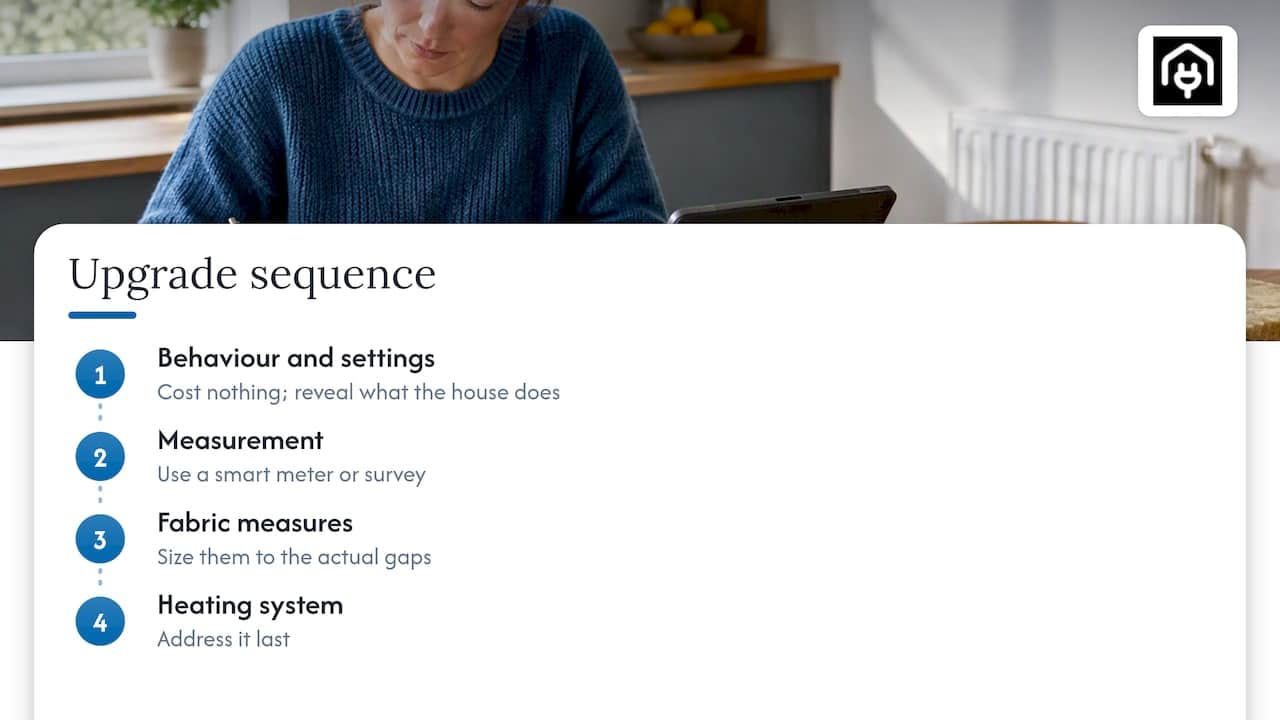
That is why we suggest a fixed order. First, behaviour and settings, because they cost nothing and show what the house does. Second, measurement, whether a smart meter or a survey. Third, fabric measures sized to the actual gaps. Last, the heating system itself. Replacing a boiler or fitting a heat pump in a leaky house tends to produce disappointing results, and the sums look different once the heat loss is reduced.
A proper assessment also keeps records consistent. An EPC or a SAP-based calculation draws on the same property details every time: construction, insulation, glazing, heating and controls. Gathering those facts once saves repeated work for landlords and investors who handle more than one property. Our guides on reducing home energy bills and the energy-saving steps for UK homes follow the same sequence.
— Danny
When an assessment is worth booking
Everyday habits can be tried alone. A formal assessment is worth considering when:
- a property is being sold, let or newly built and needs a valid certificate;
- a landlord or investor manages several properties and needs consistent upgrade priorities;
- a commercial building has air conditioning that requires inspection;
- a planning application needs an energy statement or Part G water calculation.
Homeenergymodel helps owners request quotes from assessors and inspectors. Relevant pages include domestic EPC assessments, commercial EPCs, TM44 air conditioning inspections and SAP calculations for new builds. Prices are not published on the site, so the quote form is the route to a figure for a specific property.
A sensible order of action for this winter
- This week: check the thermostat, timer and boiler flow temperature, close curtains at dusk, and switch off standby devices.
- This month: fit draught-proofing, check loft depth against the 270 mm benchmark, and request a smart meter from the supplier if none is fitted.
- Before the VAT cut ends on 31 March 2027: review the tariff, including fixed options and off-peak electricity, and compare with the cap.
- Within the year: use the GOV.UK improvement service and the existing EPC to plan larger works, and check grant eligibility.
The home energy saving tips guide and the broader efficiency guide give more detail on each step.
FAQ
What is the quickest way to save on an energy bill?
Turning down the thermostat slightly, lowering a combi boiler’s flow temperature and switching off standby devices cost nothing and can be done today. The government’s Clean Energy campaign lists the flow temperature change among three tips worth around £100 a year in total. Actual savings depend on the home and how it is used.
Do smart meters reduce bills by themselves?
No. A smart meter does not cut use on its own. It gives accurate readings instead of estimates and shows spending in pounds and pence, and that information helps households decide what to change. Savings come from acting on what the display shows.
Does the VAT cut on electricity apply to gas?
No. The temporary zero rate applies to domestic electricity in Great Britain from 1 October 2026 to 31 March 2027. VAT stays at 5% on other domestic fuels, and Northern Ireland is not covered. Suppliers apply the change automatically.
Is loft insulation worth it if the loft already has some?
It can be. The Met Office suggests at least 270 mm of insulation, so an older, thinner layer may be worth topping up. A survey or the GOV.UK improvement service can show what a given home needs and the estimated saving.
Sources
- Ofgem: energy price cap will rise by 4% from October 2026
- GOV.UK: temporary zero rate of VAT for domestic electricity in Great Britain
- GOV.UK: breathing space on your energy bill
- Ofgem: save money on your energy bill
- Clean Energy campaign: save energy in your home
- Met Office: keeping your home warm this winter
- National Grid: energy saving tips
- GOV.UK: find ways to save energy in your home
- GOV.UK: smart meters, a guide for households
- Smart Energy GB: are smart meters worth it?
- National Energy Action: top energy saving tips
- GOV.UK: help with your energy bills