

TL;DR:
- The UK is shifting to the Home Energy Model (HEM), which assesses property performance across four separate metrics rather than a single score. Landlords must now evaluate fabric, heating, smart readiness, and energy costs independently to ensure compliance, requiring targeted improvements across each area. Preparing early with comprehensive assessments and cost-effective upgrades will help owners meet new standards and avoid costly last-minute measures.
The way home energy performance is assessed in the UK is about to change fundamentally. The Home Energy Model (HEM), set to replace the long-standing SAP and RdSAP methodology, scraps the familiar single-score EPC system in favour of a multi-metric framework that scores your property across four separate dimensions. Most homeowners and landlords are still planning their compliance strategies around the old model, which means they risk costly mistakes. This guide breaks down what HEM actually measures, what the new metrics mean in practice, and how to plan improvements that will genuinely move the needle on compliance.
Table of Contents
- What is home energy analysis and why does it matter?
- Inside the Home Energy Model: The four new EPC metrics explained
- How HEM analysis changes compliance: What landlords and owners must do differently
- Benchmarking cost and improvement: Using data and surveys for sanity checks
- A fresh perspective on HEM and EPC: What most advice misses
- Take the next step: Home energy solutions made simple
- Frequently asked questions
Key Takeaways
| Point | Details |
|---|---|
| HEM means multi-metric analysis | You must manage four separate performance areas instead of relying on a single EPC score. |
| Modular compliance is flexible | The new system allows targeted upgrades, so you can focus resources based on specific weaknesses. |
| Data benchmarks prevent overspend | Using national averages from the English Housing Survey helps tune your improvement budget. |
| Government guidance forthcoming | Landlords and councils will soon receive detailed instructions for meeting HEM and MEES requirements. |
What is home energy analysis and why does it matter?
Home energy analysis is the structured evaluation of how a property uses, loses, and generates energy. It examines everything from wall insulation and glazing to heating systems and smart controls. Under the old Reduced data Standard Assessment Procedure (RdSAP), this analysis produced a single composite score, and a single letter rating from A to G. Under HEM, the process becomes considerably more nuanced.
The importance of efficiency has never been greater, both for landlords facing tightening Minimum Energy Efficiency Standards (MEES) and for homeowners who want to protect the long-term value and comfort of their properties. Energy bills, tenant satisfaction, environmental targets, and legal obligations are all tied directly to how a property performs.
Here is what a thorough home energy analysis now covers:
- Fabric performance: The thermal efficiency of walls, roofs, floors, and windows
- Heating system performance: The type, age, and efficiency of heating and hot water equipment
- Smart readiness: The property’s capacity to use smart controls and demand-side flexibility
- Estimated energy costs: The predicted annual energy expenditure based on standard occupancy
HEM methodology supports detailed on-site inputs and modular simplifications — not an all-or-nothing system.
This modular approach matters enormously in practice. An assessor can apply simplified inputs where detailed data is unavailable, rather than being forced to use blanket defaults. The result is a more accurate picture of your property and a more targeted list of improvement recommendations.
Inside the Home Energy Model: The four new EPC metrics explained
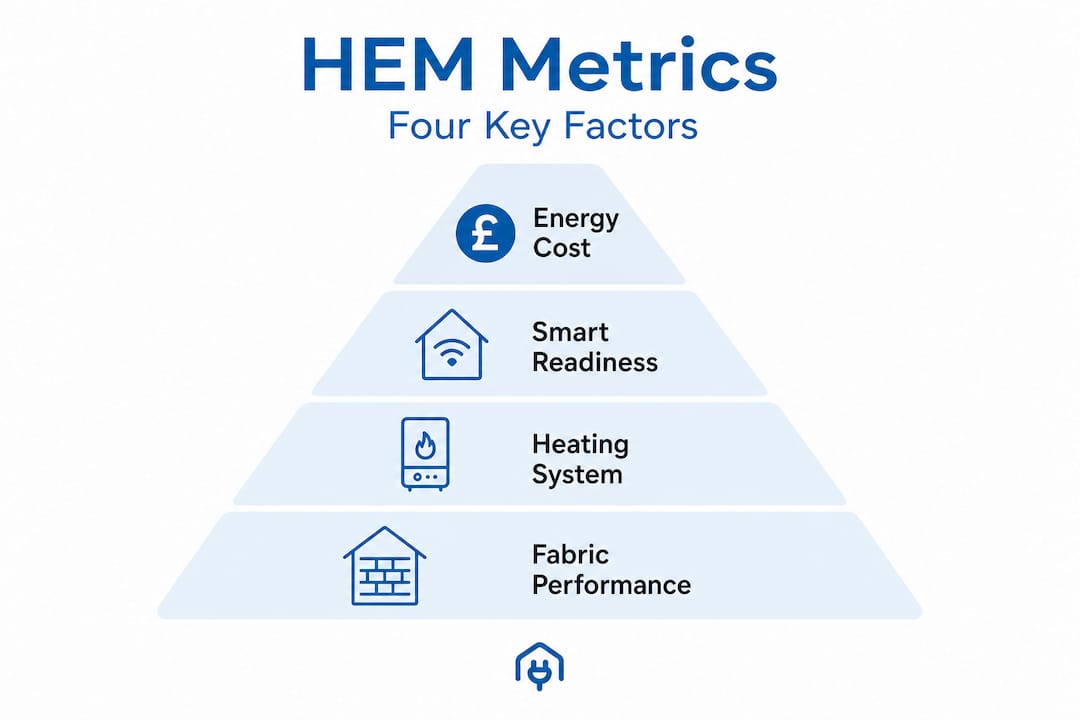
Understanding the four HEM headline metrics is not optional for landlords planning upgrades. Getting one metric into compliance does not guarantee the others will follow. Each metric stands alone, with its own A to G banding and its own C boundary as the likely compliance threshold.
The government has confirmed that HEM introduces fabric performance, heating system, smart readiness, and energy cost metrics, each with its own A–G banding and C boundary for compliance. That means four separate scores, four separate compliance thresholds, and four distinct areas where action may be required.
| Metric | What it measures | Key factors scored | Compliance target |
|---|---|---|---|
| Fabric performance | Thermal quality of the building envelope | Wall, roof, floor U-values; window glazing | Band C |
| Heating system | Efficiency of heating and hot water provision | Boiler/heat pump type, controls, age | Band C |
| Smart readiness | Capacity for smart controls and grid flexibility | Smart meters, thermostatic controls, automation | Band C |
| Estimated energy costs | Predicted annual running costs | All energy use under standard occupancy assumptions | Band C |
For navigating EPC changes under HEM, landlords need to move away from thinking in terms of a single improvement that “lifts” an EPC rating. In the old system, fitting a new boiler could tip a property from Band D to Band C. Under HEM, that same boiler upgrade improves your heating system metric but leaves your fabric, smart readiness, and cost metrics entirely unchanged.
The smart readiness metric deserves particular attention. Many properties, particularly older rental stock, will score poorly here even if heating and fabric are adequate. Smart thermostatic controls, compatible metering, and basic demand-response capability all feed into this score. For landlords managing modern city properties, this is rapidly becoming a differentiating factor, particularly when considering EPCs in London where tenant expectations around smart technology are higher.

The most important practical takeaway: Produce a baseline assessment across all four metrics before spending any money on upgrades. Without that baseline, improvement spending can be misdirected entirely.
How HEM analysis changes compliance: What landlords and owners must do differently
The shift to HEM demands a different compliance mindset. Under RdSAP, a single composite score meant a single improvement strategy. Under HEM, each metric requires its own diagnosis and its own targeted action.
The modular HEM system activates input simplifications as needed, not an all-or-nothing methodology. This means your assessment results will be more reliable, but it also means each failing metric points to a specific area of the property rather than generating a vague overall recommendation.
The government has also been clear that explicit standards for each metric, tied to higher MEES, will be set and accompanied by dedicated guidance for landlords and local authorities. This guidance has not yet been finalised, but the direction is unambiguous: multi-metric compliance is coming, and it will be enforced.
Here is a practical step-by-step approach for landlords and property owners preparing for HEM compliance:
- Commission a baseline HEM-compatible assessment. Understand your starting position across all four metrics before planning any works.
- Identify which metrics are currently below Band C. Some properties may only fail on one metric; others may fail on all four.
- Prioritise fabric improvements first. Wall insulation, loft insulation, and improved glazing have the widest knock-on impact, including reducing estimated energy costs.
- Assess heating system suitability. If a gas boiler replacement is due, consider whether a heat pump or hybrid system is appropriate given the fabric standard.
- Audit smart readiness. Installing a smart meter and programmable thermostatic controls is often low cost but can meaningfully improve this metric.
- Model projected costs against each metric. Targeted property energy assessments will show the cost-effectiveness of each intervention across all four dimensions.
| Compliance area | Common failing issue | Typical improvement action | Cost range (estimate) |
|---|---|---|---|
| Fabric performance | Uninsulated cavity walls, single glazing | Cavity wall fill, double/triple glazing | £500 to £6,000 |
| Heating system | Older G-rated boiler, no TRVs | A-rated boiler replacement, thermostatic valves | £2,000 to £4,500 |
| Smart readiness | No smart controls, outdated thermostat | Smart thermostat, smart meter installation | £150 to £600 |
| Estimated energy costs | Multiple failing metrics combined | Phased programme across all areas | Varies |
Pro Tip: Do not simply accept a single improvement quote from a contractor without first verifying which of the four HEM metrics it addresses. A well-intentioned upgrade may score well on one metric while leaving three others unchanged.
Understanding how energy use is measured under the new framework helps owners challenge assumptions embedded in improvement proposals and avoid over-spending on interventions that deliver minimal compliance benefit.
Benchmarking cost and improvement: Using data and surveys for sanity checks
Before committing budget to upgrades, it is worth anchoring expectations in real-world data. The English Housing Survey provides the most reliable national benchmarks currently available.
The English Housing Survey 2024 to 2025 reports the average SAP score in 2024 was 68, with a mean cost to reach Band C of £7,480 and a median cost of £8,648 per dwelling.
These figures provide a crucial reference point. If a contractor is quoting significantly above £10,000 for a straightforward cavity wall and boiler upgrade on a modest semi-detached property, that is a signal to seek a second opinion. Conversely, if a quote seems suspiciously low, it may not address all the metrics that matter.
Key practical uses of benchmark data:
- Sense-check upgrade proposals. Compare the total quoted cost against the national mean before signing any contract.
- Prioritise high-impact measures. Fabric improvements typically deliver the greatest cost reduction per pound spent.
- Plan phased investment. Not all measures need to be completed at once; a sequenced plan spread over two to three years can distribute costs while improving metrics progressively.
- Assess viability for rental yield. Landlords with multiple properties should model the aggregate cost against rental income projections for properties currently rated D or below.
Understanding the impact of energy policy on long-term property standards and compliance obligations is equally important. Properties that fall short of Band C under the new MEES requirements cannot legally be let, making upgrade investment a direct business necessity rather than an optional improvement.
The benefits of home energy storage are also worth factoring into the cost picture, particularly for properties with solar PV. Battery storage can reduce estimated energy costs, which feeds directly into the cost metric, and may also contribute to smart readiness depending on the technology installed. While upfront costs remain significant, falling battery prices are making this an increasingly viable option for forward-planning landlords.
Pro Tip: Ask your assessor to produce a sensitivity analysis showing how your estimated energy costs metric would change under different improvement scenarios. This allows you to optimise spending across all four metrics simultaneously rather than addressing each in isolation.
A fresh perspective on HEM and EPC: What most advice misses
Most guidance currently circulating on HEM focuses on the mechanics: what the four metrics are, what Band C means, and which upgrades are likely to help. That is useful as far as it goes. But there is a more important issue that receives far less attention.
The shift from a single score to four separate metrics creates a new category of risk: partial compliance. A property owner could invest £6,000 in a new heat pump, achieve Band B on the heating metric, and still fail to let the property legally because the fabric metric remains at Band D. Under the old system, that heat pump would likely have been enough to push the composite score over the compliance threshold. Under HEM, it is not.
This is a significant and underappreciated hazard for landlords managing older stock. Victorian terraces and inter-war properties frequently have solid walls, which are expensive to insulate. The fabric metric will be the hardest and costliest to move for this stock. Focusing on heating system upgrades first, which is the instinct for many landlords given boiler replacement familiarity, may deliver visible improvement in one metric while leaving the critical fabric metric untouched.
The greater robustness and accuracy that HEM aims to provide is genuinely valuable. However, greater granularity also means greater scope for assessment error or misclassification, particularly in the transition period when assessors are still building familiarity with the new methodology.
Property owners should not treat their first HEM-based EPC as unquestionable. Challenge any metric score that seems inconsistent with visible evidence. If a property has recently had cavity wall insulation installed, but the fabric metric still scores poorly, request an explanation of the assumptions used. Cross-referencing assessment outputs against the benchmark data discussed in the previous section is a sound discipline.
Understanding why energy modelling matters in this context helps owners engage more critically with their assessment results rather than simply accepting them at face value.
Take the next step: Home energy solutions made simple
The HEM transition creates a genuine window of opportunity for property owners and landlords who prepare early. Understanding the types of HEM models for landlords is the logical first step in identifying which assessment pathway fits your property portfolio. Whether you own a single buy-to-let flat or a large portfolio of mixed-tenure housing, the right model will clarify your compliance position across all four metrics and help you build a costed improvement plan.
For a broader grounding in how this methodology changes the industry, the full guide on how HEM impacts UK properties covers the regulatory timeline, assessor requirements, and practical implications in detail. Getting ahead of the 2026 compliance cycle now avoids the scramble and cost premium that last-minute upgrade projects typically carry.
Frequently asked questions
What are the four HEM headline metrics and their compliance boundaries?
The four headline metrics are fabric performance, heating system performance, smart readiness, and estimated energy costs, each with its own A to G banding and Band C as the likely compliance boundary under higher MEES requirements.
How does HEM differ from the old EPC scoring system?
HEM is modular with flexible input simplifications, replacing RdSAP’s single composite score with four separate metrics, each requiring its own compliance strategy rather than a single blanket improvement.
What is the typical cost to upgrade a UK home to EPC Band C?
According to the English Housing Survey, the mean cost to reach Band C is £7,480 per dwelling, with the median at £8,648, providing a useful national benchmark for budgeting upgrade works.
Will landlords receive specific guidance on the new HEM requirements?
Yes. The Government has confirmed it will confirm standards for higher MEES and publish dedicated guidance for landlords and local authorities once the consultation process is finalised.