
TL;DR:
- Heat pumps are cost-effective and reliable options for UK homes, with potential savings up to £650 annually.
- Proper installation, insulation, and system design are crucial for optimal heat pump performance and efficiency.
- Government grants and upcoming regulations make heat pump adoption increasingly advantageous for landlords and homeowners.
Many homeowners and landlords assume heat pumps are expensive to run and unreliable in the British climate. The reality is quite different. Government modelling shows a heat pump costs around £1,900 per year to run in a typical three-bedroom home, compared to £2,000 for a gas boiler, and households switching from oil heating can save up to £650 annually. Add the Boiler Upgrade Scheme grant and tightening energy regulations, and the financial case for heat pumps in 2026 is stronger than most people realise. This guide explains what heat pumps are, how they work, and what landlords and homeowners need to know before making a decision.
Table of Contents
- What is a heat pump and how does it work?
- Types of heat pumps in the UK: features and suitability
- Heat pump costs, savings, and grants: what to expect
- Heat pumps, regulations, and energy standards in 2026
- Common pitfalls, efficiency debates, and getting the most from your heat pump
- The uncomfortable truth about heat pumps in UK homes
- Enhance your home’s energy efficiency with expert support
- Frequently asked questions
Key Takeaways
| Point | Details |
|---|---|
| Heat pump basics | Heat pumps efficiently transfer heat and can replace traditional boilers in many UK homes. |
| Cost and grants | Government grants often cover a significant portion of installation and heat pumps can match or lower running costs versus gas or oil. |
| Regulation compliance | Heat pumps help landlords and homeowners meet new energy standards and avoid future penalties. |
| Avoid pitfalls | Proper sizing, installation, and upgrading home insulation are key to maximising efficiency and savings. |
What is a heat pump and how does it work?
A heat pump does not generate heat in the way a gas boiler does. Instead, it moves heat from one place to another, typically from the outside air or ground into a building. This distinction matters because moving heat is far more energy-efficient than creating it from scratch by burning fuel.
The core process works through a refrigerant cycle. The heat pump absorbs low-temperature heat from the environment, compresses it to raise the temperature, and then transfers that warmth into the home’s heating and hot water system. The refrigerant then expands, cools, and the cycle repeats. This process can deliver three to four units of heat for every one unit of electricity consumed, which is why heat pumps are classified as high-efficiency systems.
The main types available in the UK are:
- Air source heat pumps (ASHP): The most common type, extracting heat from outdoor air. Suitable for most UK properties and easier to install than ground source systems.
- Ground source heat pumps (GSHP): More efficient because ground temperatures are stable year-round, but they require significant outdoor space for ground loops and involve higher upfront costs.
- Air-to-air heat pumps: These deliver warm air directly into rooms via a fan unit. They are cheaper and simpler to install but cannot produce domestic hot water, making them unsuitable as a sole heating solution for most UK homes.
For most UK properties, air source heating is the practical starting point. Modern air source units operate effectively even when outdoor temperatures drop to minus fifteen degrees Celsius, which comfortably covers the vast majority of British winters.
Pro Tip: Before choosing a heat pump type, commission a proper heat loss calculation for the property. This calculation determines how much heat the building needs and ensures the system is correctly sized, which is the single biggest factor in whether a heat pump performs well.
Types of heat pumps in the UK: features and suitability
With a foundation in the basic workings of heat pumps, we can examine which types best suit different properties and needs across the UK.
Each heat pump type has distinct strengths and weaknesses depending on the property. The main categories are air source, ground source, and air-to-air, and no single option suits every situation.
Air source heat pumps are the dominant choice for UK residential properties. Installation requires only an outdoor unit and connection to the internal heating system, making it viable for most houses, flats with outdoor space, and many older properties. They are particularly effective in off-grid homes currently running on oil or LPG, where the running cost savings are most significant. The main limitation is that efficiency drops slightly during very cold spells, though modern units handle this far better than older models.
Ground source heat pumps deliver higher efficiency because the ground maintains a consistent temperature of around ten to twelve degrees Celsius year-round. This stability means ground source heat pumps can achieve higher seasonal performance figures than air source alternatives. However, installation requires either land for horizontal ground loops or depth for vertical boreholes, which rules them out for many urban properties and smaller gardens. The upfront cost is also considerably higher, often £20,000 to £35,000 before grants.
Air-to-air heat pumps suit specific scenarios where space heating is the priority and hot water is handled separately. They are more common in commercial settings or properties with underfloor electric heating for hot water. For most UK landlords managing residential property, they are not the primary solution.
| Heat pump type | Best for | Typical install cost | Hot water? | Efficiency (SPF) |
|---|---|---|---|---|
| Air source | Most UK homes, off-grid | £8,000 to £15,000 | Yes | 2.5 to 3.5 |
| Ground source | Rural, large gardens | £20,000 to £35,000 | Yes | 3.0 to 4.5 |
| Air-to-air | Space heating only | £3,000 to £8,000 | No | 3.0 to 4.5 |
Older homes can benefit from heat pumps, but they typically need improvements to insulation and possibly radiator upgrades first. Larger radiators or underfloor heating distribute heat more effectively at the lower flow temperatures that heat pumps operate at compared to gas boilers. Thinking about water heating efficiency alongside space heating is essential for a complete solution. For landlords reviewing their entire portfolio of energy efficient heating systems, the combination of insulation and heat pump technology tends to deliver the strongest EPC improvements.

Heat pump costs, savings, and grants: what to expect
Choosing the right type is only one part of the equation. It is vital to understand the real costs, savings, and financial support available for heat pump adoption.
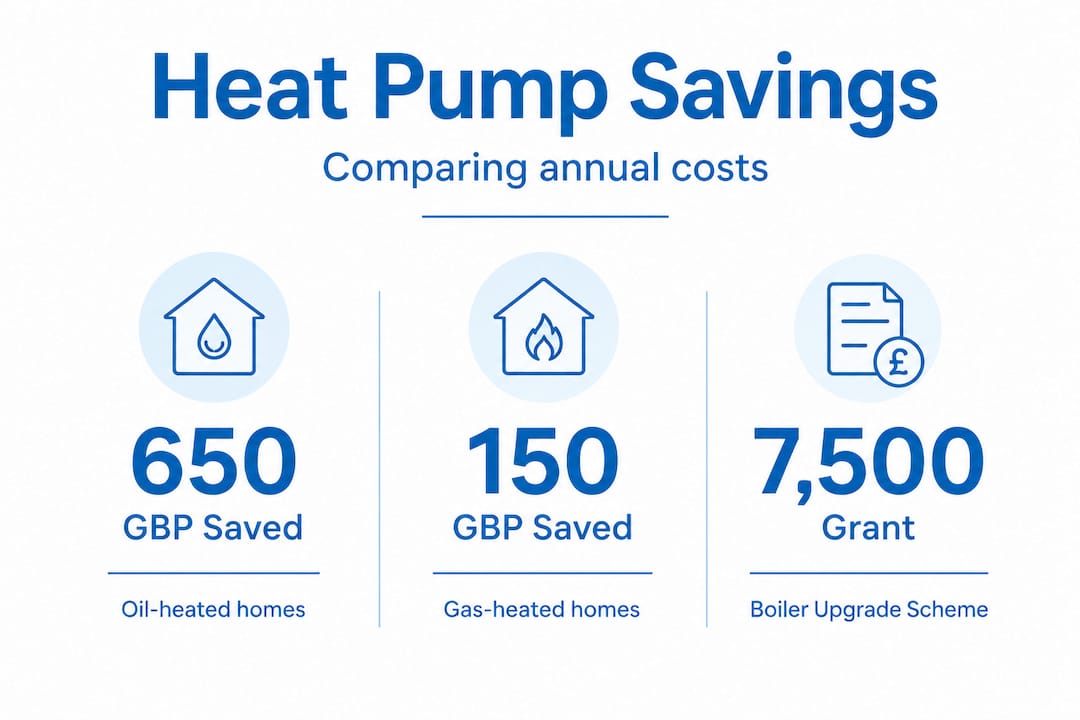
Running cost comparisons depend heavily on what fuel the heat pump is replacing. Government modelling shows that in a typical three-bedroom home, an air source heat pump costs approximately £1,900 per year to run, compared to £2,000 for a gas boiler. For homes currently on heating oil, the savings are more dramatic, with oil users saving around £650 per year by switching to a heat pump. Homes on LPG see similar or greater savings.
| Existing fuel | Estimated annual running cost | Heat pump annual cost | Estimated saving |
|---|---|---|---|
| Natural gas | £2,000 | £1,900 | £100 |
| Heating oil | £2,550 | £1,900 | £650 |
| LPG | £3,200+ | £1,900 | £1,300+ |
| Electric storage heaters | £2,800+ | £1,900 | £900+ |
The Boiler Upgrade Scheme provides a £7,500 grant in England and Wales for eligible air source and ground source heat pump installations. This grant runs until 2029/30, giving landlords and homeowners a firm window to plan upgrades. The grant is applied directly by the installer, reducing the upfront payment immediately rather than requiring a rebate claim.
Smart electricity tariffs, such as Octopus Energy’s Cosy Octopus tariff designed specifically for heat pump users, can further reduce running costs by allowing heat pumps to operate during cheaper off-peak periods. With these tariffs, heat pump running costs can drop below the gas boiler equivalent even without further efficiency improvements to the property.
Pro Tip: Combine the Boiler Upgrade Scheme grant with insulation improvements under the Great British Insulation Scheme where eligible. Doing both together maximises the return on investment and improves the EPC rating simultaneously, which matters for landlords facing upcoming Minimum Energy Efficiency Standards (MEES) deadlines.
Heat pumps, regulations, and energy standards in 2026
Beyond just cost and efficiency, heat pumps are increasingly central to keeping up with new UK energy law and regulation.
The regulatory landscape in 2026 makes heat pump investment increasingly logical for landlords, not just aspirational. Several key requirements and changes are now in motion:
- Boiler Upgrade Scheme: The £7,500 grant remains available for eligible properties in England and Wales through to 2029/30, supporting installations through MCS certified installers only.
- Future Homes Standard: New builds are already required to incorporate low-carbon heating under Part L regulations, effectively meaning heat pumps or equivalent systems for most new residential construction.
- Home Energy Model (HEM): The HEM is set to replace SAP in 2027 and will cap gas boilers at EPC band D on the heating metric. This is a significant shift. Properties with gas boilers will find it harder to achieve the EPC ratings needed for compliance.
- MEES regulations: The government has signalled tightening of Minimum Energy Efficiency Standards, with proposed requirements for rental properties to reach EPC C. Heat pumps are one of the most effective routes to achieving this.
- Permitted development rights: Planning rules have been relaxed to make it easier to install heat pumps without full planning permission, removing a previous barrier for many properties.
“Heat pumps enhance efficiency and compliance for UK homeowners and landlords via grants and low-carbon heating, aligning with net-zero, MEES, and HEM targets.” Why heat pumps are ideal for landlords seeking to future-proof their portfolio.
For landlords, the message is clear. Understanding MEES EPC regulations now and acting before the regulatory deadlines arrive will avoid the scenario of enforced upgrades under time pressure. Reviewing EPC ratings across a portfolio today makes it possible to prioritise which properties need heat pump installation most urgently.
Common pitfalls, efficiency debates, and getting the most from your heat pump
Regulations aside, getting value from a heat pump hinges on avoiding critical but common mistakes and knowing what actually works in practice.
The headline efficiency figures for heat pumps, often quoted as a coefficient of performance (COP) of 3 or 4, represent laboratory or optimal conditions. In real-world UK installations, measured seasonal performance factors average around 2.7 to 2.8, not 4. This matters because the economics of heat pumps versus gas boilers depend on achieving real-world efficiency, not marketing figures.
The most common reasons for underperformance include:
- Poor sizing: Installing a unit that is too large or too small relative to the property’s actual heat demand.
- Skipping the heat loss calculation: Without a proper room-by-room heat loss assessment, installers are guessing at system design. This is unfortunately common.
- Incorrect emitter choice: Keeping old, small radiators that were designed for high-temperature gas boiler systems. Heat pumps work best at lower flow temperatures, typically 35 to 45 degrees Celsius, which requires larger radiator surfaces or underfloor heating to distribute heat effectively.
- Inadequate insulation: A poorly insulated property forces the heat pump to work harder, which reduces efficiency and increases running costs.
- Poor controls: Without correctly set room thermostats and scheduling, even a well-installed heat pump will underperform.
The good news is that all of these pitfalls are entirely avoidable. Choosing an MCS certified installer, insisting on a heat loss calculation, and pairing the installation with fabric improvements all combine to produce a system that meets or exceeds projected efficiency. Guidance on meeting UK home standards provides a useful framework for what a compliant and high-performing installation should include. A comprehensive heating system guide can help landlords understand where heat pumps fit within a broader upgrade strategy.
Pro Tip: Ask any prospective installer for their in-situ performance data from previous installations. Reputable installers track and share real seasonal performance figures from their installed systems. This is one of the most reliable indicators of installer quality.
The uncomfortable truth about heat pumps in UK homes
The debate around heat pumps in the UK tends to run hot on both sides. Advocates point to transformative carbon savings and impressive COP ratings. Critics, citing real-world SPF figures closer to 2.7 than 4, argue that heat pumps are oversold and underperform compared to the marketing narrative.
Both camps are partially right, and that is the point most people miss.
The performance of a heat pump is determined far more by the quality of the installation and the condition of the property than by the brand on the unit or the technology itself. A well-sized, correctly installed heat pump in a well-insulated property will consistently outperform expectations. The same heat pump installed in a poorly insulated house with undersized radiators will frustrate its owner and confirm every sceptic’s critique.
What this means in practice is that the technology is not the variable. The preparation is. Landlords and homeowners who approach heat pump installation as a whole-house project, addressing insulation, radiators, controls, and system design together, consistently see the outcomes that the advocates promise. Those who treat it as a like-for-like boiler swap often do not.
Grants and regulatory change make heat pumps increasingly inevitable for UK properties, particularly those off the gas grid. But inevitability does not mean risk-free. The install stage is where the real work happens, and due diligence on installer quality and system design is not optional for those who want long-term savings and compliance. A good system guide for landlords can help structure that due diligence process effectively.
Enhance your home’s energy efficiency with expert support
Understanding heat pumps is the first step. Taking action on the right strategy for a specific property requires a more detailed look at the home’s energy performance. Homeenergymodel.co.uk offers guidance on home energy models that help landlords and homeowners assess which improvements will deliver the strongest EPC improvements and regulatory compliance. A professional energy assessment identifies exactly where a property stands against current and upcoming standards, making it straightforward to plan heat pump installation alongside insulation upgrades and other efficiency measures. For those new to EPC requirements, understanding EPCs provides a clear foundation before investing in any major upgrade.
Frequently asked questions
Are heat pumps suitable for older UK homes?
Yes, but older homes often need fabric upgrades such as improved insulation and larger radiators to maximise heat pump efficiency and achieve the best running costs.
Can heat pumps fully replace traditional gas boilers?
Yes, properly installed heat pumps can replace gas boilers and meet most UK home heating and hot water needs. The main heat pump types available in the UK, including air source and ground source, are capable of delivering full central heating and domestic hot water.
How much can UK homeowners save with a heat pump?
Savings depend on the existing fuel type. Oil-heated homes can save around £650 per year, while gas-heated homes see smaller savings that grow with smart tariffs and grants.
What grants are available for heat pumps in 2026?
The Boiler Upgrade Scheme offers up to £7,500 for eligible air source and ground source heat pump installations in England and Wales, available through to 2029/30 via MCS certified installers.
Why do some heat pump installations underperform?
Poor installation practice is the most common cause, including inadequate sizing, skipping heat loss calculations, and failing to upgrade radiators or insulation before installation.