

The government has moved the launch of reformed domestic Energy Performance Certificates (EPCs) in England and Wales from October 2026 to the second half of 2027. The delay affects the new-style certificate and the Home Energy Model (HEM) that powers it. It does not remove today’s EPC requirements, and it does not move the landlord deadline of 1 October 2030. If you own, let, build or assess property, the sensible response is to keep acting on the rules in force and to prepare for the new format.
TL;DR
- Reformed domestic EPCs, originally due in October 2026, are now planned for the second half of 2027 in England and Wales.
- Current EPCs, current ratings and the existing minimum standard of EPC E for rented homes continue to apply until then.
- The private rented sector deadline is still 1 October 2030 for EPC C-equivalent, with a £10,000 cost cap per property.
- The new EPC replaces one cost-based rating with four headline metrics, but keeps the familiar rating alongside them.
- Scotland has set its own later date: 30 April 2028.
Table of Contents
- What has been delayed, and why
- What the reformed EPC will look like
- What still applies while the reform waits
- The 2030 landlord deadline has not moved
- Commercial property
- Scotland has its own date
- What has changed over the last two years
- Will the new EPC rules become law?
- How to prepare now
- Our view on the delay
- Get an assessment while the current system applies
- FAQ
- Sources
What has been delayed, and why
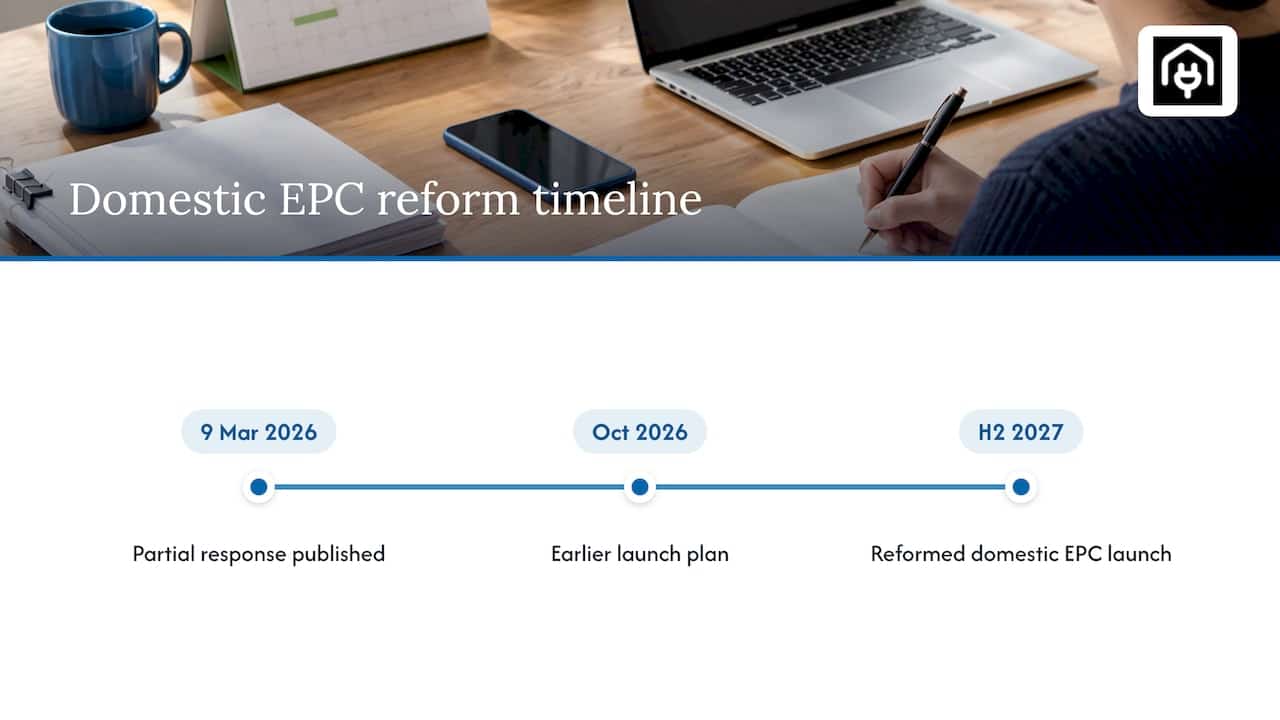
On 9 March 2026 the government published a partial response to its consultation on reforming the energy performance of buildings regime. It said that, following engagement with industry on the delivery timeline, it would move the launch of reformed domestic EPCs to the second half of 2027. The earlier plan was October 2026.
The reason given in the trade press was delivery, not direction. Property Week reported that the delay followed industry engagement on timing, including the training and upskilling of assessors. A technical manager quoted there called the original timetable optimistic and the delay a pragmatic step that gives stakeholders time to prepare.
The delay covers the new-style domestic certificate. It is not a decision to drop reform. The government has confirmed the content of the reform, and the work now is finalising the HEM and training the people who will use it.
What the reformed EPC will look like
Today a domestic EPC gives one headline result: an A to G rating based on energy cost. The government’s partial response confirms that reformed domestic EPCs will carry four headline metrics:
| Metric | What it tells you |
|---|---|
| Energy cost | The estimated cost of running the home |
| Fabric performance | How well walls, roof, floors and windows keep heat in |
| Heating system | How the heating system performs |
| Smart readiness | How ready the home is for smart, flexible energy use |
Secondary metrics will cover delivered-energy demand and carbon. The same response says the legacy Energy Efficiency Rating (EER) will stay on new domestic EPCs so that they can be compared with existing certificates and support compliance with current regulations. The ten-year validity period stays too.
The Home Energy Model is the calculation method behind the new certificate. It is the government methodology set to replace SAP (the Standard Assessment Procedure) for assessing a building’s energy performance, and it ties into the Future Homes Standard. For a plain explanation of how a rating is built, see our guide to EPC ratings.
Why four metrics
The Department for Energy Security and Net Zero (DESNZ) explains that the dual-metric standard for rented homes was designed to fix a specific problem: consumers are penalised for installing low-carbon heating such as heat pumps under a cost-only rating. It also gives landlords discretion to keep an existing heating system and reach the standard through smart measures such as solar panels. Solar with battery storage, for example a 12kWh hybrid inverter setup, is the kind of smart measure that this smart readiness metric is designed to recognise.
What still applies while the reform waits
The delay changes the format of the certificate, not the duty to hold one. Until reformed EPCs launch:
- Domestic EPCs are produced and lodged under the current system, and they stay valid for ten years.
- Landlords of privately rented homes in England and Wales must still meet the existing minimum of EPC E. The DESNZ response confirms this applies until the higher standard takes effect.
- Non-domestic buildings keep the existing headline metric, and the current non-domestic minimum remains EPC E.
A certificate is still required when a property is built, sold or let. If yours has run out or is about to, a domestic EPC assessment can be requested through our quote form. Properties that qualify for an exemption are covered in our EPC exemption guide.
The 2030 landlord deadline has not moved
The most common misreading of the delay is that landlords have more time. The government’s response to the privately rented homes consultation, published on 21 January 2026, sets one compliance date: 1 October 2030 for the EPC C-equivalent standard in England and Wales. The delay to the reformed EPC was announced afterwards, and Property Week notes that private landlords still face the 2030 deadline.
The main terms in that response are:
- Dual standard. A primary standard on fabric performance, plus a secondary standard on either heating system or smart readiness, at the landlord’s choice.
- Cost cap. Landlords must invest up to £10,000 per property, with an average estimated spend of £5,400. Spend on relevant measures since 1 October 2025 counts towards the cap.
- Exemption. If a property still falls short after the cap is reached, a 10-year cost cap exemption is available.
- Existing C ratings. A home graded C or above on the EER before 1 October 2029 is treated as compliant until that EPC expires.
The NRLA’s FAQ adds practical detail. Properties worth under £100,000 get a cap of 10% of value instead. Government grants generally count towards the cap, except Boiler Upgrade Scheme money. An EPC C obtained now, under either the current method or the HEM, stays valid for these purposes until it expires, which could keep a landlord compliant into the mid-2030s.
One point is still open. ReedSmith’s legal update notes that the effect of the delay on the timing of the residential minimum standards was unclear when it was written. Treat 1 October 2030 as the date to plan to, and check GOV.UK for any change.
For a fuller walk through of ratings for rented homes, see our EPC ratings guide for landlords.
Commercial property
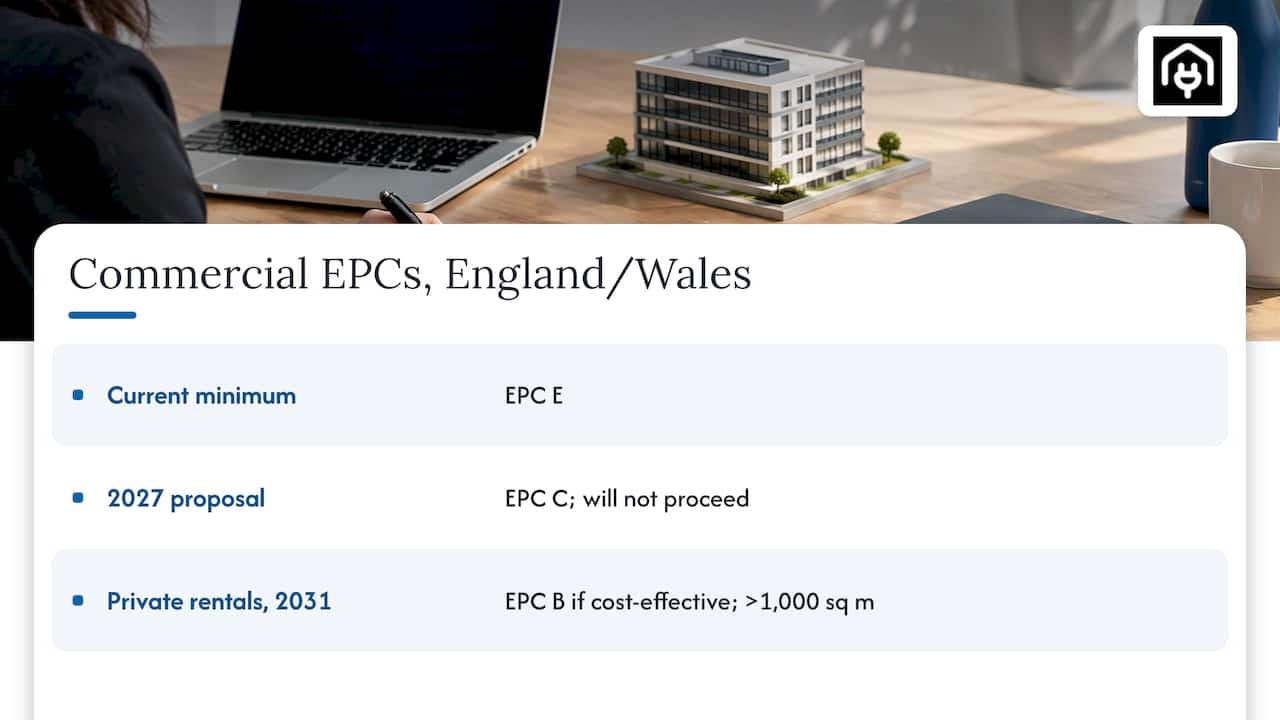
For non-domestic buildings the picture is different. The reform keeps the existing headline metric on non-domestic EPCs. On minimum standards, Cripps reported that the government’s interim response of 18 June 2026 confirms an intended standard of EPC B from 2031 for privately rented non-domestic buildings over 1,000 sq m in England and Wales where cost-effective. It also confirms that the current minimum remains EPC E and that a proposed interim EPC C milestone for 2027 will not go ahead.
Owners of commercial property should therefore keep certificates current and plan upgrades with 2031 in mind. Our commercial EPC page explains how to request an assessment, and TM44 inspections cover air conditioning systems where they apply.
Scotland has its own date
EPC policy is devolved, so Scotland does not follow the English timetable. The Scottish Government’s update of 27 August 2026 says the regulations for new-style EPCs, validity periods and rating systems will come into force on 30 April 2028 for domestic and non-domestic EPCs. Until then the 2008 Regulations and the current system remain in place. Between 30 April 2028 and 30 April 2029, properties sold or let may use either 2008-style or 2025-style EPCs, and short-term lets get a full one-year grace period.
The Scottish date comes from a shared implementation plan agreed with the UK Government and the assessor industry after the March 2026 announcement. That is useful for anyone with property in England and Scotland: the delay is a coordinated one, not a split.
What has changed over the last two years
The reform has moved in stages, and a short timeline helps separate what is settled from what is still a plan.
- December 2024 to February 2025. The government consulted on changes to EPCs, Display Energy Certificates and air conditioning inspection reports, as set out on GOV.UK.
- 15 June 2025. Per the NRLA, EPCs began using a more detailed assessment, and improvements are credited only if the assessor can see them or be shown evidence of them.
- 21 January 2026. The privately rented homes response set the 1 October 2030 date, the dual-metric standard and the £10,000 cap.
- 9 March 2026. The partial response confirmed four headline metrics and moved the reformed domestic EPC launch to the second half of 2027.
- June 2026. The interim response on non-domestic minimum standards pointed to EPC B from 2031 for larger privately rented buildings.
- 27 August 2026. Scotland set 30 April 2028 for its new-style EPCs.
The pattern is clear. The content and the end dates for landlords have been confirmed, while the launch of the new certificate has slipped.
Will the new EPC rules become law?
The reformed EPC is being delivered through the government’s reform programme, and the partial response confirms its content. The minimum standard for landlords is a separate step, which the government has set out as its intended policy for England and Wales. Because the exact legal route and timing can change, check the GOV.UK consultation pages for the latest position rather than relying on a summary. The timeline above gives the confirmed policy direction, not a guarantee of final legislation.
How to prepare now
The delay gives a window. These steps work whichever format applies when the certificate is renewed.
Landlords and property investors
- Check the current certificate. Look up each property on the government EPC register and note the rating and its expiry date.
- Sort by rating. Gamlins Solicitors advise that properties at C or above are well placed, particularly if a current-system C is secured before 1 October 2029, while D and below need a longer-term plan.
- Keep evidence. The NRLA recommends installer certificates, invoices, the boiler make and model, and photos of insulation, because improvements are credited only if the assessor can see or be shown them. Record spend from 1 October 2025 for the cost cap.
- Check grants before paying. The NRLA lists the Warm Homes: Local Grant in England, ECO4 for tenants on qualifying benefits with landlord consent, and the Boiler Upgrade Scheme at £7,500 for an air or ground source heat pump. Schemes have closing dates, so confirm the current terms on the NRLA’s guidance.
- Order a fresh assessment when work is done. A new EPC after upgrades records the improvement and secures the rating for ten years.
Our guide to improving a house’s energy rating and the energy saving technologies guide cover which measures usually raise a rating.
Homeowners
If you are selling, the new EPC format is expected from late 2027 and may present your property differently. A valid current EPC stays usable until it expires, so there is no need to wait for the new format. For a first-time explanation, start with EPCs explained.
Developers, assessors and consultants
New-build compliance work continues under current methods until the HEM is in place. SAP calculations, SBEM calculations for new commercial buildings, energy statements for planning and water calculations for Part G are all still needed on current projects. Design teams should expect the HEM and the Future Homes Standard to shape later specifications and plan fabric, heating and smart controls together.
Our view on the delay
The delay is easy to read as a reason to wait. We read it as a reason to get the basics right.
The headline score will change shape, but the inputs behind it are the ones property owners already control: insulation, heating, controls and the evidence that proves the work was done. A landlord with a clear record of upgrades and a current certificate is in a stronger position under either method.
For developers and consultants, the same logic applies. Current SAP, SBEM and water calculations remain the working tools, and the HEM sits behind the Future Homes Standard. Our job is to explain the changes in plain terms and to connect owners with assessors and inspectors who can carry out EPCs, TM44 inspections and Home Energy Model reports as the rules settle.
Use the extra time to prepare, not to pause.
Danny
Get an assessment while the current system applies
If a certificate is due, or you want a rating on record before the new format arrives, we can help you request one. Through our site you can ask for a quote for a domestic or commercial EPC, a TM44 inspection or Home Energy Model reports.

Start with the domestic EPC page or the commercial EPC page, or browse the full range from our homepage.
FAQ
When will the reformed EPC start?
The government has moved the launch of reformed domestic EPCs in England and Wales from October 2026 to the second half of 2027. It said a new launch date and shared implementation plan would be agreed with industry and the devolved administrations, so check the GOV.UK consultation page for the exact date. Scotland has set 30 April 2028.
Do I need a new EPC now?
Yes, if you are building, selling or letting and have no valid certificate. Current EPCs stay valid for ten years, and the government has confirmed it will keep the ten-year validity period for reformed EPCs. You do not need to wait for the new format.
Has the 2030 landlord deadline been delayed?
No. The 1 October 2030 date for EPC C-equivalent in privately rented homes in England and Wales was set in the January 2026 government response, before the March delay. The delay applies to the launch of the new-style certificate. Until 2030, landlords must still meet the existing minimum of EPC E.
Will my current EPC rating be replaced?
Not overnight. The government will keep the legacy Energy Efficiency Rating on new domestic EPCs for comparison with older certificates. An existing certificate remains valid until its expiry date, and an EPC C held before 1 October 2029 counts as compliant for rented homes until it expires.
Sources
- Reforms to the Energy Performance of Buildings regime, GOV.UK
- Partial government response, GOV.UK
- Improving the energy performance of privately rented homes, GOV.UK
- Government response on privately rented homes, DESNZ (PDF)
- Government pushes back EPC reforms to second half of 2027, Property Week
- EPC Reforms Update: Launch of new-style EPCs delayed, ReedSmith
- MEES update: Government interim response, Cripps
- Energy Performance Certificate Reform: updates, gov.scot
- Energy efficiency webinar FAQs on EPC C, NRLA
- EPC C by 2030: five ways to find the cheapest route, NRLA
- EPC reform: what landlords and homeowners need to know, Gamlins Solicitors