

The phrase “EPC contractor” has two meanings in the UK, and the right one depends on your project. In large-scale construction, EPC stands for Engineering, Procurement and Construction: one firm designs, sources and builds a complete facility under a single contract. In property, EPC more often means an Energy Performance Certificate, which a landlord, owner or developer needs when a building is built, sold or let. That certificate comes from an accredited energy assessor, not from a construction contractor. This guide explains both, so you appoint the right party. If your project needs a certificate, a SAP calculation or a TM44 inspection, a quote request to Home Energy Model is the practical next step.
TL;DR
- An EPC contractor in construction delivers engineering, procurement and construction under one contract, usually on energy, industrial and other large, complex projects.
- An Energy Performance Certificate for a home or commercial building can only be produced by an accredited energy assessor and lodged on the national register.
- Most landlords, homeowners and developers searching this phrase need the certificate, plus related calculations such as SAP, SBEM, water calculations or a TM44 inspection.
- If you are signing a true EPC construction contract, scope, performance criteria and variation rules need to be fixed before the price is.
- Home Energy Model takes quote requests for domestic and commercial EPCs, SAP and SBEM calculations, water calculations, energy statements, dynamic simulation modelling and TM44 inspections.
Table of Contents
- Two meanings of EPC, and why the search is confusing
- What an EPC contractor does in construction
- EPC contractor or EPCm: which model fits
- What to check before you sign an EPC construction contract
- How an EPC contractor differs from a main contractor
- The other EPC: the certificate your building needs
- Which service matches your situation
- Request a quote for your EPC or calculation
- Our perspective
- FAQ
- Sources
Two meanings of EPC, and why the search is confusing
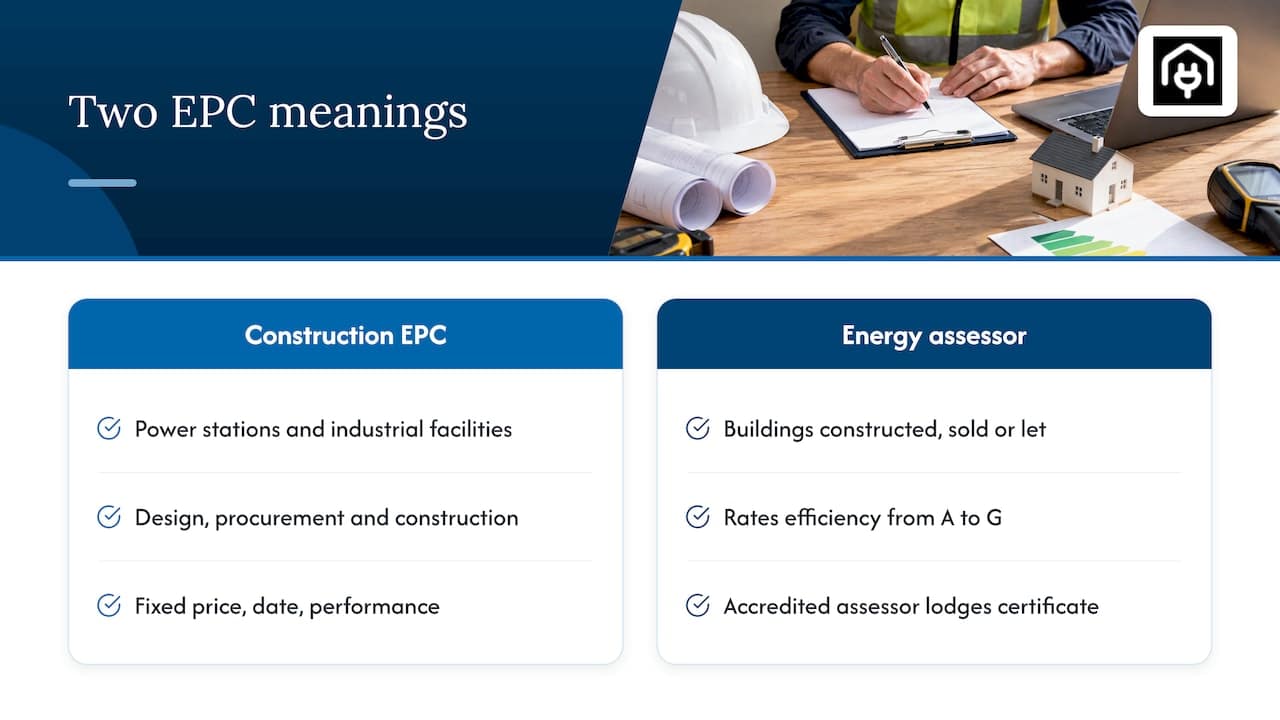
Search results for this phrase are dominated by the construction meaning. Engineering, procurement and construction contracts are used for power stations, wind farms, battery storage, chemical plants and similar facilities. The RICS guidance on contract selection describes them as a common private-sector form for large or complex projects, giving single-point responsibility for design, procurement and construction, with a fixed price, a fixed delivery date and guaranteed performance. It also treats them as a variant of design and build.
The second meaning is the one that affects most homeowners and landlords. An Energy Performance Certificate rates a building’s energy efficiency from A to G. Under the Energy Performance of Buildings (England and Wales) Regulations 2012, as summarised on GOV.UK, a property needs an EPC when it is constructed, sold or let. The certificate is valid only if an accredited energy assessor lodges it on the national Energy Performance of Buildings Register.
So the first decision is simple. If you are procuring a power plant or an industrial facility, you want an EPC contractor in the construction sense. If you are selling, letting or completing a building, you want an energy assessor. The rest of this guide covers both, starting with the construction role. Our own focus is the certificate, so that is where the practical steps end up.
For a fuller definition of the term in building projects, see our guide on what EPC stands for in construction.
What an EPC contractor does in construction
Under an EPC contract, one contractor takes the whole job from design to handover. NEC’s guidance on EPC contracts sets out the sequence: the contractor designs and plans the scheme to meet the client’s objectives, procures plant, materials and subcontracts, then constructs, tests and commissions the work. The result is a turnkey facility that meets a performance-based specification.
Procure’s UK guide splits the role into three phases:
- Engineering: feasibility studies, process-flow diagrams and value engineering.
- Procurement: sourcing in the UK and abroad, competitive tendering of subcontractors and supply-chain management.
- Construction: site coordination, health and safety, quality inspections and commissioning before handover.
The same Procore guide for the UK and Ireland adds that a UK EPC contractor must meet CDM 2015 duties, structural codes and the latest Part L energy targets during design, and that UK EPC contracts typically follow NEC4 ECC or bespoke JCT Design and Build forms.
Why owners choose the model
The appeal is risk transfer. Building magazine describes the aim as cost and risk certainty: an operational facility at a guaranteed price and programme, built to the owner’s performance requirements. The model is also favoured by project-finance lenders, which matters when a scheme depends on borrowed money. According to LexisNexis UK guidance, EPC is the most common procurement method for UK energy, large-scale and complex infrastructure projects.
Procore’s guide sums up the benefit as a single point of accountability. One contract replaces a string of separate appointments, which reduces administrative complexity for the owner. The trade-off is limited owner input once the contract is signed, so the specification has to be right on day one.
EPC contractor or EPCm: which model fits
You will often see EPCm alongside EPC. The “m” stands for management, and it changes who carries the risk.
| EPC contractor | EPCm contractor | |
|---|---|---|
| What it is | A construction contract: the contractor designs, builds and commissions | A services contract: the contractor manages design, procurement and construction supervision |
| Who hires trades and suppliers | The contractor | The owner, directly |
| Risk on design, budget and programme | The contractor | Mostly the owner |
| Overall completion date | Usually guaranteed | Rarely guaranteed |
| Typical lender view | Preferred | Harder to finance |
The distinctions come from Womble Bond Dickinson’s January 2026 analysis and a FIDIC paper by Loots and Henchie. The FIDIC authors explain that under EPCM the contractor acts as the owner’s agent and will not usually take responsibility for delivering the finished project by an overall date, so liquidated damages for overall delay are rare. They also note that the owner ultimately bears problems arising under the trade contracts, such as interfaces, delay and disruption.
The Womble Bond Dickinson article adds that a full EPC wrap is becoming harder and more expensive to secure on very complex projects, which pushes some purchasers toward EPCm. A 2024 energy storage report found a clear shift from EPC to EPCm in battery storage construction over the previous three years, though lenders still prefer the security of an EPC wrap.
What to check before you sign an EPC construction contract
These points apply to owners and developers on projects large enough to justify the model.
- Define scope and performance criteria first. Building magazine’s guidance is direct: EPC is unsuitable where these are not clearly defined, because a fixed price on a vague scope risks a poor-quality product.
- Decide how unforeseen risk is absorbed. Ground conditions are the usual example. The contract should say who carries them and how the price moves.
- Set out how variations are valued. Separate design development, which the contractor should absorb, from genuine changes in the owner’s requirements.
- Choose the form deliberately. NEC explains that the NEC4 Engineering and Construction Contract can serve as an EPC contract. Design responsibility can range from none to full, pricing options and secondary options set risk allocation, and project-specific “Z clauses” can be added.
- Check the contractor’s record and supply chain. The 2024 energy storage report notes that finding EPC partners with enough experience is a major challenge, and recommends supply-chain due diligence and, where useful, external design consultants to review the contractor’s designs.
- Agree roles early. Anesco’s chief executive, quoted in the same report, advises spending time on an initial dialogue with all parties before tenders are issued, and deciding early who takes responsibility for items such as long-lead transformers.
For regulated networks, Ofgem’s EPC contract principles for offshore transmission build tenders expect risk to sit with the party best able to manage it, with the contractor’s liability cap proportionate to the owner’s influence over construction. Projects of this size need a construction lawyer to draft the contract; the points above are a briefing list for that conversation.
How an EPC contractor differs from a main contractor
A main contractor typically manages only the build phase. An EPC contractor also takes engineering and sourcing under the same contract, according to the Procore guide. Under the CDM 2015 regulations, the HSE defines a contractor as anyone who directly employs or engages construction workers or manages construction work, including subcontractors and self-employed people. Whatever label the firm carries, contractors must plan, manage and monitor their work, make sure workers are competent, provide site induction and welfare, and coordinate with other contractors on multi-contractor sites.
A domestic extension or a small refurbishment does not need an EPC contract. A standard building contract is the normal route there, and the energy paperwork sits alongside it.
The other EPC: the certificate your building needs
If you are a landlord, homeowner or developer, the certificate is almost certainly your goal. It is a different job from construction, with a different professional.
According to the GOV.UK guide to EPCs for dwellings:
- Only an accredited domestic energy assessor may produce a home’s EPC. For a newly constructed building, it must be an accredited on-construction domestic energy assessor.
- Assessors must belong to a government-approved accreditation scheme, hold professional indemnity cover and act independently, declaring any conflict of interest.
- An EPC is valid for 10 years, and only the most recent certificate for a building unit counts.
- Most new buildings that comply with current Building Regulations achieve a C or B rating.
So a construction contractor cannot issue the certificate, however large the project. The person doing the building work does have a duty, though. Under regulation 7A of the 2012 Regulations, they must give the owner an EPC and tell the local authority its registration reference within five days of completion. Planning for that early avoids a delayed handover.
Existing buildings and new builds work differently
For an existing home, an assessor visits and surveys the property. Much of the construction detail is unavailable, so a reduced-data method fills the gaps with standard assumptions. For a new building, detailed plans and specifications exist, so the full SAP method (the Standard Assessment Procedure, the government’s calculation for home energy performance) is used instead, as the GOV.UK guide explains.
For new homes, the calculation is run at design stage and updated for any changes made on site. The final certificate is then lodged before Building Control will sign the project off. Developers who plan this with the design team avoid late surprises on a Part L (the Building Regulations section on conservation of fuel and power) result. Our guide to SAP calculations for UK property owners explains the process in plain terms, and the UK Building Regulations energy guide places it in the wider rules.
For commercial new builds, the equivalent calculation is SBEM, the Simplified Building Energy Model. Larger or more complex buildings can call for dynamic simulation modelling, which tests the design hour by hour.
Which service matches your situation
| Your situation | What you need | Page |
|---|---|---|
| Selling or letting an existing home | Domestic EPC | Domestic EPC |
| Selling or letting an office, shop or other commercial unit | Commercial EPC | Commercial EPC |
| Building new homes or converting to dwellings | SAP calculations, then the on-construction EPC | SAP calculations |
| Building a new commercial property | SBEM calculations | SBEM calculations |
| Complex design needing detailed testing | Dynamic simulation modelling | Dynamic simulation modelling |
| Planning application needing energy evidence | Energy statement | Energy statements |
| New dwellings under Part G | Water calculations | Water calculations |
| Building with air conditioning | TM44 inspection | TM44 inspections |
Two more points help landlords. Some buildings are exempt from needing a certificate, and our EPC exemption guide explains the register. In London, costs and the process have local features, covered in EPC costs in London.
A worked example
A developer is completing six flats in a converted office. The building contractor handles the works. The developer also needs a SAP calculation for each dwelling at design stage, water calculations for Part G, and an on-construction EPC for each flat before Building Control signs off. For a new-build buy-to-let, it is the developer, not the eventual buyer, who obtains that certificate. Treating this as a separate work package from week one keeps the handover date realistic. Calling it “the EPC contractor’s job” is where projects stall, because the building contractor is not the party who can lodge it.
Request a quote for your EPC or calculation
Home Energy Model takes online quote requests for domestic and commercial Energy Performance Certificates, SAP and SBEM calculations, dynamic simulation modelling, energy statements for planning, water calculations for Part G and TM44 inspections of air conditioning systems. Tell us the property type and what you need, and the request goes through our online form. Start from the domestic EPC page for a home or the commercial EPC page for a business property.

If you are unsure which assessment your project needs, the EPC services guide sets out what each one covers.
Our perspective
Most of the people who find us through this search are not building a power station. They own a flat to let, a house to sell, a small commercial unit or a development site, and they have been sent down the wrong path by a term that means two things.
Our view is that the certificate should be treated as its own work package, early. The energy assessment, the SAP or SBEM calculation and the water calculation all feed one another, and they sit alongside the building contract rather than inside it. Handled together, the numbers agree and the paperwork is ready when the building is.
That is why our site brings the rules, the calculations and the quote forms together: domestic and commercial EPCs, SAP, SBEM, dynamic simulation modelling, energy statements, water calculations and TM44 inspections. We aim to explain the regulations in practical terms for owners, landlords, developers and consultants, with step-by-step guidance for real UK compliance situations, in new construction and in retrofit.
If you are unsure whether you need a certificate, a calculation or a statement, start with the quote form and describe the property. That is a quicker route than working it out from contract jargon.
Danny
FAQ
What does EPC stand for in construction?
It stands for Engineering, Procurement and Construction. A single contractor is responsible for designing, sourcing and building a complete facility under one contract, and hands it over ready to operate. It is a different thing from an Energy Performance Certificate, which rates a building’s energy efficiency.
Who is a contractor in a building project?
Under CDM 2015, a contractor is anyone who directly employs or engages construction workers or manages construction work, including subcontractors and self-employed people. A main contractor typically manages the build phase. An EPC contractor takes engineering and procurement as well.
Can a building contractor issue an Energy Performance Certificate?
No. Only an accredited energy assessor can produce a valid EPC, and it must be lodged on the national register. For new buildings the assessor must be accredited for on-construction assessments. The person carrying out building work must give the owner the certificate and notify the local authority within five days of completion.
How long is an EPC valid?
An EPC is valid for 10 years, and only the most recent certificate for a building unit is valid. Check the register and your own certificate before a sale or letting, and request a quote for a new assessment when the date approaches.
What is the difference between EPC and EPCm?
Under EPC the contractor builds the project and takes the risk on design, budget and programme. Under EPCm the contractor provides management services and the owner contracts directly with trades and suppliers, keeping more of the delivery risk.
Sources
- RICS: Appropriate contract selection, 2nd edition
- GOV.UK: Energy Performance of Buildings Certificates, notes and definitions
- NEC: EPC contracts and NEC
- Procore: EPC contractor in construction, UK guide
- Building: Making the best of EPC
- LexisNexis UK: EPC, split EPC and multi-party contract projects
- Womble Bond Dickinson via Lexology: EPC or EPCM contracts
- FIDIC: Loots and Henchie on EPCM
- Tamarindo: Minimising risk in BESS construction
- Ofgem: EPC contract principles for OFTO build tenders
- HSE: Contractors, roles and responsibilities under CDM 2015
- GOV.UK: A guide to Energy Performance Certificates for dwellings