Home Energy Model for Existing Homes

HEMIE stands for Home Energy Model Input Expansion (also commonly referred to simply as the Home Energy Model for Existing Homes).
The government plans to introduce reformed domestic Energy Performance Certificates (EPCs) in England and Wales during the second half of 2027. Under the proposed changes, the certificate will provide a broader picture of a home’s energy performance, covering how effectively it retains heat, how well its heating system performs, how prepared it is to use smart energy technology, and what it could cost to run.
Together, these details are intended to show several different aspects of a property’s energy use, rather than focusing on a single measure. The information could help people understand how a home manages heat, the performance of its heating system, its readiness for smart energy technology and its potential running costs.
As of 27 November 2026, the published GOV.UK timetable sets out a launch window in the second half of 2027. It does not give a specific launch date, so the timing remains within that stated period. GOV.UK rollout timetable

What Are the Main Changes?
The Home Energy Model (HEM) provides a more detailed and flexible approach to assessing a property’s energy performance than the current SAP and RdSAP methodologies. Its more sophisticated calculations allow it to represent a property’s energy performance in greater depth, while offering flexibility in how that performance is assessed.
Despite the added complexity of its calculations, HEMIE is designed to make the data-collection process easier and more practical. It does this by using defaults where appropriate, automatically generating geometry, and inferring values wherever possible. These features are intended to reduce the amount of information that needs to be entered manually, while allowing the model to carry out a more detailed assessment.

Comprehensive Energy Calculations
HEMIE moves beyond monthly calculations by modelling energy performance at half-hourly intervals. Rather than treating a home’s energy use and performance as broadly consistent across a month, it can represent how conditions and activity change over the course of each day. This makes it possible to capture variations in energy demand, heating system performance, occupancy behaviour, renewable generation and electricity use at different times. By reflecting how these factors interact and shift throughout the day, HEMIE provides a more detailed and realistic picture of how homes perform in practice, helping reveal patterns that monthly averages may not show.
Property dimensions, layout, and shading
HEMIE uses significantly more detailed building geometry data than current RdSAP methodologies. Rather than relying on a relatively simplified description of a property, it can represent key building elements individually, allowing their geometry and characteristics to be described in greater detail.
This includes individual walls, roofs, floors, windows and doors. Each element can have its own orientation, pitch and dimensions, so the model can reflect differences in the way parts of a building are positioned and shaped. This more granular approach is particularly useful when a property has features that cannot be represented easily by a basic or uniform set of measurements.
HEMIE also supports more detailed modelling of complex building features, including rooms-in-roof, dormers, bay windows and conservatories. These features can be represented as distinct parts of the building, rather than being treated as simple extensions of the surrounding structure. This allows the geometry used in the assessment to better reflect the form and layout of the property.
In addition, HEMIE will provide more sophisticated calculations of solar gain and shading. These calculations will take account of the orientation and geometry of building elements, as well as obstructions that may affect the amount of sunlight reaching them. Such obstructions can include nearby or distant buildings, trees, balconies, roof overhangs and other shading features.
By combining more detailed building geometry with a broader consideration of shading, HEMIE will be able to model these aspects of a property in a more comprehensive way than current RdSAP methodologies.

Improved thermal modelling of fabric
Rather than relying primarily on assumptions associated with broad age bands, HEM can represent building elements using more specific information about their construction. Depending on the information available, this may include documented U-values, simplified descriptions of how an element is constructed, or detailed build-ups that describe its individual layers. This allows the model to draw on the level of evidence available for the building, rather than depending mainly on age as a proxy for construction performance.
HEM also provides a more detailed representation of thermal mass, solar absorption, and thermal bridging. These factors influence how heat is stored, absorbed, and transferred through the building fabric. Representing them more realistically can therefore support a more accurate assessment of the fabric’s effect on energy demand and indoor temperatures.
Walls separating a heated dwelling from an attached or integral garage will now be recorded as sheltered walls, with the adjacent space identified as a “garage.” This makes the relationship between the dwelling and the adjoining space explicit in the model and distinguishes these walls from those that directly face the external environment.
Heating and hot water systems
HEMIE provides more detailed modelling of heating and hot water systems, allowing assessments to represent a broader range of technologies and system components. In addition to conventional heating arrangements, assessments can consider technologies such as heat batteries, heat networks, smart hot water tanks and advanced controls. This wider scope makes it possible to describe more varied system configurations within the model.
The model also accounts for the way heat is distributed around a property and for components that can affect system operation. These include heat distribution systems, emitter characteristics, buffer tanks, thermal stores and primary pipework. Including these elements provides a more detailed representation of the heating system as a whole, rather than focusing only on the main heat-producing technology.
Heating emitters, including radiators and underfloor heating, are modelled in greater detail to support more accurate calculations of system performance. The model determines emitter characteristics according to their size and type, helping to distinguish between different kinds of emitters and configurations. This level of detail contributes to a more precise assessment of how the heating system operates.
Smart technologies, renewable energy, and increased flexibility
HEMIE enhances the assessment of low-carbon and smart technologies by allowing assessors to capture more detailed information about the systems installed in a home and how they are configured. For solar photovoltaic (PV) systems, this includes recording inverter specifications, alongside information about other relevant features such as battery storage, PV diverters and smart hot water systems.
By capturing these technologies in greater detail, the methodology better reflects the ways modern homes generate, store and manage energy. It also takes account of relevant limits on the amount of electricity that can be imported from or exported to the grid, helping the assessment represent these constraints as part of the home’s energy use and management.

Systems for Cooling and Ventilation
HEMIE offers a more comprehensive assessment of building performance by modelling cooling and ventilation systems in detail, alongside the range of factors that can contribute to overheating. This helps provide a more rounded picture of how a building may perform under different conditions, rather than considering individual systems or design features in isolation.
The methodology takes account of window-opening behaviour and shading, as well as the effects of thermal mass, infiltration, air permeability and trickle vents. Considering these factors together allows the assessment to reflect how ventilation, heat gain and heat retention can influence indoor conditions. It also provides a way to account for the contribution of both deliberate ventilation strategies and the characteristics of the building fabric.
Cooling systems can also be represented in the model. For example, air-conditioning and cooling heat pump systems can be assessed using performance-based inputs and system-sizing data. This enables the modelling to reflect information about the systems’ performance and capacity when evaluating their role in the building’s overall performance.
Lighting and Electrical Appliances
Within HEMIE, assessors record information about selected appliances present in each dwelling. This includes whether the dwelling has a dishwasher, a clothes-drying appliance, a separate fridge and freezer, and the fuel type used by the oven and hob. Recording these details allows the specified appliances and their fuel use to be represented in the assessment.
Appliances not included in this information are assumed to follow a standardised appliance profile. Assessors do not need to enter details for those appliances. Lighting energy use and associated heat gains are also calculated automatically by HEMIE, so no assessor input is required for these elements.

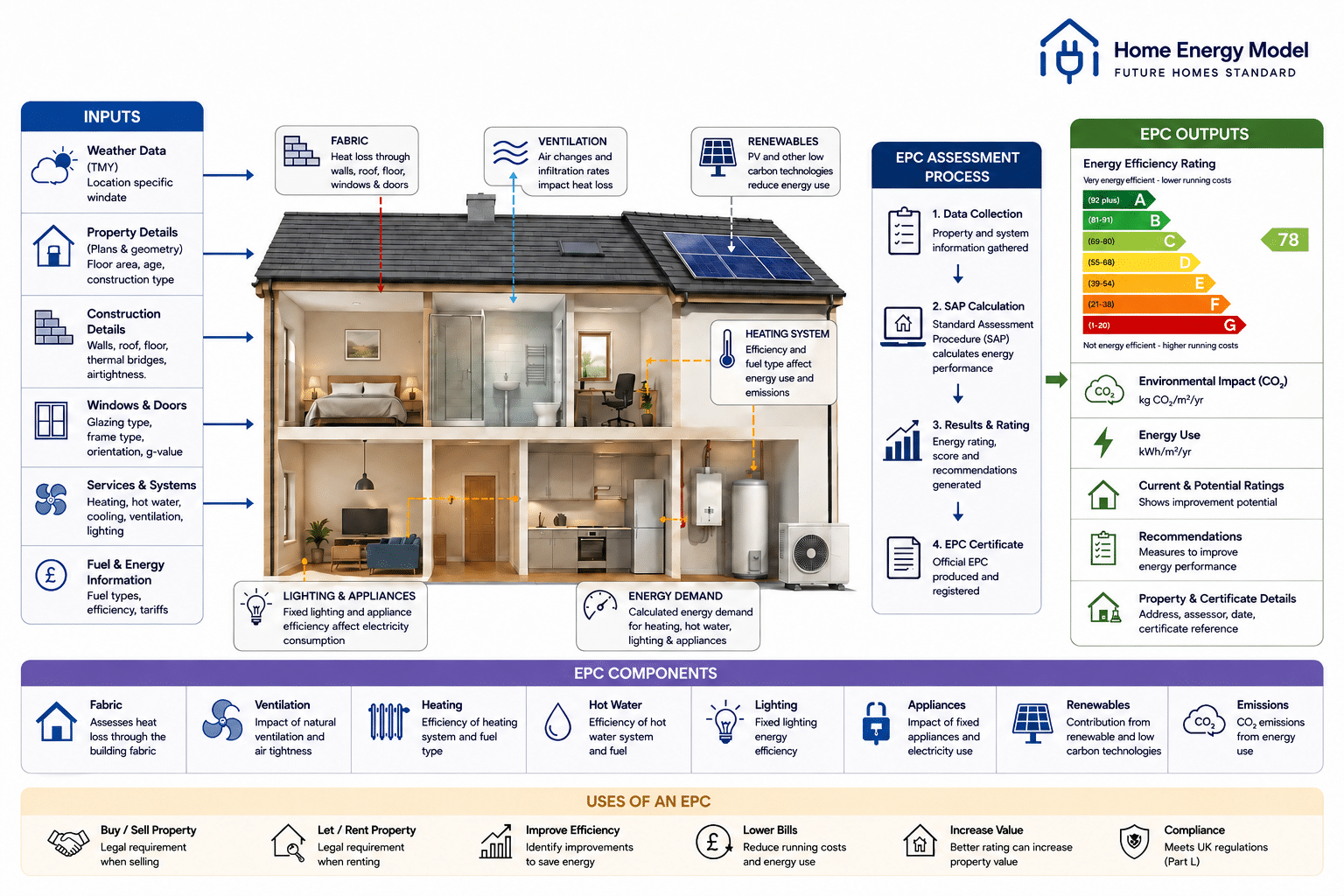
An HEMie (EPC) is required when selling or renting out a property in the UK.
When selling or renting out existing buildings, the seller or landlord must provide an Energy Performance Certificate (EPC) as soon as possible. This should happen at the latest when someone either requests information about the building or comes to view it. Additionally, the seller or landlord is required to provide a valid EPC, free of charge, to the person who ultimately becomes the buyer or tenant.
An HEMIE (EPC) is not required for certain residential properties.
EPCs are necessary for all sales or rental situations, with exceptions outlined on page 6 under “Situations where an EPC is not required.” However, not every transaction qualifies as a sale or lease. The following are some examples where EPCs are not needed:
– Lease renewals or extensions
– Compulsory purchase orders
– Share sales in a company that owns the buildings
– Lease surrender
– Stand-alone buildings under 50 square meters
– Places of worship
– Industrial sites and workshops
– Non-residential agricultural buildings with low energy demand
Here's a more detailed breakdown:
Property Assessment:
A qualified Domestic Energy Assessor (DEA) comes to visit the property.
During the visit, the DEA inspects both the interior and exterior of the property, taking measurements and noting the construction materials used.
They evaluate the heating system, hot water system, and any additional heating sources.
The assessor also examines insulation, windows, and lighting, paying special attention to any energy-saving features.
Data Collection:
The DEA gathers information on the property’s energy usage, size, and construction details. They might take photographs for their records and ask about the property’s history and any energy upgrades. If certain aspects, like insulation depth, aren’t visible, the DEA may need the homeowner to provide documentation.
Calculation and Rating:
We input the collected data into specialized software called (RdSAP) which calculates the property’s energy efficiency rating. From this, we generate the Energy Performance Certificate (EPC), which shows the rating, estimated energy costs, and suggestions for improvements.
Certificate Delivery:
The Energy Performance Certificate (EPC) is submitted to the central government register.
Homeowners usually receive a copy of their EPC through email or as a link to the register.
EPCs are valid for 10 years and can be used for various purposes, including selling or renting a property.
Essentially, the EPC offers a clear overview of a property’s energy efficiency, assisting both homeowners and potential buyers or tenants in understanding energy consumption and identifying areas for improvement.
Trouble-free EPC Service
Our EPC service is designed to make the process as seamless and hassle-free as possible. Our certified assessors will thoroughly evaluate your property, considering key factors such as insulation, heating systems, and ventilation. You’ll receive a detailed report outlining your property’s current energy performance, along with valuable recommendations for improving its efficiency.

How Do I Renewal An EPC Certificate
When it’s time to renew an Energy Performance Certificate (EPC), a qualified energy assessor should reassess the property. The assessment accounts for any changes made since the previous certificate, such as upgrades or improvements, which may affect its energy rating. An accurate, up-to-date EPC is especially important if you plan to sell or rent the property.
The renewal assessment is similar to the initial one. The assessor reviews features such as insulation, heating and cooling systems, windows, and energy use. They may also take into account energy-saving technologies or improvements that could improve the property’s rating.
Keeping your EPC current can help you meet legal requirements and give prospective buyers or tenants clear information about the property’s energy efficiency. A strong rating may also make the property more appealing, particularly because greater efficiency can mean lower energy bills.
Renewing your EPC is an important responsibility for property owners. It helps ensure the certificate reflects the property’s current energy performance and supports more sustainable energy use. A qualified assessor can carry out a thorough evaluation and issue an accurate certificate.

The benefits of investing in an Energy Performance Certificate. Not only does it help reduce energy consumption and lower your utility bills, but it also plays a significant role in promoting sustainability within our communities.
Domestic HEMie Quote