

TL;DR:
- An EPC contract consolidates engineering, procurement, and construction responsibilities into a single contractor responsible for delivering a completed facility on a fixed schedule and price. It provides high budget certainty and risk transfer, especially useful for large UK energy infrastructure projects requiring compliance with energy performance standards. Early legal and design engagement enhances project outcomes and ensures the facility meets statutory energy efficiency requirements.
An EPC contract is defined as a turnkey project delivery agreement in which a single contractor takes full responsibility for engineering, procurement, and construction, delivering a completed facility at a fixed price and on a fixed schedule. The term stands for Engineering, Procurement, and Construction, and it is the standard industry term used across energy, infrastructure, and large-scale building projects worldwide. For UK property owners, businesses, and developers working on energy infrastructure or compliance-driven construction, understanding what an EPC contract means is the first step towards managing project risk and regulatory obligations effectively.
What is an EPC contract and how does it work?
An EPC contract consolidates all three project phases under one contractor, who assumes responsibility for designing the facility, sourcing all materials and equipment, and completing the physical build to a defined performance standard. The owner receives a fully operational asset at the end of the process without managing multiple separate contracts or coordinating between different parties. This single point of accountability is the defining characteristic that separates EPC from most other construction delivery models.

The fixed price and fixed schedule structure means the contractor absorbs most of the technical and financial execution risk. If costs overrun or the project runs late, the contractor bears the financial consequences rather than the owner. This arrangement gives owners a high degree of budget certainty, which is particularly valuable in energy infrastructure projects where financing is tied to predictable cost models.
EPC contracts are used extensively across the UK in renewable energy developments, power generation facilities, water treatment plants, and large commercial construction projects. For businesses and property developers seeking compliance with UK building regulations and energy performance standards, the EPC contract model provides a structured path to delivery with defined performance obligations built into the agreement.
What are the key components of an EPC contract?
The three phases of an EPC contract are distinct but tightly integrated, and the contractor manages all of them as a single scope of work.
Engineering covers all design and planning activities. The contractor produces detailed technical drawings, specifications, and calculations that define exactly how the facility will be built. This phase also includes obtaining necessary permits and approvals, which in UK energy projects often involves compliance with Part L of the Building Regulations and relevant planning consents.
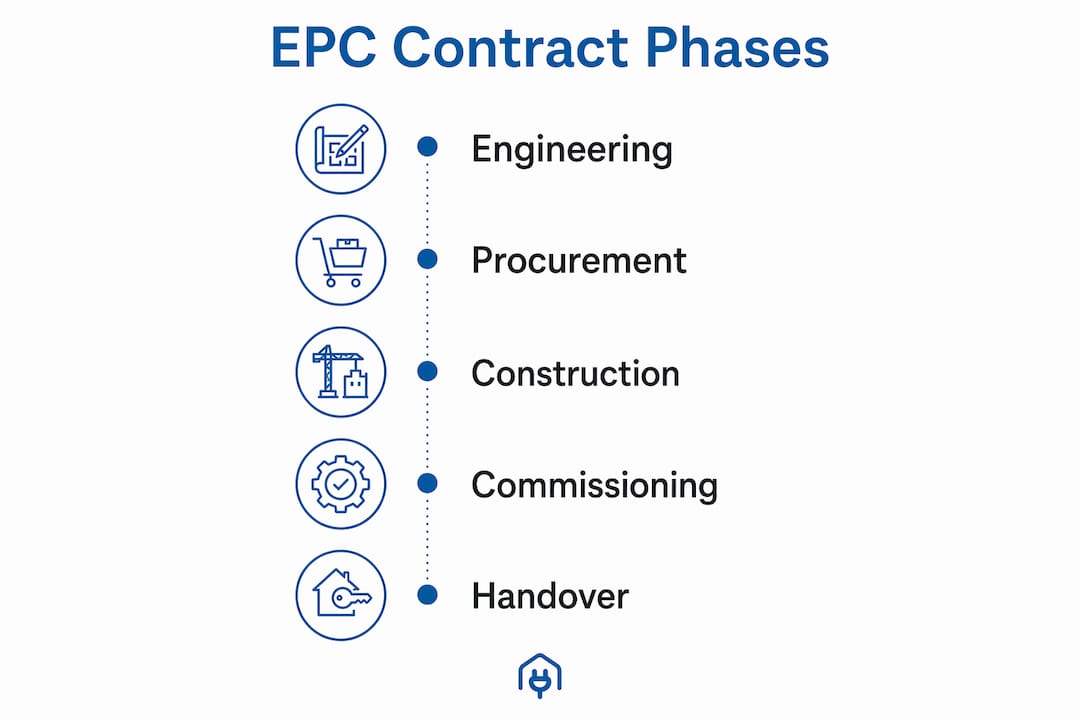
Procurement covers the sourcing and purchasing of all materials, equipment, and long-lead items. Long-lead items are components with extended manufacturing or delivery times, such as specialist electrical switchgear or large mechanical plant. Early procurement of long-lead equipment reduces the risk of construction delays and cost surprises later in the project.
Construction covers the physical build, installation, testing, and commissioning of the facility. The contractor hands over a fully operational asset that meets the performance standards defined in the contract.
Beyond these three phases, a well-structured EPC contract includes several protective provisions:
- Lump-sum fixed price: the total contract value is agreed upfront, giving the owner cost certainty
- Performance guarantees: the contractor commits to specific output or efficiency levels for the completed facility
- Performance bonds: financial instruments that protect the owner if the contractor fails to deliver
- Liquidated damages: pre-agreed financial penalties applied if the contractor misses milestones or fails to meet performance targets
- Post-completion warranties: ongoing obligations that protect the owner after handover
These key contract provisions define both the contractor’s obligations and the owner’s remedies, making the contract document itself a critical risk management tool. For a detailed breakdown of what EPC services typically include, Homeenergymodel provides a clear explanation of EPC services relevant to the UK market.
Pro Tip: Request a detailed performance guarantee schedule as part of the contract negotiation. Vague performance targets are one of the most common sources of dispute in EPC projects.
How does an EPC contract differ from EPCM and other models?
The most common source of confusion in construction contracting is the distinction between EPC and EPCM. EPCM stands for Engineering, Procurement, and Construction Management. The critical difference is who holds the construction contracts and therefore who carries the cost and schedule risk.
In an EPC contract, the contractor holds all subcontracts and bears the risk. In an EPCM arrangement, the owner holds the construction contracts directly, and the EPCM contractor acts as a management consultant rather than a delivery entity. This means the owner retains more control but also retains more risk. Owners who choose EPCM typically do so because they want direct oversight of subcontractors or because the project scope is too complex or variable for a fixed-price structure.
The table below summarises the key differences between EPC, EPCM, and the traditional design-bid-build model:
| Feature | EPC | EPCM | Design-bid-build |
|---|---|---|---|
| Risk holder | Contractor | Owner | Owner |
| Pricing structure | Fixed lump sum | Cost-reimbursable | Varies by package |
| Owner involvement | Low | High | High |
| Single point of accountability | Yes | No | No |
| Suited to | Budget certainty projects | Complex, variable scope | Smaller, defined projects |
Owners must distinguish EPC from EPCM before entering any major construction agreement, as the choice determines who carries cost and schedule exposure for the entire project duration. For UK businesses comparing construction contract options, the types of construction contracts available in the UK market provide useful context for this decision.
Pro Tip: If budget certainty is the primary objective and the project scope is well-defined, EPC is the stronger choice. If the scope is likely to evolve, EPCM may reduce contractual friction.
What are the primary risks and legal considerations?
EPC contracts carry significant commercial complexity, and owners who underestimate this complexity face real financial and legal exposure. Contract documentation can run to thousands of pages, covering detailed scope definitions, technical specifications, and numerous attachments. Misreading or overlooking key clauses leads to disputes, delays, and financial penalties.
The primary risks and legal considerations for UK owners include:
-
Pricing risk and contractor premium: EPC contractors charge a premium for risk absorption, particularly for design and construction risk. This makes EPC more expensive upfront than cost-reimbursable alternatives. Owners must assess whether the budget certainty justifies the additional cost.
-
Performance guarantee enforceability: Performance guarantees are only as strong as the drafting behind them. Vague or ambiguous performance targets create room for dispute at handover. Owners need clearly defined, measurable output standards written into the contract.
-
Liquidated damages and termination clauses: These provisions define the financial consequences of contractor failure. Poorly drafted liquidated damages clauses can be unenforceable under English law if they are deemed punitive rather than a genuine pre-estimate of loss.
-
Specialised legal counsel: Engaging construction legal counsel is not optional for EPC contracts of any significant scale. Solicitors with specific EPC experience will identify contractor contingencies, evaluate owner remedies, and negotiate protective provisions that a general commercial lawyer may overlook.
-
Front-End Engineering Design (FEED): The FEED phase occurs before the main EPC contract is awarded. Proactive owner involvement during FEED is critical to ensuring the contractor’s final output meets the owner’s specific performance and compliance targets. Owners who disengage during FEED often find the delivered facility does not meet their expectations.
How do EPC contracts relate to UK energy performance compliance?
In the UK, EPC contracts play a direct role in energy infrastructure development and in ensuring that completed facilities meet statutory energy performance requirements. The connection between EPC contracts and Energy Performance Certificates (EPCs) is not coincidental. Both share the same abbreviation because both are concerned with the performance of built assets against defined energy standards.
For UK property owners and businesses, the practical implications are as follows:
- EPC contracts used in the construction of commercial or residential buildings must deliver facilities that comply with Part L of the Building Regulations, which governs energy efficiency in new and refurbished buildings.
- The performance guarantees written into an EPC contract can and should reference specific energy performance targets, including SAP ratings or, from 2025 onwards, the new Home Energy Model (HEM) methodology.
- EPC contracts in UK energy projects support compliance with energy performance standards and help ensure properties meet legal requirements for energy efficiency certification.
- Landlords and property investors commissioning construction or refurbishment works under an EPC contract should specify minimum EPC ratings as a contractual deliverable, not merely an aspiration.
- Engaging qualified EPC assessors and energy consultants during the design and commissioning phases provides independent verification that the completed facility meets its contractual and regulatory obligations.
The impact of EPC ratings on UK property value and lettings compliance makes this connection increasingly significant for investors and landlords. A building that fails to achieve its contracted EPC rating may not only trigger liquidated damages under the construction contract but may also be unlettable under Minimum Energy Efficiency Standards (MEES) regulations.
Key takeaways
An EPC contract transfers design, procurement, and construction risk to a single contractor under a fixed price and schedule, making it the most owner-protective delivery model available for large-scale UK energy and infrastructure projects.
| Point | Details |
|---|---|
| Single contractor accountability | One entity is responsible for engineering, procurement, and construction from start to finish. |
| Fixed price carries a premium | Contractors charge more upfront to absorb risk; owners must weigh certainty against cost. |
| EPC differs fundamentally from EPCM | In EPCM, the owner holds construction contracts and retains cost and schedule risk. |
| Legal counsel is non-negotiable | Specialised construction solicitors are required to protect owner interests in complex EPC agreements. |
| Energy compliance must be contractual | UK owners should specify EPC ratings and energy performance targets as enforceable contract deliverables. |
Why early engagement defines EPC contract outcomes
Having worked across UK energy performance projects for a number of years, the pattern I see most often is owners treating the EPC contract as a handover document rather than a management tool. They sign the contract, step back, and expect a compliant facility to appear at the end. That approach consistently produces disappointment.
The FEED phase is where the real work happens. Early engagement during site selection and FEED improves cost accuracy and reduces regulatory risk in ways that no amount of contractual protection can replicate after the fact. Owners who invest time in defining precise performance specifications during FEED receive facilities that actually meet their energy compliance obligations. Those who leave specifications vague spend years in dispute resolution.
The other lesson I would offer is on legal due diligence. The pricing and completion clauses in an EPC contract carry the highest commercial stakes, and most owners do not read them with sufficient care. A solicitor who specialises in construction contracts will identify contractor contingencies that inflate the fixed price and negotiate owner remedies that are actually enforceable under English law. That investment pays for itself many times over on a project of any scale.
EPC contracts are genuinely powerful tools for UK energy and infrastructure projects. They work best when owners arrive at the table prepared, specific, and legally advised.
— Danny
How Homeenergymodel supports EPC contract clients
Homeenergymodel provides practical guidance on energy performance assessments, EPC ratings, and compliance with UK building regulations, including the transition to the Home Energy Model from 2025. For property owners, landlords, and developers working on projects governed by EPC contracts, understanding the energy performance requirements that sit behind those contracts is critical to achieving compliant delivery. Homeenergymodel’s resources cover energy performance certificates in London and the broader UK market, alongside guidance on home energy models for landlords seeking to meet MEES and Future Homes Standard obligations. Explore the site to find the guidance most relevant to your project.
FAQ
What does EPC stand for in a construction contract?
EPC stands for Engineering, Procurement, and Construction. It describes a turnkey contract model in which a single contractor is responsible for all three phases of project delivery under a fixed price and schedule.
Is an EPC contract the same as an Energy Performance Certificate?
No. An EPC contract is a construction delivery model, while an Energy Performance Certificate is a document rating a building’s energy efficiency. Both use the abbreviation EPC, but they refer to entirely different things.
Why is an EPC contract more expensive than other contract types?
EPC contractors charge a premium because they absorb the design and construction risk that would otherwise sit with the owner. This upfront cost reflects the risk transfer built into the fixed-price structure.
When should a UK business choose EPC over EPCM?
EPC is the stronger choice when budget certainty is the priority and the project scope is clearly defined. EPCM suits projects where the owner wants direct control over subcontractors or where the scope is likely to change during delivery.
Do EPC contracts need to reference UK energy performance standards?
Yes. UK owners commissioning construction under an EPC contract should specify compliance with Part L of the Building Regulations and, where applicable, minimum EPC ratings as enforceable contractual deliverables rather than general aspirations.