

The fastest way to save money on bills is to deal with the largest one first. For most UK households that is energy. Check the tariff, cut waste in how heating is used, fix the biggest heat losses in the home, and claim any support due. Then review the other regular outgoings one by one, starting with those that carry the most serious consequences if missed.
This guide sets out the steps in that order, with figures from official and charity sources, and notes for renters, landlords and small businesses.
TL;DR
- Energy is usually the biggest controllable bill. The Ofgem price cap for 1 October to 31 December 2026 is £1,723 for a typical household paying by Direct Debit, so small percentage savings are worth having.
- Free or cheap changes come first: lower the thermostat, manage heating controls, dry clothes without a tumble dryer, and check the tariff.
- Larger upgrades pay back over time. Energy Saving Trust figures put loft insulation top-ups at around £190 a year and professional draught-proofing at around £55 a year.
- Claim support first. The government has set out an average £150 off energy bills from April 2026 and a £150 Warm Home Discount for eligible households.
- If a bill cannot be paid, contact the supplier or creditor early. Priority bills come before credit cards and loans.
Table of Contents
- Start with a budget and a list of every bill
- Energy bills: the largest saving for most homes
- Claim the support available
- Other bills worth reviewing
- If bills are already hard to pay
- Renters: what can be done without owning the property
- Landlords and property investors: lower bills, stronger lettings
- Small businesses and commercial kitchens
- Our perspective
- Get an assessment before spending on upgrades
- FAQ
- Sources
Start with a budget and a list of every bill
Savings are hard to find when the figures are not written down. List every regular outgoing: rent or mortgage, council tax, gas, electricity, water, broadband, mobile, insurance and subscriptions. Mark which are fixed and which depend on use.
The need is real. ONS data from July 2026 show around 35% of adults in Great Britain expect to be unable to save any money over the next 12 months. About 26% reported being unable to cover an unexpected £850 expense in 2025. A household in that position gains most from reducing fixed costs that recur every month.
A simple routine works well:
- Collect the last three months of statements for each bill.
- Work out the monthly average for each one.
- Rank them by size. Energy, housing and food usually top the list.
- Pick two or three to tackle this month, rather than everything at once.
The same routine tells a household which bills are priority bills. That matters later if money becomes tight.
Energy bills: the largest saving for most homes
Energy suppliers charge by unit of gas and electricity used, and Ofgem caps the unit rates, not the total bill. Using less lowers the bill directly. The cap for the quarter from 1 October 2026 is £1,723 a year for typical use, and the figure is a benchmark, not a personal quote. A larger home, or one with poor insulation, will cost more.
Check the tariff and the payment method
Compare the current tariff with others from the supplier and the wider market. Fixed deals, time-of-use tariffs and Direct Debit arrangements all change what is paid. Use an Ofgem-accredited comparison service and have a recent meter reading ready. Take a reading before any switch so the final bill is accurate.
A smart meter helps with the next step. The Energy Saving Trust notes that smart meters let households track their usage and can help lower costs straight away.
Use heating more carefully
Heating is the largest part of most home energy use, so the biggest behavioural savings are here.
- Lower the thermostat by 1°C. The Energy Saving Trust figure for Great Britain is about £120 a year for this one change.
- Use timers and radiator valves. Heat rooms that are in use, at the times they are used. Installing full heating controls in an average semi-detached home is worth around £100 a year, according to the same source.
- Dry clothes without a tumble dryer where possible. A drying rack in a ventilated room costs nothing to run. Energy Saving Trust guidance on preparing for winter covers insulation and other seasonal steps worth checking each autumn.
- Switch off devices not in use. Standby loads are small individually but constant.
The Ofgem advice on saving money on your energy bill lists everyday actions alongside home improvements, and is a sound official reference for the rest.
Fix the biggest heat losses
Behaviour changes only go so far if heat leaks out as fast as it is made. The figures below come from the Energy Saving Trust and apply to Great Britain. Real savings depend on the home, the fuel and the prices at the time.
| Measure | Typical annual saving | Notes |
|---|---|---|
| Turn thermostat down 1°C | About £120 | No cost |
| Top up loft insulation to 270mm (from 0mm) | About £190 | Largest figure in this list |
| Full heating controls, average semi-detached | About £100 | Timer, room thermostat, radiator valves |
| Professional draught-proofing | About £55 | Gaps around doors, windows, floors |
| 80mm British Standard water tank jacket | Smaller, long-term saving | Low-cost, applies to hot water cylinders |
Do the cheap items first. Then move to those with the largest return per pound spent. Loft insulation usually leads that list for homes with little or none.
Use the EPC as a roadmap
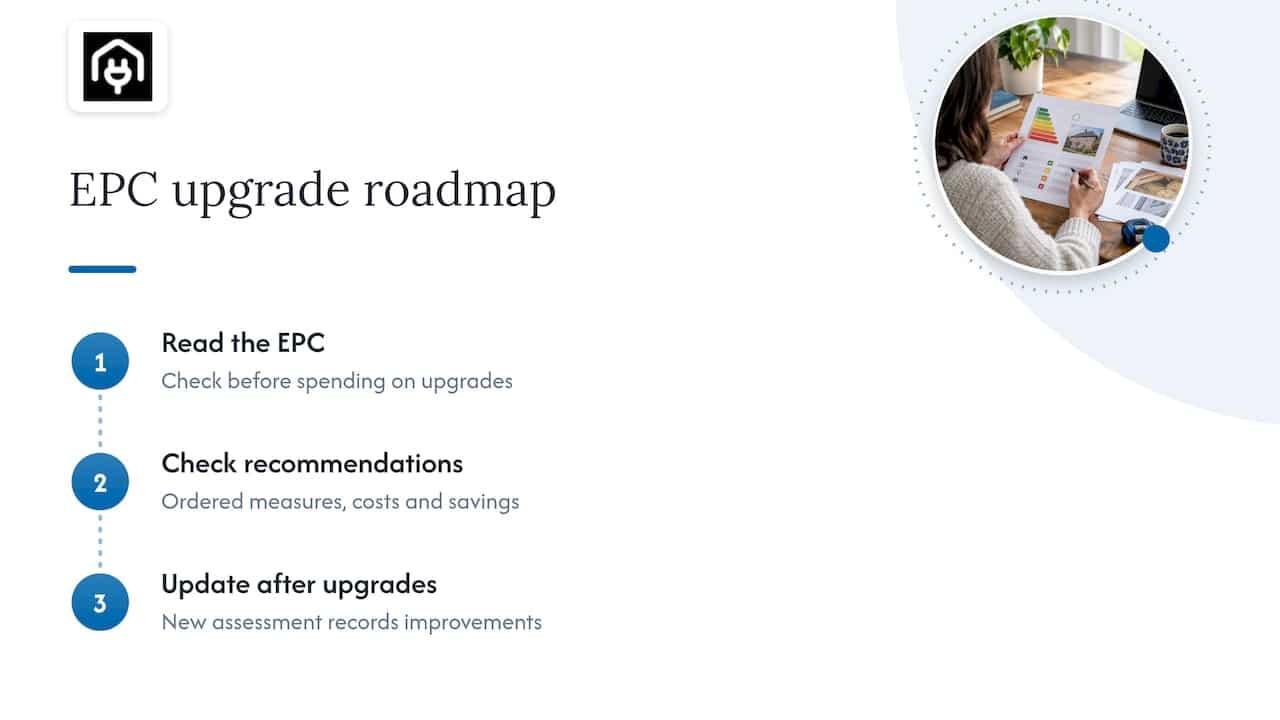
Before spending on larger upgrades, read the property’s Energy Performance Certificate. The Energy Saving Trust describes the EPC as a guide to which upgrades will give the most cost reduction for a particular property. The recommendations page lists measures in order, with indicative costs and savings.
An EPC lasts ten years, but a certificate that predates insulation, a new boiler or solar panels will understate the home. A new assessment records the improvements and gives a more accurate picture. A domestic EPC assessment from a qualified assessor can be requested online through our quote form. Homeowners who want a fuller walk-through of what the rating means can read the guide on understanding EPCs.
For more room-by-room measures, see these guides on smart energy efficiency tips for UK families and reducing home energy bills. The article on how to calculate energy savings for UK properties helps put a figure on each upgrade before committing money.
Claim the support available
Support changes with each Budget and each winter, so check the official page before assuming a figure. As of the government cost of living update from January 2026, two measures stand out:
- An average of £150 taken off energy bills from April 2026, applied through suppliers.
- The Warm Home Discount, worth £150 as a one-off for eligible low-income households.
The bill reduction is applied automatically, so no application is needed. The Warm Home Discount has eligibility rules, so check them on GOV.UK rather than waiting to be contacted. Some local areas also offer grants toward insulation. The Energy Saving Trust notes that, depending on where a household lives, money towards the cost of installation may be available, so ask the local council or an energy adviser.
Other bills worth reviewing
Energy is the biggest target, but the others add up.
Broadband, mobile and insurance
Contracts often roll onto higher prices when the initial term ends. Diarise the end date for each one. Contact the provider before it expires, ask for the best current deal, and be ready to compare alternatives. This takes a few minutes a year per contract and is among the least painful ways to save.
Council tax and water
Council tax discounts and reductions exist for some single-person households, students and people on low incomes, and councils have their own pages. Anyone who falls behind should contact the council early. Most councils offer a repayment plan; Newcastle City Council is one example and asks for the 12-digit council tax reference number from the bill.
How bills are paid
When buying appliances, insulation products or other larger household items online, the payment method matters. MoneyHelper explains that a credit card gives protection on purchases between £100 and £30,000, because the card provider shares liability with the seller under Section 75. Bank transfers offer far less protection. This only helps a household that clears the card balance in full each month, since interest would erase any benefit.
If bills are already hard to pay
Saving tips do not help when income does not cover the essentials. In that case the order of action matters more than any single tip.
Tell the supplier early
The Energy Saving Trust advises that anyone struggling should contact the supplier as soon as possible. Under Ofgem rules, suppliers must work with customers on a payment plan they can afford. Contact before arrears build, not after.
Know the priority bills
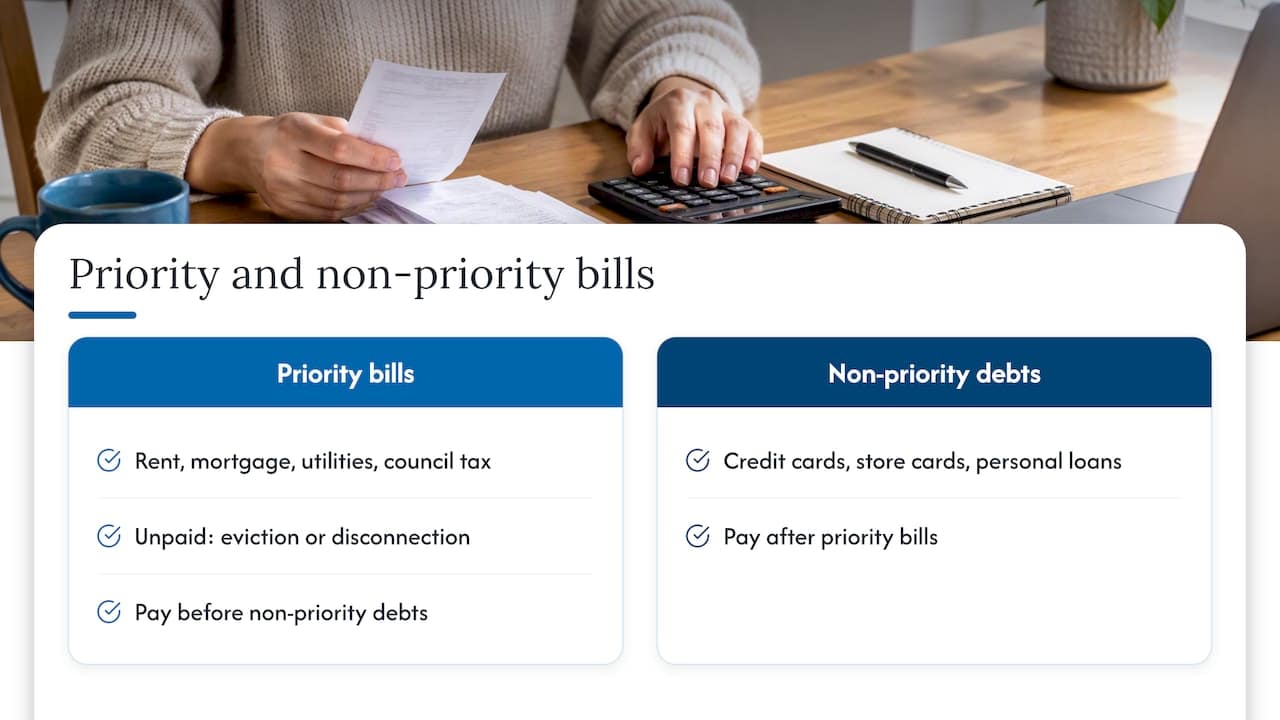
nidirect explains that priority bills include rent, mortgage payments, utility bills and council tax. These carry the most serious consequences for non-payment, including eviction or disconnection. They should be paid before non-priority debts such as credit cards, store cards and personal loans. The same guidance starts with a full list of everything owed and to whom, then sorting the debts into priority and non-priority.
Savings or debt first
MoneyHelper guidance says a cushion of three to six months of essential outgoings is a general rule of thumb. It also advises tackling high-cost debt, such as credit card balances, unarranged overdrafts and payday loans, before building a large emergency fund. A small starter buffer is still sensible. The MoneyHelper page on how much to save suggests saving regularly at a level that is affordable. An overdraft should be used for short-term borrowing or emergencies only, and managed like any other debt.
For debt that is beyond a household’s means, free debt advice services such as StepChange can help negotiate manageable payment plans, without the need for a paid debt management company.
Renters: what can be done without owning the property
Renters often assume that energy bills are out of their hands. The home’s insulation and heating system are the landlord’s responsibility, but a lot of the bill depends on use. Practical steps that need no permission include:
- Setting washing machines and dishwashers to eco modes.
- Using heating controls to heat only occupied rooms at set times.
- Fitting removable, non-invasive draught-proofing, such as door brushes or window film.
- Taking regular meter readings and checking the tariff, since the tenant usually holds the energy contract.
For larger work, ask in writing. The Energy Saving Trust notes that improvements raise a property’s value and help retain tenants, so landlords have their own reasons to invest. Landlords may need to meet a minimum EPC standard to let a property, and future requirements are expected to be tougher. Tenants can ask to see the EPC before signing, and can use its recommendations when making the case for upgrades.
Landlords and property investors: lower bills, stronger lettings
For a landlord, energy efficiency affects rent, void periods and compliance. A property with a better rating is cheaper for the tenant to heat and easier to let. The EPC exemptions and regulations guide explains when a property may be exempt and when it is not, and the overview of home energy models for landlords shows how different assessment methods apply.
If a portfolio includes buildings with air conditioning, a TM44 inspection may also be required for compliance. Efficient systems also cut running costs.
Small businesses and commercial kitchens
Business energy contracts differ from domestic ones, and the price cap does not apply in the same way. Commercial premises can start with a commercial EPC to see where energy is going. For kitchens, equipment settings matter. One supplier’s article explains how eco mode on combi ovens can reduce running costs in professional kitchens. The figures there are the supplier’s own, so test them against real usage.
Our perspective
We see the same pattern in the enquiries that reach us. Most households look for a single trick, and most savings come from a sequence. Fix the tariff, then the habits, then the fabric of the building, and use the EPC to choose the order. Skipping the EPC is the common mistake. People buy a measure they have heard about, when the certificate would have pointed to a cheaper one with a bigger effect on their particular home.
We also think the debt advice matters as much as the energy advice. A household that cannot pay a priority bill needs a plan and a conversation with the creditor before it needs a new boiler. Our role is information and, where a property needs it, connecting owners with qualified assessors through our quote forms. The energy efficiency of the building is the part of the household budget that keeps working year after year.
— Danny
Get an assessment before spending on upgrades
An accurate EPC shows which improvements suit a property and gives landlords the certificate they need to let. Property owners can request a quote for a domestic EPC or a commercial EPC, and developers can ask about SAP calculations for new builds. Prices are quoted per property, so the form is the place to start. More general reading is on our home page and in the guide to how to save money on gas and electricity bills.
FAQ
What is the quickest way to cut an energy bill?
Turn the thermostat down by 1°C and use timers and radiator controls so only occupied rooms are heated. The Energy Saving Trust puts the thermostat change at about £120 a year in Great Britain. Then check the tariff and take a meter reading before any switch.
Is it better to save or pay off debt first?
High-cost debt, such as credit cards, unarranged overdrafts and payday loans, usually costs more than a savings buffer earns, so MoneyHelper advises repaying it first. A small emergency fund is still worth building alongside. Priority bills such as rent, mortgage, utilities and council tax come before any non-priority debt.
Can renters save money on energy bills?
Yes. Renters control how heating and appliances are used, usually hold the energy contract, and can fit removable draught-proofing. For insulation or heating upgrades, they can ask the landlord in writing and point to the EPC recommendations.
What help is there with energy bills in 2026?
The government has set out an average £150 reduction on energy bills from April 2026, and a £150 Warm Home Discount for eligible low-income households. Check GOV.UK for current eligibility, because schemes change. Anyone struggling should also contact their supplier, which must agree an affordable payment plan under Ofgem rules.
Does an EPC help me save money?
It does not cut bills itself, but it lists the upgrades suited to the property and their likely savings. That helps prioritise spending, so money goes on the measures with the best return first.
Sources
- Ofgem price cap from 1 October 2026 (E.ON Next summary)
- Help with the cost of living in 2026, GOV.UK
- ONS, Public opinions and social trends, Great Britain: July 2026
- How to improve your EPC rating, Energy Saving Trust
- Help with your energy bills, Energy Saving Trust
- Five things to prepare your home for winter, Energy Saving Trust
- Save money on your energy bill, Ofgem
- Dealing with debt problems, nidirect
- Reduce borrowing on credit, MoneyHelper
- How much to save for an emergency, MoneyHelper
- Overdrafts explained, MoneyHelper
- Shopping and paying safely online, MoneyHelper
- Make an arrangement to pay, Newcastle City Council