

TL;DR:
- Floor plan energy modelling under the Home Energy Model provides more accurate EPC ratings by simulating energy performance with detailed, verified data. This shift emphasizes dynamic, half-hourly calculations, increasing compliance reliability and closing the performance gap in UK properties. Proper preparation and expert guidance are essential to meet the evolving data demands and achieve optimal energy compliance outcomes.
The Home Energy Model will replace SAP and RdSAP as the standard methodology for EPC assessments in England and Wales, and floor plan energy modelling sits at the heart of this shift. For UK property owners and investors, this is not a distant regulatory concern. The data requirements under the new framework are significantly more demanding than anything SAP required, and properties that are unprepared now face costly redesigns later. This guide covers what floor plan energy modelling involves, how to prepare your property data, how to carry out the modelling process, and how to interpret the results for compliance.
Table of Contents
- Understanding floor plan energy modelling and its importance
- Preparing your floor plan for energy modelling
- Step-by-step process to create a floor plan energy model
- Common challenges and how to avoid them in floor plan energy modelling
- Verifying and interpreting your energy model results
- Why floor plan energy modelling is a game changer for UK property owners
- Explore expert resources and solutions for floor plan energy modelling
- Frequently asked questions
Key Takeaways
| Point | Details |
|---|---|
| Importance of floor plan modelling | Accurate floor plan energy modelling is essential to meet upcoming UK Home Energy Model regulations and avoid compliance risks. |
| Data preparation is critical | Gathering detailed and precise property data is a key step to successful energy modelling and avoiding costly errors. |
| HEM transforms compliance | The Home Energy Model’s dynamic and modular simulation approach offers deeper insights but demands more rigorous inputs. |
| Interpreting EPC metrics | Understanding the four new EPC headline metrics helps property owners prioritise effective energy efficiency improvements. |
| Utilise expert resources | Professional guidance and UK-specific resources can simplify compliance and improve property energy performance outcomes. |
Understanding floor plan energy modelling and its importance
Floor plan energy modelling is the process of digitally simulating a property’s energy performance using its physical layout, construction details, and building services as inputs. The result is a calculated picture of how energy flows through a building across time. Under the Home Energy Model (HEM), this process becomes considerably more precise than it was under SAP.
The core difference lies in how each methodology calculates energy use. SAP relied on monthly average calculations, which smoothed out peak demand and behavioural variation. HEM uses half-hourly dynamic simulation, which means it models a property’s energy performance across thousands of time intervals throughout the year. This level of granularity demands much more detailed input data, and it produces results that far more accurately reflect how a building actually performs.
For UK property owners, the compliance stakes are real. Properties being assessed for EPCs under HEM will need to meet updated thresholds across four distinct performance metrics. A floor plan that has not been modelled accurately, or that has been assessed using assumptions rather than verified data, risks receiving a lower EPC band than the property actually warrants. That has direct consequences for lettings compliance, mortgage eligibility, and resale value. Understanding why use energy modelling is no longer an academic question for property professionals.
Key characteristics that distinguish HEM-based floor plan energy modelling from previous approaches include:
- Dynamic time-step simulation rather than monthly static calculations
- Site-specific inputs including shading from neighbouring structures and local climate data
- Full heating system detail rather than broad system type classifications
- Fabric performance data at element level, including thermal bridging
- Renewable energy integration covering solar PV output, battery storage, and heat pump coefficients
- Occupancy and behavioural modelling based on standardised profiles rather than averages
Each of these factors plays a direct role in the final EPC output. Getting them right from the outset is the most efficient way to protect your compliance position.
Preparing your floor plan for energy modelling
Before modelling can begin, you need to prepare detailed and accurate floor plan data. This is the stage where most property owners either invest the time to get it right or create problems that surface later in the assessment process.

HEM requires extensive new data points including shading details, window g-values (a measure of solar energy transmittance), heating system specifics, solar PV specifications, and battery storage parameters. Many of these were entirely absent from SAP assessments, which means existing property records are often insufficient as a starting point.
The following data types are essential for preparing an accurate HEM floor plan:
- Floor plan dimensions verified by measurement, not taken from estate agent listings
- Construction details for walls, floors, and roofs including U-values (the rate of heat transfer through a building element) where known
- Window and door specifications including frame type, glazing type, and orientation
- Shading analysis covering overhangs, neighbouring buildings, and trees
- Heating and hot water system details including boiler efficiency ratings or heat pump performance data
- Ventilation type and any mechanical ventilation with heat recovery specifications
- Renewable energy installations with panel area, orientation, and tilt angle
| Data category | Minimum requirement | Preferred evidence |
|---|---|---|
| Floor plan dimensions | As-built drawings or measured survey | Verified architect’s drawings |
| Wall construction | U-value or construction type | SAP worksheet, build specifications |
| Glazing details | Glazing type and orientation | BFRC certificate or manufacturer data |
| Heating system | System type and fuel | Boiler passport or heat pump data sheet |
| Solar PV (if present) | Panel area and orientation | Installer certificate or MCS documentation |
| Shading | Site description | Horizon angle survey or digital shadow study |
Pro Tip: Commission a measured survey of your property before engaging an assessor. Inaccurate dimensions are one of the leading causes of resubmissions under HEM, and the cost of a measured survey is far lower than that of a failed assessment.
Collaborating with a qualified energy assessor early in this process pays dividends. Assessors who specialise in HEM can identify data gaps before submission and advise on the level of evidence required for each input. Reviewing energy modelling best practices before your first engagement with an assessor will help you arrive at that conversation prepared. For further background on how simulation works in residential contexts, the energy simulation housing guide provides a useful reference.
Step-by-step process to create a floor plan energy model
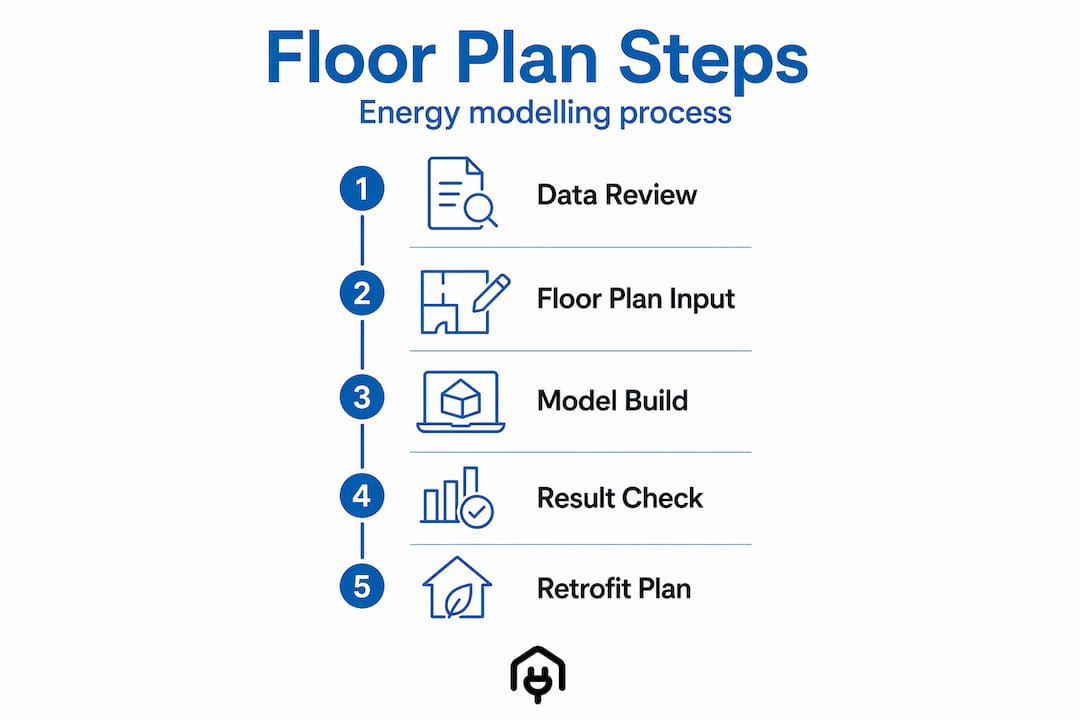
With your data prepared, the floor plan energy modelling process follows a clear sequence. HEM uses a modular approach allowing assessors to input data with flexibility, balancing the level of detail entered against the evidence available. This modularity is useful but requires deliberate management.
-
Commission a pre-assessment data review. Before any software is opened, have an accredited assessor review your collected documents and identify any gaps. Missing inputs at this stage trigger punitive defaults in HEM that can unfairly penalise a well-performing property.
-
Create or verify your floor plan drawings. Input geometry into the modelling software using verified measurements. Each room, wall, and window must be captured at the correct orientation. Even minor errors in floor area can affect the energy intensity calculations.
-
Input construction element data. Enter U-values, thermal mass classifications, and thermal bridging figures for each building element. Where certified figures are unavailable, the assessor may use approved default values, though these are conservative by design.
-
Define the heating and hot water systems. Specify the fuel type, system efficiency, controls, and distribution method. For heat pumps, include the Seasonal Coefficient of Performance (SCOP), which measures the efficiency of the heat pump across a full season.
-
Add renewable energy and battery storage details. Where applicable, enter solar PV specifications, inverter details, and battery storage capacity. These inputs directly affect the net energy cost metric on the final EPC.
-
Run the half-hourly simulation. The HEM software processes all inputs through its dynamic engine, producing outputs across the four headline metrics. This stage is handled by accredited software tools; the assessor submits results through the cloud-based lodgement system.
-
Review outputs against compliance thresholds. Compare each metric against the relevant band requirements and identify any shortfalls before lodging the EPC.
| Modelling stage | Key action | Common issue |
|---|---|---|
| Data review | Identify gaps before software input | Missing glazing certificates |
| Geometry input | Verify dimensions and orientations | Incorrect room areas |
| Construction data | Enter U-values with evidence | Default values lowering performance |
| Systems input | Specify efficiency ratings accurately | Generic boiler type selected |
| Simulation run | Assessor submits via accredited software | Software version compatibility |
| Output review | Check all four metric bands | Failing one metric despite good overall score |
Pro Tip: Ask your assessor to run a sensitivity check before final lodgement. This identifies which inputs have the greatest influence on your EPC band, allowing you to target any last-minute data improvements where they will have the most impact. For further detail on how to estimate home energy use at the property level, or to understand how building orientation affects your results, both are worth reviewing alongside the modelling process.
Common challenges and how to avoid them in floor plan energy modelling
After understanding how to create the model, it is crucial to anticipate and avoid common errors that could derail compliance. Floor plan energy modelling under HEM is more unforgiving than SAP was, and the consequences of errors are more significant.
Punitive defaults for missing inputs can cause designs to fail compliance, leading to costly redesigns or upgrades. This is one of the most important differences between HEM and its predecessors. Under SAP, a missing input might result in a modest EPC band reduction. Under HEM, the default values are deliberately conservative, meaning a single missing data point can shift a property from a C band to an E band in one metric.
The shift to HEM changes the risk profile of EPC assessments. Incomplete data is no longer a minor inconvenience. It is a compliance liability that can affect lettings legality, mortgage conditions, and sale prospects.
Common challenges to be aware of include:
- Incomplete shading data. Many existing properties have no documented shading analysis. This is a new requirement under HEM that assessors cannot fabricate, meaning a site visit or digital shadow study is often necessary.
- Unverified glazing specifications. Window U-values and g-values are frequently unknown for older properties. Without certification, the assessor must apply defaults that assume poor performance.
- Outdated heating system records. Boiler efficiency data from manufacturer websites is often available for systems installed after 2000, but older systems may require in-person testing or estimation.
- Software version mismatches. HEM is still in phased rollout, and accredited software tools continue to be updated. Assessors using an older version may produce results that cannot be lodged under the current submission system.
- Coordination delays between contractors. When assessors, architects, and mechanical engineers are working on the same project, data handoffs can create bottlenecks that push assessment timelines beyond planning deadlines.
Reviewing guidance on energy performance improvement before the assessment begins allows property owners to address known weaknesses proactively. Equally, aligning your process with established energy modelling best practices reduces the risk of surprises at the lodgement stage.
Verifying and interpreting your energy model results
Once modelling is complete, the output from floor plan energy modelling needs to be interpreted carefully. Understanding what the metrics mean for your property’s compliance and long-term efficiency is the final step in the process.
New EPCs from HEM show four headline metrics: fabric performance, heating system, smart readiness, and energy cost, each with bands from A to G. This is a significant change from the single overall band that SAP-based EPCs produced. A property can perform well in two areas and still face compliance issues if a third metric falls short.
Key outputs to review following your floor plan energy modelling assessment:
- Fabric performance band: Reflects how well the building envelope retains heat. Low scores here point to insulation and glazing upgrades as the most cost-effective interventions.
- Heating system band: Reflects the efficiency and type of heating. Properties still using direct electric heating or old gas boilers will typically score poorly here.
- Smart readiness band: Assesses the property’s capacity to integrate with smart energy systems such as time-of-use tariffs and demand response controls.
- Energy cost band: The most familiar metric for tenants and buyers, expressed as estimated annual running costs based on standardised occupancy.
| EPC metric | What a low band means | Recommended action |
|---|---|---|
| Fabric performance | Poor insulation, high heat loss | Loft, wall, or floor insulation; window upgrades |
| Heating system | Inefficient or fossil fuel system | Heat pump installation or high-efficiency boiler |
| Smart readiness | No smart controls or EV readiness | Smart thermostat, EV charger, battery-ready wiring |
| Energy cost | High predicted running costs | Combined fabric and system improvements |
Once results are in hand, use them to prioritise retrofit work in order of compliance impact, not just cost. A property sitting at a D band for fabric performance may need relatively modest wall insulation to reach C, while a property at F for heating may require a full system replacement. Reviewing how energy models affect standards for UK housing provides useful context for what bands will likely be required under future minimum EPC regulations. For a clear picture of what your results mean for compliance obligations, the guidance available sets out the current and forthcoming thresholds in practical terms.
Why floor plan energy modelling is a game changer for UK property owners
The technical details of HEM matter, but the broader implication for UK property investment is worth stating plainly. Floor plan energy modelling does not just change how EPCs are produced. It changes the quality of information available to everyone involved in a property transaction.
Under SAP, a property’s EPC was largely a paperwork exercise. The methodology was well-understood, defaults were widely used, and experienced assessors knew how to navigate the system without detailed site investigation. The result was a market in which EPC ratings were loosely connected to actual energy performance. This is the performance gap that has frustrated researchers, retrofit specialists, and energy policy teams for years. The performance gap in UK property has been a documented problem, and HEM is the most direct attempt to close it through methodological reform.
The shift to dynamic, data-intensive modelling means that assumptions are replaced with evidence. That is good news for property owners who have invested in quality construction, insulation upgrades, or renewable technology. Their properties will now receive EPC ratings that genuinely reflect those investments, rather than being averaged into a generic band.
For investors, this creates a more reliable basis for due diligence. Running costs can be forecast with greater confidence. Retrofit costs can be scoped against specific performance gaps rather than estimated broadly. And properties with strong EPC profiles will carry more verifiable value in a market that is increasingly sensitive to energy performance.
The honest challenge is upfront effort. The data requirements for HEM are real, and assembling them for an existing property takes time and, in some cases, specialist investigation. However, the alternative is an assessment built on defaults that undervalue the property and may trigger upgrade obligations that are more expensive than the original data-gathering exercise would have been. The investment in accurate floor plan energy modelling at the outset is, by most measures, the more economical path.
Explore expert resources and solutions for floor plan energy modelling
For UK property owners and investors ready to take the next step, homeenergymodel.co.uk provides detailed, regularly updated guidance on every aspect of Home Energy Model compliance. Whether you are clarifying what the UK energy modelling standards require of your property portfolio, or working through the fundamentals with the home energy model explained guide, the resources are structured to support both first-time assessments and complex retrofit projects. If you are approaching an assessment for the first time, the energy assessment checklist provides a practical, step-by-step framework to ensure nothing critical is missed before your assessor visits. Connecting early with expert guidance significantly reduces the risk of delays, failed submissions, and last-minute remediation costs.
Frequently asked questions
What is floor plan energy modelling in the UK context?
It is the process of digitally simulating a property’s energy use based on its floor plan and physical characteristics to produce EPC metrics under the new Home Energy Model, which uses dynamic dwelling data rather than the static calculations of its predecessors.
Why is detailed data input critical in the Home Energy Model?
HEM uses half-hourly simulations and applies punitive defaults for missing data, meaning incomplete inputs can cause a property to fail compliance even when its actual performance would meet the required standard.
Can I use the Home Energy Model before 2026?
Currently, SAP 10.3 remains the interim tool, with HEM being introduced through a phased rollout that moves from dual compliance to full mandatory use, with HEM expected to be the sole methodology after the transitional period closes around 2028.
How do I interpret the new EPC metrics derived from floor plan energy modelling?
New EPCs present four headline metrics, covering fabric performance, heating system, smart readiness, and energy cost, each rated from A to G, allowing property owners to identify precisely where efficiency improvements will have the greatest compliance and investment impact.