

TL;DR:
- UK homes contribute 13-20% of greenhouse gases, mainly from heating, requiring large-scale decarbonisation.
- Landlords must meet EPC C standards by 2030, with potential costs up to £10,000 per property.
- Early decarbonisation offers financial, health, and future-proofing benefits, despite initial challenges.
UK homes account for 13 to 20% of greenhouse gas emissions, with domestic heating being the single largest contributor. Beyond climate impact, poorly insulated and inefficient homes cost the NHS an estimated £857 million every year in cold-related illness. For landlords and homeowners, decarbonisation is no longer a distant ambition — it is a pressing legal, financial, and social obligation. This guide explains what home decarbonisation actually means, which regulations apply and when, what the genuine financial benefits look like, and how to navigate the most common barriers standing between a property and compliance.
Table of Contents
- What does it mean to decarbonise a home?
- Current UK rules and why compliance matters
- Why decarbonising now brings long-term dividends
- Costs, challenges and overcoming common barriers
- A fresh perspective: why short-term pain sets up long-term gain
- Ready to decarbonise? How Home Energy Model can help
- Frequently asked questions
Key Takeaways
| Point | Details |
|---|---|
| Major emissions source | UK homes create up to 20% of national greenhouse gases, mainly via heating. |
| Legal compliance essential | EPC C standards are mandatory for landlords by 2030, with large fines for non-compliance. |
| Long-term savings | Decarbonisation cuts bills, boosts property value, and improves tenant health. |
| Upgrade costs manageable | Grants, tax relief and phased works can ease the financial burden of decarbonising. |
What does it mean to decarbonise a home?
Home decarbonisation refers to the process of reducing the carbon dioxide and other greenhouse gas emissions produced by a property. In practice, this means changing how a home is heated, how well it retains warmth, and where its energy comes from.
It is worth distinguishing decarbonisation from general energy efficiency. Energy efficiency is about using less energy to achieve the same result. Decarbonisation goes further, targeting the source of that energy and the emissions it generates. A home can be relatively efficient yet still heavily reliant on a gas boiler, meaning it still contributes significantly to the UK’s carbon output.
The residential sector produces between 13% and 20% of the UK’s total greenhouse gas emissions, with space and water heating responsible for the majority of that figure. Tackling this at scale requires changes across millions of individual properties.
For landlords and homeowners, a decarbonisation plan typically involves some or all of the following:
- Fabric improvements: Loft insulation, cavity wall insulation, solid wall insulation, and draught-proofing to reduce heat loss
- Heating system upgrades: Replacing gas boilers with heat pumps, infrared heating, or district heating connections
- Renewable energy generation: Solar photovoltaic panels or solar thermal systems
- Smart controls: Thermostats, zoning systems, and demand-response technology
- Behaviour and management changes: Adjusting how and when energy is used
Decarbonisation is not a single action. It is a phased journey that most properties will undertake in stages, prioritising the highest-impact measures first.
Key terms worth knowing: an EPC (Energy Performance Certificate) rates a property’s energy performance from A to G. SAP (Standard Assessment Procedure) is the current methodology used to calculate that rating. The government’s new Home Energy Model is set to replace SAP, providing a more accurate picture of real-world energy use. Understanding the energy efficiency benefits of each upgrade helps landlords and owners make informed decisions. For a broader view of why this matters at a property level, the energy efficiency importance resource offers practical context.
Current UK rules and why compliance matters
Decarbonisation is no longer optional for many UK landlords. The government has set clear targets and introduced legislation that will affect the private rented sector (PRS) significantly over the next few years.
The most significant upcoming deadline is 1 October 2030. From that date, private rented homes must meet a new dual-metric EPC C equivalent standard. This dual-metric approach assesses both energy cost and carbon emissions, meaning a property must perform well on both measures, not just one.
Landlords will be required to invest up to £10,000 per property to achieve compliance. This investment cap is not a grant; it is the ceiling on what landlords are expected to spend before they can claim a cost-cap exemption. If a property cannot reach the required standard within that budget, an exemption may be registered on the PRS Exemptions Register.
Here is a summary of the key compliance rules:
| Requirement | Detail |
|---|---|
| Compliance deadline | 1 October 2030 |
| EPC target | Dual-metric EPC C equivalent |
| Maximum landlord spend | £10,000 per property |
| Exemption duration | Up to 5 years (some cases 10 years) |
| Maximum fine for non-compliance | Up to £30,000 |
The steps to check your current position are straightforward:
- Locate your property’s existing EPC on the government’s EPC register
- Note the current rating and the recommended improvements listed
- Obtain quotes for the highest-priority measures
- Assess whether the property can reach EPC C within the £10,000 cap
- If not, explore exemption eligibility and register accordingly
Understanding the MEES regulations (Minimum Energy Efficiency Standards) is essential for landlords planning ahead. For practical guidance on ratings and what affects them, the EPC certificate tips resource is a useful starting point.
Key fact: Non-compliant landlords face fines of up to £30,000 and lose the legal right to let their properties until the issue is resolved. Acting now avoids that risk entirely.
Why decarbonising now brings long-term dividends
Compliance is the floor, not the ceiling. Landlords and homeowners who invest in decarbonisation early stand to gain considerably more than simply avoiding a fine.

Financial benefits for landlords and owners
| Benefit | Detail |
|---|---|
| Reduced tenant energy bills | Lower running costs reduce rent arrears risk |
| Higher property value | Energy-efficient homes command stronger sale prices |
| Improved rentability | EPC C+ properties let faster in competitive markets |
| VAT relief | Zero-rated VAT on qualifying energy measures until 2027 |
| Boiler Upgrade Scheme (BUS) | Grants available for heat pump installations |
The government response to the PRS consultation confirms that VAT relief, BUS grants, and tax-deductible improvements are all available to landlords investing in energy upgrades. These incentives reduce the effective cost of compliance substantially.
Health outcomes also improve markedly in better-insulated, efficiently heated homes. Tenants suffer fewer cold-related illnesses, which reduces NHS pressure and improves quality of life. For landlords, healthier tenants mean fewer disputes, lower void rates, and stronger long-term tenancies.
There is also a ‘grandfathering’ advantage for early movers. Properties upgraded before 2030 are less likely to face further disruption when future regulations tighten, as they will already be performing at or above the required standard.
Pro Tip: Prioritise fabric improvements before switching heating systems. A well-insulated home needs a smaller, cheaper heat pump, which lowers both installation costs and running bills.
Exploring the full range of energy saving technology options helps landlords identify which upgrades deliver the best return for their specific property type. For a structured approach, guidance on prioritising energy upgrades sets out a logical sequence for investment.
Costs, challenges and overcoming common barriers
The path to decarbonisation is not without real obstacles. Understanding the numbers and the most common sticking points helps landlords and owners plan more effectively.
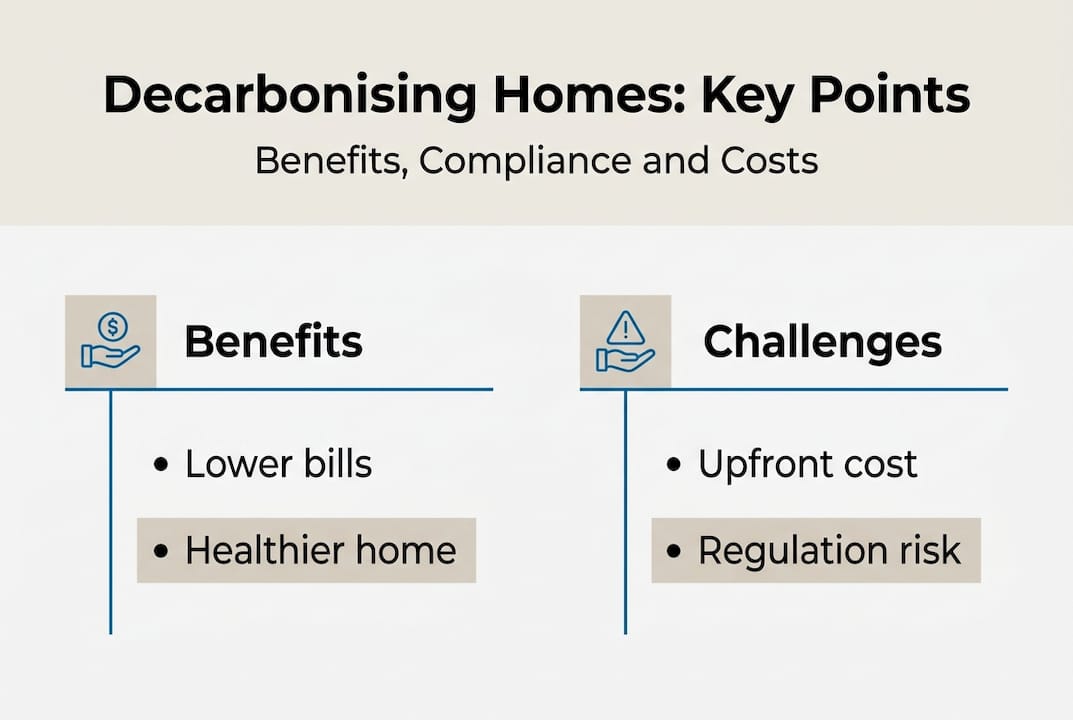
The scale of the challenge is significant. Around 3.38 million PRS properties require upgrades to meet the 2030 standard, with the total estimated cost sitting between £21 billion and £26 billion across the sector. In rural areas, upgrade costs can reach up to 148% of annual rental income, making the financial pressure particularly acute for landlords outside major cities.
The most common barriers landlords and owners report include:
- Upfront capital costs: Even with grants and VAT relief, the initial outlay for insulation or heat pump installation can be substantial
- Retrofit feasibility: Older or non-standard properties (solid walls, listed buildings, flats) can be harder and more expensive to upgrade
- Tenant disruption: Works carried out while a property is occupied require careful management and communication
- ‘Green premium’ perceptions: Some landlords worry that energy improvements do not translate directly into higher rents, making the return on investment feel uncertain
- Finding reliable contractors: The retrofit supply chain is still developing, and quality varies considerably
Acting in phases rather than all at once is one of the most effective ways to manage costs. Spreading improvements across two or three years keeps annual spend manageable and allows time to access multiple rounds of grant funding.
Pro Tip: Check eligibility for local authority retrofit schemes and the Great British Insulation Scheme before commissioning any work. These programmes can significantly reduce the cost of insulation measures in particular.
For landlords concerned about achieving a higher EPC rating cost-effectively, detailed EPC improvement strategies outline the most impactful measures by property type and current rating. Acting early also means access to a wider pool of contractors and more competitive pricing, before demand peaks closer to the 2030 deadline.
A fresh perspective: why short-term pain sets up long-term gain
Much of the commentary around home decarbonisation focuses on cost and compliance burden. That framing, while understandable, misses a more important point.
The hidden risk of waiting is rarely discussed. Market signals are already shifting. Mortgage lenders are beginning to price energy performance into lending decisions. Tenants are increasingly aware of running costs and actively seek out efficient homes. A property sitting at EPC D or E in 2028 will not just face regulatory risk — it will face a narrowing tenant pool and a weakening resale position.
Those who act strategically now, phasing improvements sensibly and accessing available grants, are building resilient portfolios. They are not just avoiding fines; they are positioning their properties for stronger capital values and lower vacancy rates over the next decade.
The wider benefits of energy efficiency extend beyond individual savings. Warmer, healthier homes reduce NHS pressure, improve productivity, and contribute meaningfully to national climate goals. That is a return no balance sheet fully captures, but it is real.
Decarbonisation is not a cost to absorb. It is an investment in the long-term performance of a property and the wellbeing of the people who live in it.
Ready to decarbonise? How Home Energy Model can help
Navigating decarbonisation obligations can feel complex, but the right information makes a significant difference. The Home Energy Model overview explains the new government methodology replacing SAP, helping landlords and homeowners understand how their properties will be assessed from 2025 onwards. For those working through EPC requirements, detailed EPC guidance covers ratings, what affects them, and how to improve them. Landlords looking to model different upgrade scenarios will find the energy model types resource particularly useful for planning investment decisions with confidence. Start with the right information and take the next step towards compliance.
Frequently asked questions
What is a decarbonised home?
A decarbonised home uses less fossil fuel energy for heating and power, instead relying on efficient systems, renewable sources, and improved insulation to cut carbon emissions significantly. The focus is on both reducing energy demand and switching to lower-carbon energy sources.
When do UK landlords need to comply with new EPC rules?
From 1 October 2030, most private rented homes must meet new dual-metric EPC C standards or secure a registered exemption. Landlords should begin planning and budgeting for upgrades well before that date.
Are there grants to help lower the cost of home decarbonisation?
Yes, UK government incentives include VAT relief, BUS grants, and tax-deductible improvements for landlords investing in qualifying energy measures. Local authority schemes may offer additional support depending on the property’s location.
What happens if I don’t decarbonise my rental property?
Landlords risk fines up to £30,000 and lose the legal right to let non-compliant properties until remedial works are completed. The reputational and financial consequences of non-compliance are considerable.
Is decarbonisation really worth it for rural landlords?
Rural landlords face higher upfront costs, with upgrade costs reaching 148% of annual rental income in some areas, but early action secures grant access, avoids peak contractor costs, and future-proofs properties against tightening standards.
Recommended
- Sustainable heating explained: cut emissions, future-proof your home
- Zero Carbon Home Explained: UK Standards and Costs – Home Energy Model
- The essentials of a low carbon home in the UK: 2026 guide
- Low-cost energy-saving tips for UK homes in 2026
- Top clean energy solutions for European homes: save & sustain