
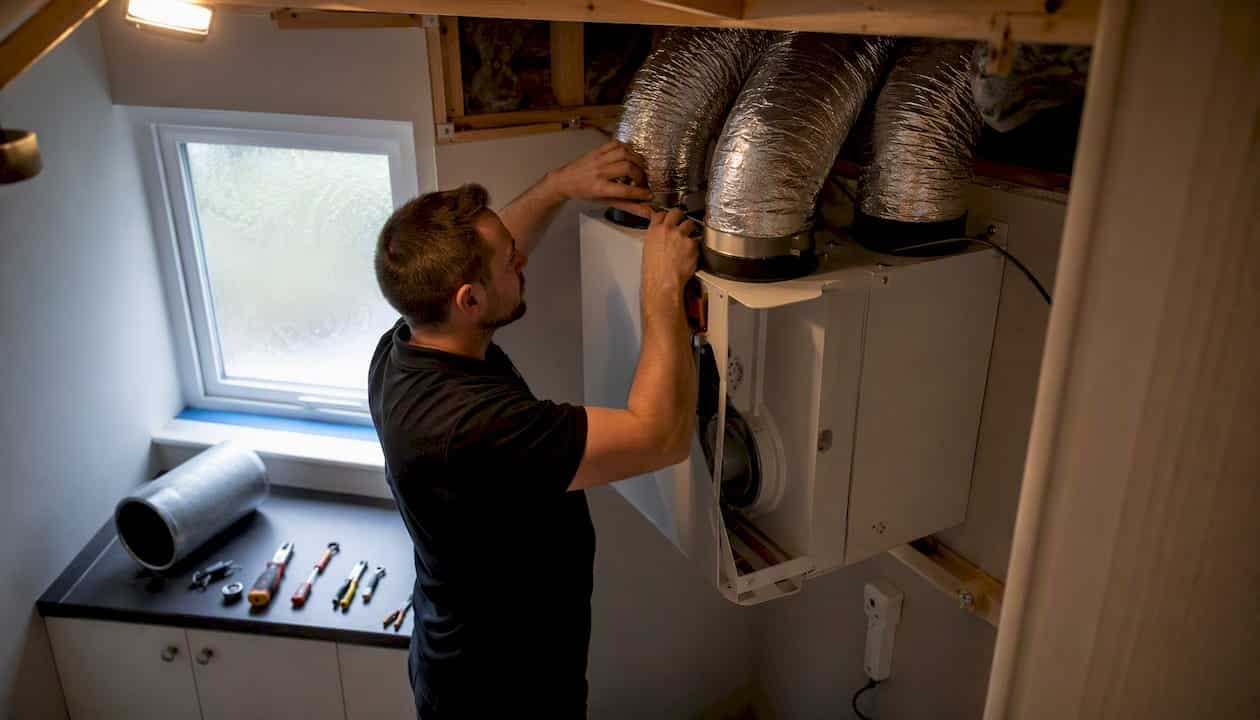
A heat recovery fan, more precisely known as a Mechanical Ventilation with Heat Recovery (MVHR) system or heat recovery ventilator (HRV), continuously extracts stale air from your home and supplies fresh filtered air in return, capturing up to 85–95% of the heat (95%) that would otherwise be lost through conventional ventilation. For most modern, well-insulated UK homes, this makes MVHR one of the most effective ways to maintain healthy indoor air quality without the energy penalty of simply opening windows or running extract fans.
The system suits airtight, well-insulated properties best. In a draughty Victorian terrace with no insulation upgrades, the benefits shrink considerably because uncontrolled air leakage undermines the heat exchanger’s work.
Quick summary:
- Energy recovery: recaptures heat from extracted air and uses it to pre-warm incoming fresh air, reducing heating demand
- Continuous ventilation: removes moisture, CO2 and airborne pollutants around the clock without manual intervention
- Indoor air quality: filtered supply air benefits allergy and asthma sufferers in particular
- Key caveats: upfront installation costs are significant; the building needs to be reasonably airtight; filters require regular replacement; commissioning by a qualified installer is non-negotiable
Key takeaways
Heat recovery fans (MVHR/HRV) deliver their full benefit only in airtight, well-insulated homes — the building envelope determines whether the technology performs as specified.
| Point | Details |
|---|---|
| What MVHR does | Extracts stale air and supplies fresh filtered air, recovering 80–95% of ventilation heat in the process. |
| Best-fit properties | Airtight new builds and deep retrofits; properties with air permeability at or below approximately 5 m³/hr/m² at 50 Pa. |
| Primary benefits | Reduced heating demand, improved indoor air quality, and lower condensation risk throughout the year. |
| Maintenance requirement | Filter checks every three months, annual heat exchanger clean, and a full professional service every two to three years. |
| Homeenergymodel | Provides independent energy performance assessments and modelling to help homeowners and landlords evaluate ventilation upgrades in the context of their EPC rating and the Home Energy Model. |
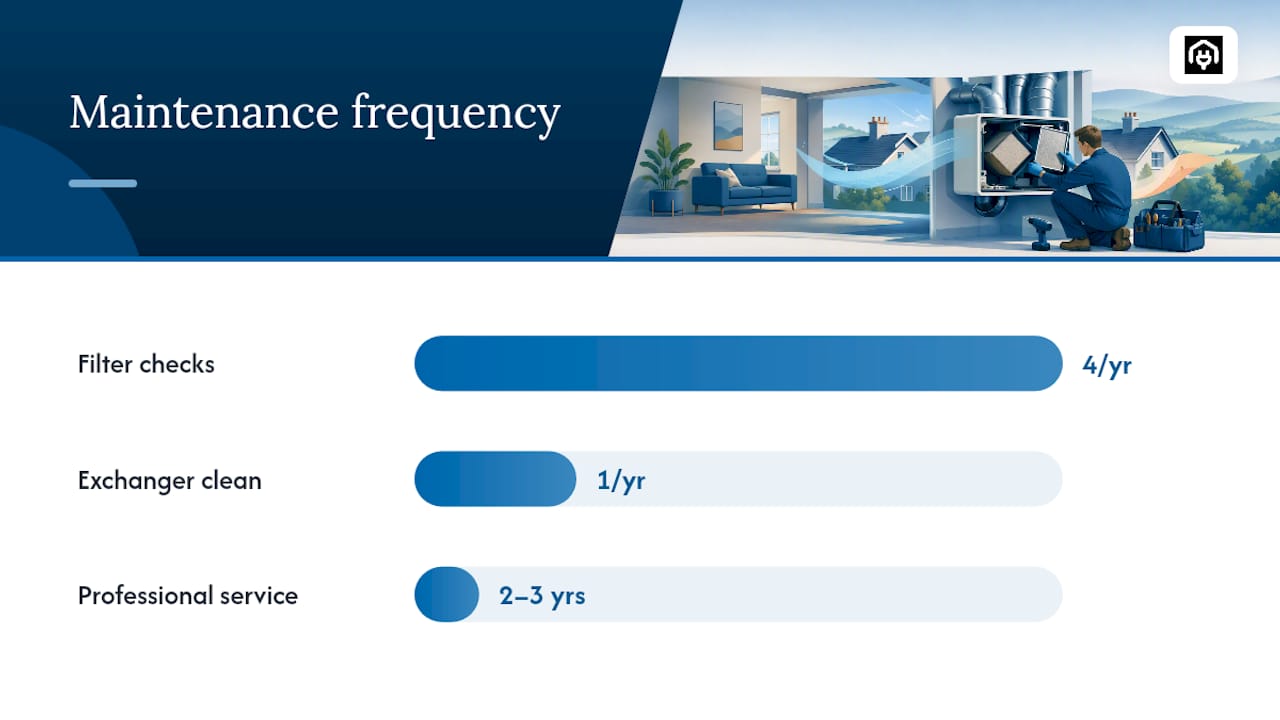
Table of Contents
- How does a heat recovery ventilation system actually work?
- What types of heat recovery system are available?
- What are the main benefits of heat recovery fans for UK homeowners?
- When does MVHR make the biggest difference in UK homes?
- What does heat recovery fan installation cost in the UK?
- UK regulations and what correct installation involves
- What maintenance does an MVHR system need?
- When heat recovery fans are not the right choice
- Is a heat recovery fan right for your home?
- How Homeenergymodel can support your ventilation and energy assessment
- Sources
How does a heat recovery ventilation system actually work?
At its core, an MVHR system runs two separate airstreams simultaneously. One stream draws stale, humid air out of wet rooms (kitchen, bathrooms, utility room). The other draws fresh air in from outside and delivers it to habitable rooms (living room, bedrooms). The two streams pass through a heat exchanger inside the central unit, where heat transfers from the warm outgoing air to the cool incoming air. Crucially, the airstreams never mix: only heat crosses between them, not moisture or pollutants.
The main components are:
- Central unit: houses the heat exchanger, two fans (supply and extract), and filters; typically installed in a loft, cupboard, or utility room
- Extract ducts: run from kitchen and bathrooms to the central unit
- Supply ducts: run from the central unit to living rooms and bedrooms
- Heat exchanger: the core component where thermal energy transfers between airstreams
- Filters: protect the exchanger and supply air from dust, pollen and particulates; usually G4 on the extract side and F7 on the supply side
- Controls: most units offer a continuous trickle mode and a boost mode triggered manually or by humidity/CO2 sensors
Well-specified MVHR units often quote heat recovery efficiency in the 85–95% range, but real-world performance depends on duct layout, airtightness and commissioning quality. A poorly installed system with undersized ducts and no balancing can fall well short of its rated figure.
The Centre for Sustainable Energy describes MVHR as a whole-house balanced system that extracts stale air, supplies filtered fresh air, and uses a heat exchanger to reduce ventilation heat loss, with guidance reporting typical system efficiencies in the 80–90% band.
Pro Tip: Ask any installer for the specific heat exchanger efficiency certificate for the unit they propose, not just a headline marketing figure. Counterflow exchangers consistently outperform cross-flow designs at the same airflow rate.
What types of heat recovery system are available?
Understanding the distinctions between system types helps homeowners and property managers choose the right approach for their building and budget.
Whole-house MVHR
A central unit with a full duct network serving every room. This is the standard approach for new builds and deep retrofits. It provides balanced ventilation throughout the property and delivers the highest heat recovery efficiency. Installation is most straightforward when the building is at shell stage; retrofitting into an occupied home requires careful duct routing and access to ceiling voids or loft space.

Single-room heat recovery ventilators (SRHRV)
Decentralised units installed through an external wall in a single room, typically a bathroom or kitchen. BEAMA guidance classifies these as a development of the extract fan family, providing balanced supply and extract in one room. They suit flats, listed buildings, or properties where full duct runs are impractical. They are not a substitute for whole-house MVHR in most new builds, because habitable rooms still rely on background ventilation (trickle vents) for fresh air supply.
HRV versus ERV: what is the difference?
- HRV (Heat Recovery Ventilator): transfers heat only between airstreams; moisture does not cross. Better suited to UK climates where winter humidity indoors is typically higher than outdoors, because it removes excess moisture with the extract air.
- ERV (Energy Recovery Ventilator, also called Enthalpy Recovery Ventilator): transfers both heat and moisture. More common in very cold or very dry climates where retaining indoor humidity is desirable. Less common in UK residential applications.
Heat exchanger types
- Fixed plate (cross-flow): the most common type in UK residential units; simple, no moving parts, moderate efficiency
- Counterflow plate: higher efficiency than cross-flow because airstreams travel in opposite directions, maximising the temperature gradient across the exchanger
- Thermal wheel (rotary): a rotating drum transfers heat and, in ERV variants, moisture; high efficiency but has moving parts and a small risk of cross-contamination between airstreams
- Heat pipe: passive, no moving parts, used in specialist applications; less common in domestic settings
For most UK homes, a counterflow fixed-plate unit offers the best balance of efficiency, reliability, and maintenance simplicity. Thermal wheels are more often found in commercial or larger residential schemes.
What are the main benefits of heat recovery fans for UK homeowners?
The case for MVHR rests on three overlapping gains: energy savings, healthier indoor air, and better comfort.
Energy and heating demand
By pre-warming incoming fresh air with heat recovered from the extract stream, MVHR reduces the amount of energy the heating system needs to maintain indoor temperature. In airtight, well-insulated homes, this can reduce heating demand meaningfully, with some estimates suggesting reductions in the region of tens of per cent for well-specified installations. MVHR and heat pumps work particularly well together: pre-warmed supply air reduces the temperature lift the heat pump must achieve, which improves its coefficient of performance. See Homeenergymodel’s guide on air source heating efficiency for more on that interaction.
Indoor air quality
- Continuous extraction removes cooking odours, bathroom moisture, CO2 from occupants, and volatile organic compounds (VOCs) from furnishings
- Supply-side filters (typically F7 class) capture pollen, fine particulates and traffic pollution before air enters habitable rooms
- Allergy and asthma sufferers often report noticeable improvement in symptoms, particularly during high-pollen periods when windows would otherwise need to stay closed
Condensation and mould prevention
Continuous balanced ventilation keeps relative humidity in check throughout the year. Persistent condensation on windows and cold surfaces, a common problem in UK homes during winter, reduces significantly when moisture is extracted before it can settle. For landlords managing properties with recurring damp issues, this is a meaningful maintenance benefit. Practical guidance on removing mould safely from UpKeep UK illustrates how costly remediation can become when ventilation is inadequate.

Comfort
Draught-free fresh air supply, without the noise and heat loss of open windows, maintains a more stable indoor temperature and avoids cold spots near supply points when the system is correctly balanced.
When does MVHR make the biggest difference in UK homes?
MVHR is not equally effective in every property. The evidence consistently points to a clear set of conditions that determine whether a homeowner will see the quoted benefits in practice.
Conditions that favour MVHR strongly:
- Air permeability at or below approximately 5 m³/hr/m² at 50 Pa (the threshold above which uncontrolled draughts begin to overpower the system’s designed airflow, according to Homebuilding guidance)
- High levels of insulation (walls, roof, floor) that reduce fabric heat loss and make ventilation heat loss the dominant remaining source
- New build or whole-house deep retrofit, where duct routes can be planned from the outset
- Properties with occupants sensitive to air quality: allergy sufferers, young children, or those with respiratory conditions
Practical scenarios:
A new-build home built to Future Homes Standard airtightness targets is the ideal candidate. MVHR is effectively mandatory in this context because the building is too airtight for natural ventilation to work safely. A 1990s semi-detached that has received external wall insulation, loft insulation, and new triple-glazed windows as part of a deep retrofit can also benefit substantially, provided an airtightness test confirms the envelope is tight enough. A Victorian terrace with original sash windows, solid walls, and no draught-proofing is a poor candidate: the investment in MVHR would be better spent on fabric improvements first.
Pro Tip: Commission an airtightness test (blower door test) before specifying MVHR. The result, expressed in m³/hr/m² at 50 Pa, tells you directly whether the building envelope will support the system’s designed performance. Skipping this step is the single most common reason homeowners are disappointed with MVHR outcomes.
What does heat recovery fan installation cost in the UK?
Costs vary considerably depending on system type, property size, and installation complexity.
Key cost drivers:
- System type: whole-house MVHR costs significantly more than a single-room unit
- Ducting complexity: the number of rooms served, duct run lengths, and access to ceiling voids or loft space all affect labour time
- Commissioning and balancing: a properly commissioned system requires airflow measurement and adjustment at every terminal; this adds cost but is essential for performance
- Property type: new builds allow duct routes to be designed in; retrofits into occupied homes with finished ceilings are more disruptive and expensive
Whole-house MVHR installation in a typical UK three-bedroom home generally requires a significant investment including supply, installation, and commissioning, though larger or more complex properties can exceed this. Single-room heat recovery units cost considerably less per unit (typically £300–£800 installed), but multiple units are needed to serve a whole property and the result is not equivalent to a whole-house system.
Running costs
Manufacturer data show example annual electrical consumption for a mechanical ventilation unit around 258.1 kWh per year. At current UK electricity rates, this represents a modest annual running cost. Demand-controlled units with CO2 or humidity sensors can reduce actual consumption by running fans at lower speeds when occupancy is low.
Illustrative payback calculation:
- Assume annual electricity cost for running the MVHR unit: approximately £70–£90 at current rates
- Assume annual heating saving from reduced ventilation heat loss in an airtight home: this varies widely but conservative estimates for a well-specified installation suggest £100–£200 per year
- Net annual benefit: broadly neutral to modestly positive on energy costs alone, before accounting for improved air quality and reduced maintenance from condensation damage
Payback on the capital cost from energy savings alone is typically long (10–20 years or more). The strongest financial case combines energy savings with avoided remediation costs (damp, mould, condensation damage) and the contribution to a higher energy efficiency rating for the property. Use Homeenergymodel’s energy savings calculator to model figures specific to your property.
UK regulations and what correct installation involves
Building Regulations Part F
Building Regulations Part F sets the ventilation requirements for dwellings in England. For new builds and major renovations, it specifies minimum whole-dwelling ventilation rates and requires that mechanical ventilation systems are commissioned and tested before handover. MVHR systems installed in new builds must meet the airflow rates set out in Approved Document F, and the commissioning record must be provided to the building control body.
What commissioning and balancing mean in practice:
- Commissioning involves measuring actual airflow at every supply and extract terminal using a calibrated anemometer or flow hood
- Balancing adjusts dampers and fan speeds until measured flows match the design specification for each room
- A commissioning report documents the results; this is the evidence that the system performs as designed
Without commissioning, there is no way to confirm the system is delivering the correct airflow to each room. An unbalanced system may over-extract from one area and under-supply another, reducing both comfort and efficiency.
Choosing a qualified installer:
- Look for membership of recognised industry bodies and evidence of MVHR-specific training
- Ask for references from completed MVHR installations, not just general ventilation work
- Require a written commissioning report and airflow balancing data as a contractual deliverable
- Confirm the installer will provide filter replacement guidance and a maintenance schedule at handover
What maintenance does an MVHR system need?
Maintenance is straightforward but non-negotiable. A neglected system loses efficiency, degrades air quality, and can develop noise problems.
Routine maintenance tasks:
- Filter inspection every three months; replacement typically every six to twelve months depending on local air quality and occupancy
- Heat exchanger cleaning: remove and rinse the exchanger core annually (most units allow tool-free access)
- External grille and duct terminal inspection: check for blockages from leaves, insects, or debris twice a year
- Full professional service every two to three years, including airflow rebalancing and fan inspection
| Task | Frequency | Typically done by |
|---|---|---|
| Filter check | Every 3 months | Homeowner |
| Filter replacement | Regularly | Homeowner |
| Heat exchanger clean | Annually | Homeowner (most units) |
| External grille check | Twice yearly | Homeowner |
| Full service and rebalance | Every 2–3 years | Qualified engineer |
Annual DIY maintenance costs are modest (replacement filters typically cost £20–£60 per set depending on the unit). Professional servicing adds to this but protects the system’s warranty and performance over its expected lifespan of 15–25 years. For landlords managing multiple properties, building maintenance routines into a property upkeep schedule, as outlined in essential property upkeep guidance, reduces the risk of neglected systems and tenant complaints.
Pro Tip: Set a calendar reminder for filter checks when the system is first commissioned. Most homeowners who neglect filters do so simply because there is no visible reminder. A blocked filter forces fans to work harder, increases electricity consumption, and reduces supply airflow to habitable rooms.
When heat recovery fans are not the right choice
MVHR is not universally appropriate, and a poorly specified or installed system can perform worse than simpler alternatives.
Main limitations:
- Upfront cost: the capital outlay is significant compared with extract-only or natural ventilation; payback from energy savings alone is long
- Airtightness dependency: in leaky buildings (air permeability above approximately 5 m³/hr/m² at 50 Pa), uncontrolled infiltration dilutes the system’s performance and the energy savings largely disappear
- Noise: undersized ducts create turbulence and noise at terminals; a system with inadequate duct sizing or poorly fitted terminals can be audible in bedrooms
- Summer overheating: in warm weather, the heat exchanger pre-warms incoming air when cooling is what occupants want. A summer bypass mode, which routes incoming air around the exchanger, is the standard solution; any system specified for a UK home should include one. For properties with overheating risk, TM59 compliance guidance sets out the assessment methodology
- Opening windows: doing so is not harmful, but it temporarily bypasses the system and reduces its efficiency. In very airtight homes, occupants sometimes find they rarely need to open windows at all
MVHR is not a heating system replacement. It recovers heat from ventilation airstreams but works best alongside good insulation and efficient glazing. Installing MVHR in a poorly insulated home with significant fabric heat loss will not deliver the energy savings the technology is capable of — the Centre for Sustainable Energy is explicit on this point.
Red flags in proposals to watch for:
- No mention of commissioning or airflow balancing in the quote
- Duct sizes not specified or clearly undersized for the room volumes
- No filter access point shown on the system layout
- Installer unable to provide a commissioning report from a previous installation
- No summer bypass included in the specification
Is a heat recovery fan right for your home?
A structured decision process saves time and avoids costly mistakes. Work through these prompts before requesting quotes.
Decision checklist:
- Has the property had an airtightness test, or is it a new build designed to tight targets? If not, this is the first step.
- Has significant insulation been installed (loft, walls, floor) or is the property a new build? MVHR delivers diminishing returns in poorly insulated homes.
- Are occupants experiencing persistent condensation, mould, or poor air quality? These are strong indicators that ventilation is inadequate.
- Are any occupants asthmatic or have significant allergies? Filtered supply air is a meaningful quality-of-life benefit in these cases.
- Is the property a new build, or is a deep retrofit planned? These are the contexts where duct routes can be designed properly from the outset.
Recommended next steps:
- Commission a blower door airtightness test if one has not been done
- Obtain at least two quotes from MVHR-specialist installers, each including a duct layout drawing and commissioning plan
- Ask each installer for a commissioning report from a recent comparable installation
- Review the MVHR UK guide on Homeenergymodel for further context on how ventilation choices interact with heating systems and EPC ratings
How Homeenergymodel can support your ventilation and energy assessment
Understanding whether MVHR is the right investment for a specific property requires more than a general guide. It depends on the building’s current airtightness, insulation levels, heating system, and energy performance rating — all of which interact in ways that a site-specific assessment can quantify.
Homeenergymodel provides energy performance assessments and modelling that place ventilation strategy in the context of a property’s overall energy profile. For landlords and property managers, this includes guidance on how ventilation upgrades interact with EPC ratings and the evolving requirements of the Home Energy Model (HEM), which is set to replace SAP as the UK’s standard assessment methodology. Homeenergymodel is an advice and modelling service, not an installation contractor, so the guidance is independent of any particular product or installer.
To understand how a ventilation upgrade would affect your property’s energy performance certificate, speak to a qualified EPC assessor through Homeenergymodel and request an assessment that includes ventilation strategy as part of the scope.
Sources
- Mechanical ventilation with heat recovery – Centre for Sustainable Energy
- MVHR systems explained
- GPG268
- MVHR explained costs and savings (2026) | Axiom Eco Homes