
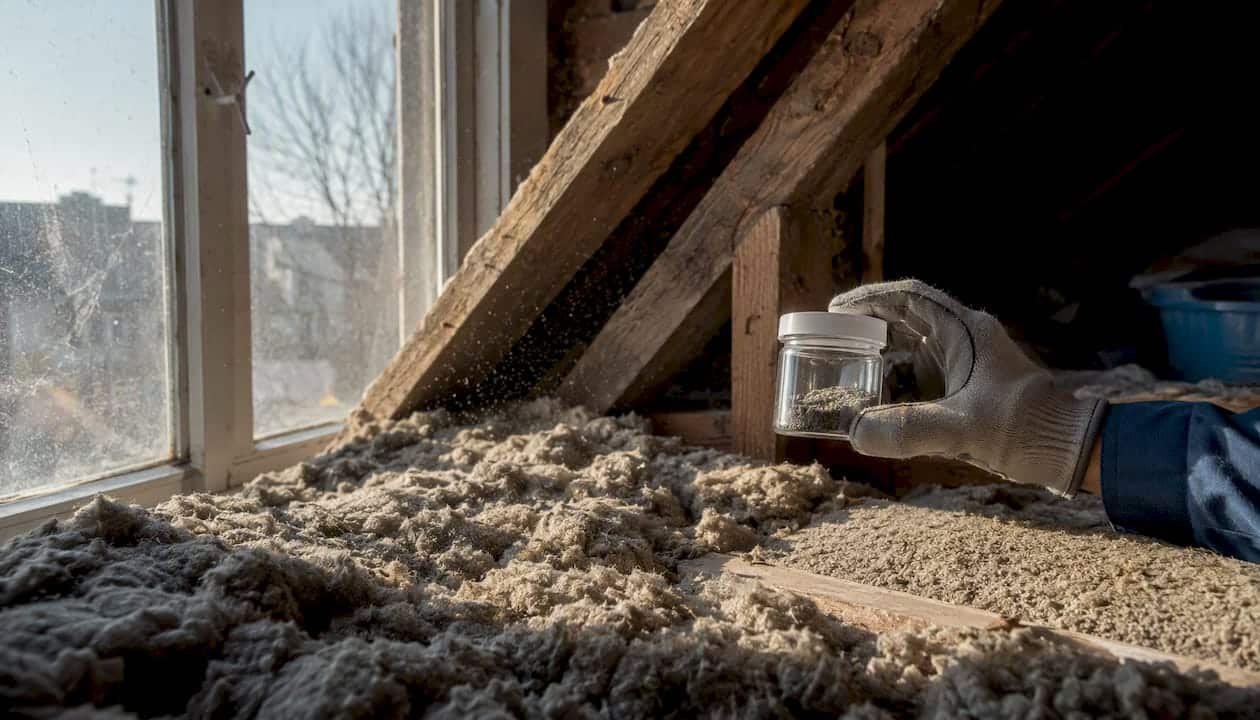
The most common old types of insulation found in UK homes are loose-fill asbestos, asbestos lagging, sprayed asbestos coatings, asbestos insulating board (AIB), mineral/rock wool, fibreglass batts, vermiculite, urea-formaldehyde (UF) foam, cellulose, cork/insulating lumber, rigid foam boards, reflective foil, and older spray foams. If any of these materials is suspected in a pre-2000 property, treat it as potentially hazardous, do not disturb it, and arrange professional testing before any work begins.
These materials turn up across the whole house: lofts, pipe runs, cavity walls, behind partition panels, around boilers, and under floors. Knowing which era produced which material is the first step toward a safe, informed decision about testing or upgrading.
- Asbestos forms (loose-fill, lagging, sprayed, AIB): pre-1999 properties; lofts, pipes, ceilings, partition walls
- Mineral/rock wool and fibreglass: 1950s onward; lofts, cavity walls, pipe wraps
- Vermiculite: 1950s–1990s; loft floors (treat as suspect until tested)
- Urea-formaldehyde foam: 1970s–1980s; cavity walls
- Cellulose: 1970s onward; lofts, walls (blown-in)
- Cork and insulating lumber: pre-1950s; floors, walls, cold stores
- Rigid foam boards (older PIR/EPS): 1970s onward; walls, roofs, floors
- Reflective foil: 1960s onward; loft rafters, underfloor
- Older spray foams: 1970s–2000s; loft timbers, roof undersides
Key takeaways
Properties built before 1999 carry a real risk of containing asbestos-containing materials; visual inspection alone cannot confirm or rule out their presence, and laboratory testing by a UKAS-accredited facility is the only reliable method of confirmation.
| Point | Details |
|---|---|
| Inspect visually only | Observe from a safe distance, photograph the material, and do not touch or disturb it. |
| Building age is a risk indicator | Pre-1999 construction or refurbishment raises the likelihood of ACMs, but is not definitive proof. |
| Test before any work begins | Commission a UKAS-accredited laboratory test; a management survey is the right starting point for most homes. |
| Licensed contractors for high-risk removal | Sprayed asbestos, most insulation removal, and much AIB work legally requires an HSE-licensed contractor. |
| Homeenergymodel for assessment and planning | Once ACMs are resolved, a home energy assessment confirms the insulation specification and models the EPC outcome. |
Table of Contents
- Common old types of insulation: what they are and where to find them
- Asbestos in insulation: forms, friability, and why it demands a different approach
- How to identify old insulation without creating a risk
- What to do when you suspect asbestos is present
- When to upgrade old insulation and which modern materials to consider
- Who to hire and what credentials to check
- How old insulation affects energy ratings and the Home Energy Model
- Sources
Common old types of insulation: what they are and where to find them
Each material below carries its own era, location, appearance, and risk profile. The guidance column is a starting point only; professional assessment is needed before any decision to remove or disturb.
| Material | Era (approx.) | Typical locations | Appearance clues | Primary hazard | Decision guidance |
|---|---|---|---|---|---|
| Loose-fill asbestos | Pre-1980s | Loft floors, cavity walls | Grey/white fluffy granules, very light | Carcinogenic fibres if disturbed | Do not touch; arrange UKAS test |
| Asbestos lagging | Pre-1980s | Boiler pipes, ductwork | White/grey wrap, often crumbling | High fibre release when friable | Licensed contractor required |
| Sprayed asbestos | Pre-1980s | Steel beams, concrete ceilings | Rough, textured grey coating | Highest fibre risk; highly friable | Licensed contractor required |
| AIB (asbestos insulating board) | Pre-1980s | Partition walls, ceiling tiles, soffits | Flat grey/cream panels | Moderate-high; releases fibres if cut | Licensed contractor for most work |
| Mineral/rock wool | 1950s–present | Lofts, cavity walls, pipe wraps | Yellow/brown/grey fibrous rolls | Skin and respiratory irritant (dust) | Manage or replace; PPE when handling |
| Fibreglass (glass wool) | 1950s–present | Lofts, stud walls | Pink/yellow fluffy rolls | Skin and eye irritant; dust inhalation | Replace if degraded; PPE required |
| Vermiculite | 1950s–1990s | Loft floors (poured loose) | Gold/silver granular pellets | Possible asbestos contamination (Libby) | Treat as suspect; UKAS test first |
| Urea-formaldehyde foam | 1970s–1980s | Cavity walls (injected) | Off-white crumbly foam | Formaldehyde off-gassing; shrinkage | Specialist survey; consider replacement |
| Cellulose | 1970s–present | Lofts, walls (blown-in) | Grey fluffy loose fill | Low risk; fire-retardant treated | Manage or replace if damp-damaged |
| Cork/insulating lumber | Pre-1950s | Floors, cold-store walls | Brown compressed boards/blocks | Low risk; may harbour moisture | Replace if structurally compromised |
| Rigid foam boards (older PIR/EPS) | 1970s–present | Walls, roofs, floors | White/yellow rigid panels | Older boards may off-gas; fire risk | Check condition; replace if damaged |
| Reflective foil | 1960s–present | Loft rafters, underfloor | Shiny metallic sheet | Low risk; may degrade over time | Replace if torn or delaminated |
| Older spray foam | 1970s–2000s | Loft timbers, roof undersides | Yellow/cream rigid or flexible foam | Structural masking; mortgage issues | Specialist survey before any sale |
Visual identification is unreliable. Many of these materials look similar to one another, and some asbestos-containing materials (ACMs) are indistinguishable from safe alternatives by eye alone. Industry practice is to treat any pre-2000 insulation as suspicious and confirm content through laboratory testing.
Pro Tip: Vermiculite is the most commonly overlooked hazard. Because it looks like ordinary granular loft insulation, homeowners often disturb it during loft clearances. Some vermiculite insulation, notably material from the Libby, Montana mine, was contaminated with asbestos and must be treated as hazardous until a UKAS-accredited laboratory confirms otherwise.
Asbestos in insulation: forms, friability, and why it demands a different approach
Asbestos is not a single material. In insulation contexts, it appears in four main forms, each with a different risk profile tied directly to how easily it releases fibres into the air.
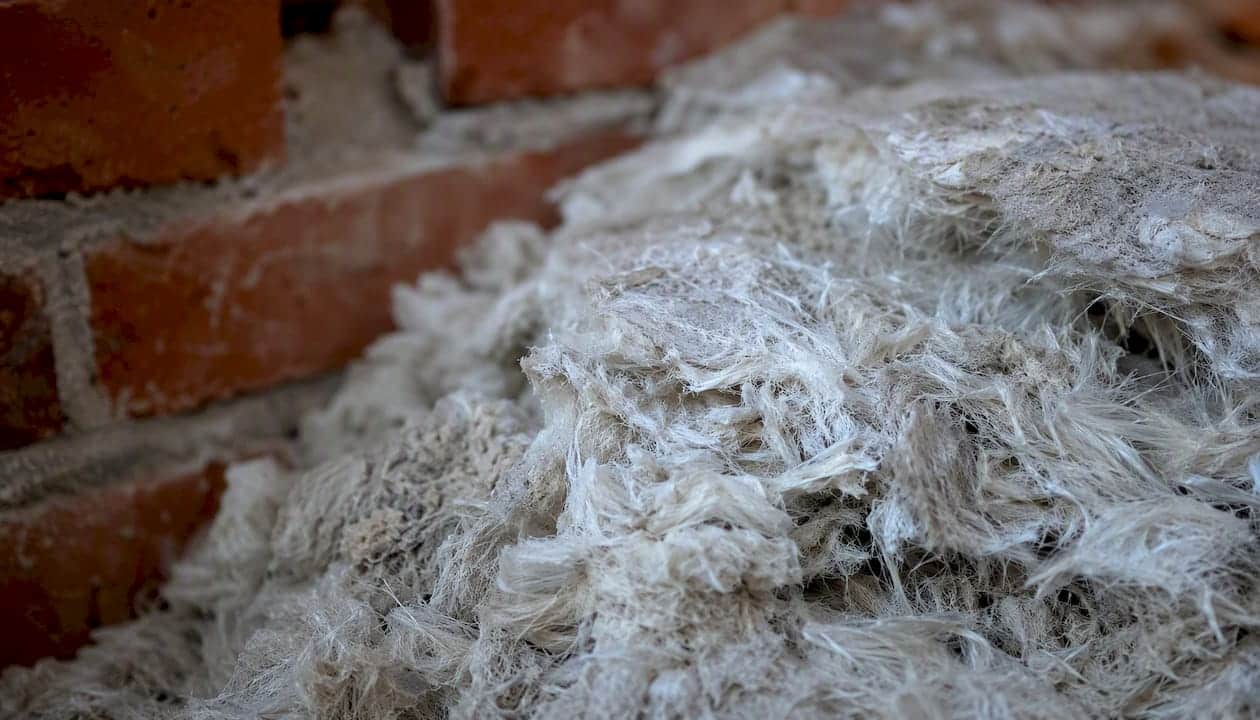
Loose-fill asbestos was poured directly into loft spaces and cavity walls as a cheap, lightweight insulator. It is among the most dangerous forms because even minor air movement can lift fibres. Asbestos lagging was wrapped around hot pipes and boilers; when it begins to crumble with age, fibre release accelerates sharply. Sprayed asbestos coatings were applied to structural steelwork and concrete ceilings for fire protection and thermal performance; they are the most friable form and carry the highest airborne fibre risk. Asbestos insulating board (AIB) was used in partition walls, ceiling tiles, and soffits; it is denser than sprayed coatings but still releases fibres when cut, drilled, or broken.
The governing principle is friability: the more easily a material crumbles, the more readily it releases respirable fibres. Loose-fill and sprayed forms sit at the high-risk end; bonded materials such as asbestos cement sheets sit at the lower end, though no ACM is risk-free when disturbed.
Asbestos is commonly found in pipe lagging, loose-fill cavity insulation, and Asbestos Insulating Board (AIB) used for fire protection in partition walls, ceiling tiles, and soffits. — HSE, Asbestos: location and materials
The UK banned the use of asbestos in insulation and construction materials in 1999. Any building constructed or refurbished before that date carries a risk of containing ACMs. That date is a risk indicator, not a guarantee: some pre-1999 buildings were never fitted with asbestos, and some post-1999 refurbishments disturbed existing ACMs without full removal. Only a survey and laboratory test can confirm what is present.
How to identify old insulation without creating a risk
The safest inspection is a visual one carried out from a distance, without touching, cutting, or disturbing any material. The following steps help form a reasonable suspicion that merits professional testing.
- Check the building’s age. Properties built or substantially refurbished before 1999 are at elevated risk of ACMs. Pre-1960s properties may also contain cork, early fibreglass, or mineral wool in poor condition.
- Look at the loft from the hatch. Note colour, texture, and whether the material is loose-fill, rolled, or board-form. Do not walk on it or move any material.
- Inspect pipe runs and the boiler. White or grey wrapping around pipes, particularly if crumbling or flaking, is a strong indicator of asbestos lagging.
- Examine partition walls and ceiling tiles. Flat grey or cream panels around older boilers, in utility rooms, or forming ceiling soffits may be AIB.
- Look for granular loft insulation. Gold or silver pellets poured loose across the loft floor may be vermiculite.
- Check cavity walls for injection holes. Small circular plugs in mortar joints, typically at regular intervals, indicate past cavity-fill injection, possibly UF foam.
- Note any crumbling, dustiness, or discolouration. These are signs of degradation that increase the risk of fibre or chemical release.
- Photograph everything before leaving. Capture the material in context: its location, approximate area, condition, and any labels or date stamps visible on boards or packaging. Good photographs help a surveyor assess risk remotely before attending.
Do not disturb suspected asbestos under any circumstances. Stop all work, leave the area, and contact a licensed asbestos surveyor or contractor before re-entering. Visual inspection alone cannot confirm or rule out asbestos content — only laboratory analysis of a professionally taken sample can do that.
What to do when you suspect asbestos is present
Acting quickly and calmly reduces risk. The steps below follow HSE-aligned guidance for domestic properties.
Immediate actions:
- Stop all work in the affected area immediately.
- Isolate the space: close doors and restrict access for all household members.
- Do not vacuum, sweep, or use compressed air near the suspect material.
- Avoid unnecessary ventilation that could spread airborne fibres to other rooms.
- Wash hands and any exposed skin; bag and seal any clothing worn during the inspection.
- Inform all household members and any contractors on site.
Testing and survey options:
A management survey identifies the location, condition, and extent of ACMs across a property and is the appropriate starting point for most homeowners. A refurbishment and demolition survey is required before any structural work begins. Both must be carried out by a competent surveyor; samples are sent to a UKAS-accredited laboratory for analysis. Turnaround for a standard domestic sample is typically five to ten working days, though faster services are available.
Manage in place versus removal:
HSE guidance confirms that materials in good condition can sometimes be managed in place rather than removed. Repairing, sealing, or enclosing an ACM is often safer than disturbing it through improper removal. The right decision depends on the material’s condition, its location, and any planned future work.
Higher-risk work, including removal of sprayed asbestos, most asbestos insulation removal, and much work on AIB, must be carried out by a contractor holding an HSE licence. Unlicensed removal of licensable materials is a criminal offence and creates serious health risks for occupants and contractors alike.
Pro Tip: Ask any contractor whether the specific work they propose is licensable before they begin. Some small, controlled tasks on AIB — such as painting undamaged board or drilling a single small hole — may fall outside the licensable category under HSG210 task sheet guidance, but most insulation removal does not. If there is any doubt, the work is licensable.
When to upgrade old insulation and which modern materials to consider
Safety is the primary driver for upgrading, but thermal performance and energy rating outcomes matter too. The decision to replace rather than manage in place typically rests on one or more of the following:
- Safety risk: confirmed ACMs, degraded UF foam off-gassing formaldehyde, or vermiculite awaiting test results
- Thermal degradation: mineral wool or fibreglass that has become compressed, damp, or pest-damaged loses a significant proportion of its insulating value
- Moisture damage: wet insulation conducts heat rather than resisting it and can accelerate structural decay
- EPC and HEM impact: the English Housing Survey 2024 to 2025 shows older dwellings are more likely to retain legacy insulation mixes that underperform against current standards, directly affecting modelled energy ratings
- Planned sale or remortgage: older spray foam in loft spaces is a known mortgage barrier; lenders routinely require specialist reports before proceeding
Modern replacement options by location:
- Loft (open): modern mineral wool rolls (100–270mm), blown cellulose, sheep’s wool
- Cavity walls: modern EPS bead, mineral wool cavity fill, closed-cell polyurethane foam (specialist installation)
- Solid walls: external wall insulation (EWI) with mineral wool or EPS boards, internal wall insulation (IWI) with PIR boards or mineral wool
- Pipes and ducts: pre-formed mineral wool or foam pipe sections
- Floors: PIR rigid boards, mineral wool between joists
For practical guidance on benefits of home insulation and how modern materials compare on cost and performance, Homeenergymodel’s resource library covers the full range of upgrade options.
Who to hire and what credentials to check
Choosing the right professional protects both health and budget. The checklist below applies whether commissioning a survey, a sample test, or full removal.
Credentials and quality signals:
- HSE licence number for any licensable asbestos work (verify on the HSE public register)
- UKAS accreditation for the testing laboratory handling samples
- Written scope of works before any task begins
- Employer’s liability and public liability insurance certificates
- Waste carrier licence number for disposal of ACM waste
- Asbestos waste transfer notes (required by law for all ACM disposal)
Questions to ask before instructing:
- “Is the specific work you are proposing licensable under HSE rules?”
- “Which UKAS-accredited laboratory will you use, and can you provide their accreditation number?”
- “What containment method will you use, and how will the area be decontaminated afterwards?”
- “What waste disposal route will you follow, and can you provide a waste transfer note on completion?”
- “Can you provide references or case examples from comparable domestic projects?”
Typical deliverables and timescales:
A standard domestic management survey and sample test typically completes within one to two weeks from instruction to written report. Licensed removal of a moderate area of insulation (for example, a loft clearance) usually takes one to three days on site, with a further period for air clearance testing before the area is re-occupied. Expect a written survey report, a laboratory certificate for each sample, and waste transfer notes as minimum documentation.
How old insulation affects energy ratings and the Home Energy Model
The condition and type of insulation in a property directly affects the outputs of any energy assessment, whether under the current SAP methodology or the incoming Home Energy Model (HEM) that is set to replace SAP for new dwellings.
The English Housing Survey 2024 to 2025 home insulation fact sheet confirms that older dwellings commonly retain legacy insulation mixes, with pre-1919 stock showing notably higher rates of internal and external wall insulation relative to mid-century properties. This matters for energy modelling because assessors must either measure actual insulation performance or apply default assumptions when the material type or condition is uncertain.
How assessors handle suspect or unknown insulation:
- When a material cannot be confirmed (e.g., suspected ACM that has not been tested), assessors typically apply conservative default U-values, which produce lower energy ratings than the actual installed material might warrant
- A physical inspection or post-upgrade retest can improve model accuracy and raise an EPC band, which has direct implications for rental compliance and property value
- Removing degraded or suspect insulation and replacing it with a modern, measured alternative gives assessors a confirmed specification to model against
Practical implications for homeowners and landlords:
- Upgrading from legacy insulation to a modern equivalent often produces a measurable improvement in EPC band
- Properties with unresolved ACMs or degraded cavity fill may be modelled at their worst-case thermal performance until the issue is resolved
- Coordinating an energy assessment before and after an upgrade provides documented evidence of improvement for EPC, mortgage, and compliance purposes
For a step-by-step approach to improving energy efficiency after insulation work is complete, Homeenergymodel’s guides cover the full upgrade pathway.
Balancing safety and energy improvement: a perspective
The instinct to improve a home’s energy performance is sound, but the sequence matters more than the speed. Asbestos testing and any required licensed removal must come before any insulation upgrade work, not alongside it. Disturbing an ACM during a well-intentioned loft upgrade creates a far more serious problem than a lower EPC band.
What many homeowners underestimate is how well the two processes can be coordinated. A management survey carried out before an upgrade project gives the energy assessor confirmed information about what is present, where, and in what condition. That single step removes the guesswork from both the safety plan and the energy model, and it avoids the costly scenario of completing an upgrade only to discover ACMs that require licensed removal and reinstatement.
The priority order is clear: test first, remove if required, then upgrade and reassess. Properties built before 1999 should treat that sequence as standard practice, not an optional precaution.
How Homeenergymodel supports safe upgrade planning
Once asbestos testing and any required licensed removal are complete, the next step is understanding what the property’s insulation profile actually means for its energy performance. Homeenergymodel provides home energy assessments and EPC services that translate confirmed insulation specifications into accurate modelled outcomes, helping homeowners and landlords plan upgrades in the right order and with clear evidence of improvement.
Homeenergymodel handles assessment, modelling, and upgrade sequencing advice. Licensed asbestos removal is a separate, specialist service that must be commissioned independently through an HSE-licensed contractor. For homeowners ready to understand their property’s current energy rating and plan what comes next, book a home energy assessment to get a clear, documented starting point.
Sources
The sources below are the primary guidance and statistical references used throughout this article.
Regulatory and safety guidance:
- HSE — Asbestos: location and materials
- HSG210 — HSE task sheets
- CDC — Vermiculite and asbestos contamination (Libby, Montana)
- English Housing Survey 2024 to 2025 — Home insulation fact sheet
Statistical background:
Public health reference:
This article is general information, not a substitute for advice from a qualified doctor. Consult a qualified healthcare professional about your own circumstances before acting on anything here.