

TL;DR:
- Residential insulation reduces heat loss to improve comfort and cut energy costs, making it a legal requirement for new builds and major retrofits in the UK by 2026. Improving insulation, especially loft and cavity wall types, offers quick payback periods and increases property value, with grants available for eligible households. Proper planning involves assessing existing conditions, choosing appropriate materials, and ensuring ventilation is maintained to prevent damp and mould issues.
Residential insulation is defined as the materials and methods used to reduce heat loss through a home’s building fabric, improving thermal comfort and cutting energy costs. For UK homeowners and property investors, it is also a compliance matter. Improving an EPC rating by one band increases property value by 1–3% and saves £300–£500 annually. The 2026 Building Regulations, under Approved Document L, set specific U-value targets that all new builds and major retrofits must meet. Getting insulation right is no longer optional. It is the foundation of every energy efficiency decision a property owner makes.
What are the main types of residential insulation?
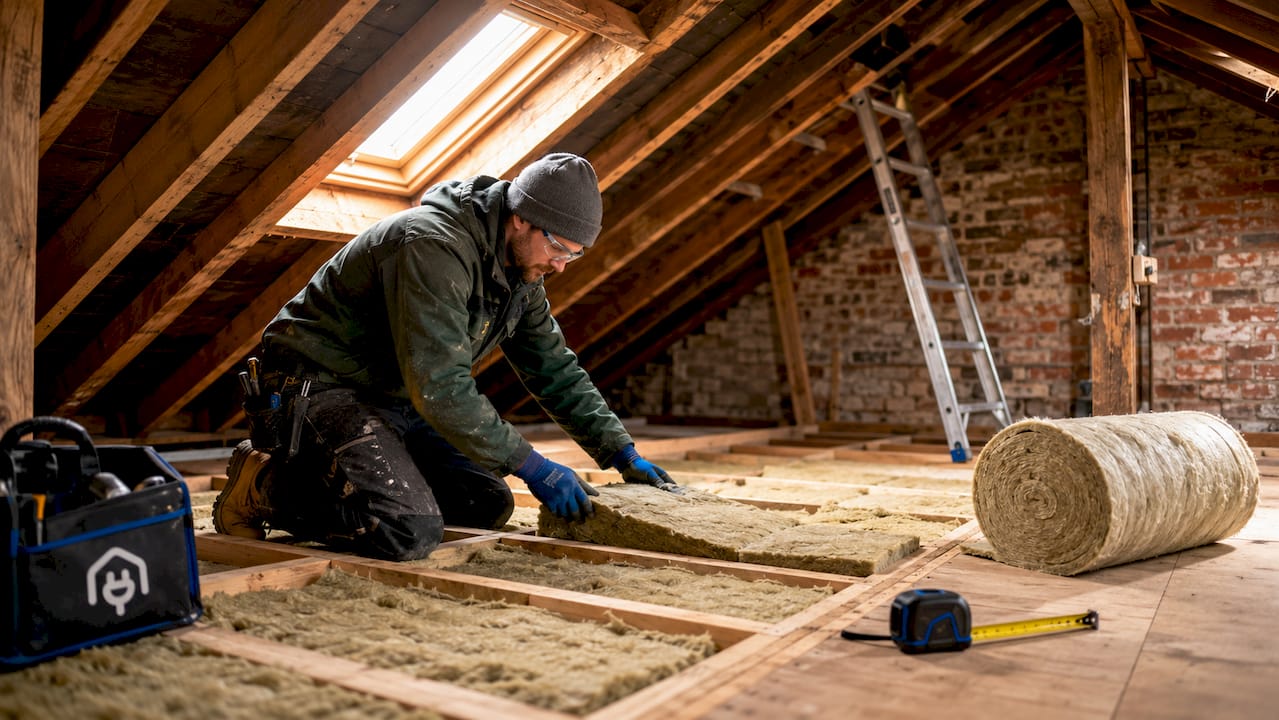
Loft insulation delivers the fastest return on investment of any home insulation solution. Topping up to 270mm mineral wool from below 100mm saves an average semi-detached home around £180 per year. Installation costs range from £300 to £600, with payback typically achieved within 1–3 years. Almost every property with a pitched roof and accessible loft qualifies.
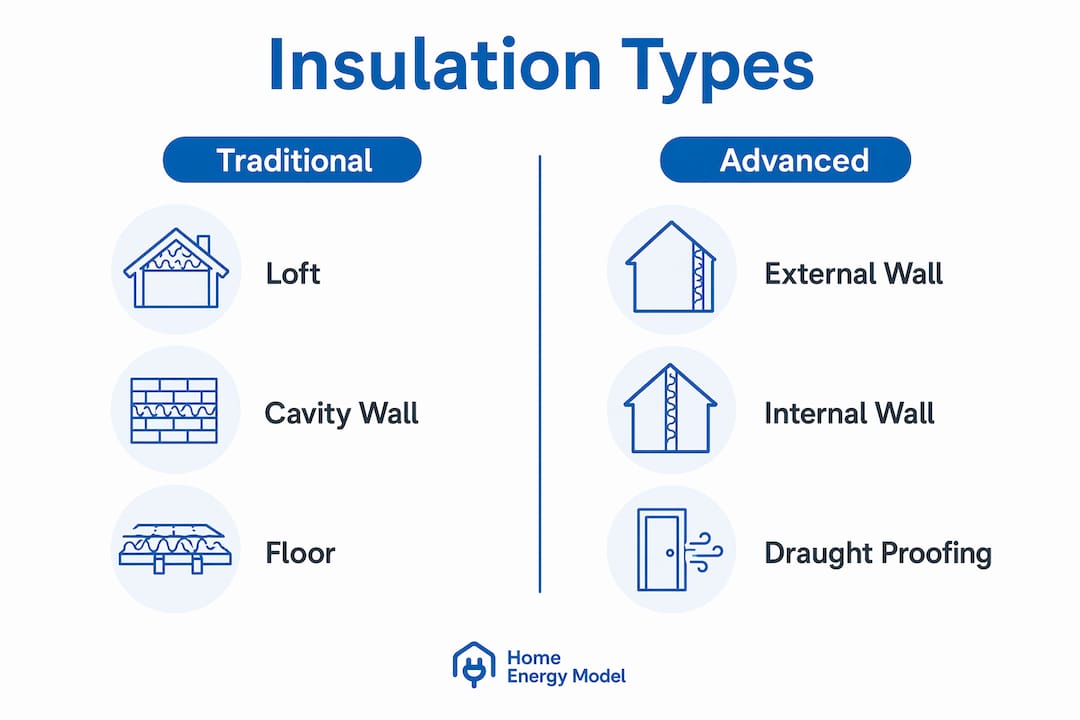
Cavity wall insulation suits homes built after the 1920s, where a gap exists between the inner and outer leaf of the wall. Costs run from £500 to £1,200, with payback in 2–4 years. A specialist installer drills small holes in the outer masonry, injects mineral wool or EPS beads, and seals the holes. The process takes half a day and causes minimal disruption.
Solid wall insulation applies to older properties without a cavity. Two approaches exist:
- Internal wall insulation uses rigid PIR boards or a timber frame filled with mineral wool fixed to the inside face of the wall. It reduces room size slightly but avoids external scaffold costs.
- External wall insulation wraps the outside of the building in insulation board and a render finish. It is more expensive but does not reduce internal floor area and improves weatherproofing.
Both options cost significantly more than loft or cavity work and carry longer payback periods, but they are often the only viable route for pre-1920s solid-wall stock.
Floor insulation and draught-proofing round out the main options. Suspended timber floors can be insulated from below using mineral wool batts between joists, though access is often difficult. Draught-proofing, by contrast, is low cost and quick. Sealing gaps around windows, doors, and floorboards with brush strips or silicone costs very little and complements every other measure.
| Insulation type | Typical cost | Payback period | Best suited to |
|---|---|---|---|
| Loft (270mm mineral wool) | £300–£600 | 1–3 years | Most homes with accessible loft |
| Cavity wall | £500–£1,200 | 2–4 years | Post-1920s homes with wall cavity |
| Internal solid wall | £5,500–£8,500 | 15–25 years | Pre-1920s solid-wall properties |
| External solid wall | £9,000–£13,000 | 20–30 years | Pre-1920s solid-wall properties |
| Draught-proofing | £100–£300 | Under 1 year | All property types |
How do 2026 UK Building Regulations govern insulation?
2026 Approved Document L specifies U-value targets rather than fixed insulation thicknesses. A U-value measures how quickly heat passes through a building element, expressed in W/m²K. Lower numbers mean better thermal performance. The targets for new builds are: roofs at 0.11 W/m²K, walls at 0.18 W/m²K, and floors at 0.13 W/m²K. Retrofit works carry a less stringent wall target of 0.30 W/m²K, reflecting the practical constraints of existing buildings.
Insulation thickness is not fixed by regulation. It depends on the thermal conductivity (lambda value) of the chosen material. Mineral wool has a lambda value of around 0.038 W/mK, requiring approximately 270mm to meet the roof U-value target. Rigid PIR boards have a lambda value closer to 0.022 W/mK, so around 200mm achieves the same result. Choosing the right material for the available space is therefore a technical decision, not just a cost one.
Thermal bridging must be included in U-value calculations. Structural elements such as timber joists, steel lintels, and wall ties conduct heat around insulation layers. Ignoring them produces an optimistic U-value that does not reflect real-world performance. SAP assessments and online calculators account for these bridges when sizing insulation correctly.
New builds face stricter targets than retrofits. Technical feasibility exemptions exist where meeting a target would cause structural damage or disproportionate cost, but these must be documented and justified. Ventilation is a parallel requirement. Adding insulation without addressing airflow creates conditions for condensation and damp.
Pro Tip: Before specifying insulation thickness, confirm the lambda value of the exact product with the manufacturer. Generic values in tables can differ from certified product data, and the difference matters when calculating compliance.
What financial benefits and grants are available in 2026?
The financial case for energy-efficient insulation is clear. Loft and cavity wall insulation offer payback periods of 1–4 years, making them among the best-performing home improvements by return on investment. Solid wall insulation carries higher upfront costs but remains the primary route to significant EPC band improvements for older stock.
EPC rating improvements translate directly into property value. One band improvement adds 1–3% to market value and cuts annual energy bills by £300–£500. For a property worth £300,000, that is up to £9,000 in added value from a single upgrade cycle. For landlords, the calculation also includes legal exposure: minimum EPC standards for rental properties tightened from 2025, making insulation upgrades a compliance requirement, not a discretionary spend.
Government grant schemes reduce the financial barrier significantly:
- ECO4 targets low-income and fuel-poor households, funding loft, cavity wall, and solid wall insulation at no cost to qualifying residents.
- Great British Insulation Scheme extends support to a broader group, covering single insulation measures for homes in lower EPC bands.
Both schemes cover installation at free or discounted rates for eligible households. Eligibility depends on income, property EPC band, and council tax band. Checking eligibility before commissioning private installation work is worth doing, as grant-funded work carries no upfront cost.
Installer certification matters for grant access. TrustMark-registered contractors and those accredited by CIGA (Cavity Insulation Guarantee Agency), BBA (British Board of Agrément), or NIA (National Insulation Association) are required for most funded schemes. Using an uncertified installer disqualifies a property from grant support and may void the installation guarantee.
Pro Tip: Check the EPC rating tips for your property before applying for any grant scheme. Knowing the current band and the measures already recorded on the EPC avoids duplication and speeds up the application process.
What practical steps should homeowners take before insulating?
The fabric-first approach is the correct sequencing principle. Insulate the building fabric before upgrading heating systems. Installing a heat pump in an uninsulated home wastes capital, because heat escapes as fast as the system generates it. Insulation first reduces the heating load, which then determines the correct size and type of heating system.
Inspecting existing insulation before adding more is a step many homeowners skip. Loft insulation that is compressed, damp, or contaminated with debris performs poorly regardless of depth. Topping up over degraded material traps moisture and can cause structural damage. A visual inspection, or a professional survey, confirms whether existing material should be removed or supplemented.
Ventilation deserves equal attention. Poor ventilation when insulating traps moisture, leading to condensation, damp, and mould. This undermines both health and energy efficiency. Trickle vents, mechanical extract ventilation in kitchens and bathrooms, and background ventilation in habitable rooms all need to be checked and maintained when the building envelope is tightened.
Key practical steps before starting any insulation project:
- Confirm the property type and wall construction (cavity or solid) before specifying materials.
- Check the current EPC for existing measures and their recorded depths.
- Obtain at least two quotes from TrustMark or NIA-accredited installers.
- Verify grant eligibility through ECO4 or the Great British Insulation Scheme before committing to private installation.
- Confirm ventilation provision is adequate for the tighter building envelope being created.
Key takeaways
Residential insulation is the single most cost-effective way to improve a UK property’s energy performance, reduce heating bills, and meet 2026 Building Regulations compliance targets.
| Point | Details |
|---|---|
| Loft insulation first | 270mm mineral wool delivers the fastest payback, typically 1–3 years, for most UK homes. |
| U-values set the standard | 2026 Approved Document L targets 0.11 W/m²K for roofs and 0.18 W/m²K for new-build walls. |
| EPC improvement adds value | One band improvement raises property value by 1–3% and saves £300–£500 per year in energy bills. |
| Grants reduce upfront cost | ECO4 and the Great British Insulation Scheme fund free or discounted installation for eligible households. |
| Ventilation is non-negotiable | Tightening the building envelope without addressing airflow risks damp, mould, and structural damage. |
Why insulation decisions in 2026 require a different mindset
The conventional view treats insulation as a comfort upgrade. That framing is now outdated. Since 2025, rental property EPC standards have tightened, and landlords who have not acted face real legal and financial exposure. Insulation is no longer a discretionary improvement. It is a compliance asset.
What I find most underappreciated is the summer thermal comfort argument. Most homeowners focus on winter heat retention, but the same fabric improvements that keep heat in during winter slow heat gain during summer. The Warm Homes Plan explicitly recognises this, recommending fabric interventions alongside blinds and reflective films to manage overheating risk. As UK summers become warmer, this dual benefit will matter more.
The fabric-first principle also protects investment in heating technology. Property owners who install heat pumps before insulating often find the system oversized for the post-insulation heat load. That means higher upfront equipment costs and lower running efficiency. Getting the building fabric right first is not just good practice. It is the financially rational sequence.
My consistent observation is that properties with correct insulation, properly documented on the EPC, sell faster and let more easily. Buyers and tenants are increasingly aware of energy costs. An EPC band C or above is becoming a baseline expectation, not a selling point.
— Danny
How Homeenergymodel supports your insulation upgrade
Homeenergymodel provides property owners and investors with the technical guidance needed to make insulation decisions that hold up under regulatory scrutiny. Understanding how insulation choices affect your EPC band, your compliance position under Approved Document L, and your property’s long-term value requires more than a contractor’s quote. It requires proper energy modelling.
The types of home energy models available through Homeenergymodel help identify the most effective upgrade pathway for each property type, whether a Victorian terrace or a modern flat. Homeenergymodel also provides guidance on energy simulation for housing, so property owners can model the impact of insulation measures before committing to installation costs. For landlords facing compliance deadlines, that clarity is worth having early.
FAQ
What is the minimum loft insulation depth under UK Building Regulations?
The Energy Saving Trust recommends a minimum of 270mm mineral wool for loft insulation to meet current standards. Topping up from below 100mm to 270mm saves an average semi-detached home around £180 per year.
Does insulation improve an EPC rating?
Yes. Insulation improvements are among the most effective measures for raising an EPC band. One band improvement adds 1–3% to property value and reduces annual energy bills by £300–£500.
What U-value does a wall need to meet 2026 Building Regulations?
New-build walls must achieve 0.18 W/m²K under 2026 Approved Document L. Retrofit wall upgrades carry a less stringent target of 0.30 W/m²K, reflecting the constraints of existing construction.
Can I get free insulation through a government scheme?
ECO4 and the Great British Insulation Scheme offer free or discounted insulation for eligible households. Eligibility depends on income, EPC band, and council tax band.
Do I need planning permission to install external wall insulation?
External wall insulation on most houses falls under permitted development and does not require planning permission. Properties in conservation areas or listed buildings require consent before any external changes.