

TL;DR:
- Heat pumps are the most efficient heating technology available to UK homeowners today due to their ability to move heat from outside air or ground into homes. Combining heat pumps with proper insulation reduces energy consumption and cost by around 30 percent, making the whole-house approach essential for maximum savings. The choice between air-source and ground-source heat pumps depends on space, budget, and existing infrastructure, with proper maintenance and system matching further enhancing efficiency.
Heat pumps are the most efficient standard heating technology available to UK homeowners today. A heat pump paired with comprehensive insulation delivers the best combination of low running costs, reduced carbon emissions, and compliance with the UK’s tightening energy regulations. Understanding what is the most efficient way to heat your home matters more than ever as the Future Homes Standard and updated EPC requirements reshape what landlords and homeowners must achieve. This guide covers the technology, the building fabric, and the daily habits that together produce the greatest savings.
What makes heat pumps the most efficient heating systems?
Heat pumps do not generate heat. They move it from outside air or the ground into your home, which is why they outperform every combustion-based system on efficiency. A gas boiler converts fuel into heat at a maximum ratio of roughly one unit of heat per unit of fuel burned. A heat pump delivers multiple units of heat for every unit of electricity consumed.
The standard measure for this is the Coefficient of Performance, or COP. It expresses how many units of heat a system delivers per unit of electricity used. Geothermal heat pumps achieve a COP of 3.0–5.0, while air-source heat pumps typically reach 2.0–4.0. That means even a modest air-source unit delivers at least twice the heat output of an electric resistance heater running on the same electricity.
Cost comparisons reinforce this advantage. Heat pumps cost significantly less to run than electric resistance heating, and in areas with competitive electricity tariffs they can undercut gas too. The gap widens as the electricity grid becomes greener, because heat pumps reduce fossil fuel reliance and benefit directly from increasing renewable generation.
Air-source vs ground-source heat pumps
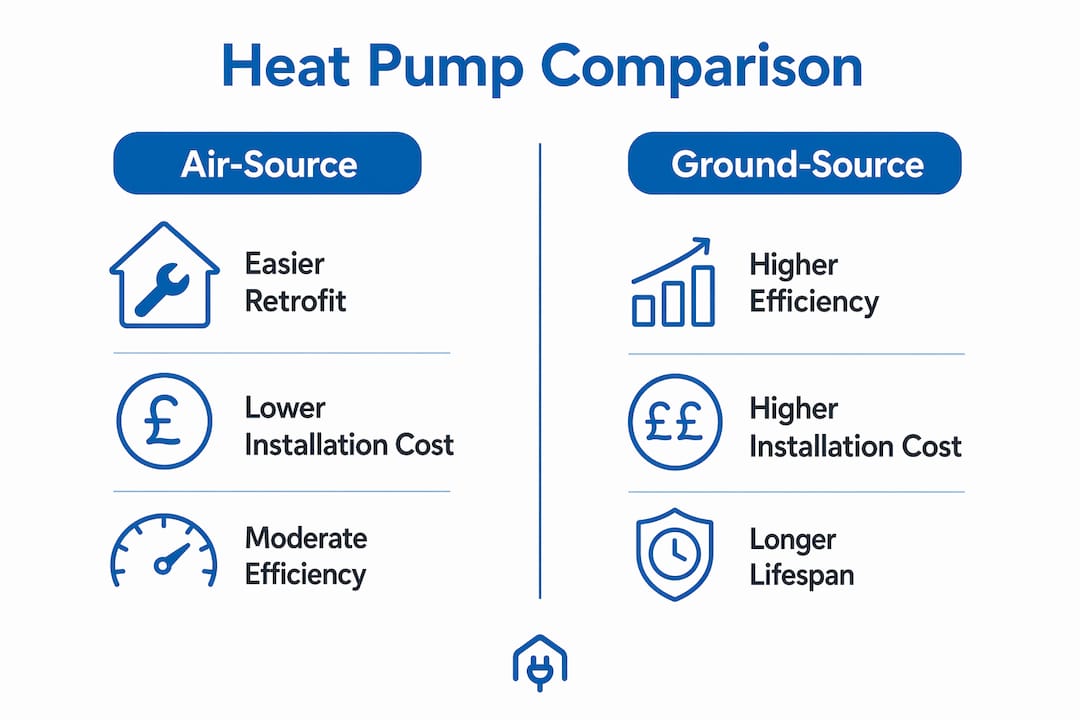
Air-source heat pumps (ASHPs) extract heat from outdoor air and are the most common choice for UK retrofits. They are easier to install and carry a lower upfront cost than ground-source alternatives. Ground-source heat pumps (GSHPs) use buried pipework to draw heat from the earth, achieving higher and more stable COP values because ground temperature stays consistent year-round.
The right choice depends on available outdoor space, budget, and the existing heat distribution system inside the property. Both types work best when the home is well insulated and the heat emitters, whether radiators or underfloor heating, are correctly sized.
Keeping heat pump efficiency high
- Service the unit annually to maintain refrigerant charge and airflow.
- Keep outdoor units clear of debris, ice, and obstructions.
- Check and replace air filters every three months.
- Avoid frequent large temperature setbacks, which force the system into an energy-intensive auxiliary heat mode.
- Match the heat pump to the correct heat emitter type to avoid efficiency losses.
Does insulation really make that much difference?
Insulation is not a secondary consideration. It is the foundation that determines how hard any heating system must work. A heat pump installed in a poorly insulated home will run longer, consume more electricity, and deliver a worse COP than the same unit in a well-sealed property.
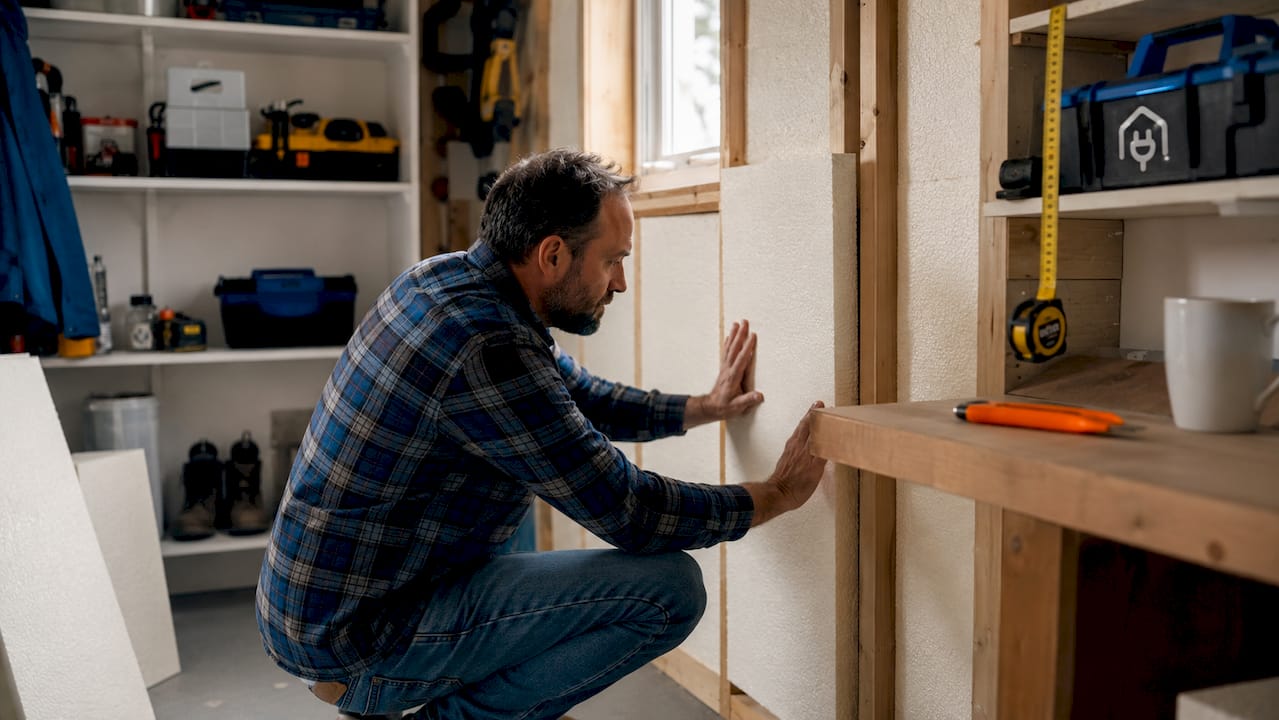
Combining equipment upgrades with insulation and air sealing reduces heating bills by around 30% compared with equipment changes alone. That figure reflects the whole-house approach: treating the building fabric and the heating system as a single system rather than separate projects. For UK homeowners facing rising energy costs, that 30% reduction translates directly into hundreds of pounds saved each year.
Air leaks are the most underestimated source of heat loss. Gaps around windows, loft hatches, pipework penetrations, and skirting boards allow warm air to escape and cold air to enter continuously. Draught-proofing these points costs very little but delivers immediate results. Loft insulation, cavity wall insulation, and solid wall insulation address the larger losses and are eligible for government grant support through schemes such as the Great British Insulation Scheme.
Low-carbon heating options like heat pumps depend on building fabric for peak efficiency. A heat pump in a draughty Victorian terrace will underperform relative to its rated COP. The same unit in a well-sealed, well-insulated home will operate at or near its best figures throughout the heating season.
Pro Tip: Commission a whole-house retrofit assessment before choosing a heating system. A qualified assessor will identify the specific air leakage points and insulation gaps in your property, allowing you to sequence improvements correctly and avoid oversizing or undersizing the new system.
Insulation improvements worth prioritising
- Loft insulation: The single highest-return fabric improvement for most UK homes.
- Cavity wall insulation: Suitable for properties built after the 1920s with unfilled cavity walls.
- Solid wall insulation: Internal or external, required for older solid-wall properties.
- Floor insulation: Suspended timber floors lose significant heat; rigid insulation boards between joists address this.
- Draught-proofing: Windows, doors, loft hatches, and service penetrations should all be sealed.
Homeenergymodel’s home retrofit tips guide covers sequencing these improvements to maximise return on investment.
Comparing common home heating options
Different systems suit different properties, budgets, and energy goals. The table below sets out the key distinctions across the most common options available to UK homeowners and tenants.
| Heating system | Efficiency measure | Typical efficiency | Running cost | Carbon emissions | Best suited to |
|---|---|---|---|---|---|
| Gas condensing boiler | AFUE | Up to 98% | Moderate | High | Homes with gas supply and existing radiators |
| Air-source heat pump | COP | 2.0–4.0 | Low to moderate | Low (grid-dependent) | Well-insulated homes, retrofit and new build |
| Ground-source heat pump | COP | 3.0–5.0 | Low | Very low | Homes with outdoor land, new build |
| Electric resistance heating | Efficiency ratio | 100% | High | Moderate to high | Small spaces, supplementary use only |
| Biomass boiler | AFUE | 70–90% | Low to moderate | Near-zero (carbon-neutral) | Rural homes off the gas grid |
AFUE, or Annual Fuel Utilisation Efficiency, measures how much of a fuel’s energy a combustion system converts to heat over a full year. A 98% AFUE boiler wastes only 2% of the gas it burns. COP, by contrast, measures heat moved per unit of electricity, and a COP of 3.0 means 300% of the electrical input is delivered as heat. This is why direct percentage comparisons between boilers and heat pumps mislead. A 98% AFUE boiler and a heat pump with a COP of 3.0 are not comparable: the heat pump delivers three times the thermal output per unit of energy consumed.
No single heating system is ideal for every home. The right choice depends on insulation levels, climate zone, existing heat distribution infrastructure, and budget. Homeowners should evaluate all four factors before committing to any system.
Practical tips to heat your home efficiently and reduce bills
Efficient heating is not only about the system installed. Daily habits and correct system management account for a meaningful share of total energy use.
- Set the thermostat correctly. The Energy Saving Trust recommends 18–21°C for living areas. Each degree above this adds measurably to running costs.
- Use a programmable or smart thermostat. Devices such as Nest or Hive allow precise scheduling so the system only heats occupied rooms at occupied times.
- Apply zone heating. Only heat rooms in active use. Thermostatic radiator valves (TRVs) on individual radiators give room-by-room control without a full smart system.
- Bleed radiators annually. Trapped air reduces heat output and forces the boiler or heat pump to work harder to reach the set temperature.
- Service the heating system every year. Annual servicing of boilers and heat pumps maintains rated efficiency and identifies faults before they become expensive.
- Avoid large temperature setbacks with heat pumps. Heat pumps require stable thermostat settings rather than large overnight drops. Recovering from a significant setback triggers auxiliary electric resistance heating, which is far less efficient.
- Consider solar PV. Pairing a heat pump with rooftop solar panels reduces the net electricity cost of heating, particularly during daylight hours in spring and autumn.
Pro Tip: If you rent your property, ask your landlord about the EPC rating. Properties rated below E are already subject to Minimum Energy Efficiency Standards (MEES) regulations. A low rating often signals poor insulation that is costing you money on every heating bill.
Homeenergymodel’s guide to reducing home energy bills covers additional measures applicable to both owned and rented properties across the UK.
Heat distribution compatibility is a factor many homeowners overlook. High-temperature heat pumps can work with existing radiators, but standard models require low-temperature systems such as underfloor heating or oversized radiators. Installing the wrong combination wastes the efficiency gains the heat pump would otherwise deliver.
Key takeaways
A heat pump combined with thorough insulation and correct heat distribution is the most cost-effective and carbon-efficient way to heat a UK home in 2026.
| Point | Details |
|---|---|
| Heat pumps lead on efficiency | Air-source units achieve a COP of 2.0–4.0; ground-source units reach 3.0–5.0, far exceeding gas boilers. |
| Insulation multiplies savings | Combining insulation with a new system reduces heating bills by around 30% more than equipment change alone. |
| Efficiency metrics differ | COP and AFUE measure different things; a heat pump with COP 3.0 outperforms a 98% AFUE boiler on energy delivered. |
| Stable thermostat settings matter | Large temperature setbacks force heat pumps into auxiliary mode, significantly reducing efficiency. |
| Heat distribution must match the system | Mismatched emitters, such as undersized radiators with a standard heat pump, undermine the efficiency gains. |
Why the whole-house view changes everything
Most articles on efficient home heating focus on the heating unit itself. That framing misses the point. The system that heats a home is the building and the equipment together, not the boiler or heat pump in isolation.
I have seen homeowners invest in a high-specification ground-source heat pump only to find their bills barely changed, because the property still lost heat through an uninsulated loft and draughty sash windows. The equipment was excellent. The building was not ready for it. Upfront costs of heat pumps are recouped in 5–10 years when paired with insulation, but that payback period stretches considerably when the fabric work is skipped.
The other misconception I encounter regularly is about efficiency ratings. Homeowners see a gas boiler advertised at 98% efficiency and assume a heat pump cannot beat that. Consumers often misunderstand efficiency ratings because the percentage framing does not translate across different measurement systems. A COP of 3.0 means 300% efficiency in the terms a boiler manufacturer would use. Once that clicks, the case for heat pumps becomes straightforward.
The practical advice I give consistently is this: get a proper whole-house assessment before spending anything. Understand your building’s heat loss, your existing heat distribution system, and your local electricity tariff. Then choose the system. Skipping that sequence is the most common and most expensive mistake in home heating upgrades.
— Danny
How Homeenergymodel can support your heating decisions
Choosing the right heating system for a UK property requires more than a product comparison. It requires an accurate picture of how the building performs today and what improvements will deliver the greatest return. Homeenergymodel provides resources and guidance on home energy assessments that identify exactly where a property loses energy and what changes will have the most impact. For landlords navigating MEES compliance and the upcoming Future Homes Standard, understanding your property’s EPC rating and energy model is the essential first step before committing to any heating upgrade. Professional energy modelling removes the guesswork from those decisions and supports long-term compliance.
FAQ
What is the most efficient heating system for a UK home?
A heat pump is the most efficient heating system available. Air-source models achieve a COP of 2.0–4.0, meaning they deliver two to four units of heat per unit of electricity consumed.
How does insulation affect heating efficiency?
Good insulation reduces the amount of heat a system must generate to maintain a comfortable temperature. Combining insulation improvements with a new heating system reduces bills by around 30% more than replacing the system alone.
What does COP mean for heat pumps?
COP stands for Coefficient of Performance. A COP of 3.0 means the heat pump delivers three units of heat for every one unit of electricity it uses, making it far more efficient than any combustion-based system.
Can tenants benefit from heating efficiency improvements?
Tenants benefit directly from lower bills in well-insulated properties. Under MEES regulations, landlords must meet minimum EPC standards, so tenants in poorly rated properties have grounds to request improvements.
Should a heat pump replace a gas boiler in every home?
Not necessarily. The right system depends on insulation levels, existing heat distribution infrastructure, and budget. A professional whole-house assessment is the correct starting point before any system replacement.