

Most british homeowners are surprised to learn that over 13% of households struggle with fuel poverty, often due to confusing home energy terminology. As energy regulations tighten and efficiency requirements become more ambitious across the United Kingdom, understanding the right terms has never been more crucial. By unpacking essential home energy concepts, this guide offers the clarity property owners and professionals need to make smarter choices about energy consumption and compliance.
Table of Contents
- Key Home Energy Terms Defined
- Types of Energy Performance Measurements
- How EPCs, SAP, and HEM Interconnect
- Essential Water and Energy Efficiency Terms
- Legal Requirements Under UK Regulations
- Risks, Costs, and Common Assessment Mistakes
Key Takeaways
| Point | Details |
|---|---|
| Understanding Key Terms is Essential | Familiarity with home energy terminology like Fuel Poverty, Energy Efficiency, and Decarbonisation is crucial for informed decision-making in energy management. |
| Energy Performance Measurements Guide Improvements | Systems such as Energy Performance Certificates (EPCs) and Display Energy Certificates (DECs) provide essential insights for enhancing building efficiency and reducing carbon emissions. |
| Legal Compliance is Critical | Awareness of UK energy regulations, including Minimum Energy Efficiency Standards (MEES), is vital to avoid penalties and promote sustainable practices. |
| Mitigating Risks in Assessments is Necessary | Recognising potential discrepancies between predicted and actual energy performance is key to optimising investments and avoiding financial pitfalls. |
Key Home Energy Terms Defined
Home energy terminology plays a critical role in understanding how properties consume, manage, and optimise energy resources. From efficiency ratings to technical specifications, these terms help property owners, landlords, and building professionals navigate the complex landscape of energy performance.
When exploring domestic energy terminology, several key concepts emerge that are essential for comprehending energy consumption. Fuel poverty represents a significant challenge where households cannot afford adequate warmth, typically defined as spending more than 10% of household income on energy costs. This concept highlights the intersection between energy pricing, household income, and property efficiency.
Critical terms in the home energy sector include energy efficiency, which measures how effectively a property uses energy, and decarbonisation, the process of reducing carbon emissions through technological and strategic interventions. These concepts are increasingly important as the United Kingdom moves towards net zero carbon targets. Property stakeholders must understand terms like thermal performance, which evaluates how well a building retains heat, and energy performance certificates (EPCs), standardised documents that rate a property’s energy efficiency on a scale from A (most efficient) to G (least efficient).
Understanding these fundamental home energy terms empowers property owners to make informed decisions about energy consumption, retrofit investments, and sustainability strategies. By mastering this terminology, individuals can better navigate the evolving landscape of energy efficiency and contribute to broader national goals of reducing carbon emissions and addressing fuel poverty.
Types of Energy Performance Measurements
Energy performance measurements provide critical insights into how buildings consume and manage energy resources, offering property owners and professionals a comprehensive understanding of efficiency and sustainability. These standardised assessments help identify opportunities for improvement and track progress towards reducing carbon emissions.
The UK government has developed several key energy performance measurement systems to evaluate property efficiency. Display Energy Certificates (DECs) are particularly important for public buildings, assessing actual energy consumption and providing a transparent view of real-world performance. Energy Performance Certificates (EPCs) represent another crucial measurement tool, rating residential properties on a scale from A to G based on their theoretical energy efficiency potential.

Additional measurement frameworks include the National Home Energy Rating (NHER) scheme, which offers a more holistic assessment of residential energy consumption. This comprehensive approach considers multiple factors such as heating systems, lighting efficiency, appliance energy use, and overall thermal performance. By examining these diverse metrics, property stakeholders can develop targeted strategies for improving energy efficiency and reducing environmental impact.
Understanding these different energy performance measurements enables property owners, landlords, and developers to make informed decisions about energy investments, retrofit strategies, and sustainability improvements. Each measurement system provides unique insights, helping stakeholders create more energy-efficient, cost-effective, and environmentally responsible buildings across the United Kingdom.
How EPCs, SAP, and HEM Interconnect
Home energy assessment methodologies form a complex network of interconnected systems designed to evaluate and improve property energy performance. These frameworks provide comprehensive insights into how buildings consume, manage, and potentially reduce energy resources across the United Kingdom.
The Standard Assessment Procedure (SAP) represents a critical foundation in this interconnected ecosystem, serving as the primary method for calculating energy performance in residential properties. Energy Performance Certificates (EPCs) are directly produced using SAP calculations, creating a direct link between these assessment tools. This methodology allows for a standardised approach to measuring a dwelling’s energy efficiency, rating properties on a scale from A (most efficient) to G (least efficient).
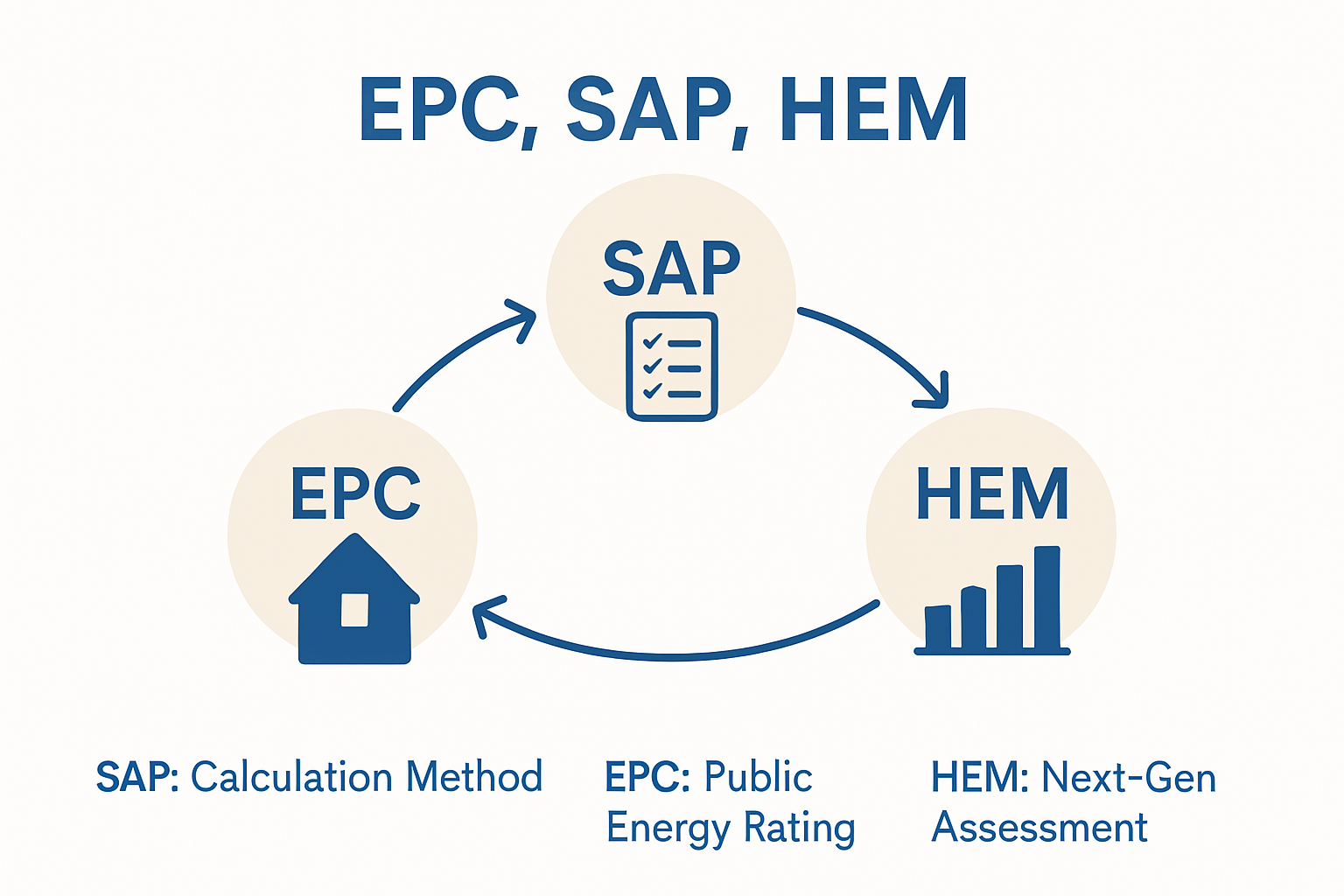
The emerging Home Energy Model (HEM) is set to transform this landscape by introducing more sophisticated, dynamic assessments of energy performance. Unlike traditional static measurements, HEM promises to incorporate real-time data and more nuanced factors such as occupant behaviour, technological advancements, and localised environmental conditions. This approach represents a significant evolution from previous methodologies, offering a more holistic and responsive framework for understanding residential energy consumption.
Understanding the intricate relationships between EPCs, SAP, and HEM enables property owners, developers, and energy professionals to make more informed decisions about energy efficiency improvements. These interconnected systems not only provide valuable insights into current performance but also guide strategic investments in sustainable building technologies and retrofit strategies.
Essential Water and Energy Efficiency Terms
Energy and water efficiency terminology provides a critical framework for understanding how properties consume and manage critical resources. These specialised terms help property owners, developers, and environmental professionals communicate complex concepts related to sustainable building practices and resource management.
Key terminology includes decarbonisation, which represents the process of reducing carbon emissions through strategic technological interventions. Water efficiency calculations encompass technical assessments that measure water consumption, identifying opportunities for reduction and conservation. Thermal performance describes how effectively a building retains heat, directly influencing both energy consumption and overall environmental impact.
Additional crucial terms include embodied energy, which represents the total energy consumed in producing, transporting, and installing building materials, and net zero, describing the balance between carbon emissions produced and carbon emissions removed from the atmosphere. Dwelling is a technical term referring to a self-contained residential unit, providing a precise definition for housing-related energy and water efficiency assessments.
Understanding these essential water and energy efficiency terms empowers property stakeholders to make informed decisions about sustainable building practices. By mastering this specialised vocabulary, individuals can better navigate complex environmental regulations, implement effective conservation strategies, and contribute to broader national goals of reducing carbon emissions and promoting resource efficiency.
Legal Requirements Under UK Regulations
Energy regulation frameworks create essential guidelines for property owners, developers, and landlords to ensure sustainable building practices and environmental compliance. These legal requirements represent a comprehensive approach to managing energy performance across residential and commercial properties in the United Kingdom.
Public buildings face stringent UK building regulations that mandate transparent energy performance reporting. For instance, buildings exceeding 250 square metres must prominently display Display Energy Certificates (DECs), providing clear insights into actual energy consumption. Minimum Energy Efficiency Standards (MEES) represent another critical legal requirement, preventing landlords from leasing properties with extremely low energy performance ratings, typically those falling below an Energy Performance Certificate (EPC) rating of E.
The Domestic Minimum Energy Efficiency Standard introduces specific obligations for residential properties, requiring landlords to invest in energy efficiency improvements when rental properties fail to meet minimum performance thresholds. Energy Performance Certificates have become a crucial legal document, providing a standardised assessment of a property’s energy efficiency and potential carbon emissions, with penalties for non-compliance potentially including significant financial sanctions.
Understanding these legal requirements is paramount for property stakeholders, as compliance not only avoids potential financial penalties but also contributes to broader national objectives of reducing carbon emissions and promoting sustainable building practices. By navigating these regulations proactively, property owners can make informed investments in energy efficiency, ultimately benefiting both their financial interests and environmental responsibilities.
Risks, Costs, and Common Assessment Mistakes
Energy performance assessments involve complex evaluations that can expose significant financial and operational risks for property owners and developers. Understanding these potential pitfalls is crucial for making informed decisions about energy efficiency investments and compliance strategies.
Research highlights notable discrepancies between predicted and actual energy performance in building assessments. Performance gaps represent a critical risk, where theoretical energy calculations dramatically differ from real-world consumption patterns. Non-domestic buildings frequently experience substantial variations, with assessment models potentially underestimating actual energy usage by up to 200%, leading to unexpected operational costs and reduced energy efficiency.
Common assessment mistakes include oversimplified thermal modelling, inadequate consideration of occupant behaviour, and failing to account for complex building systems. Thermal bridging, air infiltration, and equipment performance are frequently overlooked factors that can significantly impact energy consumption. Comprehensive assessments must incorporate dynamic simulation techniques that capture the nuanced interactions between building design, technological systems, and human interaction.
Mitigating these risks requires a holistic approach that combines rigorous technical assessment, ongoing monitoring, and adaptive management strategies. Property stakeholders must invest in detailed, multi-dimensional energy performance evaluations that provide realistic projections, helping to minimise financial risks and optimise long-term energy efficiency investments.
Understand Key Home Energy Terms Effortlessly and Take Control of Your Property’s Efficiency
Navigating complex home energy terminology such as fuel poverty, thermal performance, and decarbonisation can feel overwhelming. This essential UK guide highlights the challenges property owners and landlords face in understanding energy ratings like EPCs and the upcoming Home Energy Model (HEM). If you want to confidently manage your property’s energy consumption and meet evolving government regulations, gaining clear knowledge and practical tools is vital.
Discover how HomeEnergyModel.co.uk can empower you with the latest insights on energy performance standards and calculations. Learn more about the transition from SAP to HEM and explore expert advice on water and energy efficiency. Start future-proofing your property today with trusted resources and guidance tailored specifically for the UK market. Visit our site now to unlock straightforward explanations and take the next step towards sustainable and compliant property management.
Frequently Asked Questions
What is fuel poverty?
Fuel poverty occurs when households cannot afford adequate warmth, typically defined as spending more than 10% of their household income on energy costs.
How do Energy Performance Certificates (EPCs) work?
EPCs provide a standardised assessment of a property’s energy efficiency, rating it on a scale from A (most efficient) to G (least efficient), based on theoretical energy consumption potential.
What is decarbonisation in the context of home energy?
Decarbonisation refers to the process of reducing carbon emissions through technological and strategic interventions aimed at making energy systems more sustainable.
What is thermal performance and why is it important?
Thermal performance measures how well a building retains heat, which significantly impacts energy consumption and overall environmental sustainability.
Recommended
- Domestic Energy Terminology: Complete UK Guide
- Home Energy Efficiency Terms: Complete UK Guide
- Energy Consumption in UK Homes Explained: Key Facts
- Complete Guide to Domestic Energy Use (UK)
- The Essential Guide to Saving Energy at Home – Projector Display
- Energy-Efficient Shutters: Smart Solutions for UK Homes 2025 | Shutter World