

Rising energy bills and confusing tariff options leave many UK households frustrated and overpaying. Switching energy suppliers in 2026 is simpler than ever, typically completing within just three to five working days thanks to Ofgem’s Faster Switching Programme. Whether you’re a homeowner seeking lower costs or a landlord navigating new energy efficiency regulations, understanding the switching process can unlock annual savings of £150 to £300 whilst helping you comply with upcoming government standards. This guide walks you through preparation, execution, and troubleshooting to ensure a smooth transition.
Table of Contents
- What You Need Before Switching Energy Suppliers
- Step By Step Guide To Switching Your Energy Supplier
- Avoiding Common Mistakes And Troubleshooting Switch Delays
- Energy Efficiency And Regulatory Considerations For Landlords In 2026
- Explore Expert Home Energy Models And Solutions
- Frequently Asked Questions
Key takeaways
| Point | Details |
|---|---|
| Fast switching | Most switches complete within 3 to 5 working days under Ofgem rules |
| Potential savings | Households can save £150 to £300 annually by choosing better tariffs |
| Exit fees | Fixed tariffs typically charge £30 to £50 per fuel if ended early |
| Landlord compliance | Properties must reach EPC rating C by 2030 or face fines up to £30,000 |
| Accurate readings | Provide actual meter readings on switch day to prevent billing errors |
What you need before switching energy suppliers
Before initiating a switch, gather essential information to streamline the process and avoid delays. When switching suppliers, have the following information ready: current supplier name, current tariff name, energy usage amount, payment method, and postcode. This data ensures your new provider can process the transfer accurately and quickly.
Start by identifying your current supplier and tariff details, which appear on recent bills or online account statements. Knowing your average monthly or annual energy usage helps you compare tariffs effectively and select options that match your consumption patterns. Your payment method, whether direct debit, prepayment, or standard credit, influences which tariffs are available and how quickly billing transitions occur.
Check whether you’re on a fixed tariff, as exiting early often incurs fees. Review your contract end date and any exit penalties before committing to a new supplier. Understanding your meter type is equally important. Smart meters, traditional meters, prepayment meters, and Radio Teleswitching Service (RTS) meters each have different implications for switching and billing accuracy.
Landlords face additional considerations due to regulatory pressures. Properties must meet minimum energy efficiency standards, making supplier choice and tariff selection critical for compliance. Renewable energy tariffs or those supporting heat pumps and electric vehicle charging can reduce emissions and align with government initiatives.
Pro Tip: Take actual meter readings the day before you plan to switch. Estimated readings can cause billing disputes and delay your final account settlement with the old supplier.
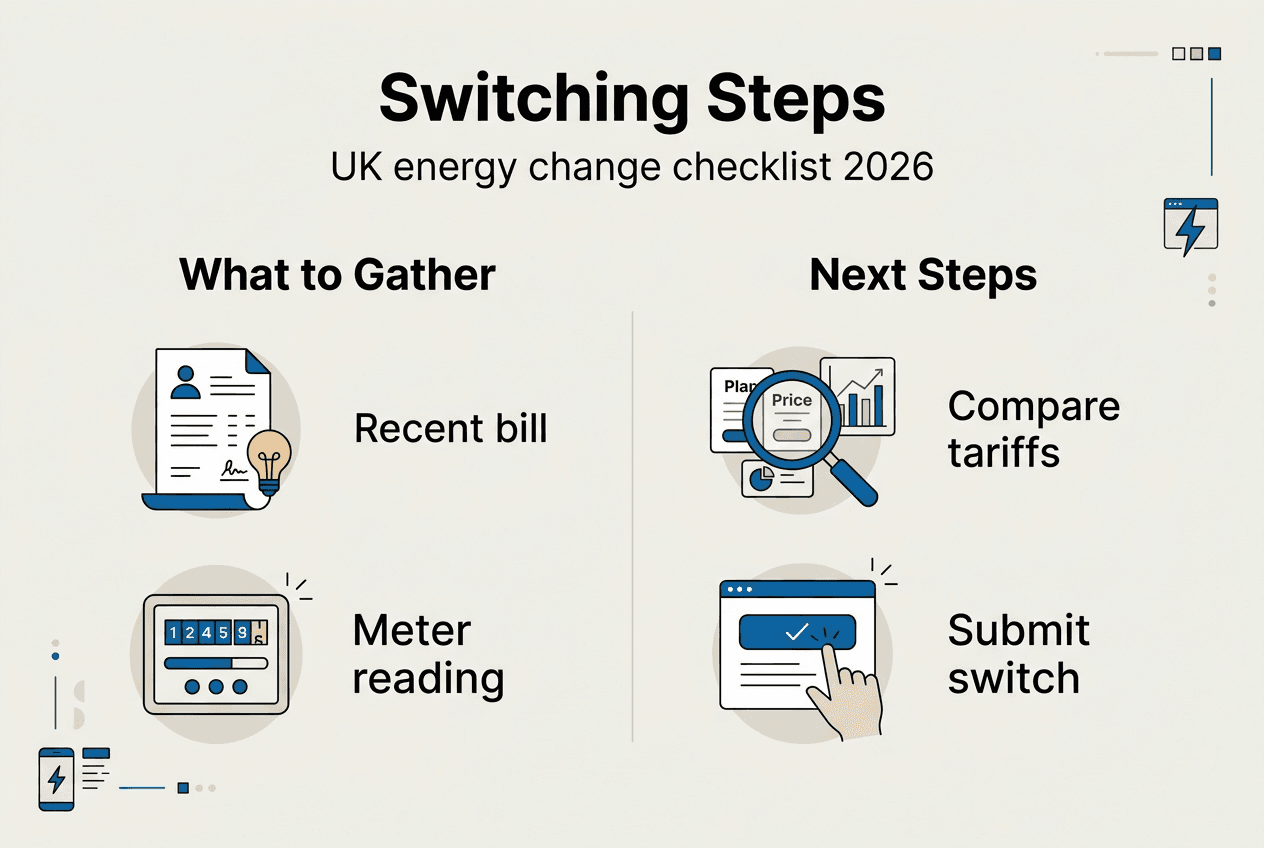
Gather recent actual meter readings for both electricity and gas. These figures ensure your final bill from the old supplier reflects true consumption, preventing overcharges or undercharges that complicate account closure. Accurate readings also help your new supplier set up billing correctly from day one.
For more detailed guidance on the overall switching process, explore how to switch energy supplier UK resources that cover preparation and execution steps comprehensively.
Step by step guide to switching your energy supplier
Once you’ve prepared your information, follow these steps to execute a smooth switch. The process is straightforward, with most administrative tasks handled by your new supplier.
-
Compare tariffs and select a new supplier. Use independent comparison tools to evaluate tariffs based on your annual consumption data. Look beyond headline rates to understand standing charges, payment method discounts, and contract lengths. Consider renewable energy options if sustainability is a priority.
-
Submit accurate meter readings. On the day you initiate the switch, take actual meter readings for all fuels. Provide these readings to both your old and new suppliers. This step is critical to ensure your final bill from the old supplier is accurate and your new supplier starts billing from the correct baseline.
-
Allow the new supplier to manage the switch. Your new supplier contacts your old supplier and handles administrative tasks including account transfers and meter point registration. You don’t need to notify your old supplier directly. Most UK households can switch energy suppliers within 3 to 5 working days under Ofgem’s Faster Switching Programme.
-
Monitor the switch timeline. The switching process typically involves selecting a new supplier, providing necessary information including meter readings, and allowing the new supplier to handle the switch. Track your switch status through your new supplier’s online portal or customer service channels.
-
Understand your cooling off period. If you’ve signed a fixed contract, you have a 14 day cooling off period during which you can cancel without penalty. This protection applies from the date you agree to the contract, not from the switch completion date.
-
Check for exit fees before finalising. If you’re leaving a fixed tariff before the contract end date, exit fees typically apply. These fees usually range from £30 to £50 per fuel, though some suppliers charge higher amounts. Calculate whether potential savings from a new tariff outweigh exit fees.
Pro Tip: Set a calendar reminder for two weeks before your fixed tariff ends. This timing allows you to compare tariffs and switch seamlessly without incurring exit fees or rolling onto a more expensive variable rate.
| Switch stage | Typical timeline | Key action |
|---|---|---|
| Application submitted | Day 0 | Provide meter readings and account details |
| Old supplier notified | Day 1 | New supplier contacts old supplier |
| Switch processed | Days 2 to 4 | Meter point transferred to new supplier |
| Switch completed | Day 3 to 5 | Billing starts with new supplier |
| Final bill issued | Days 7 to 14 | Old supplier sends final account statement |
Smart meter users benefit from faster, more accurate switches since meter readings transfer automatically. However, some smart meters lose functionality when switching between suppliers, particularly first generation SMETS1 devices. Check whether your smart meter will remain operational with your new supplier. For more information on smart meter impacts, visit smart meter impacts UK homes to understand compatibility and functionality issues.
Avoiding common mistakes and troubleshooting switch delays
Even straightforward switches can encounter problems if you overlook key details. Understanding common mistakes helps you prevent delays and resolve issues quickly.
Always use actual meter readings rather than estimates. Using estimated meter readings instead of actual readings is a common mistake to avoid. Estimated readings cause billing discrepancies that can delay account closure and complicate the switch process. Take photos of your meter displays as evidence if disputes arise.
Verify that your information matches your address and account details exactly. Mismatched postcodes, misspelled names, or incorrect meter serial numbers trigger validation failures that halt the switch. Double check all fields before submitting your application.
Track your switch status and keep evidence of all communications. Save confirmation emails, reference numbers, and notes from phone calls. If delays occur, this documentation supports complaints and compensation claims.
Understand that not all delays qualify for compensation. Customer errors such as providing wrong meter readings or incomplete information do not trigger compensation payments. However, if your supplier fails to meet Ofgem’s switching timelines without valid cause, you may be entitled to automatic compensation under Guaranteed Standards of Performance.
Common scenarios that cause delays include objections from your old supplier, outstanding debt on your account, or technical issues with meter registration. If your old supplier objects to the switch, contact them directly to resolve the issue. Outstanding debt typically prevents switches until you settle the balance or agree a payment plan.
If your switch exceeds five working days without valid explanation, escalate the issue through your new supplier’s complaints process. Keep records of all attempts to resolve the problem. If the supplier fails to address your complaint within eight weeks, or if you’re dissatisfied with their response, contact the Energy Ombudsman for independent resolution.
Pro Tip: Screenshot your meter readings with a timestamp on switch day. This evidence protects you if billing disputes arise and provides clear proof of consumption at the transfer point.
Be prepared to provide additional documentation if requested. Some suppliers require proof of identity or address, particularly for new customers or properties with complex billing histories. Having these documents ready accelerates verification and prevents unnecessary delays.
For guidance on avoiding common pitfalls, review switching mistakes to avoid resources that detail frequent errors and prevention strategies.
Energy efficiency and regulatory considerations for landlords in 2026
Landlords face unique pressures when switching energy suppliers due to evolving regulatory requirements and efficiency standards. Understanding these obligations helps you make informed decisions that support compliance whilst reducing costs.

The Minimum Energy Efficiency Standards (MEES) now require all privately rented properties in England and Wales to reach EPC rating C by October 2030, with penalties rising to £30,000 per property for non-compliance. This deadline creates urgency for landlords to improve property efficiency through insulation upgrades, heating system replacements, and smart energy management.
Switching to energy suppliers offering renewable or tailored tariffs supports compliance efforts. Suppliers providing tariffs optimised for heat pumps, solar panels, or electric vehicle charging help reduce carbon emissions and align with government sustainability goals. These tariffs often include time of use pricing that rewards off peak consumption, lowering bills for properties with flexible energy demand.
Replacing RTS meters is critical for landlords with older properties. RTS meters must be replaced as the phased switch off started mid 2025, avoiding higher bills or service loss. Properties still using RTS technology face service interruptions and increased charges as suppliers phase out support. Coordinate with tenants and suppliers to schedule smart meter installations before service disruptions occur.
Choosing tariffs that support emerging technologies reduces long term energy costs. Heat pump tariffs typically offer lower unit rates during off peak hours when heat pumps operate most efficiently. Electric vehicle charging tariffs provide similar benefits for properties with EV charging infrastructure, making renewable transport more affordable for tenants.
| Landlord consideration | Impact on switching | Recommended action |
|---|---|---|
| MEES compliance deadline | Must reach EPC C by 2030 | Choose suppliers supporting efficiency upgrades |
| RTS meter phase out | Service loss if not replaced | Coordinate smart meter installation before switching |
| Renewable energy targets | Lower carbon emissions required | Select green tariffs or renewable energy suppliers |
| Heat pump installations | Require optimised tariffs | Switch to time of use tariffs for heat pumps |
| Tenant billing arrangements | Determines who can switch | Clarify billing responsibility before switching |
Proper switching aids efficiency and aligns with government initiatives including the Future Homes Standard and Home Energy Model assessments. These frameworks emphasise whole building performance, making supplier choice part of a broader strategy to improve energy ratings and tenant comfort.
Pro Tip: Review your Energy Performance Certificate before switching. Understanding your property’s current rating and recommended improvements helps you select suppliers and tariffs that support efficiency upgrades and compliance timelines.
Landlords should also consider how switching affects tenants. If tenants pay their own energy bills, they control supplier choice. If you include energy costs in rent, you select the supplier and tariff. Clear communication with tenants about switching plans prevents confusion and ensures smooth transitions.
For more information on tariff options tailored to landlords, explore energy tariffs for landlords UK resources that compare supplier offerings and regulatory implications.
Explore expert home energy models and solutions
Switching energy suppliers is one step towards better energy management, but comprehensive property assessments unlock deeper savings and compliance benefits. Home Energy Model offers specialised tools to assess and improve property energy performance through detailed modelling and expert consultations. Services help landlords meet MEES requirements cost effectively by identifying priority upgrades and quantifying potential energy savings. Energy modelling supports better tariff choice and long term savings by revealing consumption patterns and efficiency opportunities. Whether you’re a homeowner seeking to reduce bills or a landlord preparing for 2030 compliance deadlines, explore detailed guides and expert consultations for tailored advice. Visit home energy models for landlords to understand assessment options, review home energy model explained UK for methodology insights, and access the building energy performance guide for practical improvement strategies.
Frequently asked questions
Can tenants switch energy suppliers if landlords pay the bills?
Tenants paying their own energy bills can switch suppliers freely without landlord permission. The energy account is in the tenant’s name, giving them full control over supplier choice and tariff selection. However, if your landlord covers your energy bills, you do not have the right to switch. The account belongs to the landlord, who makes all decisions about suppliers and tariffs. If you’re unsure who pays the bills, check your tenancy agreement or ask your landlord directly. For more guidance on landlord energy arrangements, visit energy tariffs for landlords.
How much can I typically save by switching energy suppliers?
Households can save between £150 to £300 per year by choosing a cheaper tariff, though actual savings depend on usage and market conditions. Comparing tariffs using annual consumption data is essential for accurate savings estimates. Households with higher energy usage or those currently on expensive standard variable tariffs typically see larger savings. Fixed tariffs may offer stability but not always the lowest rates, so compare total annual costs including standing charges. Use independent comparison tools and input your actual consumption figures rather than estimates. To understand how to calculate potential savings accurately, explore calculate energy savings UK resources.
Are there costs or penalties when switching energy suppliers?
Fixed tariffs often have exit fees if ended early, creating a financial barrier to switching before contract expiry. Exit fees may be charged if leaving a fixed tariff early, typically ranging from £30 to £50 per fuel. Standard variable tariffs usually have no exit fees, allowing you to switch at any time without penalty. Always check your current contract terms before initiating a switch to understand potential charges. Calculate whether savings from a new tariff outweigh exit fees over the remaining contract period. If your fixed tariff is within 49 days of ending, many suppliers waive exit fees. For detailed guidance on managing exit fees, visit switching with contract exit fees.
What should landlords do about RTS meters during switching?
RTS meters are being phased out and must be replaced to maintain service and avoid higher charges. RTS meters must be replaced to avoid higher bills or loss of service; landlords or tenants should contact energy suppliers to arrange upgrades. Failure to upgrade can cause service interruptions, particularly for properties using Economy 7 or Economy 10 tariffs that rely on RTS signals. Landlords need to coordinate with tenants and suppliers on replacement timelines, ensuring minimal disruption to energy supply. Smart meters replace RTS functionality whilst providing additional benefits including accurate billing and consumption monitoring. Schedule upgrades before switching suppliers to prevent compatibility issues. For more information on smart meter benefits and installation, explore smart meter upgrades UK.