

TL;DR:
- EPCs are theoretical ratings based on building features, while DECs measure actual energy use.
- New reforms will introduce multi-metric assessments, emphasizing fabric, smart systems, and costs.
- Accurate energy data and monitoring are crucial for compliance, performance gaps, and investment decisions.
Many property owners assume their EPC rating tells the full story about a building’s energy performance. In practice, EPCs and DECs measure energy in fundamentally different ways, and confusing the two can create real compliance risks. UK landlords and investors face evolving regulations, rising minimum standards, and an entirely new assessment methodology on the horizon. Understanding how energy use is actually measured, which method applies to your property, and what the numbers mean for legal compliance is no longer optional. This guide covers every major method used across domestic and non-domestic properties in the UK.
Table of Contents
- The two pillars: asset ratings and operational ratings explained
- How energy is measured in domestic properties
- Energy measurement in non-domestic and public buildings
- Upcoming reforms: Home Energy Model and multi-metric EPCs
- Compliance in practice: minimum standards and closing the gap
- Why understanding both ratings matters more than ever
- Navigate energy measurement and compliance with expert support
- Frequently asked questions
Key Takeaways
| Point | Details |
|---|---|
| EPCs estimate, not measure | An Energy Performance Certificate is based on assumptions about your building, not your actual bills. |
| Operational ratings reveal true use | Display Energy Certificates use real meter data and are the best way to check practical performance. |
| Upcoming rules add multi-metrics | The Home Energy Model will introduce multiple scores for greater accuracy on property energy compliance. |
| Asset and actual gaps matter | Landlords should track both asset ratings and real usage to avoid compliance and financial risks. |
| Action now ensures compliance | Submetering and regular checks help you stay ahead of both current standards and impending changes. |
The two pillars: asset ratings and operational ratings explained
There are two distinct ways to measure and report building energy performance in the UK. Each serves a different purpose, and each carries different implications for compliance and investment decisions.
Asset ratings form the basis of Energy Performance Certificates. They are theoretical estimates derived from a building’s physical characteristics, such as wall insulation, window type, heating system, and floor area. Crucially, asset ratings are theoretical; they assume standardised occupancy and usage patterns, not how a specific tenant actually uses the property.
Operational ratings, by contrast, are based on real metered consumption. DECs for public buildings over 250m² use this approach, making them a far more accurate reflection of how a building performs in practice.
An EPC tells you what a building should use. A DEC tells you what it actually uses. Both matter for a complete picture of energy performance.
For investors, this distinction is critical. A property may hold a respectable EPC asset rating yet generate unexpectedly high energy bills if the building fabric underperforms or occupants use energy intensively. Equally, a lower-rated property with efficient management practices may cost less to run than its certificate suggests.
| Feature | Asset rating (EPC) | Operational rating (DEC) |
|---|---|---|
| Based on | Building features and standardised assumptions | Actual metered energy consumption |
| Applies to | Domestic and non-domestic properties | Mainly public buildings over 250m² |
| Reflects real use? | No | Yes |
| Required for letting? | Yes | No (domestic); Yes (qualifying public buildings) |
| Useful for investment? | Baseline comparison | Actual running cost insight |
Key points to keep in mind:
- Asset ratings enable like-for-like comparison between properties.
- Operational ratings reveal real performance gaps.
- Dynamic simulation modelling can bridge the two for complex buildings.
- Both ratings may be required for certain non-domestic assets.
How energy is measured in domestic properties
For homes, two methodologies dominate: the Standard Assessment Procedure (SAP) for new builds, and Reduced Data SAP (RdSAP) for existing properties. New builds use full SAP, while existing homes rely on RdSAP for annual energy estimation.
SAP assessments for new builds involve detailed data collection: construction drawings, specifications, heating system data, and ventilation details. The calculation produces an energy cost rating (the familiar A to G scale) and a carbon emissions figure. It is thorough, but it requires complete design information.

RdSAP simplifies this process for existing homes, using a site visit and a set of conventions to fill gaps where data is unavailable. RdSAP uses defaults due to limited site data, which makes it less accurate than a full SAP. An assessor may apply default U-values for walls or assume a standard heating system age if evidence is not available.
The main drivers of a SAP or RdSAP score are:
- Building fabric: insulation levels for walls, roof, and floor.
- Glazing: window type, area, and orientation.
- Heating system: fuel type, efficiency, and controls.
- Hot water provision: cylinder insulation, solar thermal, etc.
- Lighting: proportion of low-energy fittings.
- Ventilation: natural or mechanical, and air permeability.
| EPC band | Typical annual energy use (kWh/m²) | Typical gas consumption (kWh) |
|---|---|---|
| A/B | Below 100 | Under 8,000 |
| C | 100 to 150 | 8,000 to 12,000 |
| D | 150 to 200 | 12,000 to 16,000 |
| E | 200 to 250 | 16,000 to 20,000 |
| F/G | Over 250 | Over 20,000 |
Pro Tip: Where possible, request a full SAP assessment rather than RdSAP for new acquisitions or major refurbishments. The additional accuracy is valuable when estimating home energy use for investment appraisals or retrofit planning. The cost difference is modest; the data quality difference is significant. Understanding these factors also helps landlords appreciate the energy efficiency benefits of targeted improvements.
Energy measurement in non-domestic and public buildings
Commercial and public buildings operate under a different framework. The National Calculation Methodology (NCM) governs how energy is assessed, and it offers two routes depending on building complexity.
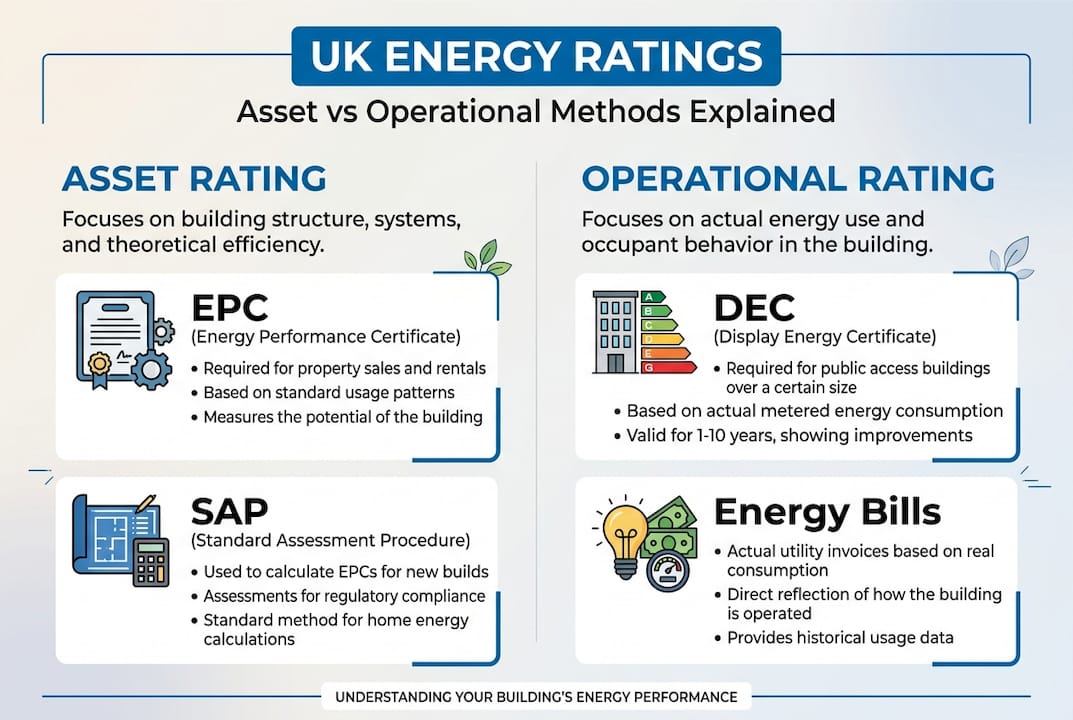
SBEM (Simplified Building Energy Model) is used for standard commercial buildings: offices, retail units, schools, and similar. It calculates energy use based on building geometry, construction, HVAC systems, and lighting. DSM (Dynamic Simulation Modelling) is required for complex buildings where SBEM cannot adequately represent the systems involved. Non-domestic properties use SBEM or DSM for EPCs, while DECs use actual metered consumption.
For public buildings, Display Energy Certificates must be displayed visibly and renewed annually (for buildings over 1,000m²) or every ten years (for buildings between 250m² and 1,000m²). The DEC process requires:
- Twelve months of actual energy consumption data from meters.
- Benchmarking against a reference building of the same type.
- An advisory report identifying improvement opportunities.
- Display in a prominent location visible to the public.
For building owners and managers, public DECs create accountability. A poor operational rating is visible to occupants and visitors, which can affect reputation and tenant satisfaction. For investors evaluating public or non-domestic assets, always request recent DECs alongside EPCs. The gap between the two reveals how well a building is actually managed.
Pro Tip: When acquiring a non-domestic asset, compare the EPC asset rating with the most recent DEC. A large gap between the two often signals poor building management, inefficient tenant fit-outs, or ageing plant. This is also where dynamic simulation in non-domestic properties adds genuine value for pre-acquisition due diligence.
Upcoming reforms: Home Energy Model and multi-metric EPCs
The current SAP and RdSAP methodologies are being replaced. The Home Energy Model (HEM) will replace SAP/RdSAP and introduce multi-metric EPCs covering fabric, heating, smart readiness, and running cost, addressing longstanding limitations of the single-score approach.
HEM is more granular than SAP. It models energy use on a half-hourly basis, accounts for the interaction between smart technologies and grid carbon intensity, and produces separate scores for different aspects of performance. This means a property can no longer mask poor fabric performance with an efficient boiler.
Key statistic: Only 17% of domestic properties currently achieve an A to C EPC rating, compared with 45% of non-domestic buildings. This gap underlines the scale of improvement required in the residential sector ahead of the 2030 minimum standard.
The new multi-metric EPC will report on:
- Fabric performance: Wall, roof, and floor insulation quality.
- Heating system: Efficiency and carbon intensity of the heat source.
- Smart readiness: Ability to respond to smart grid signals.
- Running cost: Estimated annual energy spend under standard conditions.
Transitional arrangements mean most existing EPCs will remain valid until they expire. You will not need an immediate re-rating unless selling, letting, or triggering a new assessment. However, the energy modelling benefits of preparing early are clear. Landlords and investors should:
- Audit current EPC ratings against HEM criteria now.
- Identify fabric improvements that will score well under the new model.
- Plan heating system upgrades with the new metrics in mind.
- Monitor policy updates on the HEM roll-out timetable.
Compliance in practice: minimum standards and closing the gap
Regulatory pressure on landlords is increasing. The Minimum Energy Efficiency Standards (MEES) require EPC minimum E for private rentals today, rising to a C rating by 2030 for all new and existing tenancies.
For landlords, compliance is not simply about holding a valid certificate. It involves understanding what the rating means, what improvements are recommended, and whether the asset can realistically reach the required standard. A step-by-step compliance check should include:
- Confirm the current EPC rating and its expiry date.
- Review the recommendations listed on the certificate.
- Obtain quotes for the highest-impact improvements.
- Check eligibility for government funding schemes.
- Install submetering to track actual energy use against the modelled figure.
- Schedule a re-assessment after any significant improvement works.
The gap between modelled and actual performance is a persistent issue. EPC compliance relies on asset ratings, but actual bills or DECs reveal gaps; submetering helps close them. Landlords who rely solely on the certificate without monitoring energy use in practice risk unpleasant surprises when tenants report high bills or when enforcement action follows regulatory tightening.
Properties that meet the letter of compliance today may still face costly upgrades tomorrow if the gap between modelled and actual performance is not addressed proactively.
Practical actions available now include installing smart meters or submeters, commissioning periodic energy audits, and using tools for calculating energy savings to prioritise investment.
Why understanding both ratings matters more than ever
Too many property owners treat the EPC as a compliance checkbox. Once the certificate is lodged, the task feels complete. But the regulatory and financial landscape in 2026 demands a more rigorous approach.
A property’s value and marketability will increasingly depend on provable energy performance, not just a certificate on file. Tenants are more energy-aware than ever, and institutional investors are scrutinising operational data alongside asset ratings. The gap between what a building is rated and what it actually costs to run is becoming a liability, not just an inconvenience.
Occupancy patterns, management practices, and tenant engagement all affect real energy use in ways that no model can fully predict. A well-insulated flat occupied by a single person will perform very differently from the same flat shared by four people running appliances constantly. Asset ratings cannot capture this. Operational data can.
The practical advice here is straightforward: invest in submetering, schedule regular operational reviews, and start preparing now for HEM reforms. Exploring the full range of types of energy models available helps landlords and investors make informed decisions rather than reactive ones. The owners who act early will face fewer surprises and lower costs when the new standards take effect.
Navigate energy measurement and compliance with expert support
Understanding how energy use is measured is the first step. Acting on that understanding is what protects compliance and property value over the long term. homeenergymodel.co.uk offers in-depth guidance on every aspect of energy assessment, from the current SAP framework to the incoming HEM methodology.

Explore detailed resources on energy models for landlords to identify the right approach for your portfolio. Review the full breakdown of Home Energy Model explained to understand what the reforms mean for your specific assets. Whether you need a property-specific assessment, a model comparison, or guidance on closing the performance gap, the resources available support every stage of the compliance journey.
Frequently asked questions
What is the difference between an EPC and a DEC?
An EPC estimates a building’s energy use based on its physical features and standardised assumptions, while a DEC measures actual consumption using real meter data, mainly for public and non-domestic buildings. Both serve different compliance purposes and should not be treated as interchangeable.
How accurate are EPC ratings compared to real energy bills?
RdSAP uses conventions and default assumptions where site data is limited, meaning the resulting EPC may not reflect actual energy bills, particularly where occupancy or usage patterns differ from the model’s assumptions.
Will I need a new EPC for HEM reforms?
Transitional arrangements mean most existing EPCs remain valid until expiry; a new assessment is only required when HEM is introduced alongside a sale, letting, or other triggering event under the regulations.
How can I improve my property’s measured energy performance?
Upgrading insulation, installing an efficient heating system, and monitoring actual usage all improve both the EPC rating and real consumption, making the property more compliant and more cost-effective to run.
What are common pitfalls when using EPCs for compliance?
Assuming a current EPC guarantees future compliance or accurately reflects running costs is a significant risk; gaps between EPC ratings and actual performance are common, and up-to-date assessments alongside real energy data are essential for confident compliance.