

TL;DR:
- The Future Buildings Standard requires all new non-domestic buildings in England to be zero carbon ready by March 2027.
- Compliance is performance-based, focusing on building performance compared to a notional standard.
- Early action benefits landlords by reducing costs, enhancing market value, and meeting evolving energy expectations.
The Future Buildings Standard (FBS) is not simply another update to building regulations. It represents the most significant shift in non-domestic construction requirements England has seen in a generation, and the compliance deadline of 24 March 2027 is closer than many landlords realise. Some property owners assume this only affects large developers. That assumption is costly. Whether you own a small office block, a retail unit, or a mixed-use scheme currently in design, the FBS will directly shape what you can build, how you can let it, and what it will be worth in the years ahead.
Table of Contents
- What is the Future Buildings Standard and why does it matter?
- Who must comply? Buildings, exemptions, and transition periods
- How FBS compliance is measured: The notional building approach
- Essential FBS measures: Heating, insulation, lighting, and renewables
- Costs, benefits, and the business case for landlords
- Why acting early on FBS isn’t just regulatory box-ticking
- Need help navigating FBS rules? We’ve got you covered
- Frequently asked questions
Key Takeaways
| Point | Details |
|---|---|
| Major regulatory shift | The Future Buildings Standard introduces stricter standards for all new non-domestic builds starting in 2027. |
| Fabric-first and renewables | Property compliance now depends on heat pumps, high-quality insulation, and solar PV. |
| Clear exemptions exist | Listed buildings, some temporary structures, and small units are not covered by FBS requirements. |
| Upfront costs, long-term gains | Expect higher build costs initially, but significant energy savings and increased asset value over time. |
| Early action pays off | Landlords who upgrade ahead of 2027 face fewer risks and reap greater financial and compliance benefits. |
What is the Future Buildings Standard and why does it matter?
The Future Buildings Standard is a set of updated Building Regulations, principally under Part L, that requires all new non-domestic buildings in England to be zero carbon ready from March 2027. This means buildings must be designed and built so they can operate with zero carbon emissions once the national grid reaches full decarbonisation. It is not a voluntary scheme. It is a legal requirement.
The FBS delivers an expected 80% reduction in carbon emissions compared to previous Part L standards, alongside a shift to performance-based compliance. Critically, it is not enough to simply specify compliant components. The building as a whole must perform to the required standard. This is a fundamental change in how buildings are approved.
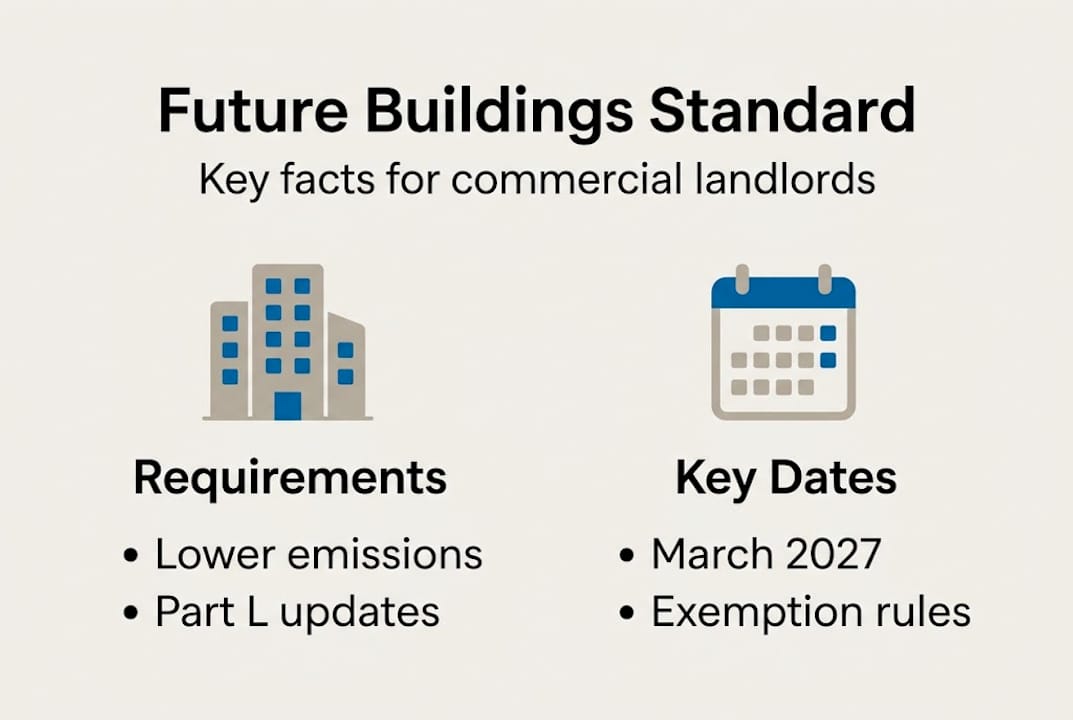
Here is a summary of what the FBS covers and when it applies:
| Requirement | Detail |
|---|---|
| Scope | All new non-domestic buildings in England |
| Standard compliance date | 24 March 2027 |
| Higher-risk buildings date | 24 September 2027 |
| Carbon target | 80% reduction vs. previous Part L |
| Compliance method | Performance-based (notional building) |
| Primary regulation updated | Building Regulations Part L |
The buildings affected include offices, retail premises, industrial units, schools, hotels, and most other commercial property types. For landlords, the implications go beyond construction. Tenants, investors, and lenders are increasingly scrutinising energy performance. Understanding the FBS is now a core part of responsible portfolio management for landlords.
Key requirements under FBS include:
- Low-carbon or zero-carbon heating systems
- High-performance building fabric (walls, roof, glazing)
- Renewable energy generation, notably solar PV
- Efficient lighting and mechanical ventilation with heat recovery
- Performance verification using approved modelling tools
“The FBS sets out a clear direction of travel. Buildings that are not designed for a zero-carbon future will face growing commercial, regulatory, and financial pressure as 2027 approaches.”
Who must comply? Buildings, exemptions, and transition periods
Not every building is captured by the FBS. Understanding the exemptions is important, but so is avoiding the mistake of assuming your property is exempt without checking the details carefully.
The FBS applies to new non-domestic buildings in England. Certain categories are excluded. Exemptions include listed buildings, places of worship, temporary structures used for fewer than two years, very small detached buildings with a floor area under 50 square metres, and certain industrial and agricultural buildings with low heating requirements. These exemptions are specific and narrow. Most commercial landlords will not qualify.
Here is a comparison across the main compliance categories:
| Building type | FBS applies? | Key note |
|---|---|---|
| Standard new non-domestic | Yes, from 24 March 2027 | Full compliance required |
| Higher-risk new buildings | Yes, from 24 September 2027 | Additional oversight applies |
| Listed buildings | No | Exempted under heritage rules |
| Places of worship | No | Explicitly excluded |
| Temporary structures (<2 yrs) | No | Must meet temporary use criteria |
| Small detached (<50 sq m) | No | Specific size and use conditions apply |
| Industrial/agricultural (low heat) | Conditional | Depends on heating requirements |
For projects already underway, a 12-month transition process applies. Here is how it works:
- If a building notice or full plans application was submitted before the FBS compliance date, the project may continue under the previous regulations.
- The work must commence on site within 12 months of the application date.
- If work does not begin within that window, the project must be redesigned to meet FBS requirements.
- Buildings where the design has not been submitted by the relevant date must comply in full.
Pro Tip: If you have a scheme currently in pre-application or planning, confirm your Part L submission status now. A 12-month window sounds generous, but procurement and contractor delays can erode it quickly.
For landlords uncertain about their EPC obligations during this period, EPC exemption guidance offers further clarity on what applies and when.
How FBS compliance is measured: The notional building approach
One of the more technical aspects of the FBS is how compliance is actually determined. Unlike older prescriptive regulations, the FBS uses a performance-based method. This means the design is not assessed against a list of approved components. Instead, it is compared against a theoretical reference building.
This reference is called the notional building. It has the same geometry and usage as the actual design but is modelled with standardised, FBS-compliant specifications. The actual design must match or outperform this notional building on two key metrics: carbon emissions intensity and primary energy use. SBEM and DSM are the approved modelling tools used to run these calculations.
SBEM (Simplified Building Energy Model) is used for most standard commercial buildings. DSM (Dynamic Simulation Modelling) is used for more complex buildings with unusual geometry, mixed use, or high internal gains. Both tools must be operated by qualified assessors.
Core metrics to watch:
| Metric | What it measures | FBS target |
|---|---|---|
| Carbon emissions intensity | kg CO2/m²/year | Must match or beat notional building |
| Primary energy use | kWh/m²/year | Must match or beat notional building |
| Fabric energy efficiency | Heat loss via envelope | Minimum standards apply |
Preparing compliance documents requires a clear process. A practical checklist includes:
- Appoint a qualified energy assessor early in the design phase
- Run SBEM or DSM modelling at concept stage, not just pre-submission
- Check fabric specifications against notional building benchmarks
- Confirm renewable energy generation meets required thresholds
- Document all assumptions and inputs for the compliance report
Understanding how these calculations connect to legacy methods such as SAP calculations helps landlords see the direction regulations have taken. For practical guidance on improving your building’s performance ahead of assessment, the guide to improving building efficiency is a useful starting point. If you want to quantify the financial impact of proposed changes, calculating energy savings for UK properties sets out the methodology clearly.
Essential FBS measures: Heating, insulation, lighting, and renewables
Meeting FBS requirements means making specific, practical decisions about building fabric, services, and renewable energy. For most non-domestic buildings, the requirements centre on four areas.
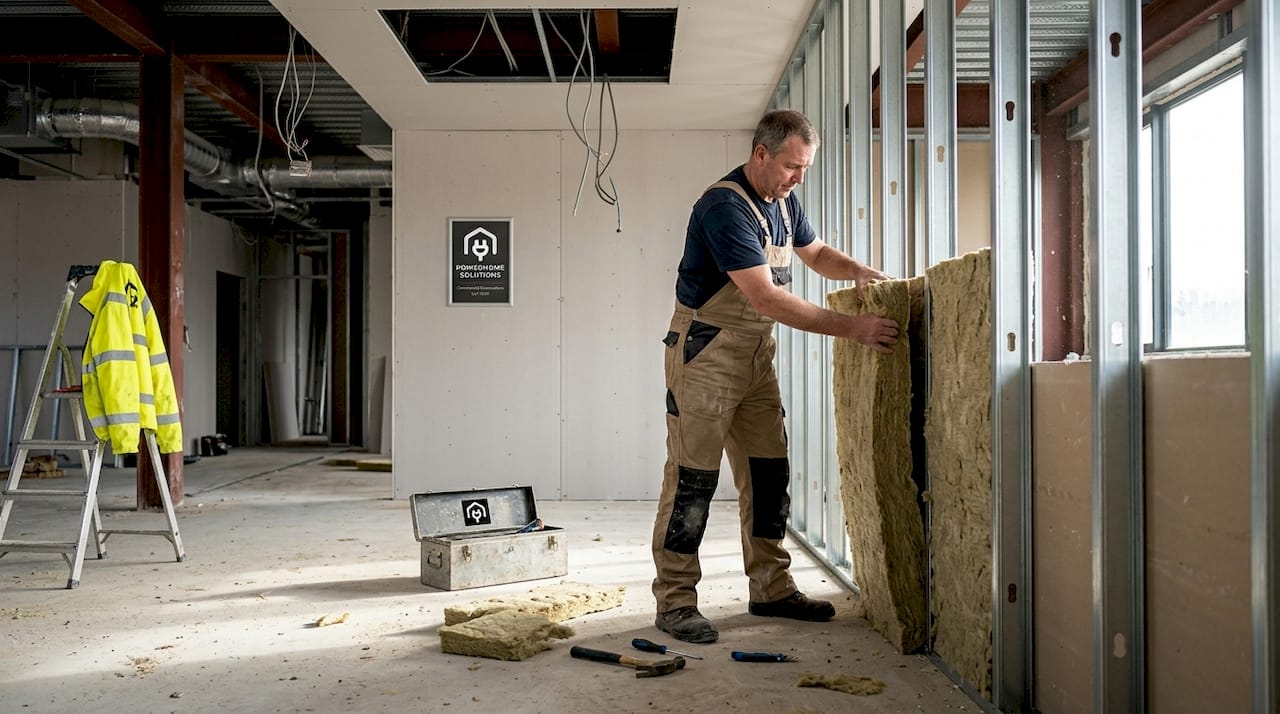
Landlords must ensure low-carbon heating, high fabric efficiency, a minimum of 40% solar PV coverage for most building types, plus efficient lighting and mechanical ventilation with heat recovery. These are not optional enhancements. They are baseline expectations under FBS.
Key measures by category:
- Heating: Air source or ground source heat pumps replace gas boilers as the standard approach. District heating connections may also qualify where available.
- Fabric: Walls, roofs, and glazing must meet significantly tighter U-value standards than previous regulations required. Airtightness testing is mandatory.
- Solar PV: A 40% minimum coverage of the available roof area applies to most building types. This is a firm requirement, not a recommendation.
- Lighting: LED systems with effective controls, including occupancy sensors and daylight dimming, are expected.
- Ventilation: Mechanical ventilation with heat recovery (MVHR) is required where natural ventilation is insufficient to meet air quality and energy targets.
Pro Tip: The most effective approach is fabric first. Reducing heat loss through the building envelope before specifying heating and renewables lowers the overall system size needed, reducing both capital cost and running costs over the building’s lifetime.
For offices, the shift to heat pumps is straightforward where roof plant space exists. Retail and industrial settings may face greater challenges with grid connection capacity for larger heat pump installations. Costs vary significantly by building type, but forward planning reduces both delay and expense. The guide to renewable energy compliance covers the workflow for meeting these requirements in practice.
Costs, benefits, and the business case for landlords
The financial picture for FBS compliance is more balanced than many landlords initially assume. Yes, there are upfront costs. But the long-term case is compelling.
Additional build costs are estimated at approximately £4,350 per property, with a projected overall net social benefit of £11.3 billion across the programme and significant reductions in tenant energy bills. Lower operating costs translate directly into more attractive commercial tenancies and stronger rental yields.
| Cost or benefit | Estimated figure |
|---|---|
| Additional build cost per property | ~£4,350 |
| Net social benefit (programme total) | £11.3 billion |
| Carbon reduction vs. previous Part L | ~80% |
| Energy bill reduction for occupants | Significant (varies by building type) |
Landlords who delay face specific risks:
- Properties built to pre-FBS standards may become harder to let as tenants prioritise low energy costs
- Lenders and investors are already applying green premiums to FBS-ready assets
- Stranded assets (properties requiring costly retrofits to remain lettable) are an emerging risk in the commercial sector
- Regulatory penalties for non-compliance on new builds are enforced through Building Control sign-off
“Energy efficiency is no longer a desirable feature in commercial property. It is becoming a baseline expectation for tenants, lenders, and investors alike.”
Funding options worth exploring include the UK Shared Prosperity Fund, local authority energy grants, green finance products from lenders, and tax reliefs on qualifying energy-efficient plant and machinery. For a detailed breakdown of practical improvement strategies, the building efficiency guide covers the options available to non-domestic landlords.
Why acting early on FBS isn’t just regulatory box-ticking
There is a tendency in the property sector to treat new regulations as a compliance burden to be managed at the last possible moment. The FBS should be viewed differently.
Landlords who move early on FBS-aligned upgrades are not just avoiding penalties. They are repositioning their assets in a market where energy performance is becoming a primary valuation driver. Tenants facing high energy costs actively seek buildings with lower running costs. Investors applying ESG criteria are already filtering out underperforming assets. The landlords who understand this dynamic will outperform those who treat FBS as a 2027 problem.
The uncomfortable reality is that most landlords under-invest in building fabric. They prioritise cosmetic improvements or tenant fit-outs over insulation, airtightness, and efficient services. Yet it is precisely these fabric investments that deliver the most durable financial returns, through lower maintenance costs, stronger occupier retention, and higher resale values.
Acting early also means access to better contractors, more competitive pricing, and the ability to sequence upgrades logically. Waiting until 2026 or 2027 means competing for the same constrained supply of specialist installers. For those wanting to understand how energy modelling and UK standards connect to portfolio strategy, the case for early action becomes even clearer.
Need help navigating FBS rules? We’ve got you covered
Preparing for the Future Buildings Standard requires clear, practical guidance tailored to your specific property type and portfolio. At Home Energy Model, we provide in-depth resources covering home energy models for landlords, EPC compliance, energy performance certification, and the tools used to assess buildings under new regulations. Whether you are starting a new development or reviewing an existing pipeline, understanding how modelling and compliance intersect is essential. Explore our home energy model guide to see how the latest assessment methodologies apply to your properties and what steps to take before the 2027 deadline.
Frequently asked questions
Does the Future Buildings Standard apply to extensions or refurbishments?
The FBS targets new builds, not extensions, unless the extension is classified as a new building under current regulations. Most refurbishments and extensions remain subject to the previous Part L requirements.
What is the deadline for complying with the FBS?
Key compliance dates are 24 March 2027 for all standard new non-domestic buildings and 24 September 2027 for higher-risk buildings, with a 12-month transition for projects already in progress.
Are existing tenanted properties affected by FBS?
Existing properties are not retroactively brought under FBS, but redevelopments classified as new builds under regulations must comply in full with the new standards.
Can landlords still use gas boilers under FBS?
No. The FBS requires low-carbon heating and prohibits new gas boiler systems in non-domestic buildings, making heat pumps or equivalent low-carbon alternatives the required solution.