

TL;DR:
- Renewable energy comes from natural sources that replenish faster than they are consumed, such as sunlight and wind.
- Understanding how to implement these technologies is essential for compliance with UK regulations and reducing operating costs.
Renewable energy is power generated from natural sources that replenish faster than consumed, including sunlight, wind, water currents, and geothermal heat. This definition, recognised by the International Energy Agency, separates renewables from fossil fuels, which are finite stores of ancient solar energy that cannot be replaced on any human timescale. For UK property owners, landlords, and organisations, understanding how to explain renewable sources of energy is no longer optional. Upcoming regulations tied to the Future Homes Standard and revised Energy Performance Certificate (EPC) requirements make renewable integration a compliance matter, not just a sustainability preference. Wind now accounts for 30% of UK electricity generation, with solar at 5% and hydro at 2%.
What are the main types of renewable energy?
Renewable energy is distinct from alternative energy. Renewable sources specifically exclude resources that replenish too slowly for practical human use, such as nuclear fuels. The focus is on current energy flows rather than stored ancient reserves. Five main types define the renewable energy sources list used by governments and energy assessors.
Solar energy is generated when photovoltaic (PV) cells convert sunlight directly into electricity. Solar thermal systems use sunlight to heat water rather than generate power. Both technologies are widely deployed across UK residential and commercial properties.
Wind energy captures kinetic energy from moving air via turbines. Onshore wind farms are common across Scotland and Wales, while offshore installations such as Hornsea One in the North Sea represent the UK’s largest deployments.

Hydropower uses the movement of water, either through dammed reservoirs or run-of-river systems, to drive turbines. Tidal stream energy is a subset of hydropower that captures energy from tidal currents rather than river flow.
Biomass energy burns organic material, including wood pellets, agricultural waste, and dedicated energy crops, to produce heat and electricity. Unlike solar and wind, biomass is dispatchable, meaning output can be controlled to match demand.
Geothermal energy draws heat from beneath the Earth’s surface. Ground source heat pumps (GSHPs) are the most common residential application in the UK, using stable underground temperatures to heat and cool buildings efficiently.
| Energy type | Energy form | Intermittency | Typical scale | Common application |
|---|---|---|---|---|
| Solar PV | Electricity | Intermittent | Domestic to utility | Rooftop panels, solar farms |
| Wind | Electricity | Intermittent | Onshore to offshore | Wind farms, turbines |
| Hydropower | Electricity | Controllable | Small to large | Dams, run-of-river, tidal |
| Biomass | Heat and electricity | Controllable | Domestic to industrial | Boilers, combined heat and power |
| Geothermal | Heat and electricity | Controllable | Domestic to commercial | Ground source heat pumps |
Pro Tip: Solar and wind are intermittent sources. Any property relying on them without battery storage or grid backup will experience supply gaps. Factor storage costs into any renewable installation plan from the outset.
How does renewable energy work in practice?
Understanding renewable energy in theory is one thing. Knowing how each technology functions in a real UK property is what matters for compliance and cost planning.
Solar PV systems convert sunlight into direct current (DC) electricity via semiconductor cells. An inverter converts this to alternating current (AC) for household use. Surplus electricity feeds back to the grid under the Smart Export Guarantee (SEG), or is stored in a battery such as a Tesla Powerwall or Sonnen unit for later use. Solar PV directly affects EPC ratings, which is a critical consideration for landlords facing minimum energy efficiency standards.
Wind turbines work by converting the kinetic energy of wind into rotational energy, which drives a generator. Small domestic turbines are available for rural properties, but the most significant UK capacity sits offshore. Hornsea One, operated by Ørsted, has a generating capacity of 1.2 gigawatts and powers over one million UK homes.
Renewable energy displaces conventional fuels across four areas: electricity generation, space and water heating, transportation, and off-grid energy services. This breadth means renewables are relevant to almost every property type, from a terraced house in Leeds to a commercial warehouse in Birmingham.
- Ground source heat pumps extract heat from soil or rock at depths where temperature remains stable year-round. The US Environmental Protection Agency confirms that stable underground temperatures make GSHPs significantly more efficient than conventional heating systems that must work against seasonal extremes.
- Tidal stream turbines are submerged devices that capture energy from tidal currents. The UK government invests £20 million annually in tidal stream development, with projections suggesting it could meet up to 10% of UK electricity demand.
- Biomass boilers burn wood pellets or chips and can replace gas boilers in properties where grid gas is unavailable or where carbon reduction targets apply.
- Battery storage systems, including lithium-ion units from manufacturers such as LG Energy Solution and BYD, pair with solar or wind installations to smooth out supply gaps caused by intermittency.
Pro Tip: Most property owners focus on generation technology and underestimate the importance of energy storage. A solar array without storage delivers limited benefit during evenings and overcast periods. Always model the full system, including storage, before committing to an installation.
What are the benefits and limitations of renewable energy sources?
The advantages of renewable resources are well established, but a clear-eyed view of the limitations is equally important for property owners making investment decisions.
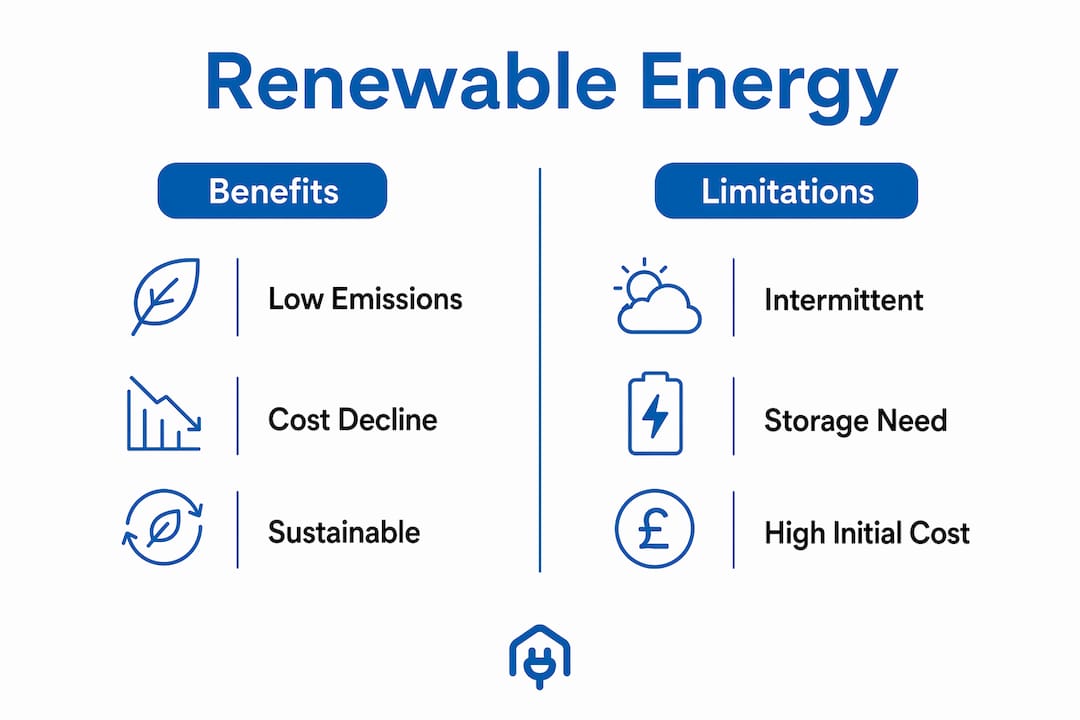
The primary environmental benefit is low carbon emissions during operation. Solar, wind, and hydro generate electricity with negligible greenhouse gas output once installed. This directly supports compliance with the UK’s legally binding net zero target for 2050. Energy security is a secondary benefit. Generating power on-site or from domestic sources reduces exposure to volatile international fossil fuel markets, as demonstrated by the energy price spikes of 2021 and 2022.
Cost trends favour renewables. The cost of solar PV has fallen dramatically over the past decade, and renewables account for roughly 11% of global primary energy, a figure that continues to rise as costs fall further. The UK’s own electricity mix reflects this shift, with wind alone now the single largest source of generation.
| Factor | Renewables | Fossil fuels |
|---|---|---|
| Carbon emissions | Very low during operation | High throughout lifecycle |
| Fuel cost | Zero (sun, wind, water are free) | Subject to market price volatility |
| Intermittency | Solar and wind are weather-dependent | Dispatchable on demand |
| Infrastructure | Requires storage or grid backup | Existing grid infrastructure |
| Long-term cost | Declining installation costs | Rising extraction and compliance costs |
| Regulatory direction | Supported by UK policy | Increasingly restricted |
The limitations are real. Wind and solar are intermittent, meaning output fluctuates with weather conditions. Biomass and hydropower are controllable but depend on geography and fuel supply chains. Initial installation costs for technologies such as GSHPs remain high, though the Boiler Upgrade Scheme offers grants to offset this. A common misconception is that renewables are unreliable. In practice, a well-designed system combining multiple sources and storage delivers highly reliable supply.
How can property owners implement renewables for compliance?
Practical implementation requires matching the right technology to the property type, usage pattern, and regulatory requirement. The steps below apply to both residential landlords and commercial property managers.
- Conduct an energy assessment first. A professional home energy assessment identifies current consumption patterns and highlights where renewable generation will have the greatest impact on EPC ratings and running costs.
- Understand the regulatory context. The Future Homes Standard, due to take effect from 2025 onwards, requires new homes to produce significantly lower carbon emissions. Existing properties face tightening minimum EPC requirements. Renewable integration is one of the most direct routes to compliance.
- Choose technology suited to the property. Urban terraced houses are well suited to solar PV. Rural detached properties may benefit from GSHPs or biomass boilers. Coastal and upland sites may have viable small wind options.
- Model the full system. Energy modelling tools, including the Home Energy Model (HEM) that replaces SAP from 2025, assess how renewable technologies interact with building fabric, insulation, and occupancy patterns. This modelling is required for new build compliance and is increasingly used for retrofit planning.
- Pair renewables with efficiency measures. Renewable generation is most cost-effective when combined with reduced demand. Insulation upgrades, double or triple glazing, and efficient heating controls all reduce the generation capacity required to meet a property’s needs.
- Access available incentives. The Smart Export Guarantee pays property owners for surplus electricity exported to the grid. The Boiler Upgrade Scheme provides grants for heat pump and biomass boiler installations. The UK government’s tidal stream investment signals further support for emerging hydro technologies.
Organisations managing multiple properties benefit from portfolio-level energy modelling. Understanding energy consumption across UK homes at scale allows prioritisation of the highest-impact interventions first.
Key takeaways
Renewable energy sources are the most direct route to meeting UK energy efficiency regulations while reducing long-term operating costs for both residential and commercial properties.
| Point | Details |
|---|---|
| Core definition | Renewable energy comes from natural sources replenished faster than they are consumed. |
| UK electricity mix | Wind supplies 30% of UK electricity, making it the largest single generation source. |
| Intermittency requires storage | Solar and wind need battery or thermal storage to deliver reliable supply. |
| Compliance link | Renewable integration directly improves EPC ratings under the Future Homes Standard. |
| Implementation order | Conduct an energy assessment before selecting or installing any renewable technology. |
The case for renewables is settled. The execution is where it gets complicated.
The debate about whether renewables work is over. Wind is now the UK’s largest electricity source. Solar costs have fallen to the point where residential payback periods are measured in years, not decades. The question for property owners and organisations is no longer whether to adopt renewables, but how to do it correctly.
What I see consistently is a mismatch between ambition and planning. Property owners install solar panels without modelling the impact on their EPC rating. Landlords invest in heat pumps without first addressing building fabric, which means the system runs inefficiently and the expected savings never materialise. The technology is not the problem. The sequencing is.
Green hydrogen is worth watching, but it is not a near-term solution for most property owners. Green hydrogen faces significant cost and infrastructure barriers and remains impractical for small-scale use as of 2026. Directing attention there instead of proven technologies like solar PV and GSHPs is a distraction.
The regulatory direction is clear and will not reverse. The Future Homes Standard, revised EPC minimum requirements, and the government’s net zero commitments all point in the same direction. Property owners who model their energy performance now, pair renewables with efficiency measures, and access available incentives will be ahead of compliance deadlines rather than scrambling to meet them. That is the practical case for acting on renewable energy understanding today.
— Danny
Homeenergymodel: supporting renewable energy compliance in UK properties
Homeenergymodel provides property owners, landlords, and organisations with the technical guidance needed to assess energy performance and integrate renewable technologies effectively. The platform covers the Home Energy Model methodology, EPC requirements, and the practical steps required to meet the Future Homes Standard. For landlords managing multiple properties, understanding how renewable generation affects energy performance ratings is a direct compliance requirement. Homeenergymodel’s resources on home energy models for landlords provide the structured guidance needed to make informed decisions about renewable adoption, retrofit planning, and regulatory compliance across a property portfolio.
FAQ
What is the definition of renewable energy?
Renewable energy is power derived from natural sources that replenish at a rate faster than they are consumed, according to the International Energy Agency. Solar, wind, hydro, biomass, and geothermal are the five primary categories.
What are the main types of renewable energy in the UK?
The main types are solar PV, onshore and offshore wind, hydropower including tidal stream, biomass, and ground source geothermal. Wind is currently the largest source, supplying 30% of UK electricity as of 2024.
Why do solar and wind need battery storage?
Solar and wind are intermittent sources whose output varies with weather and time of day. Without battery or thermal storage, properties relying solely on these sources will experience supply gaps during low-generation periods.
How do renewables affect EPC ratings in the UK?
Renewable technologies such as solar PV and ground source heat pumps reduce a property’s calculated carbon emissions and energy costs, both of which feed directly into the EPC rating calculation under SAP and the incoming Home Energy Model.
Is geothermal energy practical for UK homes?
Ground source heat pumps are the most accessible geothermal technology for UK properties. They use stable underground temperatures to provide efficient heating and cooling year-round and are eligible for support under the Boiler Upgrade Scheme.