
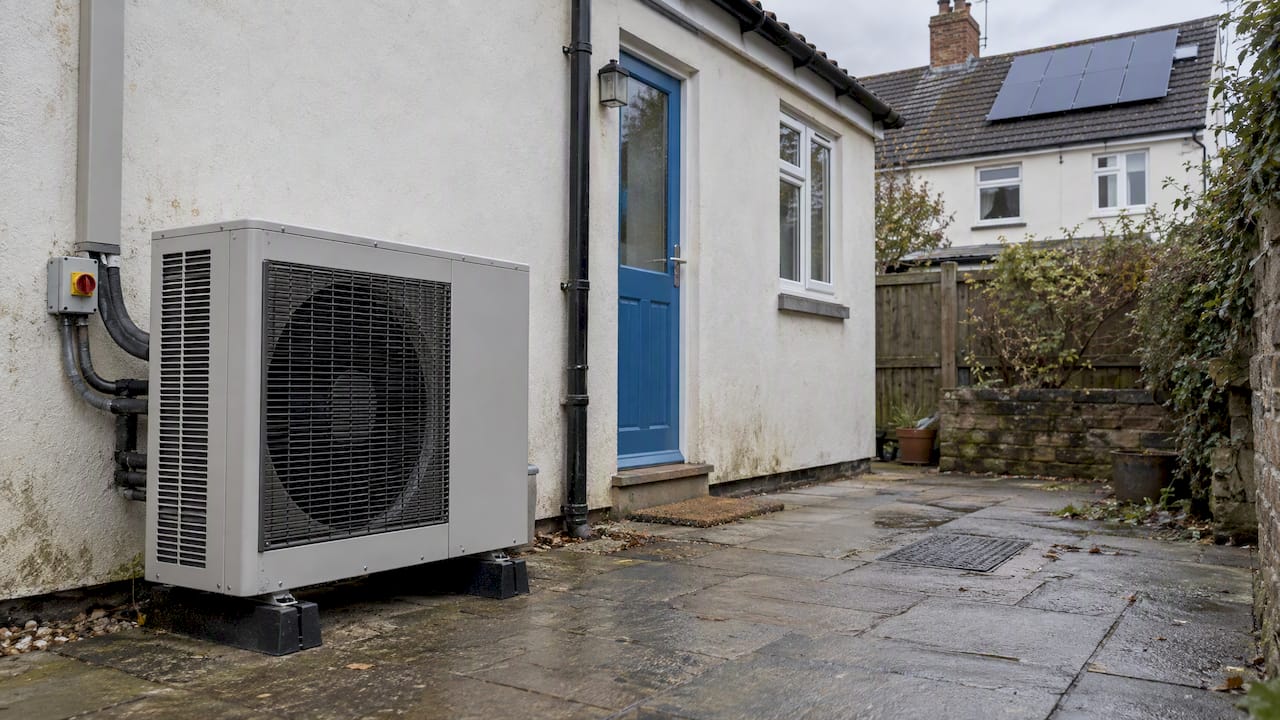
The most effective energy efficient technologies in UK buildings are not the newest ones. Draught-proofing and insulation come first, followed by well-designed heating, smart controls and on-site generation such as solar panels. The best choice depends on the building, its heat loss and how it is used. This guide sets out each technology, typical costs, the evidence behind it and how it feeds into EPCs and the Home Energy Model.
TL;DR
- Fabric measures (draught-proofing and insulation) remain the strongest general-purpose option, according to Scottish Government-commissioned research.
- Heat pumps, solar panels and smart controls perform best when sized and specified against the building’s calculated heat loss.
- In commercial property, controls such as building energy management systems are often a lower-disruption first step than replacing plant.
- The Home Energy Model simulates performance half-hourly, so batteries, solar, smart controls and hot-water demand will matter more in assessments.
- Predicted savings only appear when installation is verified, so commissioning and a post-works assessment matter.
Table of Contents
- What counts as an energy efficient technology
- Fabric first: insulation and draught-proofing
- Heating technologies: heat pumps and the efficiency question
- Solar panels, solar thermal and batteries
- Smart controls and zoning
- Commercial buildings: controls before major plant
- What the evidence says about real-world savings
- How the Home Energy Model changes the picture
- Choosing technologies: a decision order
- Our perspective
- Getting an assessment
- FAQ
- Sources
What counts as an energy efficient technology
The term covers any product, system or control that delivers the same comfort, light or hot water for less energy. In buildings it falls into four groups:
- Building fabric: loft, wall and floor insulation, glazing, draught-proofing, airtightness and thermal-bridge control.
- Heating, cooling and ventilation: heat pumps, efficient boilers, heat recovery, variable-speed fans and air conditioning.
- Controls and monitoring: thermostats, zoning, building energy management systems (BEMS), occupancy and CO₂ sensors.
- Generation and storage: solar photovoltaic panels, solar thermal and batteries.
These groups work as a package. A heat pump in a leaky, uninsulated house will cost more to run than the same unit in a well-sealed one. The same logic applies to a new BEMS in an office with a poorly balanced ventilation system.
Fabric first: insulation and draught-proofing
The Scottish technology-landscaping study shortlisted 55 fabric technologies. It found that 44 (80%) suited domestic use, 45 (82%) community buildings, 49 (89%) public buildings and 46 (85%) commercial buildings. Its emphasis is on gradual gains in materials, airtightness, thermal-bridge control, surveying and installation, not on a single breakthrough product. The study is Scottish, but the building physics applies across Great Britain.
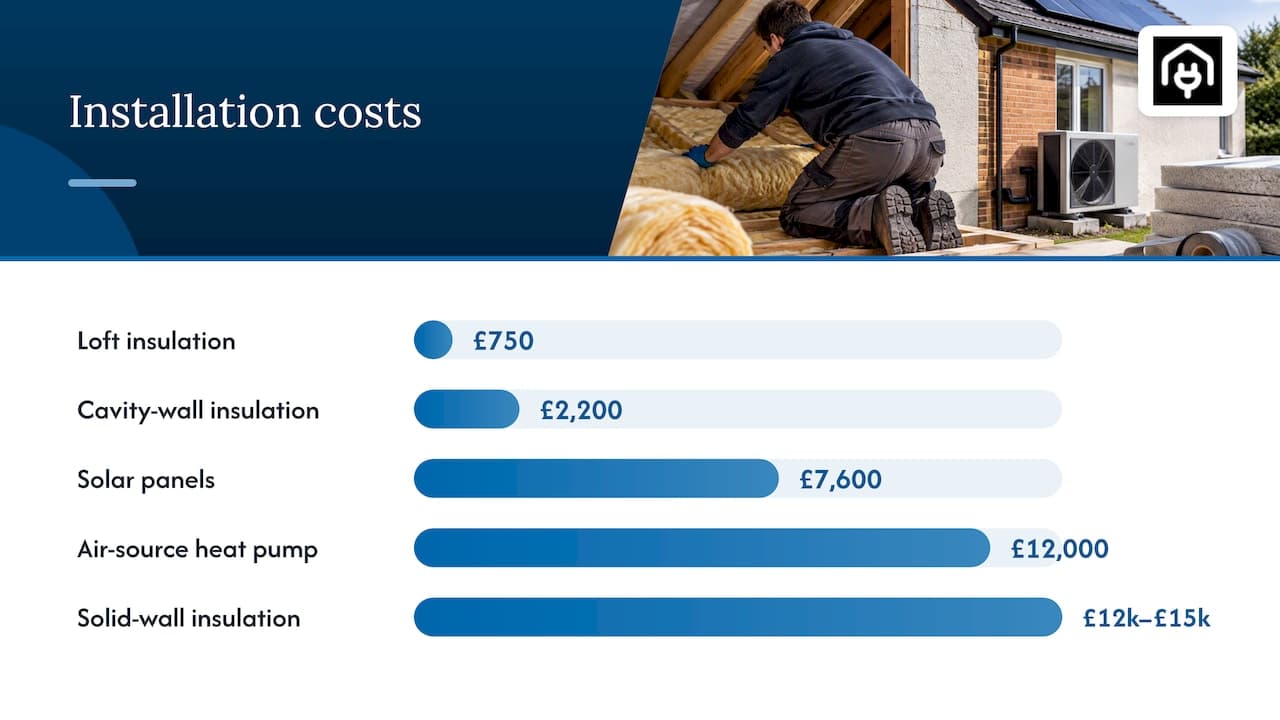
For a typical UK semi-detached home, Energy Saving Trust average installation costs listed in February 2026 were:
| Measure | Average installation cost |
|---|---|
| Loft insulation | £750 |
| Cavity-wall insulation | £2,200 |
| Floor insulation | £1,700 |
| Solid-wall insulation | £12,000 to £15,000 |
| Heating controls | £600 |
| A-rated double glazing | £4,800 |
| Solar panels | £7,600 |
| Air-source heat pump | £12,000 |
These are indicative averages, not quotes. They vary by property and exclude any funding. Combining works can reduce both cost and disruption, for example insulating a loft while the roof space is already accessible for other work.
Why fabric comes before equipment
Insulation and airtightness reduce the heat a building needs. That lowers the size, cost and running load of whatever heating system follows. Fabric also keeps working for decades without moving parts, settings or user behaviour. For landlords, it is the most defensible route to a better EPC rating, because the improvement is visible in the assessment inputs and in the energy bills.
Heating technologies: heat pumps and the efficiency question
Heat pumps move heat instead of generating it, so one unit of electricity can deliver several units of heat. Two measures are used. COP (coefficient of performance) is heat output divided by electrical input at a given moment. SCOP is the seasonal equivalent. UK government research on air-to-air units notes that they must meet a UK/EU Ecodesign minimum SCOP of 3.474, yet reported in-situ SCOPs in Scotland ranged from 1.2 to 4.5.
That spread explains most disputes about whether heat pumps “work”. A ClimateXChange evidence review found no evidence that heat pumps cannot operate effectively in Scotland and identified design and specification as the leading causes of poor performance. A headline product rating tells little without the following:
- the building’s calculated heat loss;
- emitter capacity (radiator size or underfloor circuits);
- the intended flow temperature;
- controls and how the system is operated.
A heat pump should be designed against those figures before equipment is chosen, not after.
Funding
In England and Wales, the Boiler Upgrade Scheme offers up to £7,500 towards replacing a fossil fuel boiler with a heat pump, with a lower grant of £2,500 for air-to-air units. Temporary extra funding for eligible off-gas-grid properties runs from 21 July 2026 to 31 March 2027. Eligibility rules change, so check the current scheme page before committing to a quote.
Solar panels, solar thermal and batteries
Solar photovoltaic panels generate electricity. Solar thermal supplies hot water and normally needs supplementary heating. The two should not be ranked against each other without defining the output required. The same caution applies to the common question of which clean technology is “most efficient”: a heat pump delivers heat at a seasonal efficiency well above 100% of the electricity it uses, while a solar panel converts a fraction of sunlight into power. They do different jobs.
The average UK semi-detached solar installation cost listed above is £7,600. The Home Energy Model changes how generation and storage are reflected in assessment, which is covered below.
Smart controls and zoning
Heating controls cost far less than most other measures (an average of £600 in the Energy Saving Trust list) and reduce unnecessary running. Thermostats, programmers, thermostatic radiator valves and zoning let heat follow occupancy. They work best on top of insulation and a correctly sized heat source, not as a substitute.
Commercial buildings: controls before major plant
For offices, shops, hotels and restaurants, efficient controls are often the lowest-disruption technology because they avoid replacing major plant. Carbon Trust guidance states that building energy-management systems can reduce total energy costs by 10% or more, and that optimum-start controls can save 10% in energy costs. The same guidance describes demand-controlled ventilation, which adjusts airflow using occupancy or CO₂ sensors, and variable-speed drives, which cut fan energy when full output is not needed.
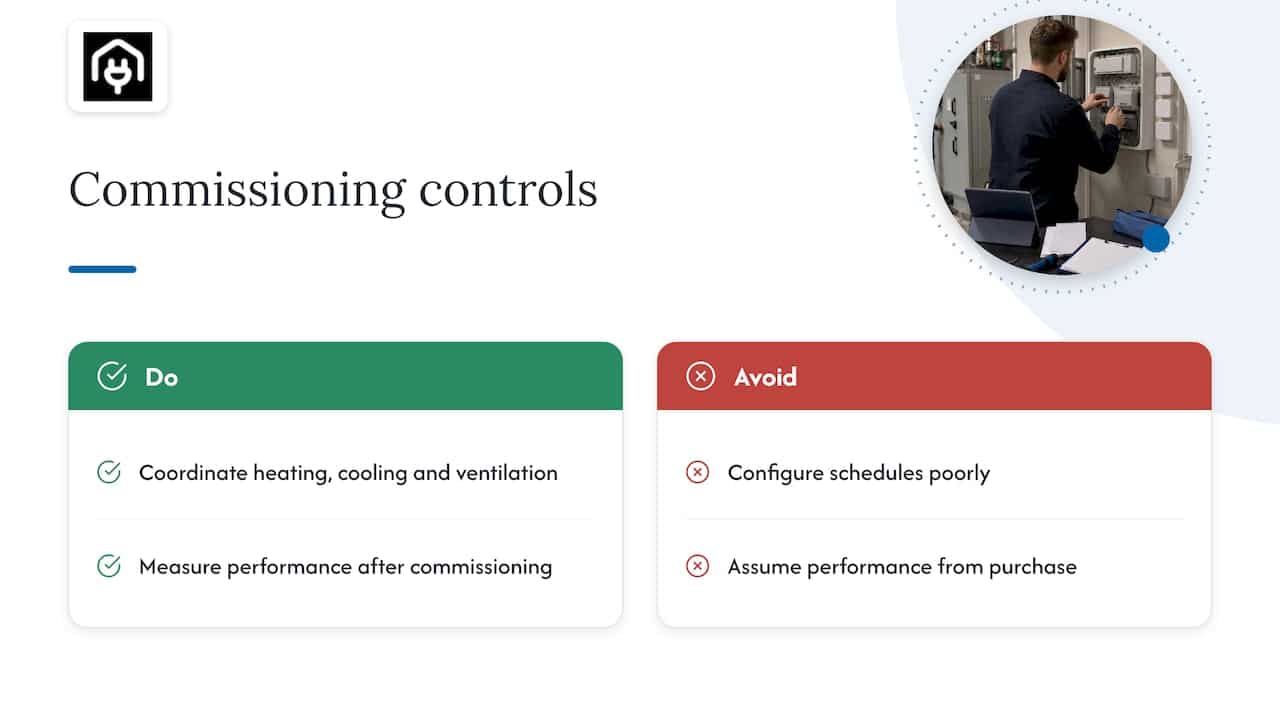
The caveat is commissioning. Poorly configured schedules can waste energy or cause heating and cooling to run at the same time. Carbon Trust’s hospitality guidance makes the same point: sensors, schedules, drives and BEMS only deliver when heating, cooling and ventilation are coordinated with occupancy and indoor-air requirements. Performance should be measured after commissioning, not assumed from the purchase.
Kitchens are a clear example, because extraction rates drive both comfort and energy use. A Romanian-language guide on restaurant kitchen ventilation rules and airflow rates shows how airflow is sized for catering spaces; the principle of matching extraction to actual demand carries over to UK sites, where local regulations apply.
Commercial owners with air conditioning above the relevant thresholds should also be aware of TM44 inspections for air conditioning systems, which review how efficiently cooling is run and often surface control and maintenance savings.
What the evidence says about real-world savings
DESNZ’s 2025 National Energy Efficiency Data-Framework analysis found that in England and Wales, median domestic gas consumption in 2023 was 12% lower than in 2021 and electricity consumption 7% lower. Properties with more energy-efficient EPC ratings used less gas and electricity. These figures describe observed changes across many homes. They do not isolate one technology, and they do not mean every household will achieve the same reduction.
The lesson for owners is practical. Savings depend on correct specification, quality installation and verification. The Scottish landscaping review cautions against waiting for a single “game-changing” invention and favours combinations of fabric measures, airtightness improvements and system upgrades that are properly specified, installed and checked. For landlords and developers this matters because installation quality can decide whether a predicted EPC rating or energy saving appears in actual bills.
How the Home Energy Model changes the picture
The Home Energy Model (HEM) is the government’s developing replacement for SAP. It is intended to support Future Homes Standard compliance and later EPC functions, and the government consultation presents it as a calculation methodology for assessing the energy performance of homes. Two features matter for technology choices:
- Half-hourly simulation. The model calculates performance every half-hour instead of monthly, which better represents smart technologies and systems.
- Separate core physics and policy assumptions. The technical summary of the Future Homes Standard assessment shows the building physics kept apart from policy-specific inputs.
In practice, load profiles, hot-water demand, tariffs, batteries, solar generation and smart controls can influence results. A design optimised only for a monthly average or a nominal appliance rating may not perform as expected. The Future Homes Standard assessment compares actual and notional dwellings using target emission rate, target primary energy rate and target fabric energy-efficiency metrics.
The exact regulatory implementation and EPC use should be checked against the latest government publication before relying on it for a live project. For background, see the guides on the Home Energy Model and what energy policy means for UK property standards.
Choosing technologies: a decision order
A sequence that suits most existing properties:
- Assess first. An EPC or a fuller home energy assessment shows where heat is lost and which measures the building suits.
- Seal and insulate. Draught-proofing, loft and wall insulation, and floor insulation where practical.
- Size heating to the reduced load. Calculate heat loss, check emitters and set the flow temperature before choosing a heat pump or other system.
- Add controls. Zoning, thermostats and, in commercial buildings, BEMS and sensors.
- Consider generation and storage. Solar and batteries, with tariffs and hot-water demand in mind.
- Verify. Commission the system, then compare predicted and actual consumption.
For homes, the guide on how to increase energy efficiency in the home goes through measures in more detail, and the article on calculating energy savings for UK properties explains how to estimate returns.
New builds and developments
New dwellings are assessed through calculation methods rather than by choosing individual products. SAP calculations cover homes, SBEM calculations cover new commercial buildings, and dynamic simulation modelling tests more complex designs hour by hour. Energy statements for planning and water calculations for Part G are often needed alongside them. Early modelling lets a design team compare technology options before they are fixed in drawings.
Our perspective
We see the same pattern repeatedly: owners ask which product to buy, when the better question is what the building actually needs. The evidence we work from points one way. Fabric and airtightness do the heavy lifting, systems should be sized to the reduced load, and results should be checked after installation.
For landlords, we would start with the EPC and its recommendations, because the rating drives both compliance and tenant demand. For developers, we would model early and test options in the calculation method that will be used for compliance, as the move towards the Home Energy Model rewards designs that handle smart controls, storage and generation properly. For commercial occupiers, we would look first at controls and commissioning before considering plant replacement.
We also advise caution with headline figures. Savings quoted by manufacturers rarely match a particular building. An assessment based on measured data is a better basis for spending.
— Danny
Getting an assessment
An accurate assessment is the starting point for any technology decision. Through Homeenergymodel, owners, landlords and developers can request quotes for a domestic EPC, a commercial EPC or a TM44 inspection, as well as calculations for new builds. No prices are published, so each quote is based on the property and the requirement. Start from the Homeenergymodel home page to submit a request.
FAQ
What are examples of energy saving technologies?
Common examples are loft, wall and floor insulation, draught-proofing, double glazing, heat pumps, solar panels, batteries, smart thermostats and zoning controls. In commercial buildings, BEMS, occupancy and CO₂ sensors and variable-speed drives are typical. Fabric measures are usually the best first step.
What is the most efficient clean energy technology?
It depends on the output measured. Heat pumps deliver several units of heat per unit of electricity, while solar photovoltaic panels generate electricity and solar thermal supplies hot water. Ranking them without defining the required output is misleading, and real-world performance depends heavily on design and installation.
Do energy efficient technologies lower EPC ratings or raise them?
They generally raise them, as DESNZ’s analysis found that more energy-efficient EPC-rated properties used less gas and electricity. The effect of a single measure depends on the property, so an assessment before and after works shows the actual change.
Is a heat pump worth installing without insulation?
It can work, but results are less predictable. Poor design and specification are the main causes of underperformance, so the heat pump should be sized against the building’s calculated heat loss, emitter capacity and flow temperature. Improving the fabric first usually reduces the size and running cost of the system.
Sources
- ClimateXChange: Energy efficiency technology landscaping report
- ClimateXChange: Heat pump use in Scotland, an evidence review
- Energy Saving Trust: Retrofit explained
- Energy Saving Trust: Boiler Upgrade Scheme
- GOV.UK: Air-to-air heat pump literature review
- GOV.UK: NEED summary of analysis 2025
- GOV.UK: The Home Energy Model consultation
- GOV.UK: HEMFHS-TP-01 assessment wrapper summary
- Carbon Trust: Heating, ventilation and air conditioning
- Carbon Trust: Hospitality sector guide