

The fastest way to cut an electric bill is to find out which appliances and habits use the most electricity, then deal with those first. Small habit changes add up to a few hundred pounds a year at most, and bigger savings come from fixing how the building itself performs. An Energy Performance Certificate (EPC), the rating document that grades a property’s energy efficiency from A to G, shows where a building loses energy and which upgrades suit it. We can arrange an assessment through our domestic EPC service.
This guide is written for homeowners, landlords and property professionals. It covers measuring your use, the everyday changes with published savings, the upgrades that follow, and what changes for rental and commercial property.
TL;DR
- Work out what uses the most power first: wattage × hours used ÷ 1,000 gives kWh, and kWh × your unit rate gives the cost.
- Appliances such as electric showers, washing machines, dishwashers and tumble dryers make up the largest share of most UK electricity bills, according to the Centre for Sustainable Energy.
- The Energy Saving Trust says ten quick tips could save up to £313 a year in Great Britain, with no major building work.
- Controls, insulation and draught proofing come next, and an EPC ranks the upgrades for your particular property.
- Landlords and businesses have extra levers: EPC upgrades, air conditioning inspections and monitoring across several properties.
Table of Contents
- Start by finding out where your electricity goes
- Everyday changes with published savings
- Keep the heat you pay for
- Upgrades worth planning
- What an EPC adds to a savings plan
- Get a quote for the assessment
- Perspective
- FAQ
- Sources
Start by finding out where your electricity goes
Saving effort spent on the wrong things is wasted. A lightbulb change saves pennies, while a shower used daily can cost far more. So measure before you change anything.
The Centre for Sustainable Energy (CSE), an independent charity giving UK energy advice, says the largest share of most households’ electricity bills comes from appliances like washing machines, dishwashers and electric showers. What an appliance costs depends on two things: its power rating in watts and how long it runs.
The formula
Find the wattage on the appliance label or in the manual, then:
- Wattage × hours used ÷ 1,000 = kWh used.
- kWh × your unit rate in pence = cost.
Your unit rate is printed on your bill or in your supplier’s app. As a worked example, take an illustrative rate of 26p per kWh. A 2,500 W tumble dryer running for one hour uses 2.5 kWh, so it costs 65p. That matches the CSE’s own estimate of about 65p an hour for a dryer of that size. The same page puts a 9,000 W electric shower at about £2.34 an hour.
Unit rates change when your tariff changes, so use the rate on your latest bill rather than a figure from an article.
Find your base load
An energy monitor, a small device that shows your electricity use in real time, makes this much easier. The CSE suggests a simple routine: switch everything off at night, read the base load, then switch appliances on one at a time to see which use the most. What is left running when you think everything is off is your base load. Fridges and freezers account for some of it, but a high figure usually points to standby devices, old equipment or something left on.
The CSE also points out that some appliances draw a lot of power briefly, like a kettle, while others draw less for long periods, like a tumble dryer or halogen lights. Monitoring for a week shows which pattern costs you more, and lets you test changes such as a new hot-water timer.
For a landlord with several properties, or a professional advising clients, the same method scales. Record base load and the biggest appliances at each property, then compare. Our guide on how to calculate energy savings for UK properties goes further into the arithmetic.
Everyday changes with published savings
The Energy Saving Trust (EST) publishes per-year savings for common habits. Its ten quick tips together could save up to £313 a year in Great Britain. The individual figures below come from the same page.
| Change | Saving per year (GB) |
|---|---|
| Keep showers to four minutes | £45 |
| Switch appliances off standby | £45 |
| Wash at 30°C and run one fewer load a week | £26 |
| Avoid overfilling the kettle | £10 |
| Turn off lights in empty rooms | £7 |
Two points about these figures. First, they are estimates for a typical household, so your own saving depends on your tariff and how you live. Second, the shower line covers water heating, which is electric in homes with an electric shower and gas in many others. Check which fuel heats your water before counting it as an electricity saving.
Standby and always-on devices
Most electrical appliances can be switched off at the plug without losing their programming, according to the EST. Some items need to stay on: fridges and freezers, and some TV recorders if you want scheduled recordings. A standby saver, a multi-socket that switches everything off at once, helps with TV and computer set-ups. Your base-load reading will show how much this is worth in your home.
Laundry and the dishwasher
Tumble dryers are among the most expensive appliances to run, as the 65p-an-hour example shows. Drying on a rack or line removes that cost. For washing, fewer and cooler loads save money, and a dishwasher is cheapest to run when it is full.
Hot water
Heating water is a major cost in most homes. A hot-water cylinder with poor insulation loses heat constantly, so topping up its insulation is one of the EST’s quick tips. For electric showers, shower time is the lever: the 9,000 W example above costs about £2.34 an hour, so every minute saved counts. Our guide to 7 smart home energy saving habits gives more routines you can build into daily life.
Keep the heat you pay for
Electricity bills rise sharply in homes with electric heating, heat pumps or plug-in heaters. Keeping heat inside lowers the demand for all of them.
- Draught proofing. Gaps around windows, doors, loft hatches and floorboards let warm air out. It is one of the EST’s ten quick tips and needs little outlay.
- Controls. Timers, room thermostats and radiator valves stop heating running when nobody needs it. Our guide on 10 electricity cuts for UK homes explains how to use your EPC and smart meter together to decide which to do first.
- Insulation. Loft, wall and floor insulation reduce heat loss for the long term. The best starting point depends on the building, which is why a certificate for that building matters more than a generic list.
Our energy saving tips guide covers the practical order of work in more detail.
Upgrades worth planning
Once the free and cheap changes are done, upgrades come next. The sensible order is to deal with the biggest energy users first and start with simple, low-cost, high-impact measures, advice that Australia’s energy agency gives and that holds in any climate.
- Efficient appliances. Replacing an old fridge-freezer, washing machine or dishwasher cuts the running cost of things that stay in use for years. Our guide to efficient appliances explains what to look for on the label.
- LED lighting. Replacing halogen bulbs removes one of the long-running loads the CSE mentions.
- Heating and hot-water upgrades. Better controls, a modern cylinder or a heat pump matter most in homes that heat with electricity. Do the insulation first, so the new system can be sized smaller.
- Solar and batteries. These suit properties with a suitable roof and steady daytime or evening use. Our smart homes energy efficiency guide explains how they fit with controls and monitoring.
One caution on expectations: savings only appear if you do not offset them. If cheaper running costs lead you to heat more rooms or run extra equipment, the bill may not fall, an effect known as rebound. Compare your monitor readings and bills before and after each change, and keep to the same tariff when you compare.
Automating the saving
Timers and controls are only effective when they run without you remembering. Home energy management systems link meters, chargers, batteries and solar so loads shift automatically. A Belgian installer explains the principle in its article on automated home energy management. Tariffs and equipment differ by country, so match any set-up to UK tariffs and your own supplier’s options.
Cooling
In homes and offices with air conditioning, the type of unit affects running cost. An explainer on inverter versus on/off air conditioning shows why inverter units, which vary their output instead of cycling on and off, suit regular use.
What an EPC adds to a savings plan
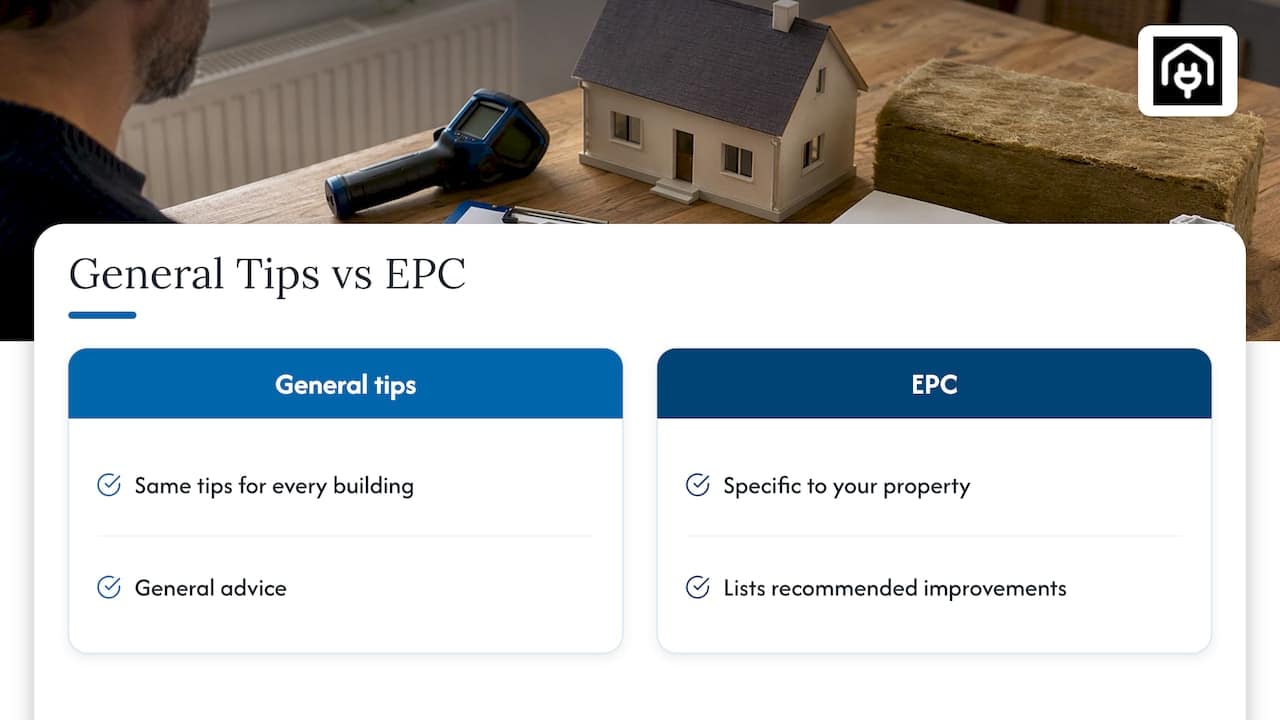
General tips treat every building alike. A certificate is specific to yours. An EPC rates the property from A to G and lists recommended improvements, so the plan covers walls, loft, glazing, heating and lighting in the order that suits the building. Our page on EPC ratings explains the bands, and the guide to what an energy performance certificate means covers the rest.
For landlords and investors, there is a second reason. Tenants pay the bills, but a better rating makes a property cheaper to run and easier to let. Our EPC saving tips set out the changes that most often lift a rating, and the EPC exemption guide covers the rules for properties that do not need a certificate.
Commercial buildings
For offices, shops and other commercial buildings, cutting an electric bill includes cooling and lighting systems. We offer a commercial EPC service, and TM44 inspections for air conditioning systems, which check that systems are running to the compliance standard.
New builds and developments
Developers and building professionals work at the design stage, where the calculations decide the final running cost. We provide SAP calculations for new homes, SBEM calculations for new commercial buildings, dynamic simulation modelling, energy statements for planning and water calculations for Part G. The Home Energy Model is the government methodology set to replace SAP, so it is worth following how that change affects your projects.
Get a quote for the assessment
If you want a plan built for your property rather than a generic list, request a quote for a domestic EPC through our site. Landlords with several properties and professionals with projects can choose from the services on our homepage. We do not publish prices, so the quote form is the way to get a figure for your property.
Perspective
Most people try to lower their bill by guessing. They turn off a light, they fret over the kettle, and the bill barely moves, because nobody has told them what the big loads are.
Our view is that the order matters more than any single tip. Measure first, fix the habits that cost most, then use a certificate to decide which building upgrades come next. An EPC puts the house in front of you, with its rating and its recommendations, which a list of 50 tips cannot do.
For landlords and developers the same logic holds on a larger scale. Decisions made at assessment or design stage, through SAP and SBEM calculations and soon through the Home Energy Model, set the running costs for decades. We think getting those figures right early is the cheapest saving there is.
Danny
FAQ
What is the quickest way to reduce my electric bill?
Use an energy monitor or the kWh formula to find your biggest loads, then cut those first. For most households that means electric showers, tumble dryers, washing machines and standby devices. The Energy Saving Trust’s ten quick tips could save up to £313 a year in Great Britain.
Does turning off lights really save electricity?
Yes, but the amount is small. The Energy Saving Trust puts it at about £7 a year in Great Britain, so it is worth doing but will not move your bill much alone. Standby devices and shower time are worth several times more.
How do I work out what an appliance costs to run?
Multiply its wattage by the hours you use it, divide by 1,000 to get kWh, then multiply by your unit rate. A 2,500 W dryer used for an hour at 26p per kWh costs 65p. Your latest bill gives your actual rate.
Will an EPC lower my electric bill by itself?
The certificate itself does not, but it lists the improvements that do. It ranks them for your specific property, so you know where to spend first. Request a quote through our domestic EPC page.
Sources
- How much electricity am I using? Centre for Sustainable Energy
- Energy monitors, Centre for Sustainable Energy
- Quick tips to save energy at home, Energy Saving Trust
- Reduce your energy bills, energy.gov.au
- Domotica energiebeheer, TJ-Technics
- Inverter or on/off air conditioning