

The quickest way to find a property’s energy efficiency in the UK is to look up its Energy Performance Certificate (EPC). The government’s energy certificate service lets anyone search by postcode, by street name and town, or by certificate number. The result is a letter rating from A (most efficient) to G (least efficient), plus a list of recommended improvements. If no certificate exists, a new assessment by an accredited assessor produces one.
This guide covers each route in order: finding an existing certificate, reading it properly, working out what the figure is based on, and getting a new rating when none is on record.
TL;DR
- Search the official register by postcode, address or certificate number to see a property’s A to G rating for free.
- The rating describes the building, not the people in it, so it is a fair comparison between homes but not a prediction of a particular bill.
- An EPC is valid for 10 years and lists recommended improvements alongside the rating.
- No certificate, or an expired one? An accredited assessor must carry out a new assessment.
- The calculation uses the building’s fabric, heating system and fuel, which is why accurate property details matter.
Table of Contents
- Step 1: Search the official register
- Step 2: Read the rating and the recommendations
- What the rating does and does not tell you
- Step 3: Understand how the figure is worked out
- Step 4: What to do when there is no certificate
- Perspective: what we see from the assessment side
- Getting a new assessment through Home Energy Model
- Common mistakes when checking energy efficiency
- What good practice looks like for each reader
- FAQ
- Sources
Step 1: Search the official register
Every EPC lodged in England and Wales sits on a public register. The Find an energy certificate service on GOV.UK covers three document types: energy performance certificates, display energy certificates for public buildings, and air conditioning inspection certificates and reports. Scotland has its own separate service, so a Scottish property needs a different search.
The register accepts three kinds of search:
- Postcode. The fastest option. Enter the postcode, then pick the address from the list.
- Street name and town. Useful when the postcode is unknown or returns many flats.
- Certificate number. The most precise route, for anyone who already holds a certificate or has seen the number on a listing or tenancy document.
Flats and converted houses often share one postcode, so check the full address line, including the flat number, before reading the rating. A neighbouring property can look similar and score very differently.
If the search finds nothing or the search page does not behave, the service publishes a contact route for help finding a certificate on its own page. Common reasons for a blank result are an expired certificate, a recent new-build whose certificate is not yet lodged, or a property that has never been sold, let or assessed since the scheme began.
Useful places to find the number without searching
- The property listing, since certificates are required when a property is marketed for sale or rent.
- The tenancy pack, if renting.
- The sale pack from a conveyancer, if buying.
- Previous correspondence from an assessor or letting agent.
For London addresses, the Londoner’s checklist for obtaining an energy performance certificate walks through what to gather before an assessment is booked.
Step 2: Read the rating and the recommendations
Once a certificate is open, three parts matter most.
The A to G rating and the score
The certificate shows a letter band and a numerical score. The government guide to EPCs for marketing, sale and let describes how a dwelling is rated from A to G and how the certificate carries recommendations for improving it. A is the most efficient. The higher the number within the scale, the lower the expected fuel bills for that building.
For a fuller walk through each band, see the site’s guide to energy performance certificate ratings explained.
Estimated energy use and costs
An EPC reports information on the property’s energy efficiency, energy use and typical energy costs, according to the National Home Improvement Council’s guide to the EPC. Treat the cost figures as a way to compare properties on equal terms. They are not a quote from a supplier.
The recommendations
The recommendations page is often the most practical part. It lists measures such as loft insulation, wall insulation, heating controls or a different heating system, usually with an indication of cost and the likely effect on the rating. For an owner or landlord, this list is a ready-made starting plan. For a buyer, it is a rough guide to what the next ten years of upgrades might involve.
Check the date
The NHIC guide states that an EPC is valid for 10 years. A certificate close to expiry is still legally usable until it lapses, but the rating may no longer reflect the property if work has been done since. Insulation, a new boiler, double glazing or solar panels installed after the assessment will not appear until the property is reassessed.
What the rating does and does not tell you
An EPC is an asset rating. Per the government guide, it is calculated on standard occupancy patterns, so it does not depend on how a particular household lives. Two identical houses get the same rating whether one is occupied by a single person who is out all day and the other by a family of five.
That has practical consequences:
- It is good for comparison. Buyers and tenants can compare two properties on the same footing.
- It is not a bill forecast. Actual use depends on heating habits, household size, appliances and how the building is run. The CIBSE publication on operational energy use makes the same point for larger buildings: real performance depends heavily on how a building is operated and maintained, not only on design and construction.
- It suits some buildings better than others. The IEA’s overview of energy performance certification notes that asset ratings fit buildings with frequent changes of occupant, while operational ratings are better suited to large, complex buildings.
For a home buyer, the sensible approach is to use the EPC rating to shortlist, then ask the seller for recent energy bills to see real-world use.
Step 3: Understand how the figure is worked out
Readers who ask how to calculate energy efficiency usually want one of two things: the method behind an EPC, or a way to measure their own household’s use. They are different tasks.
How an assessor calculates an EPC
A domestic EPC is produced from a survey of the building. According to the government guide, the inputs can include:
- building type and age
- number of rooms and any extensions
- dimensions
- glazing
- construction materials and insulation
- roof construction
- chimneys and flues
- heating system and fuel
These details go into approved software, which applies a standard calculation method and returns the score and band. The IEA toolkit makes the case that software tools standardise calculations, reduce manual input errors and handle large datasets. In the UK, the domestic method has been the Standard Assessment Procedure (SAP), and the government’s new Home Energy Model is the methodology intended to succeed it. The site’s SAP calculations explained page covers how SAP works for new homes.
At an international level, ISO 52016-1 sets out calculation methods for a building’s energy needs for heating and cooling, internal temperatures and heat loads. It is designed to harmonise how building energy performance is assessed while leaving regulators room to make region-specific choices.
How to estimate savings in your own home
An EPC cannot say how much a single household will save, so owners often do a simple check of their own:
- Collect 12 months of electricity and gas readings or bills, so seasons are covered.
- Divide total kilowatt hours by the floor area to get a per-square-metre figure.
- Repeat after an upgrade and compare, adjusting for a colder or milder winter.
This gives a personal baseline. For a structured approach to the sums, see the guide on how to calculate energy savings for UK properties. Readers who also want to trim the cost side of household bills can look at an energy-saving checklist for household bills, which sets out practical steps to reduce consumption and tariffs.
Step 4: What to do when there is no certificate
Sometimes the register returns nothing. That does not mean the property has no rating, only that none is on record, or that an old one has expired. GOV.UK’s guidance on getting a new energy certificate says the route is to arrange a new assessment with an accredited assessor.
A practical order of work:
- Search again with the postcode and with the street and town, in case the address is recorded slightly differently.
- Check whether a certificate is needed. Some buildings are exempt. The site’s EPC exemption guide explains the categories.
- Prepare access and documents. Gather boiler details, loft insulation evidence, window information and any installer certificates for recent work. Good evidence can prevent the assessor from applying cautious default values.
- Book an accredited assessor and be present or arrange access for the survey.
- Read the new certificate and note the recommendations.
The survey for a typical home is visual and measured: the assessor inspects the building, takes dimensions, photographs relevant features and records the heating system. No destructive investigation is involved.
Domestic or commercial
Houses and flats need a domestic EPC. Offices, shops, warehouses and other non-domestic buildings need a commercial EPC, which follows a different calculation route. Buildings with air conditioning systems above a size threshold may also need a separate inspection report, which is where TM44 comes in. The register service itself lists air conditioning inspection certificates and reports alongside EPCs.
Perspective: what we see from the assessment side
Most people who contact us about energy efficiency are not asking for a certificate for its own sake. They want to know whether a property is cheap to run, or what to do first with a limited budget. The EPC answers the first question only roughly and the second question quite well.
We would put it this way. Use the rating to compare properties, and use the recommendations to plan work. Do not treat the letter as a verdict on a building. A well-maintained home in band D can cost less to run than a neglected band C home occupied by someone who heats every room all day. The certificate measures the building under standard assumptions, and that is its strength and its limit.
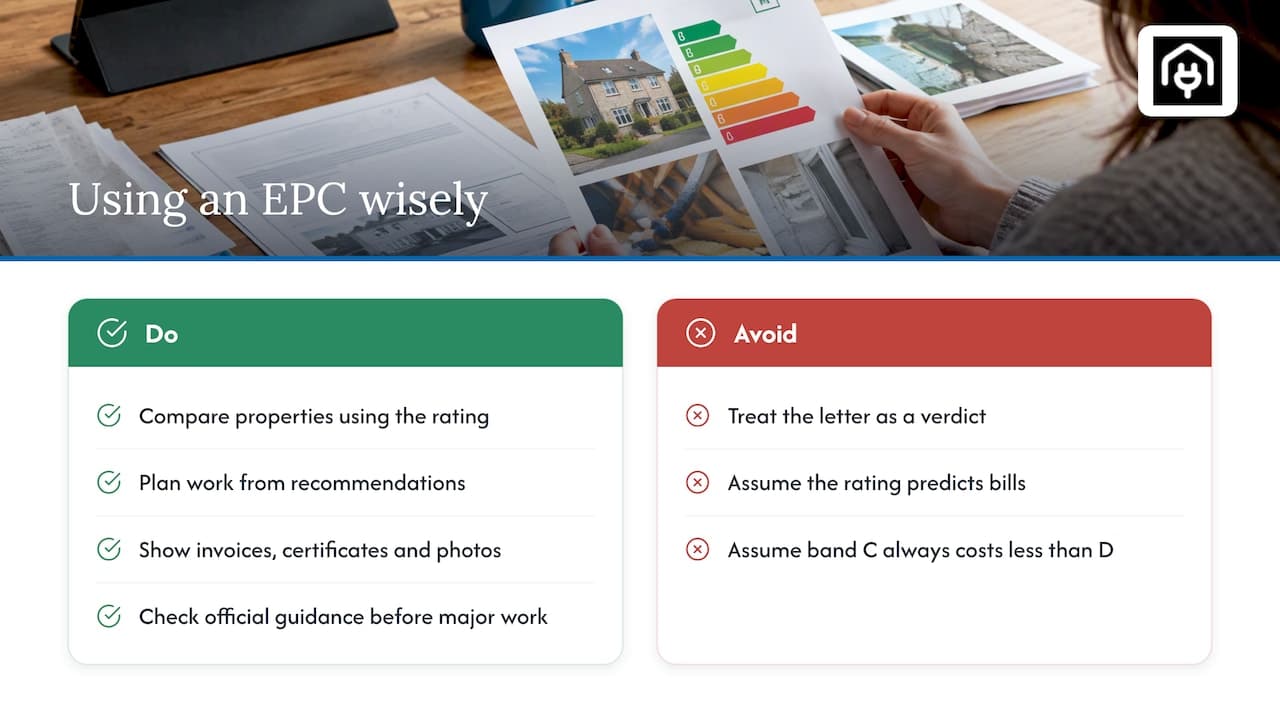
The second point is data quality. An assessment is only as good as the evidence behind it. Owners who can show invoices, installer certificates and photographs of insulation often see their rating reflect the work they have actually done. Owners who cannot may find that cautious assumptions drag the score down. A few minutes of preparation before the survey is the cheapest improvement available.
The third point is timing. The methodology behind domestic ratings is changing as the Home Energy Model develops alongside the Future Homes Standard. Anyone planning major work should check the current position on the official pages before committing, and should keep records so that a future reassessment can take account of what was installed.
— Danny
Getting a new assessment through Home Energy Model
When the register shows no valid certificate, or the rating no longer reflects recent upgrades, a fresh assessment is the next step. Home Energy Model connects property owners, landlords and developers with assessors for:
- a domestic EPC for homes being sold, let or improved
- a commercial EPC for offices, shops and other non-domestic premises
- TM44 inspections for air conditioning systems
No prices are published on these pages, so costs are confirmed through the quote request form on each one. New-build and development projects can also request SAP calculations and water calculations for Part G.
Common mistakes when checking energy efficiency
Reading the wrong address. Flats and shared postcodes cause most errors. Confirm the full address on the certificate.
Ignoring the date. A certificate that is close to 10 years old may predate insulation, boiler or window upgrades, so the rating may understate the property.
Treating cost estimates as a quote. The cost figures are modelled using standard assumptions, so they will not match a real bill exactly.
Skipping the recommendations page. The rating is the headline, but the improvement list is the part that helps with decisions.
Assuming no result means no requirement. A blank search may simply mean a certificate has not been lodged or has expired. Check whether the property needs one before it is marketed.
What good practice looks like for each reader
Buyers and tenants
Search the address before viewing. Compare the rating against similar homes in the area, read the recommendations to judge likely upgrade costs, and ask for recent bills.
Homeowners
Find the current certificate, compare it with work done since the survey, and consider a reassessment if significant upgrades are not reflected. Keep a folder of installer paperwork.
Landlords and investors
Check every property in the portfolio, not only those about to be let. Note expiry dates, review the recommendations for each building, and plan assessments ahead of tenancy changes. The site’s guide to EPC ratings meaning is a useful companion when briefing a portfolio team.
Developers and building professionals
New buildings follow a design-stage calculation rather than a survey of an existing property. Plan for SAP or, for non-domestic buildings, SBEM calculations, and for larger or complex schemes consider dynamic simulation modelling.
FAQ
How do I work out the energy efficiency of a building?
For an existing home, look up its EPC, which already contains the calculated rating. For a new or altered building, an assessor enters the construction, glazing, insulation, heating system and fuel into approved software that applies a standard method. A household can also track its own kilowatt hours per square metre over 12 months.
Can I get my own EPC certificate?
A valid certificate must come from an accredited assessor, who surveys the property and lodges the result on the register. Owners cannot issue their own. Once lodged, the owner can download it from the government search service.
How long does an EPC last?
An EPC is valid for 10 years. A new one is worth considering earlier if upgrades such as insulation or a new heating system have been installed since the last assessment.
Does a high rating mean low bills?
It means the building is likely to be cheaper to run under standard assumptions. Actual bills still depend on how many people live there, how heating is used and the fuel tariff.
Sources
- Find an energy certificate, GOV.UK
- A guide to Energy Performance Certificates for the marketing, sale and let of dwellings, GOV.UK
- Get a new energy certificate, GOV.UK
- Guide to the Energy Performance Certificate (EPC), NHIC
- Energy Performance Certification of Buildings, IEA
- TM54 Evaluating operational energy use at the design stage, CIBSE
- ISO 52016-1:2017