

TL;DR:
- An Energy Performance Certificate measures a property’s energy efficiency on a scale from A to G, affecting costs and compliance. Property ratings are calculated using the SAP 10.2 model based on building features, not occupant behavior. Improving EPC ratings involves targeted upgrades like insulation and system replacements to meet legal standards and boost asset value.
An Energy Performance Certificate (EPC) rating is a standardised measure of a property’s energy efficiency, expressed on an A-to-G scale, where A is the most efficient and G the least. Every property sold or rented in England and Wales requires a valid EPC under UK law. The rating directly affects running costs, property value, and legal compliance under the Minimum Energy Efficiency Standards (MEES). For landlords and property owners, understanding energy performance certificate ratings explained in full is no longer optional. Regulatory thresholds are tightening, and the financial and legal consequences of falling short are significant.
How are energy performance certificate ratings calculated?
EPC ratings are calculated using the Standard Assessment Procedure (SAP) 10.2 methodology, the government-approved framework for assessing residential energy performance. SAP 10.2 models primary energy consumption across a property’s key services: space heating, hot water, and lighting. The calculation is based on the physical characteristics of the building, not on how occupants actually use it.
The assessment process works as follows:
- A qualified assessor visits the property and records data on wall construction, roof insulation, window glazing, heating systems, and floor area.
- That data is entered into approved software, which applies SAP 10.2 to produce an estimated energy cost per square metre.
- The software generates a score between 1 and 100, which maps to a letter band from G to A.
- The final certificate includes the current rating and a potential rating if recommended improvements are made.
- The assessor lodges the certificate on the national EPC register, where it remains valid for ten years.
One important nuance: the model uses standardised fuel prices and fixed occupancy assumptions, not real household behaviour. A property with electric heating often scores lower than a comparable gas-heated property, because electricity carries a higher cost weighting within the model. This does not necessarily mean the electric-heated home is less comfortable or less efficient in practice. Under SAP 10.2, homes with heat pumps benefit more than under older cost-based methods, because the standard now accounts for primary energy use rather than fuel cost alone.
Pro Tip: If a property has recently had a heat pump installed, commissioning a new EPC assessment under SAP 10.2 may produce a meaningfully better rating than the previous certificate suggests.

What do the different EPC rating bands mean in practice?
EPC rating bands run from A to G, each covering a defined score range and reflecting a distinct level of energy efficiency.
| Band | Score range | Efficiency label | Typical annual energy cost (3-bed semi) |
|---|---|---|---|
| A | 92–100 | Most efficient | Under £500 |
| B | 81–91 | Very efficient | £500–£1,000 |
| C | 69–80 | Good | £1,000–£1,500 |
| D | 55–68 | Average | £1,500–£2,000 |
| E | 39–54 | Below average | £2,000–£2,500 |
| F | 21–38 | Poor | £2,500–£3,500 |
| G | 1–20 | Very inefficient | Over £3,500 |
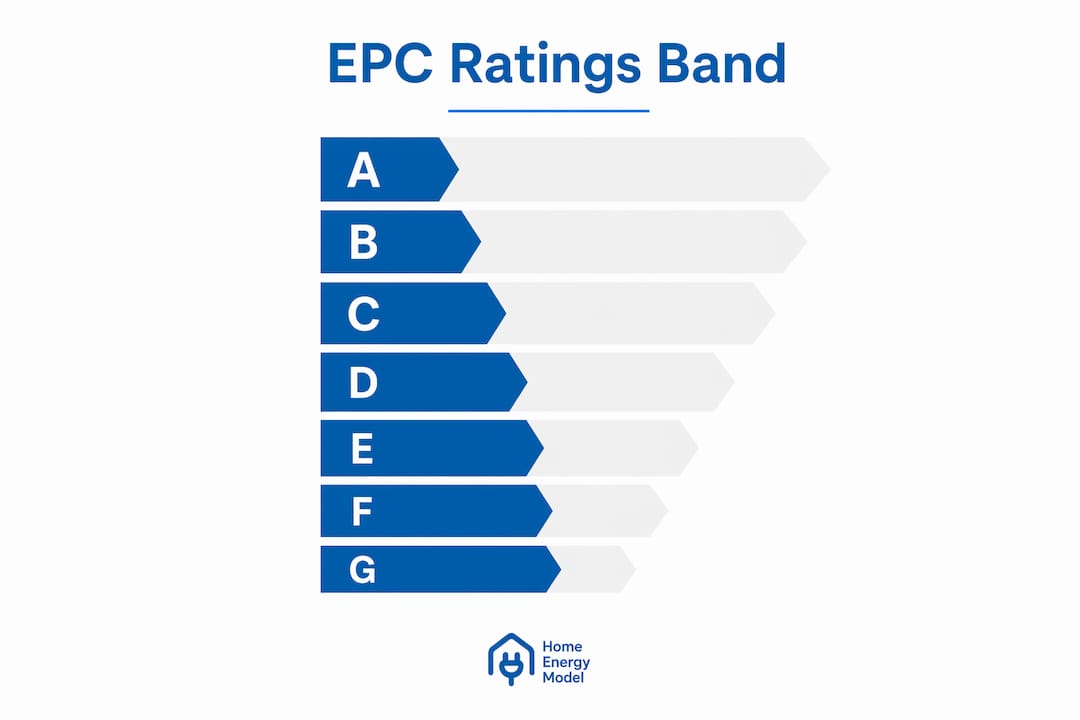
The gap between an A-rated and a G-rated property is stark. Annual energy costs range from under £500 for band A to over £3,500 for band G on a standard three-bedroom semi-detached home. That difference represents thousands of pounds over a tenancy, which directly affects tenant affordability and landlord attractiveness.
The distribution of ratings across the housing stock is uneven. 88% of new-build homes in England achieve an A or B rating, while only around 23% of pre-1919 homes reach A, B, or C. That gap reflects decades of differing construction standards and explains why so many older properties require significant investment to meet modern thresholds.
Key points for landlords to note:
- Band D is the most common rating across the existing UK housing stock.
- Bands F and G represent a legal risk for landlords under MEES regulations.
- A band C or above is the target threshold for new tenancies from 2025 onwards.
- Higher ratings correlate with lower tenant energy bills, which improves tenant retention.
Properties rated F or G are not simply inefficient. They are a compliance liability. Renting out an F or G rated property without a valid exemption is a breach of MEES, which triggers regulatory action from local authorities.
Why EPC ratings matter: legal requirements and compliance
The legal framework around energy efficiency certificates is clear and carries real financial consequences. A valid EPC is required by law whenever a property is sold or let in England and Wales. The certificate must be made available to prospective buyers or tenants before marketing begins.
The current compliance picture for landlords:
- The minimum EPC rating for private rentals is band E under MEES.
- The threshold rises to band C for new tenancies from 2025, with all existing tenancies expected to follow.
- Failing to hold a valid EPC when selling or renting triggers a £200 fixed penalty.
- Renting out an F or G rated property without a registered exemption constitutes a breach of MEES and can result in further enforcement action.
- Exemptions exist but are limited: they cover circumstances such as third-party consent being refused or where the cost of improvements exceeds a defined cap.
The trajectory of UK regulations points firmly towards higher minimum standards. Landlords who treat EPC compliance as a box-ticking exercise are taking a short-term view. The cost of upgrading a property from E to C is almost always lower than the cumulative cost of penalties, void periods caused by unlettable properties, and emergency retrofits under time pressure.
Pro Tip: Check the national EPC register before purchasing any rental property. A certificate close to expiry on a low-rated property signals an immediate upgrade cost that should factor into the acquisition price.
Landlords managing multiple properties should also consider broader landlord compliance obligations, which extend beyond energy ratings to cover safety and regulatory requirements across the tenancy.
How can property owners improve their EPC ratings?
Improving an EPC rating requires targeted investment in the property’s fabric and systems. The EPC report itself provides a strategic roadmap of recommended measures, ranked by cost-effectiveness. Property owners should treat this section of the report as a planning document, not a suggestion list.
The most impactful improvements, in order of typical cost-effectiveness, are:
- Loft insulation. Adding or topping up loft insulation to 270mm is one of the cheapest measures and delivers consistent rating gains across most property types.
- Cavity wall insulation. Applicable to most post-1920 properties with unfilled cavities. The improvement to both rating and running costs is substantial.
- Heating system upgrade. Replacing an old gas boiler with a modern condensing boiler, or installing a heat pump, can move a property up one or two bands.
- Double or triple glazing. Replacing single-glazed windows improves both the fabric score and the comfort of the property for tenants.
- LED lighting throughout. A low-cost measure that contributes to the lighting element of the SAP calculation.
- Solar photovoltaic panels. A higher-cost intervention that can push properties from C to B or even A, particularly when combined with battery storage.
Cost-benefit decisions depend on the property’s current band and the target band required for compliance. Moving from G to E costs far less than moving from D to B. Property owners should commission a full assessment before committing to any single measure, as the interaction between improvements is not always linear.
After any upgrade, a new EPC assessment is required. The existing certificate does not update automatically. Assessment costs typically run from £65 to £120, which is a minor cost relative to the investment in improvements.
Common questions and misconceptions about EPC ratings
Several persistent misunderstandings about energy efficiency certificates cause landlords and property owners to make poor decisions. Addressing them directly prevents costly mistakes.
- An EPC is not a pass or fail test. Every property receives a rating. The question is not whether a property passes, but whether its rating meets the legal threshold for its intended use.
- The rating reflects modelled performance, not actual consumption. Real energy bills depend on occupant behaviour, thermostat settings, and lifestyle. The EPC uses standardised assumptions so that all properties can be compared on equal terms.
- EPC certificates are valid for ten years. A certificate issued in 2016 remains legally valid until 2026, even if the property has changed hands or had work done. However, if improvements have been made, a new assessment will reflect the updated rating.
- Obtaining an EPC assessment costs between £65 and £120 in most cases. This is a regulated market, and prices are broadly consistent across qualified assessors.
- Certificates can be checked on the national EPC register at no cost. Any member of the public can search by postcode to view a property’s current rating, its score, and the recommendations on the certificate.
A common misconception among landlords is that an old EPC on a recently renovated property still reflects the property accurately. It does not. A property that has had insulation added, a new boiler fitted, or windows replaced will have a different energy profile from what the old certificate records. Commissioning a new assessment after improvements is the only way to capture and demonstrate that progress.
Key takeaways
EPC ratings are a legal requirement, a compliance tool, and a financial indicator that every UK landlord and property owner must understand and act on.
| Point | Details |
|---|---|
| Rating scale | EPC bands run from A (score 92–100) to G (score 1–20), with annual costs ranging from under £500 to over £3,500. |
| Calculation method | Ratings use SAP 10.2 modelling based on property fabric and systems, not actual occupant energy use. |
| Legal threshold | The current minimum for rentals is band E; the threshold rises to band C for new tenancies from 2025. |
| Improvement process | Upgrades do not automatically update an EPC. A new assessment costing £65–£120 is required after any improvement works. |
| New-build advantage | 88% of new-build homes achieve A or B, compared with only 23% of pre-1919 properties reaching A, B, or C. |
Why landlords need to treat EPCs as a strategic asset
Having worked closely with UK energy performance data and property compliance for years, I find that the most common mistake landlords make is treating an EPC as a document to obtain and file, rather than a tool to use. The recommendations section of an EPC report is genuinely useful. It tells a property owner exactly which interventions will move the needle, in what order, and by how much. Most landlords never read past the front page.
The regulatory direction is unambiguous. The minimum standard for rentals is moving from E to C, and the government has signalled that further tightening is likely beyond that. Landlords who invest now, guided by the EPC’s own recommendations, will spend less per rating band gained than those who retrofit under deadline pressure. The economics of proactive improvement are straightforward.
There is also a valuation argument that too few landlords make. A band C or B property commands higher rents, attracts longer tenancies, and sells at a premium compared with an equivalent band E or F property. The EPC is not just a compliance document. It is a signal of asset quality. Engaging a qualified EPC assessor who can advise on the most cost-effective improvement pathway is one of the better investments a landlord can make before committing to any retrofit spend.
— Danny
How Homeenergymodel supports UK property owners with EPC compliance
Homeenergymodel provides detailed, practical guidance for UK landlords and property owners navigating EPC requirements and the forthcoming Home Energy Model (HEM), which is set to replace SAP as the government’s primary assessment methodology. The site covers everything from understanding types of home energy models relevant to landlords, to the practical steps involved in booking and completing an EPC assessment. For property owners who want to understand how their property’s energy performance is calculated, what their current rating means for compliance, and which improvements will deliver the greatest gains, Homeenergymodel offers clear, regulation-aligned resources. Guidance on the EPC exemption register is also available for landlords managing properties where standard compliance routes are not straightforward.
FAQ
What is an EPC rating?
An EPC rating is a standardised measure of a property’s energy efficiency, expressed on a scale from A (most efficient) to G (least efficient), calculated using the SAP 10.2 methodology.
How long is an EPC valid for?
An EPC certificate is valid for ten years from the date of issue. A new assessment is required after that period, or sooner if significant energy improvements have been made to the property.
What is the minimum EPC rating for renting a property?
The current minimum EPC rating for private rental properties in England and Wales is band E under MEES. This threshold rises to band C for new tenancies from 2025.
Can a property fail an EPC assessment?
No property fails an EPC assessment. Every property receives a rating between G and A. However, renting out a property rated F or G without a registered exemption breaches MEES regulations.
How much does an EPC assessment cost?
An EPC assessment typically costs between £65 and £120. Failing to hold a valid EPC when selling or renting a property can result in a £200 fixed penalty.