

TL;DR:
- SAP calculations assess a property’s energy performance influencing compliance, value, and rental standards.
- From 2026, the Home Energy Model will replace SAP, using dynamic simulation for better accuracy.
- Improving insulation, heating, and renewables can enhance energy ratings and future-proof properties.
Many property owners treat a SAP calculation as a box to tick before selling or renting. That view is costing them money. The Standard Assessment Procedure (SAP) is the UK government’s official method for measuring the energy performance of residential buildings, and it sits at the heart of Energy Performance Certificates (EPCs), building regulations compliance, and increasingly, property value. With SAP being replaced by the Home Energy Model from 2026 onwards, understanding this system is no longer optional for landlords and investors. This guide explains what SAP calculations involve, how they work in practice, and what the shift to the new model means for your property decisions.
Table of Contents
- What are SAP calculations and why do they matter?
- How SAP calculations work: The basics explained
- From SAP to Home Energy Model: What’s changing in 2026?
- Impact on property decisions: Compliance, value, and the future
- What most guides miss: Why your SAP score is the start, not the finish
- Find the right support for SAP and Home Energy Model compliance
- Frequently asked questions
Key Takeaways
| Point | Details |
|---|---|
| SAP is changing | The Home Energy Model will replace SAP from 2026, requiring more detailed data but offering better accuracy. |
| Your rating matters | Energy calculations affect legal compliance, property value, and running costs—critical for owners and investors. |
| Practical improvements boost ratings | Upgrades like insulation and renewables can significantly enhance your SAP or HEM energy rating. |
| Start preparing now | Understanding the new requirements early helps you stay compliant and protect your investment. |
What are SAP calculations and why do they matter?
SAP stands for Standard Assessment Procedure. It is the UK government’s approved methodology for rating the energy performance of dwellings. Introduced in the 1990s and updated over the years, SAP assigns a numerical score between 1 and 100 (or higher for very efficient homes), which then translates into an EPC band from A to G. The higher the score, the more energy efficient the property.
For property owners, SAP calculations carry significant legal weight. They are required when:
- Constructing a new residential building
- Making material changes to an existing property
- Applying for an EPC to sell or rent a property
- Demonstrating compliance with Part L of the Building Regulations (energy efficiency)
The score affects far more than compliance paperwork. Lenders, tenants, and buyers increasingly factor EPC ratings into their decisions. A low SAP score can reduce rental appeal, depress sale prices, and even prevent a property from being legally rented under Minimum Energy Efficiency Standards (MEES).
For landlords specifically, optimising your home’s energy performance is becoming a financial necessity, not just a regulatory one. Properties with strong EPC ratings command higher rents in many markets and are far less exposed to retrofit risk as regulations tighten.
The UK housing stock has a average SAP rating of 68 as of 2024, while new builds typically achieve scores of 80 to 100 or above. That gap between the existing stock and new build performance tells the story of where the retrofit challenge lies for landlords.
“SAP has served as the backbone of UK energy performance assessment for decades. As decarbonisation targets intensify, the limitations of the existing methodology have made a replacement both necessary and overdue.”
Understanding what your SAP score means for your specific property is the first step towards making informed investment decisions. The full SAP calculation demystified process is worth examining closely before any renovation work or property transaction.
How SAP calculations work: The basics explained
A SAP calculation is not a simple inspection. It draws on a detailed set of inputs about the physical characteristics of a property and its installed systems. The assessor uses approved software to process all the data and produce an energy rating.
The key inputs required for a SAP calculation are:
- Construction details: Floor area, wall types, roof and floor construction, and the thermal properties (U-values) of each element.
- Insulation levels: Cavity wall insulation, loft insulation thickness, and any solid wall treatments.
- Heating system: Type of boiler or heat source, fuel used, controls, and efficiency ratings.
- Hot water system: How hot water is generated and stored.
- Ventilation: Whether the property has natural, mechanical, or heat recovery ventilation.
- Lighting: Proportion of fixed low-energy light fittings.
- Renewable energy: Solar panels, heat pumps, or other on-site generation.
Here is an example of how inputs translate into outputs for a typical semi-detached house:
| Input | Example value | Effect on SAP score |
|---|---|---|
| Wall insulation (U-value) | 0.28 W/m²K | Moderate positive |
| Boiler efficiency | 91% condensing gas | High positive |
| Loft insulation | 270mm mineral wool | High positive |
| Solar PV | 2.5 kWp system | Significant positive |
| Draught proofing | Partial | Small positive |
New builds in the UK are expected to achieve SAP ratings of 80 to 100+ to satisfy current building regulations. Older properties often fall short without targeted upgrades.
Pro Tip: One of the most common mistakes landlords make before a SAP assessment is assuming the assessor will gather all the required data on the day. Preparing a clear record of your heating system specifications, insulation certificates, and any installed renewables before the visit can prevent delays and inaccurate results.
For those ensuring your new build meets energy standards, the calculation also feeds into predicted energy performance during planning and construction stages. Understanding the energy compliance impact of each design decision early on can save significant costs during construction.

From SAP to Home Energy Model: What’s changing in 2026?
SAP has been the standard for decades, but it was designed in an era before heat pumps, smart controls, and dynamic energy tariffs became mainstream. The methodology has faced growing criticism for being unable to accurately model modern low-carbon technologies. A property fitted with a ground source heat pump, for instance, could be scored less favourably under SAP than one with a traditional gas boiler, simply because the older method was not built to reflect the real-world performance of newer systems.
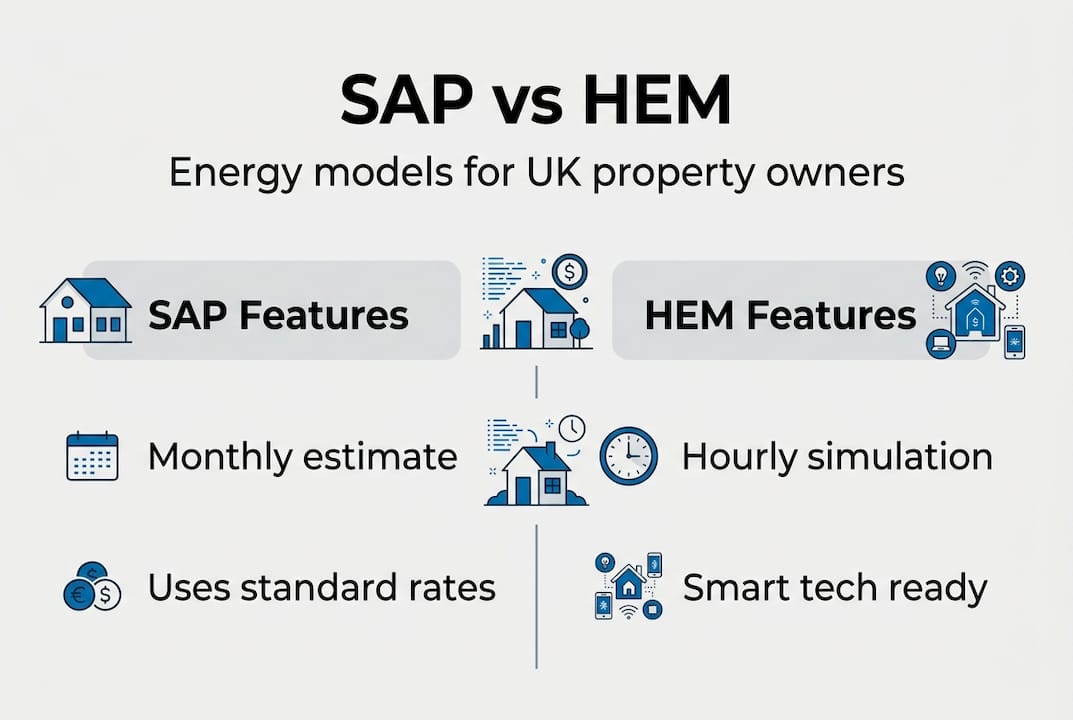
The Home Energy Model (HEM) replaces SAP as the official methodology for new homes from 2026, aligning with the Future Homes Standard. HEM uses dynamic simulation techniques that model energy use hour by hour, rather than relying on the simplified monthly calculations that SAP applies. This makes it far more capable of reflecting how homes with heat pumps, battery storage, and smart heating controls actually perform.
Here is how the two methodologies compare:
| Feature | SAP | Home Energy Model (HEM) |
|---|---|---|
| Simulation type | Monthly static calculation | Hourly dynamic simulation |
| Heat pump modelling | Limited accuracy | Significantly improved |
| Renewable integration | Basic | Advanced |
| Technology coverage | Older systems focus | Future-ready technologies |
| Data requirements | Moderate | More detailed |
The transition has drawn mixed views. SAP has been widely criticised for its outdated approach, while HEM has been broadly welcomed for its improved accuracy. Some industry voices have raised concerns about the increased data demands and the learning curve for assessors.
For property owners and landlords, the practical implications are:
- New builds approved after 2026 will need HEM calculations, not SAP
- HEM will influence EPC ratings for new homes under the Future Homes Standard
- Existing properties will continue to use the current EPC framework for now, but changes to assessments for existing homes are expected to follow
- Investments in heat pumps and renewables will be reflected more accurately under HEM
Exploring the full scope of UK energy model standards and the Future Homes Standard implications will help landlords and developers plan their portfolios with confidence.
Impact on property decisions: Compliance, value, and the future
Energy ratings are no longer a niche concern for eco-conscious buyers. They are a mainstream factor in property transactions, lending decisions, and rental compliance. An EPC rating of F or G currently makes a property unlawful to rent in most circumstances under MEES. The government has signalled further tightening, with proposals that could require rental properties to reach EPC band C by the end of this decade.
With the average UK SAP rating sitting at 68 in 2024, many properties in existing rental portfolios will need significant improvement to meet future standards. Landlords who act now, rather than waiting for legislation to force the issue, are in a far stronger position.
Steps to improve energy ratings cost-effectively include:
- Loft insulation: One of the highest-impact, lowest-cost improvements available
- Cavity wall insulation: Significant thermal gains for eligible properties
- Boiler upgrade or heat pump installation: Moves the heating score substantially
- Smart heating controls: Low cost, measurable impact on performance scores
- Solar photovoltaic panels: Improves both the SAP/HEM score and running costs
- Draught proofing and window upgrades: Addresses air leakage, often overlooked
Pro Tip: Future-proofing your investment ahead of the HEM roll-out means considering not just what raises the current EPC rating, but what technologies HEM will reward most. Heat pumps and renewables will carry greater weight under the new model. Installing infrastructure now, even if full systems come later, can reduce future retrofit costs substantially.
For a detailed breakdown of calculating energy savings across different retrofit options, and for SAP rating insights relevant to your property type, the resources available can help landlords and investors make evidence-based decisions rather than guesswork.
What most guides miss: Why your SAP score is the start, not the finish
Most guides treat the SAP score as an endpoint: achieve compliance, move on. That framing misses a significant strategic opportunity. Energy modelling data is one of the most underused tools available to property owners and investors.
A SAP calculation tells you, in granular detail, where your property loses energy and what changes would produce the greatest improvement. Savvy investors use this information to prioritise refurbishment spending, negotiate purchase prices on properties with poor ratings, and plan phased improvements that align with EPC deadlines. Treating optimal home energy use as a strategic variable rather than a compliance checkbox changes how property decisions get made.
Relying solely on minimum compliance is a short-term view. Properties that merely scrape through the current standard will require repeated expenditure as regulations tighten. Owners who invest in genuinely high-performing assets, informed by accurate energy modelling, build portfolios that are more resilient to regulatory change and more attractive to quality tenants. The score is the start of a conversation about your property’s long-term performance, not the end of it.
Find the right support for SAP and Home Energy Model compliance
Understanding SAP calculations and the move to the Home Energy Model is one thing. Applying that knowledge effectively to a specific property portfolio requires the right resources. Homeenergymodel.co.uk offers a range of guides and tools tailored to landlords, developers, and property investors navigating compliance requirements. For those managing multiple properties, the guidance on energy models for landlords provides a practical starting point. Those looking for a clear overview of what is coming can explore HEM explained for properties, while the detailed energy simulation UK guide covers the technical landscape for developers and assessors working with new methodology requirements.
Frequently asked questions
What documents do I need for a SAP calculation?
You will need architectural plans, construction specifications, and details for heating, cooling, lighting, ventilation, and any renewables. Gathering insulation and heating details in advance helps avoid delays and ensures accurate results.
How does SAP affect my EPC rating?
The SAP score is the direct basis for your Energy Performance Certificate band. A higher score produces a better EPC rating, which influences rental appeal, sale value, and legal compliance under MEES.
What changes with the Home Energy Model in 2026?
From 2026, the Home Energy Model replaces SAP for new homes, using hourly dynamic simulation for greater accuracy. It will require more detailed property data but offers much better modelling of heat pumps and renewables.
Can I prepare my property for higher energy ratings?
Yes. Improving insulation, upgrading heating systems, and integrating renewables are all proven ways to raise a SAP or HEM rating and strengthen compliance ahead of tightening regulations.
Recommended
- SAP Calculation Demystified: London Homeowner’s Guide to Energy Ratings – Home Energy Model
- SAP Calculations for Energy Rating Dwellings: 5 Key Insights
- SAP Calculations in London: Optimising Your Home’s Energy Performance – Home Energy Model
- Local Expertise: Finding SAP Calculations Near Me for London Properties – Home Energy Model