
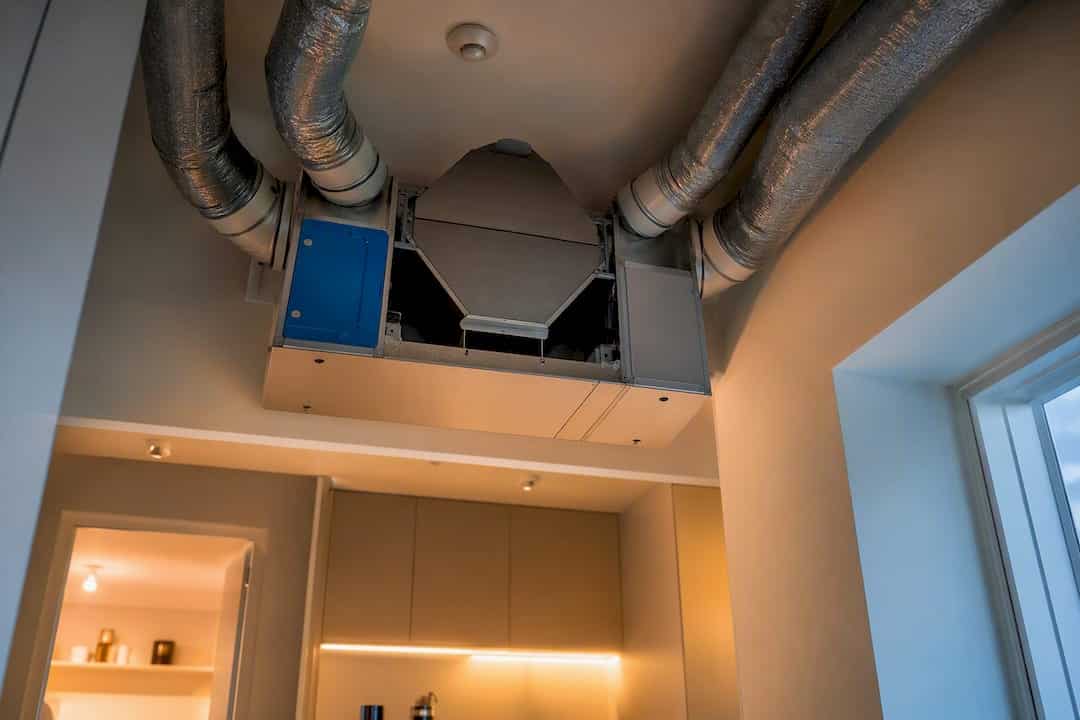
A fresh air exchanger, more precisely called a heat recovery ventilator (MVHR or HRV), continuously extracts stale air and supplies filtered fresh air while recovering most of the heat that would otherwise escape. Quoted heat recovery efficiencies typically sit in the 85–95% range, and the Home Energy Model methodology increasingly rewards this in energy assessments. It suits airtight, well-insulated homes far better than draughty older properties.
TL;DR:
- Properly installed and commissioned MVHR systems can reduce heating costs by approximately 10 to 30 percent in airtight homes.
- Heat exchange efficiency typically ranges from 85 to 95 percent, but real-world performance often falls short due to ductwork and airtightness issues.
- Systems that transfer both heat and moisture (ERV) suit humid climates, while heat-only systems (HRV) are better for cold, dry winters; MEV offers only basic extraction without heat recovery.
- Continuous operation of balanced systems is essential to maintain indoor air quality and energy savings, with regular filter maintenance and system checks.
- Correct sizing and airtightness are critical; oversized units waste energy, and leaks bypass the heat exchanger, undermining system efficiency.
Table of Contents
- How a fresh air exchanger works: supply, extract, and heat exchange
- HRV, ERV or MEV: which suits your home?
- What indoor air quality and energy benefits should you expect?
- Is your home a good fit? Checking airtightness and building type
- What does installation, sizing and running MVHR actually cost?
- Should a fresh air exchanger run all the time?
- Choosing an installer: the questions worth asking at quote stage
- Why ventilation choices matter for UK energy modelling
- Author perspective: priorities when improving home ventilation
- How Homeenergymodel can help you plan the right system
- Sources
How a fresh air exchanger works: supply, extract, and heat exchange
Every mechanical ventilation heat recovery system runs two separate air streams side by side, and they never mix. One duct network extracts warm, moist air from bathrooms, kitchens and utility rooms. The other supplies fresh, filtered outdoor air to bedrooms and living rooms. Both streams pass through a heat exchanger core, where energy transfers from the outgoing air to the incoming air without the two airstreams physically combining, as Homebuilding’s guide to MVHR sets out clearly.
The core itself comes in two common forms. A plate heat exchanger uses thin aluminium or polymer sheets stacked to create narrow channels, transferring sensible heat only. A rotary or thermal wheel exchanger rotates slowly between the two airstreams and, in enthalpy (ERV) versions, also carries moisture across, which matters in dry climates or overly humid ones.
Real-world performance rarely matches the manufacturer’s laboratory figure. Several factors pull efficiency down:
- Poor ductwork design, with long runs, sharp bends or undersized pipework
- Inadequate airtightness, allowing unfiltered air to bypass the system entirely
- Incorrect commissioning, leaving supply and extract flows unbalanced
- Skipped bypass control, which should let the unit shortcut the heat exchanger during warm weather
Field research from the AIVC found these installation shortcomings recur often enough to warrant far more attention at the design and commissioning stage than most installers currently give them.
HRV, ERV or MEV: which suits your home?
The shorthand causes genuine confusion, so here’s the plain version. HRV (often labelled MVHR in the UK) transfers sensible heat only. ERV transfers both heat and moisture, because the exchanger core is enthalpic rather than purely thermal, a distinction explained in the technical overview of heat recovery ventilation. MEV, or mechanical extract ventilation, simply pulls stale air out continuously with no heat recovery at all, relying on trickle vents or gaps for replacement air.
Rules of thumb that hold up in practice:
- Choose ERV where humidity swings matter year round, particularly in mixed or humid climates
- Choose HRV/MVHR for cold, dry winters where moisture retention in incoming air isn’t a priority
- Choose MEV only as a basic, lower-cost fallback where full heat recovery isn’t affordable or practical
A quick checklist before you commit: check your climate’s humidity pattern, confirm your home’s airtightness, and decide whether whole-house or single-room coverage fits your budget. Homeenergymodel’s comparison of HRV and ERV for UK properties goes into the regional nuances further.
What indoor air quality and energy benefits should you expect?
Balanced mechanical ventilation does three things reliably: it dilutes carbon dioxide build up, removes airborne pollutants like cooking fumes and VOCs, and moderates humidity enough to cut condensation on cold surfaces. Occupants often notice fewer draughts too, since the system replaces the need to crack windows open in winter.
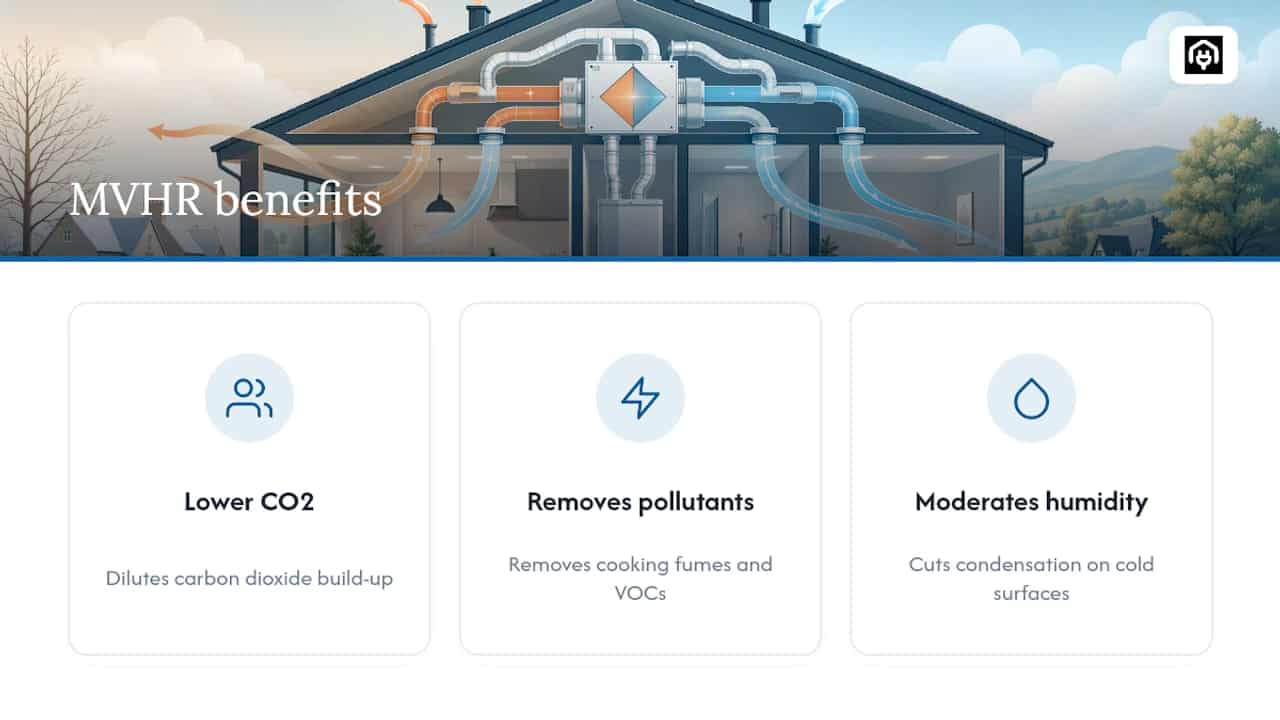
Heat recovery, in numbers: Properly selected and installed MVHR systems can cut heating costs by roughly 10–30% in suitably airtight homes, though the saving depends heavily on building fabric and how occupants actually run the system. As insulation standards rise, ventilation heat loss becomes the largest remaining energy leak in many new-build homes, which is exactly why heat recovery matters more now than it did a decade ago.
Filtration is the quieter benefit. Supply-side filters, usually rated to at least a coarse particulate standard, catch pollen and dust before it reaches living spaces, which is a real difference for anyone with allergies or asthma in the household.
Is your home a good fit? Checking airtightness and building type
MVHR performs best in a genuinely airtight envelope. Where uncontrolled air leaks through gaps, badly sealed loft hatches or old sash windows, that infiltration bypasses the heat exchanger entirely and undermines the whole point of the system, as MVHR guidance for UK homes makes plain. Common leakage paths include loft hatches, service penetrations, and old suspended timber floors.
Before requesting a quote, run through this checklist:
- Does the property already have trickle vents or rely on natural infiltration for fresh air?
- Is there recurring condensation on windows or mould in corners despite normal heating?
- Do CO2 monitors or a simple “stuffy room” test suggest poor air exchange?
- Is this a new build designed to a tight airtightness target, or a retrofit into an older, leakier structure?
Pro Tip: If whole-house ductwork isn’t practical in a retrofit, a single-room heat recovery fan fitted in a bathroom or kitchen, paired with background trickle ventilators elsewhere, is a sensible compromise rather than an all-or-nothing decision. Guides to heat recovery fans available online cover this retrofit route in more depth, and they align with guidance from BEAMA’s technical documentation on where single-room units fit.
What does installation, sizing and running MVHR actually cost?
Quotes vary enormously because several separate cost components stack up:
- The unit itself, priced by airflow capacity and heat exchanger type
- Ductwork, including insulated pipework, diffusers and any structural work to route it
- Labour for installation, particularly in retrofits where floors or ceilings need opening up
- Commissioning and balancing, to set supply and extract airflow rates correctly
- Controls, from basic humidity sensors to app-connected boost settings
Running costs come mainly from continuous fan electricity use, which is modest for a correctly sized unit, plus periodic filter replacement every few months. Some units include automatic summer bypass or frost protection defrost cycles that briefly change fan behaviour in extreme weather.
Correct sizing matters more than most homeowners expect. An oversized system wastes electricity and money; an undersized one fails to clear moisture and CO2 properly. Airflow rates need calculating against room volumes and occupancy, then verified at commissioning, not just assumed from a spec sheet.
Should a fresh air exchanger run all the time?
Yes, for balanced systems, continuous low-speed operation is the standard recommendation. Stopping and starting the fan defeats the purpose: humidity and CO2 build up again quickly once extraction stops, and boost mode exists precisely for short bursts of extra demand, such as cooking or showering, rather than as the system’s normal state.
A simple maintenance routine keeps performance close to the quoted efficiency figures:
- Check and vacuum or wash washable filters roughly every three months
- Replace disposable filters on the manufacturer’s stated schedule, typically every six to twelve months
- Have the system rebalanced or recommissioned every few years, or after any building work that alters airtightness
- Wipe diffusers and grilles to stop dust build up affecting airflow readings
Watch for warning signs: unusual fan noise, noticeably weaker airflow at the diffusers, or persistent odours despite the system running. Any of these usually points to a blocked filter, an unbalanced system, or a fault needing a service call.
Choosing an installer: the questions worth asking at quote stage
Ask every installer the same set of questions so quotes are genuinely comparable:
- Will they carry out or arrange an airtightness test before specifying the system?
- Do they include full commissioning with measured airflow rates, not just an estimate?
- Can they show the proposed ductwork design, including run lengths and diffuser positions?
- Do they have references or case studies from similar UK properties?
Treat vague efficiency claims, missing commissioning line items, or underspecified ductwork drawings as red flags. A good handover includes a written user guide, clearly labelled filter locations, and an agreed maintenance schedule, exactly the gaps field studies of installed systems flag most often.
Why ventilation choices matter for UK energy modelling
Ventilation strategy feeds directly into modelled energy performance under the Home Energy Model, the methodology replacing SAP for EPC-relevant assessments. A system that looks efficient on paper only delivers if it’s properly commissioned and matched to measured airtightness.
Before specifying anything, homeowners should:
- Get an airtightness test done rather than guessing at the building’s leakiness
- Understand how air tightness affects heating bills before committing to a ventilation spec
- Consider a brief professional energy assessment if the property is heading toward retrofit or an EPC review
Author perspective: priorities when improving home ventilation
Fix airtightness and get proper commissioning before worrying about which brand of unit to buy. Ventilation only delivers on its promise as part of a whole-home energy plan, not as an isolated purchase decision.
— Danny
How Homeenergymodel can help you plan the right system
Choosing between HRV, ERV or a single-room retrofit fan is easier with a proper baseline. Rather than guessing at airtightness or accepting a generic quote, Guidance rooted in the Home Energy Model methodology, which will shape UK EPC assessments going forward, offers recommendations grounded in a property’s actual fabric and measured performance, not a one-size-fits-all sales pitch.
If you’re weighing up a ventilation upgrade alongside broader efficiency improvements, a home energy assessment can provide the airtightness and performance picture needed to specify the right system with confidence. Prospective users can request a quote to get advice tailored to what their property can genuinely achieve.
Sources
- MVHR Systems Explained for UK Homes
- MVHR: an expert guide to this ventilation system | Homebuilding
- Mechanical ventilation with heat recovery – Centre for Sustainable Energy
- Characterising actual performance: domestic mechanical ventilation and heat recovery systems (AIVC)