

The three measures that shift most properties up an EPC band are fabric insulation (loft first, then walls and floors), a heating system upgrade, and improved heating controls. Start with loft insulation to 300mm depth — it is the single highest-impact, lowest-disruption step the RdSAP model recognises. Then address wall insulation and heating before considering renewables. Quick wins that help but move the needle least include:
- Switching to LED lighting throughout
- Fitting a hot water cylinder jacket
- Draught-proofing doors, windows and letterboxes
Before spending anything, find your current EPC on GOV.UK. The assessor recommendations on that certificate are the exact levers the model uses — work from that list, not a generic checklist.
Table of Contents
- What is an EPC and how is it calculated?
- How to find your current EPC and read its recommendations
- Practical measures that raise an EPC rating
- Where to find funding for EPC improvements
- Typical costs and timescales for common measures
- Expert retrofit advice and pitfalls to avoid
- Key takeaways
- The case for investing in fabric over quick fixes
- Homeenergymodel: professional EPC and retrofit services
- Useful sources
What is an EPC and how is it calculated?
An Energy Performance Certificate rates a property on an A–G scale, where A is the most efficient and G the least. The rating is a modelled estimate, not a measurement of actual energy use. For existing homes, assessors use Reduced data Standard Assessment Procedure (RdSAP), which infers building characteristics from a survey and applies standardised occupancy assumptions. That distinction matters: two identical houses with different occupants will receive the same EPC score, because the model reflects the building’s fabric and services, not how people actually live in it.
The government is replacing RdSAP with the Home Energy Model (HEM), a more granular methodology aligned with the Future Homes Standard. HEM will introduce a dual-metric EPC: a primary fabric performance standard and a secondary metric covering either heating system performance or smart readiness. This reform changes how landlords should prioritise expenditure, placing fabric quality at the centre of compliance.
55% of private rented sector properties in England were rated below EPC Band C in 2023 — the band the government requires landlords to reach by 1 October 2030.
For landlords, the legal stakes are clear. Under the current Minimum Energy Efficiency Standards (MEES), privately rented properties in England and Wales must hold at least an EPC E. The new standard raises that to the equivalent of EPC C by 1 October 2030, with a cost cap of up to £10,000 per property. Homeowners selling or letting must commission a valid EPC before marketing — and an EPC rating explained resource can help clarify what each band means in practice.
How to find your current EPC and read its recommendations
Locating and reading your existing certificate correctly is the essential first step before any improvement works.
- Search the GOV.UK EPC register. Go to find-energy-certificate and enter the property’s postcode. The register covers England, Wales and Northern Ireland.
- Check the current energy efficiency rating. Note the band (A–G) and the numerical score. The potential rating shown assumes all cost-effective recommendations are implemented.
- Read the recommended measures. The EPC lists improvements in cost-effectiveness order, with indicative costs, typical annual savings and the projected rating after each measure. These are the specific actions the model will recognise when a new certificate is issued.
- Note the issue date and validity. An EPC is valid for ten years. If yours is approaching expiry or was issued before significant works were done, commission a new assessment.
- Check assessor notes and inputs. Confirm the heating fuel type, heating system and insulation depths recorded are accurate. Errors in these fields can materially alter the modelled score.
Pro Tip: Ask the assessor for the data lodgement report, which shows every input used in the calculation. If the heating system or wall construction type is recorded incorrectly, a corrected assessment — not new physical works — may itself improve the rating.
The recommendations on the certificate are not a bespoke retrofit plan. They are outputs from the RdSAP model, and targeted work listed there will generate model points on reissue. Prioritise the measures the certificate lists first, since those deliver the greatest modelled improvement per pound spent.
Practical measures that raise an EPC rating
The measures below are ordered by typical EPC impact. The model weights heat loss and heating efficiency most heavily, so fabric and heating upgrades consistently outperform small electrical or lighting changes.
Fabric-first: insulation and glazing
| Measure | Typical EPC impact | Suitable property types | Notes |
|---|---|---|---|
| Loft insulation (to 300mm) | High | Most house types with accessible loft | Low disruption; often partially funded |
| Cavity wall insulation | High | Post-1930 cavity-wall properties | Requires cavity survey first |
| Internal wall insulation | Medium–High | Pre-1930 solid-wall properties | Reduces floor area; specialist install |
| External wall insulation | Medium–High | Solid-wall properties | Higher cost; may need planning consent |
| Floor insulation | Medium | Suspended timber ground floors | Access from below preferred |
| Double/triple glazing | Medium | Single-glazed properties | Biggest gain where single glazing remains |
| Draught-proofing | Low | All property types | Quick win; low cost |
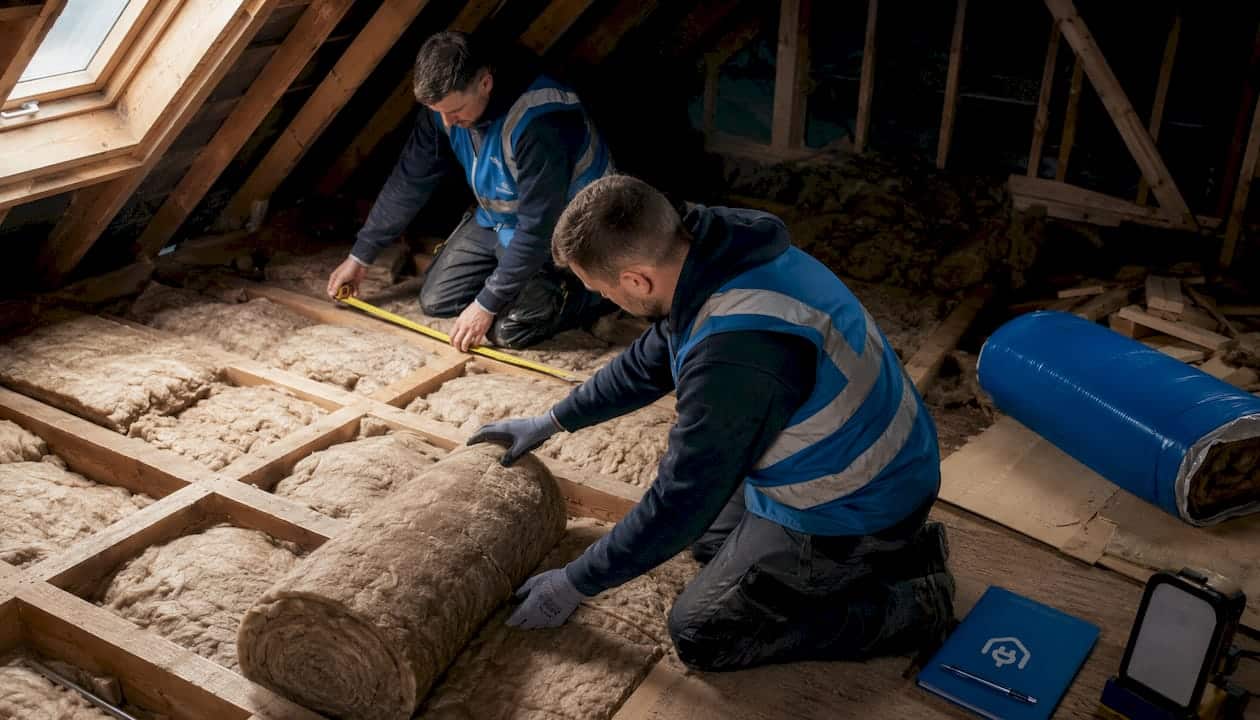
Fabric measures improve the heat loss parameter most directly, which is the primary metric under the new HEM dual-metric standard. Pre-1930 solid-wall properties cannot receive cavity fill — for these homes, maximising loft insulation and improving the heating system are the highest-impact steps before considering internal or external wall insulation, which requires a specialist survey.
Heating upgrades and controls
A condensing boiler replacing a non-condensing model typically delivers a meaningful EPC uplift because the model recognises the higher seasonal efficiency. A heat pump can score even better, but only where the fabric is already well insulated — installing a low-temperature system in a poorly insulated home leads to poor outcomes and the model will reflect that. Thermostatic radiator valves (TRVs), a programmable or smart thermostat, and zone controls all contribute model points and are relatively low cost.
- Condensing boiler replacement: high EPC impact; suitable where gas supply exists and fabric is reasonable
- Air source heat pump: high EPC impact under HEM; requires good insulation levels and adequate radiator sizing
- Smart thermostat and TRVs: low–medium EPC impact; low cost; recognised by the model as heating controls
Renewables and secondary measures
Solar photovoltaic (PV) panels can add EPC points, particularly under HEM’s smart readiness metric. Hot water cylinder insulation is a low-cost measure with modest but real model recognition. LED lighting contributes the fewest points of any listed measure — LED upgrades are worth doing for bill savings but should not be treated as a route to a band change on their own.
Pro Tip: Installers who promise large EPC band jumps from lighting or smart controls alone are over-promising. RdSAP weights heat loss and heating system efficiency far above small electricity savings — fabric and heating upgrades are where the model points are.
Do not seal a property without addressing ventilation. Draught-proofing and insulation reduce air infiltration, which can cause condensation and damp if background ventilation is not maintained. Trickle vents, mechanical extract ventilation (MEV) or a whole-house mechanical ventilation with heat recovery (MVHR) system may be needed alongside fabric upgrades.
Where to find funding for EPC improvements
Several national schemes can reduce the upfront cost of energy efficiency works significantly.
- ECO4 (Energy Company Obligation): Funded by energy suppliers, ECO4 targets low-income and fuel-poor households. Eligible properties can receive insulation, heating upgrades and other measures at no or low cost. Check eligibility via the GOV.UK ECO scheme page or directly with energy suppliers.
- Boiler Upgrade Scheme (BUS): Provides grants of £7,500 towards an air source heat pump or £7,500 towards a ground source heat pump. Note that BUS funding does not count towards the £10,000 MEES cost cap for landlords.
- Great British Insulation Scheme: Targets single insulation measures for properties in lower EPC bands; available to a broader income range than ECO4.
- Local authority and devolved-nation grants: Many councils and the devolved governments in Scotland, Wales and Northern Ireland operate their own retrofit grant programmes. Check your local authority website and the relevant devolved government portal.
- Warm Homes Plan: The government’s overarching framework for up to 5 million home upgrades by 2030; specific scheme details continue to be published.
For landlords, the £10,000 cost cap is the maximum required investment per property under the new MEES standard. Third-party funding — including ECO4 grants — counts towards this cap. The cost of EPC assessments themselves also counts. The existing standard carries a £3,500 cap for E-band compliance under current MEES guidance, with defined exemptions for high cost, third-party consent issues and other circumstances.
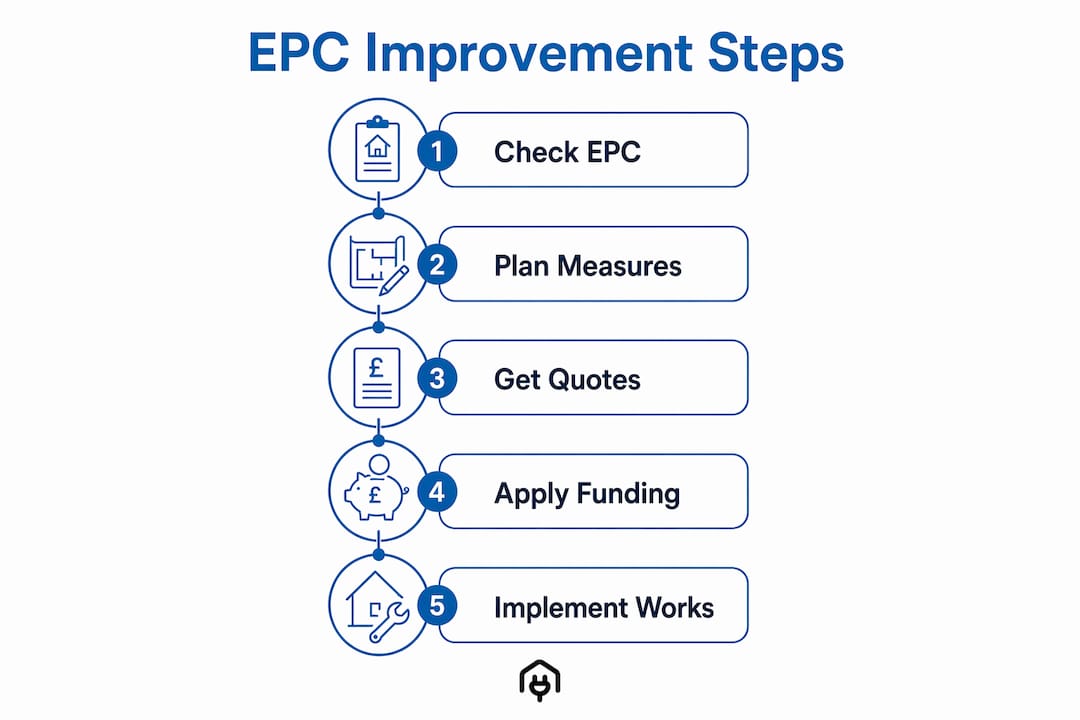
The practical order: obtain installer quotes, confirm scheme eligibility, then apply or claim. Do not commission works before checking grant availability — some schemes require pre-approval.
Typical costs and timescales for common measures
The figures below are indicative. Actual costs vary by property size, location, and installer.
| Measure | Typical cost band | Installation time | EPC impact |
|---|---|---|---|
| Loft insulation (top-up to 300mm) | Low (£300–£600) | Half a day | High |
| Cavity wall insulation | Low–Medium | One day | High |
| Internal wall insulation | High | Several weeks | Medium–High |
| External wall insulation | High | Several weeks | Medium–High |
| Floor insulation (suspended timber) | Medium | One to two days | Medium |
| Condensing boiler replacement | Medium | One to two days | High |
| Air source heat pump | High | Two to five days | High |
| Smart thermostat and TRVs | Low | Half a day | Low–Medium |
| Solar PV (3–4kWp system) | High | One to two days | Medium |
| Double glazing (whole house) | High | Two to five days | Medium |
| LED lighting (whole house) | Low | A few hours | Low |
| Hot water cylinder jacket | Low | Under an hour | Low |
When getting quotes, obtain at least three from competent installers. For insulation and heating systems, confirm the installer holds relevant accreditations: PAS 2035 compliance for retrofit works, and Microgeneration Certification Scheme (MCS) registration for solar PV and heat pumps.
Watch for hidden costs:
- External wall insulation often requires scaffolding and may need planning permission in conservation areas or for listed buildings.
- Solid-wall insulation may trigger building control notification.
- Ventilation upgrades are frequently needed alongside airtightness improvements and should be costed in from the outset.
EPC assessment costs for pre- and post-works certificates count towards the MEES cost cap for landlords — keep receipts.
Expert retrofit advice and pitfalls to avoid
Sequencing retrofit works correctly matters as much as the technology chosen. Installing a heat pump before adequate insulation is in place is one of the most common and costly errors — the system will run inefficiently, bills will not fall as expected, and the EPC will not reflect the potential of the technology. Fabric first, then low-temperature heating.
Common pitfalls to avoid:
- Inadequate ventilation after sealing: Draught-proofing without providing background ventilation creates condensation risk and potential damp damage. Always assess ventilation needs before sealing works.
- Incorrect assessor inputs: If the assessor records the wrong wall construction, heating fuel or insulation depth, the model will undervalue improvements already made. Provide documentary evidence (installation certificates, building control sign-off) at the assessment.
- Unsuitable measures for listed buildings or conservation areas: Cavity fill, external wall insulation and certain glazing upgrades may require listed building consent or planning permission. Check with the local planning authority before commissioning works.
- Over-reliance on EPC recommendations as a retrofit plan: The certificate lists model-recognised measures, not a sequenced, property-specific retrofit specification. For larger packages of work, a bespoke plan is needed.
Pro Tip: For any package of works costing more than a few thousand pounds, consult a PAS 2035-aligned retrofit co-ordinator or a RICS chartered surveyor before committing. Small individual measures — a cylinder jacket, loft top-up — can be handled by competent trades, but complex combinations of insulation, heating and ventilation upgrades benefit from professional sequencing advice. Homeenergymodel’s home retrofit tips guide covers the key questions to ask before work begins.
For properties where energy performance improvements touch on international comparisons, practical retrofit sequencing principles applied in other European markets reinforce the same fabric-first logic used in the UK.
Key takeaways
Fabric insulation, heating upgrades and heating controls are the three levers that most reliably shift a UK property up an EPC band, and addressing them in that order gives the best modelled and real-world outcomes.
| Point | Details |
|---|---|
| Check your EPC first | Search the GOV.UK register, read the recommendations, and verify the assessor’s recorded inputs before spending anything. |
| Fabric insulation delivers most | Loft insulation to 300mm, then wall and floor insulation, produces the highest EPC model points per pound invested. |
| Heating upgrades follow fabric | Replace a non-condensing boiler or install a heat pump only after insulation levels are adequate; controls add points at low cost. |
| Funding can reduce costs significantly | ECO4, the Boiler Upgrade Scheme and local grants can offset major costs; third-party funding counts towards the £10,000 MEES cap. |
| Homeenergymodel supports assessment and compliance | Homeenergymodel provides domestic EPC services, retrofit consultation and post-works assessments to help owners and landlords meet new standards. |
Landlords should note: properties graded EPC C or above before a specified compliance date will be treated as compliant with the new higher standard until that certificate expires. If works exceed the £10,000 cost cap, register a cost-cap exemption via the EPC exemption register to continue letting lawfully.
The case for investing in fabric over quick fixes
The temptation to chase quick EPC wins — LED bulbs, a smart thermostat, a cylinder jacket — is understandable. These measures cost little and cause no disruption. But they rarely move a property across a band boundary, and under the new HEM dual-metric standard, the primary compliance test is fabric performance. A landlord who spends £600 on lighting and controls and then discovers the property still fails the fabric standard has not saved money; they have deferred the harder decision.
The more productive approach is to treat the £10,000 cost cap as a planning budget. Map the fabric measures the EPC recommends, get quotes, identify which grants apply, and sequence the work so that fabric comes first and heating upgrades follow once heat loss is reduced. Landlords who achieve EPC C against the legacy Energy Efficiency Rating before 1 October 2029 gain a meaningful compliance window — the certificate is recognised until it expires, buying time to plan the next phase of works under HEM metrics.
For homeowners not subject to MEES, the calculus is different but the conclusion is similar. Fabric investments reduce bills year after year and add to property value. Quick wins are worth doing, but they should not substitute for the structural improvements that deliver lasting results. Qualified advice — from a PAS 2035 retrofit co-ordinator or a RICS-aligned assessor — pays for itself when it prevents a costly sequencing error or an unsuitable measure being installed.
Homeenergymodel: professional EPC and retrofit services
Homeenergymodel gives property owners and landlords direct access to accredited domestic EPC assessments, retrofit consultation and post-works energy modelling — all aligned with the transition from RdSAP to the Home Energy Model. For landlords planning compliance with the 2030 MEES standard, understanding how the new dual-metric EPC will assess your property is the logical starting point. Homeenergymodel’s home energy model explained resource sets out exactly how the new methodology differs from the current system and what it means for your property’s rating.
For landlords weighing up which modelling route suits their portfolio, the types of home energy models for landlords page outlines the options clearly. To commission a domestic EPC or discuss a post-retrofit assessment, contact Homeenergymodel directly for a quote.
Useful sources
- GOV.UK: Find an energy certificate — search the EPC register for any property in England, Wales or Northern Ireland
- GOV.UK: Improve your home’s energy efficiency — official guidance on measures and scheme eligibility
- GOV.UK: MEES landlord guidance — current cost cap, exemption routes and compliance requirements
- GOV.UK: PRS MEES government response 2025 — the new £10,000 cap, dual-metric standard and 2030 deadline
- Energy Saving Trust: tips to improve your EPC rating — practical measure-by-measure guidance with cost estimates
- RICS: retrofitting and improving energy efficiency — independent retrofit advice and PAS 2035 guidance
- Homeenergymodel: what an EPC assessor does — how to select an accredited assessor and what to expect from the process
- Homeenergymodel: EPC exemption register explained — exemption routes and documentation for landlords who cannot meet the standard within the cost cap
This article provides general information about EPC ratings and energy efficiency measures in England and Wales. It is not professional legal, financial or retrofit advice. Confirm current scheme rules, cost caps and compliance requirements with GOV.UK or a qualified professional before committing to works.