

TL;DR:
- UK homeowners do not have access to a residential clean energy tax credit like in the US. Instead, they benefit from a zero percent VAT rate on qualifying energy-saving installations until March 2027 and various government grants. These incentives aim to improve energy efficiency and meet new regulations for property standards.
Does a residential clean energy credit exist in the UK?
The short answer is no. The residential clean energy credit is a US federal tax mechanism, and it has no direct equivalent in UK tax law. UK property owners do not claim energy credits on a tax return. The confusion is understandable: US coverage of the credit is widespread, and UK homeowners searching for similar benefits often land on American guidance that simply does not apply here.
What the UK offers instead is a 0% VAT rate on qualifying energy-saving materials installed by VAT-registered professionals, running until 31 March 2027, after which the rate reverts to 5%. No tax return is required. The installer applies the zero rate directly on the invoice, so the saving is immediate and automatic.
Qualifying technologies include:
- Solar PV and solar thermal panels
- Air, ground, and water source heat pumps
- Cavity wall, loft, solid wall, and floor insulation
- Electrical battery storage (including standalone grid-connected batteries since February 2024)
- Smart diverters and draught stripping
The Boiler Upgrade Scheme (BUS) and the broader Warm Homes Plan sit alongside VAT relief as the primary home renewable energy incentives available to UK property owners in 2026.
Table of Contents
- UK grants and VAT reliefs for residential clean energy improvements
- How UK homeowners have used these incentives
- How upcoming UK energy regulations interact with these incentives
- Key takeaways
UK grants and VAT reliefs for residential clean energy improvements
VAT relief in practice
The 0% VAT rate applies only when a VAT-registered business supplies and installs the qualifying materials together. DIY purchases attract the standard 20% VAT rate. One critical threshold: if ancillary work exceeds 60% of the total job cost, HMRC may reassess the entire installation at 20%. Homeowners should confirm project breakdowns with their installer before work begins.

Pro Tip: Ask your installer to include a line on the invoice stating “Zero-rated supply under Group 23, Schedule 8, VAT Act 1994.” This protects both parties during any HMRC inspection.
Boiler Upgrade Scheme
The BUS provides grants of up to £7,500 for air and ground source heat pumps in England and Wales, deducted directly from the installer’s invoice. Oil-heated homes can access an increased grant of £9,000. Biomass boilers qualify for £400. The grant is not a tax rebate; the homeowner simply pays a reduced invoice.
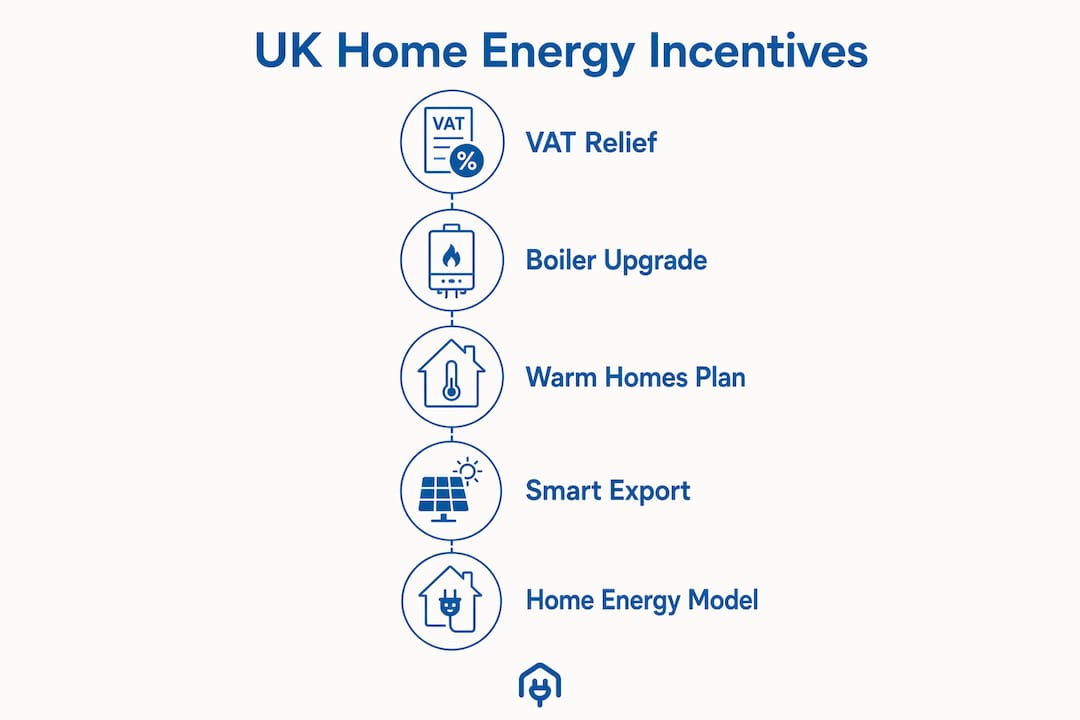
Warm Homes Plan
The government’s Warm Homes Plan commits £15 billion to upgrade up to five million homes by 2030. It covers solar panels, heat pumps, battery storage, and insulation, with grants for low-income households and low or zero-interest loans available to all homeowners regardless of income. Local councils administer the Warm Homes: Local Grant for households with an EPC rating of D to G and a household income of £36,000 or below. The Energy Saving Trust and local authority websites are the most reliable sources for checking current local availability.
Home Energy Model and EPC compliance
The Home Energy Model replaced the Standard Assessment Procedure (SAP) in 2025 as the official methodology for assessing residential energy performance. It underpins Energy Performance Certificates (EPCs) and informs compliance with Minimum Energy Efficiency Standards (MEES). Landlords in particular should note that planned MEES tightening will require EPC ratings of C or above, making energy efficiency rebates and grants directly relevant to compliance strategy. Homeenergymodel provides detailed guidance on renewable energy grants and how they interact with these standards.
Smart Export Guarantee
Homeowners with solar panels can earn payments through the Smart Export Guarantee (SEG). SEG income below £1,000 annually is tax-free under the Trading Allowance; amounts above that threshold must be declared on a Self Assessment return.
How UK homeowners have used these incentives
A rural homeowner in Shropshire on heating oil, for example, would qualify for the £9,000 BUS grant, removing the largest single barrier to switching from oil to an air source heat pump. Combined with the 0% VAT on installation, the total saving on a £15,000 heat pump project could reach well over £4,000 before any running cost reductions are counted. Practical utility bill savings compound over time once the system is in operation.
A landlord with a portfolio of EPC E-rated properties faces a different calculation. Upgrading insulation and installing solar panels under the Warm Homes: Local Grant, where eligible, costs nothing upfront for qualifying tenants. The EPC improvement that results directly supports MEES compliance, reducing the risk of being unable to let the property under future regulations.
How upcoming UK energy regulations interact with these incentives
The Home Energy Model is the most significant regulatory change for residential properties in 2026 and beyond. Because HEM replaces SAP as the basis for EPC calculations, properties assessed under the new methodology may receive different ratings than under the old system. Homeowners and landlords who invest in heat pumps, solar, and insulation now will generally see stronger HEM scores, which translates directly into better EPC ratings and stronger compliance positions.
The planned tightening of MEES to require EPC C for privately rented properties creates a direct financial case for acting before the deadline. VAT relief and BUS grants reduce the upfront cost of the improvements needed to reach that threshold. Homeenergymodel’s guidance on energy efficiency ratings explains how specific measures affect EPC scores under the new model.
The 0% VAT rate itself expires on 31 March 2027. Property owners planning larger projects, particularly ground source heat pump installations or whole-house insulation packages, should factor that date into their timelines. After April 2027, the same installations revert to 5% VAT, a meaningful cost increase on high-value projects.
Key takeaways
The UK delivers home energy incentives through VAT relief and government grants, not income tax credits, making the application process simpler but the eligibility rules more specific.
| Point | Details |
|---|---|
| No UK tax credit equivalent | The residential clean energy credit is a US mechanism with no equivalent in UK income tax law. |
| 0% VAT until March 2027 | Qualifying installations by VAT-registered professionals attract zero VAT until 31 March 2027, then revert to 5%. |
| BUS grants up to £9,000 | Oil-heated homes in England and Wales can claim £9,000 off a heat pump via the Boiler Upgrade Scheme; air and ground source heat pumps for other homes qualify for £7,500. |
| Warm Homes Plan: £15 billion | The government commits £15 billion to upgrade up to five million homes by 2030, with grants and low-interest loans. |
| HEM replaces SAP from 2025 | The Home Energy Model now underpins EPC ratings, making energy upgrades directly relevant to MEES compliance. |