

TL;DR:
- Existing buildings significantly impact UK’s goal for net zero by 2050, requiring retrofitting.
- Property owners face evolving regulations, deadlines, and standards, with compliance essential by 2030.
- Fabric-first upgrades and early action help reduce costs, improve EPC ratings, and meet legal obligations.
Buildings account for roughly 17% of UK greenhouse gas emissions, and around 80% of the properties that will exist in 2050 are already standing today. That means the path to net zero runs directly through existing homes and commercial premises, not just new builds. Many property owners assume net zero targets are a concern for large industrial polluters or major developers. In reality, the obligations now extend to landlords letting a single flat, homeowners planning a sale, and commercial occupiers of all sizes. This guide explains what net zero means for UK property owners, which rules apply, when deadlines fall, what upgrades are needed, and where to find financial support.
Table of Contents
- What does net zero mean for UK property owners?
- Key rules, deadlines, and changes: EPCs, upgrades, and exemptions
- Practical pathways to compliance: actions for home and business owners
- Nuances, edge cases, and what most people miss
- The uncomfortable truth: why net zero compliance means acting before you’re forced
- How to get support and simplify your net zero journey
- Frequently asked questions
Key Takeaways
| Point | Details |
|---|---|
| Net zero is law | The UK is legally bound to achieve net zero by 2050, directly impacting property regulations. |
| EPCs getting tougher | From 2026–2030, new EPC metrics and higher standards require substantial upgrades for rented homes. |
| Most buildings must adapt | Around 80% of 2050’s buildings exist now, so retrofits are essential for compliance. |
| Act before deadlines | Early action saves money and protects property value as net zero standards tighten. |
What does net zero mean for UK property owners?
Net zero means balancing the amount of greenhouse gas emissions produced against the amount removed from the atmosphere. For the UK, this is not an aspiration. The net zero by 2050 commitment is a legal obligation enshrined in the Climate Change Act 2008, and every sector of the economy, including property, must contribute to meeting it.
Buildings produce approximately 17% of the UK’s total greenhouse gas emissions, primarily through heating systems that burn gas or oil. This makes the built environment one of the most significant areas for intervention. What makes property particularly important is the age of the existing stock. Because ~80% of 2050 buildings already exist, retrofitting older properties is not optional. It is central to the entire national strategy.
“The built environment is one of the hardest sectors to decarbonise, precisely because most of the stock is already built and in use. Incremental improvements to existing properties are therefore decisive.”
The net zero target drives a cascade of regulation. Carbon budgets set legally binding limits on total UK emissions across five-year periods. Within those budgets, buildings must improve. This translates directly into Energy Performance Certificate (EPC) requirements, minimum energy efficiency standards (MEES), and financial incentives or penalties depending on compliance status.
All property types are affected, though timelines differ. Residential landlords face the earliest and most specific deadlines. Commercial landlords and owner-occupiers follow a parallel but slightly different trajectory. Even homeowners who are not landlords are affected, because energy efficiency matters to buyers, mortgage lenders, and insurers who are increasingly factoring EPC ratings into their decisions.
Key implications for property owners include:
- Residential landlords must meet new EPC standards by 2030 or face penalties of up to £30,000
- Commercial landlords face parallel obligations under non-domestic MEES regulations
- Owner-occupiers are affected by market expectations even without a direct legal deadline
- All property types will be assessed under reformed EPC metrics from October 2026 onwards
Understanding zero carbon home standards is increasingly relevant for anyone planning a sale, a let, or a significant renovation in the years ahead.
Key rules, deadlines, and changes: EPCs, upgrades, and exemptions
The regulatory landscape for property energy performance is changing substantially. Here is a structured overview of the most important rules and timelines.
| Milestone | Date | Who is affected |
|---|---|---|
| Reformed EPC metrics introduced | October 2026 | All domestic properties |
| EPC C equivalent required for new tenancies | October 2028 | Residential landlords |
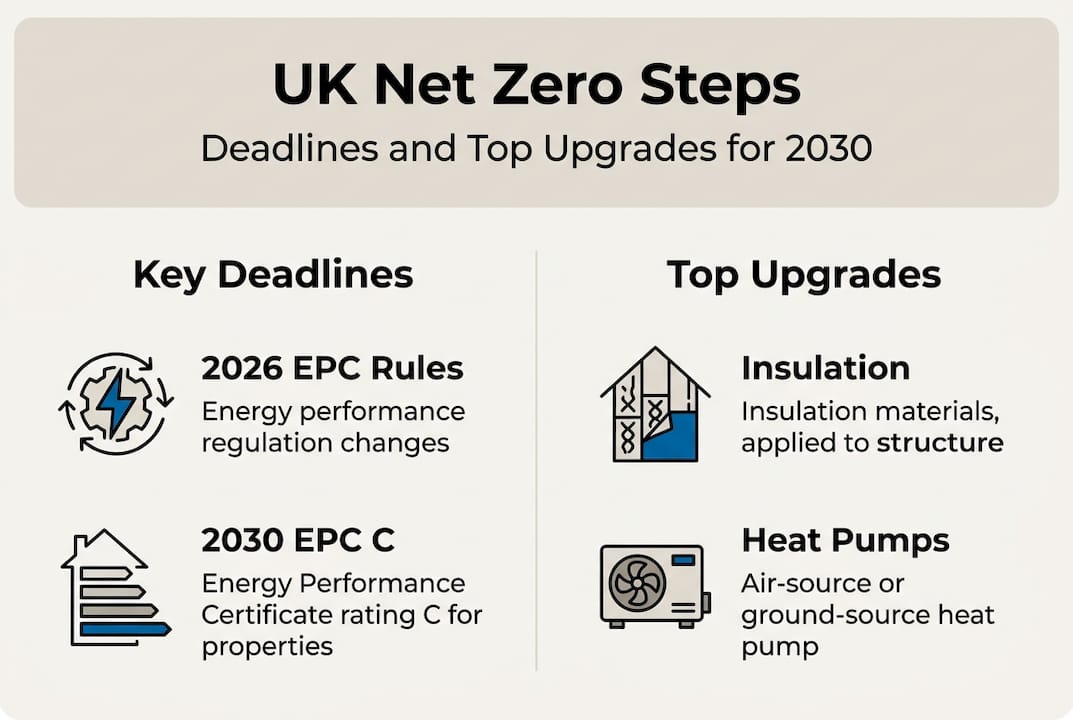
| EPC C equivalent required for all tenancies | October 2030 | All residential landlords |
| Non-domestic MEES tightening | Ongoing from 2027 | Commercial landlords |
From October 2026, domestic EPCs will be assessed using new multi-metric criteria covering fabric performance, heating system efficiency, smart readiness, and energy cost. Non-domestic buildings will retain a carbon-based metric. This is a significant shift from the current single-score SAP methodology, and it means that a property which currently holds an EPC C may not automatically retain that rating under the new system.
For residential landlords, the core obligation is to meet an EPC C equivalent by 2030, assessed against the new multi-metric framework. The cost cap is set at £10,000 per property. If a landlord spends up to this cap and still cannot achieve the required rating, a 10-year exemption can be registered. That exemption must be formally logged on the PRS Exemptions Register.
Pro Tip: Do not assume a current EPC C rating will carry over automatically after October 2026. Commission a new assessment under the reformed metrics before making any major investment decisions.
Key exemption categories include:
- Cost cap exemption — spent £10,000 without reaching EPC C equivalent
- Solid wall and technical infeasibility — certain construction types where insulation is not viable
- Low-value property — properties valued at £100,000 or less, with a 10% of value cap on spend
- Consent exemption — where a tenant or third party refuses access or permission
- Newly let exemption — a short-term exemption for recently acquired properties
Penalties for non-compliance from 2030 can reach £30,000 per property. Landlords with larger portfolios face cumulative exposure across multiple units. Reviewing property standards for 2030 now, rather than closer to the deadline, is strongly advisable. Practical guidance on what to include in an EPC assessment is available through EPC certificate tips for those unfamiliar with the process.
Practical pathways to compliance: actions for home and business owners
Knowing the rules is one thing. Acting on them efficiently is another. The most cost-effective approach is to follow a fabric-first strategy, which is now formally embedded in the new EPC methodology.
Fabric-first means improving the thermal performance of the building shell before upgrading heating systems. This includes:
- Loft insulation — typically the lowest-cost, highest-impact measure for most properties
- Cavity wall insulation — effective for post-1920 properties with suitable cavity construction
- Solid wall insulation — internal or external, more disruptive but significant for older stock
- Double or triple glazing — reduces heat loss and improves comfort as well as EPC scores
- Draught-proofing — often overlooked but low-cost with measurable impact
Once the fabric is improved, upgrading to a low-carbon heating system such as a heat pump or solar thermal becomes far more effective, because a well-insulated building requires less energy to heat in the first place.

| Upgrade type | Typical cost range | EPC impact | Disruption level |
|---|---|---|---|
| Loft insulation | £300 to £600 | High | Low |
| Cavity wall insulation | £500 to £1,500 | High | Low |
| External wall insulation | £8,000 to £20,000 | Very high | Medium |
| Air source heat pump | £7,000 to £13,000 | High (new EPCs) | Medium |
| Solar PV panels | £5,000 to £10,000 | Medium to high | Low |
The Warm Homes Plan, launched in January 2026, commits £15 billion in public investment to support residential energy upgrades, with a focus on lower-income households and older properties. Grants and subsidies under this programme can significantly reduce out-of-pocket costs for eligible owners.
Pro Tip: Keep a detailed record of all improvement costs, contractor invoices, and EPC assessments. This documentation is essential if you later need to register a cost cap exemption or demonstrate compliance.
For those planning energy efficient home upgrades, starting with a professional EPC assessment under the new metrics gives a clear baseline and a prioritised action list tailored to the specific property.
Nuances, edge cases, and what most people miss
Even property owners who have read the regulations carefully can miss important details that affect their compliance position or their costs.
One of the most significant changes in the new EPC framework concerns heat pumps. Under the old energy cost metric, heat pumps were sometimes penalised because electricity is more expensive per unit than gas. The new EPC metrics treat heat pumps more favourably, reflecting their lower carbon output and efficiency. This means properties that installed heat pumps in recent years may see their EPC rating improve when reassessed after October 2026.
Smart controls and solar PV are also rated more accurately under the new framework. Properties with smart thermostats and demand-response systems gain credit for their readiness to integrate with a flexible grid, which was not recognised under the previous methodology.
Key edge cases that property owners frequently overlook:
- Solid wall exemptions require formal documentation of the technical infeasibility, not just a verbal assessment from a contractor
- Low-value property exemptions apply where the property is valued at £100,000 or less, with improvement spend capped at 10% of that value
- Mixed-use buildings are assessed by floor area allocation, meaning the residential and commercial portions are evaluated separately under their respective metrics
- Pre-2029 EPC C ratings that were issued under the old system are preserved until their expiry date, but owners should plan for reassessment under the new metrics
“Voluntary standards such as the Net Zero Carbon Buildings Standard provide useful benchmarks and industry leadership, but the government’s regulatory focus remains on the rented sector first. Owner-occupiers are not yet subject to mandatory upgrade requirements.”
This distinction matters. Voluntary standards can inform best practice and future-proof investment decisions, but they do not carry the same legal weight as MEES regulations. Understanding where the mandatory line sits is essential for prioritising spend. Reviewing EPC exemptions explained in detail helps owners identify which route applies to their specific property type and construction.
The uncomfortable truth: why net zero compliance means acting before you’re forced
Many property owners assume that enforcement will be gradual or that deadlines will shift again, as they have in the past. That assumption is becoming increasingly risky.
The 2030 deadline carries higher penalties than any previous MEES iteration. More importantly, the market is already moving. Tenants are actively seeking energy-efficient properties to reduce their own bills, particularly following the energy price rises of recent years. Buyers are factoring EPC ratings into offers. Mortgage lenders are beginning to price green premiums into products for high-rated properties.
Waiting until 2029 to begin improvements creates real problems. Contractor availability tightens as deadlines approach. Material costs rise with demand. Properties sitting on lower EPC ratings lose competitive ground in the lettings market before any legal penalty applies.
The owners who act now, even when their immediate deadline has not yet arrived, benefit from lower upgrade costs, better contractor choice, and stronger rental yields in the interim. Reviewing the energy upgrades guide and commissioning an assessment under the new metrics is the most practical first step, regardless of portfolio size.
How to get support and simplify your net zero journey
Navigating net zero compliance does not have to be complicated. homeenergymodel.co.uk provides step-by-step guidance for both residential landlords and owner-occupiers, covering everything from understanding home energy models for landlords to accessing the home energy model explained in plain terms. Whether the priority is booking a property energy assessment, identifying the right upgrades for a specific building type, or registering on the EPC exemption register, the resources available cover each stage of the compliance process. Acting early, with the right information, is the most cost-effective path to meeting the 2030 standards.
Frequently asked questions
Who must comply with the UK net zero and new EPC requirements?
All residential landlords must meet the EPC C equivalent by 2030, and commercial landlords face parallel obligations. Homeowners planning to sell or let are also affected by market expectations and reformed EPC metrics.
What is the EPC cost cap, and do exemptions last forever?
The £10,000 cost cap allows landlords to register a 10-year exemption if the required standard cannot be reached after spending up to that amount. The exemption must be re-applied for once it expires.
Which upgrades are usually most cost-effective for raising EPC ratings?
Fabric insulation covering walls, roofs, and windows is typically the highest-impact starting point, followed by smart heating controls. The reformed EPC framework formally prioritises fabric performance before heating system upgrades.
How are non-domestic and mixed-use buildings affected?
Non-domestic buildings retain the carbon metric under the new EPC framework, while mixed-use properties are assessed by floor area allocation, with residential and commercial portions evaluated under their respective standards.