

TL;DR:
- Most UK homes still depend on fossil fuel-based heating systems, facing upcoming stricter regulations.
- Sustainable heating options like heat pumps use renewable energy, reduce emissions, and can improve property value.
- Early adoption, proper insulation, and expert installation are key to maximizing benefits and compliance.
Over 80% of UK home heating still relies on fossil fuels, yet upcoming regulatory changes will actively penalise gas boilers in property assessments. The new Home Energy Model (HEM), set to replace the existing SAP methodology, will score heating systems on carbon intensity, meaning homes with traditional boilers could see their EPC ratings fall sharply. For landlords and homeowners, this is not a distant concern. Sustainable heating can significantly reduce household CO2 emissions compared to gas boilers, and understanding your options now is the most practical way to stay ahead of compliance requirements and rising energy costs.
Table of Contents
- What does sustainable heating mean?
- Key sustainable heating technologies for UK homes
- How sustainable heating impacts compliance and property value
- Challenges, trade-offs, and critical success factors
- Why future-proofing with sustainable heating is about more than compliance
- Get expert help choosing and upgrading sustainable heating
- Frequently asked questions
Key Takeaways
| Point | Details |
|---|---|
| Lower carbon emissions | Switching to sustainable heating can cut household CO2 output by up to 70% and prepare homes for stricter regulations. |
| Boost property value | Efficient renewable systems make properties more attractive for future sales and rentals under new compliance rules. |
| Plan for insulation | For most benefits, combine heating upgrades with improved insulation to maximise savings and system performance. |
| Available grants | Generous grants and incentives offset the high upfront costs of sustainable heating installations. |
What does sustainable heating mean?
Sustainable heating refers to systems that draw energy from renewable or low-carbon sources rather than burning fossil fuels. The core principle is straightforward: reduce the carbon emissions associated with keeping a property warm, while maintaining comfort and reliability.
Sustainable heating uses renewable sources such as air, ground, water, solar energy, and biomass. These sources either replenish naturally or produce significantly fewer emissions than gas or oil. The goal is not necessarily to achieve zero emissions overnight, but to make a meaningful improvement over traditional systems.
Key characteristics of sustainable heating include:
- Low or zero direct carbon emissions during operation
- Use of renewable energy inputs rather than finite fossil fuels
- Compatibility with future EPC and HEM compliance standards
- Potential for reduced energy bills over the medium to long term
- Eligibility for government grants and incentives
It is worth clarifying a common misconception. Sustainable heating does not mean off-grid living or dramatic lifestyle changes. A heat pump installed in a semi-detached house in Birmingham still connects to the electricity grid. What changes is the source of energy doing the heating work.
Sustainable heating is best understood as a spectrum. Even a hybrid system that pairs a heat pump with an existing boiler represents a significant step forward in carbon reduction and compliance readiness.
For a full breakdown of the types of renewable heating available in 2026, it is worth reviewing the options in detail before committing to any single technology.
Key sustainable heating technologies for UK homes
With a working definition in mind, the next step is understanding which technologies are actually available and suitable for different property types across the UK.
Core sustainable heating technologies include air source heat pumps (ASHPs), ground source heat pumps (GSHPs), water source heat pumps, biomass boilers, solar thermal systems, and district heat networks. Each has distinct advantages depending on property size, location, and existing infrastructure.
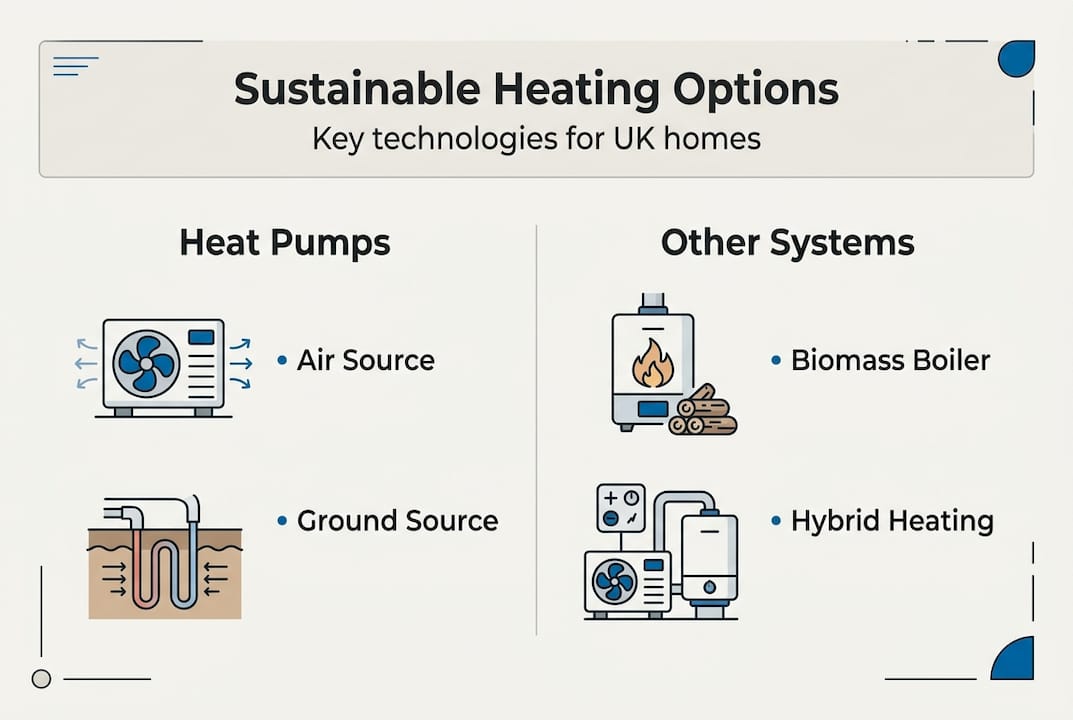
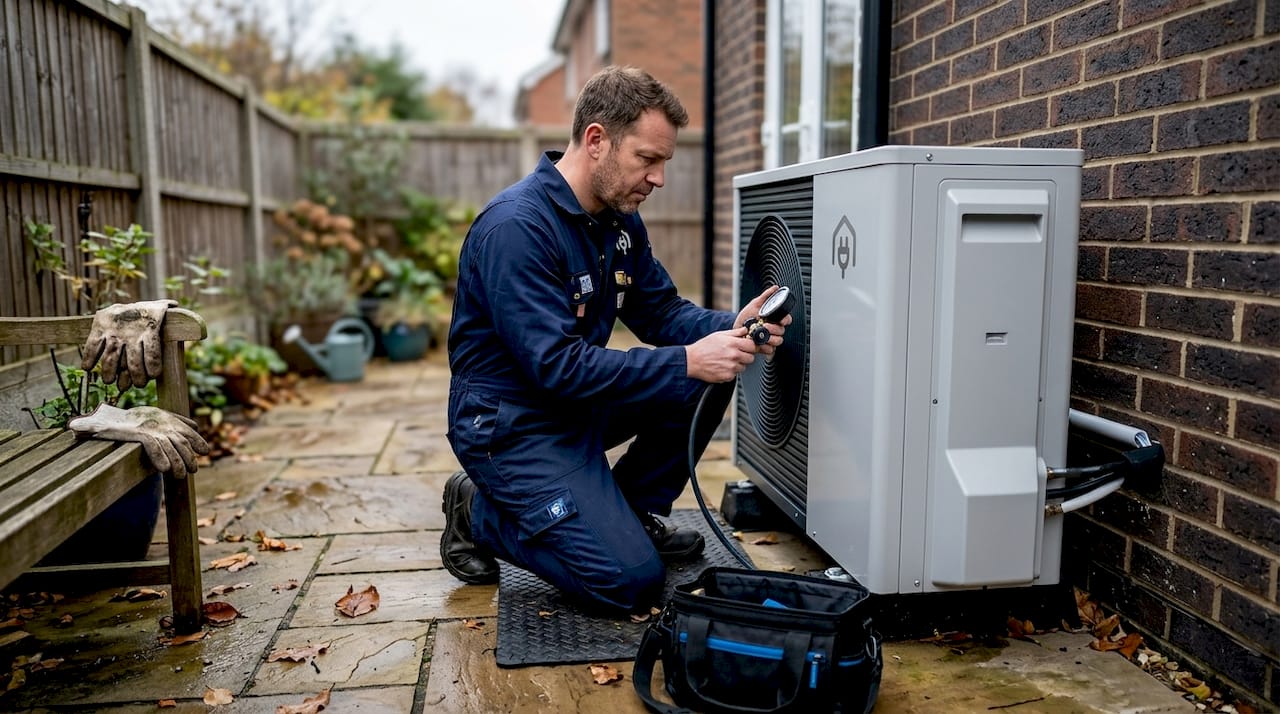
Heat pumps are currently the most widely adopted option. ASHPs extract heat from outdoor air and can achieve a Coefficient of Performance (COP) of 2.5 to 4.0, meaning they produce two to four units of heat for every unit of electricity consumed. GSHPs use buried ground loops and typically achieve slightly higher COP values, though installation is more disruptive and costly. Learn more about air source heating efficiency and ground source heat pumps explained for a deeper comparison.
| Technology | Typical COP | Best suited for | Upfront cost estimate |
|---|---|---|---|
| Air source heat pump | 2.5 to 4.0 | Most property types | £8,000 to £15,000 |
| Ground source heat pump | 3.5 to 5.0 | Larger properties with land | £15,000 to £35,000 |
| Biomass boiler | N/A | Rural, off-gas properties | £10,000 to £20,000 |
| Solar thermal | N/A | Supplement to main system | £3,000 to £6,000 |
Biomass boilers burn organic material such as wood pellets and are particularly suited to rural properties not connected to the gas grid. Solar thermal panels heat water directly and work well as a supplementary system. Review solar thermal efficiency to understand how much of a property’s hot water demand it can realistically cover.
Hybrid systems pair a heat pump with a gas boiler, allowing the boiler to assist during very cold periods. These are a practical interim solution for homes where a full retrofit is not yet feasible.
Pro Tip: Before selecting a technology, check whether your current radiators can operate at the lower flow temperatures that heat pumps require. Upgrading to larger radiators or underfloor heating can significantly improve system performance.
How sustainable heating impacts compliance and property value
Understanding the technologies is important, but compliance and financial impact often drive decisions. Here is how sustainable heating connects directly to regulations and property value.
HEM assessments replace SAP from 2027, introducing stricter fossil fuel penalties and higher standards for landlords. Under HEM, a property’s heating system will be assessed on its carbon intensity, not just its energy efficiency. Gas boilers, even modern condensing models, will score poorly against this metric.
For landlords, this is particularly significant. Properties that fail to meet minimum EPC ratings risk becoming unlettable under proposed rental regulations. Buyers and tenants are increasingly factoring energy costs and ratings into their decisions, making sustainable heating a genuine selling point.
A property with an EPC rating of C or above, supported by a low-carbon heating system, is likely to command a premium in both sale and rental markets as regulations tighten through 2026 and beyond.
On the financial side, the current support landscape includes:
- Boiler Upgrade Scheme: £7,500 grant for ASHPs, available in England and Wales
- 0% VAT on heat pump installation
- ECO4 scheme for low-income households, covering insulation and heating upgrades
- Great British Insulation Scheme for complementary insulation improvements
For landlords and investors, understanding key energy assessment terms is essential before making upgrade decisions. Acting before regulatory deadlines arrive is likely to be less costly than being forced to upgrade under time pressure.
Challenges, trade-offs, and critical success factors
Every upgrade comes with trade-offs. Understanding the practical considerations and potential pitfalls is just as important as knowing the benefits.
The most common challenge is upfront cost. Even with grant support, heat pump installations represent a significant investment. Running costs can also be higher in poorly insulated homes, where the system works harder to maintain temperatures. Heat pumps need good insulation to perform well, and up to 6 million UK homes may need insulation upgrades before a heat pump can operate efficiently.
Critical success factors for a sustainable heating upgrade:
- Insulation first: Loft, wall, and floor insulation should be addressed before or alongside any heating system change.
- Correct system sizing: An undersized heat pump will struggle; an oversized one will cycle inefficiently.
- Low flow temperature compatibility: Existing radiators may need replacing with larger models.
- Qualified installation: Only MCS-certified installers are eligible for grant funding and ensure system performance.
- Understanding financing options: Green mortgages, government grants, and council schemes can reduce the financial burden considerably.
Pro Tip: Request a heat loss calculation from your installer before agreeing to any system. This calculation determines the correct heat pump size for your property and is a strong indicator of installer quality.
Hybrid systems or connection to a local district heat network may be the most practical route for older or harder-to-treat properties, particularly in urban areas where ground works are not feasible.
For a broader view of how different heating system energy efficiency options compare in real-world conditions, reviewing independent assessments is strongly recommended before committing.
Why future-proofing with sustainable heating is about more than compliance
Most discussions about sustainable heating focus on regulations and EPC ratings. That framing is understandable, but it misses a significant part of the picture.
Modern heat pump systems, when properly installed and matched to a well-insulated home, deliver steadier, more consistent warmth than gas boilers. They require less maintenance, have fewer mechanical components, and are not subject to gas price volatility. These are practical, day-to-day benefits that compliance checklists rarely capture.
The risk of waiting is also underappreciated. As HEM compliance standards tighten, demand for qualified installers will increase, lead times will lengthen, and grant funding may become more competitive or restricted. Homeowners who act now are likely to face less disruption, more installer choice, and better grant availability than those who wait for a regulatory deadline.
Smart planning means addressing insulation and heating together, not sequentially. This approach avoids the common scenario where a heat pump is installed into a draughty property and underperforms, leading to disappointment and higher bills. Reviewing energy models and standards helps property owners understand exactly what assessors will be looking for, making it easier to plan upgrades that genuinely improve ratings rather than just meeting minimum thresholds.
Sustainable heating is not a single solution. Every UK home has a starting point and a set of practical options. The key is informed decision-making, not rushed compliance.
Get expert help choosing and upgrading sustainable heating
Ready to take the next step towards future-proof, compliant heating? Navigating the range of technologies, grants, and compliance requirements can feel complex, but the right guidance makes the process significantly more straightforward.
homeenergymodel.co.uk offers detailed resources covering EPC assessments, grant eligibility, technology comparisons, and compliance planning for both landlords and homeowners. Whether you are trying to understand energy model types relevant to your property or want a clear explanation of the home energy model explained, the site provides practical, up-to-date guidance to support informed decisions. Acting now, rather than waiting for regulatory deadlines, is the most cost-effective approach for most UK properties.
Frequently asked questions
What is the most common sustainable heating system for UK homes?
Air source heat pumps are currently the most popular sustainable heating option for UK properties, offering significant carbon reductions compared to gas boilers and benefiting from the widest grant support.
Are there grants available to help with sustainable heating costs?
Yes, homeowners in England and Wales can access a Boiler Upgrade Scheme grant of £7,500 for heat pump installations, alongside 0% VAT on fitting costs and additional support through ECO4 for eligible low-income households.
Will sustainable heating help me pass future EPC and HEM assessments?
Low-carbon heating systems such as heat pumps score considerably better under the upcoming HEM assessments, which will penalise fossil fuel heating, making them essential for achieving EPC C ratings and future rental compliance.
What are the main downsides of switching to sustainable heating?
Upfront costs are the primary barrier, and up to 6 million homes may require insulation upgrades before a heat pump performs efficiently, with installation potentially causing short-term disruption to the property.