

Most UK landlords know an EPC is a legal requirement. Far fewer are prepared for what comes next. The government’s shift to the Home Energy Model (HEM) will replace the long-standing SAP methodology for existing homes, fundamentally changing how energy performance is measured, assessed, and enforced. New EPC C requirements are set to apply across the private rented sector by 1 October 2030. This guide explains what that means in practice, how HEM changes the assessment process, what landlords must spend, and the practical steps that will protect both compliance and long-term property value.
Table of Contents
- Understanding the role of energy policy in UK property standards
- How the Home Energy Model changes energy assessment
- Landlord obligations, exemptions, and enforcement under MEES
- Practical steps: Maximising your property’s energy efficiency
- A property expert’s perspective: What most landlords get wrong about energy policy compliance
- Next steps: Enhance your property’s energy performance with expert support
- Frequently asked questions
Key Takeaways
| Point | Details |
|---|---|
| HEM transforms energy standards | The Home Energy Model replaces SAP, focusing on fabric and smart upgrades for EPCs. |
| Landlord investment cap clarifed | Landlords must invest up to £10,000 or 10% of property value for MEES compliance. |
| Act early for best results | Early HEM-backed assessment and fabric-first measures deliver the most robust long-term compliance. |
| Know your exemptions | Exemptions exist but must be registered and supported with evidence or they risk penalties. |
Understanding the role of energy policy in UK property standards
Energy policy in the UK has always had a dual purpose: reducing carbon emissions and tackling fuel poverty. The Minimum Energy Efficiency Standards (MEES) were introduced with exactly that goal. They set a legal floor for the energy performance of privately rented homes, ensuring tenants are not left with unaffordable heating bills in poorly insulated properties.
The private rented sector has a particular problem. The 2024 English Housing Survey confirms that private rented households have the highest rates of fuel poverty of any tenure type in England. That is a striking finding, and it explains why policymakers have focused regulatory pressure on landlords rather than owner-occupiers.
Regulation in this area has evolved steadily. MEES began requiring EPC E as a minimum for new tenancies in 2018 and extended to all tenancies by 2020. The next step is considerably more demanding. UK energy policy now mandates that PRS properties reach the equivalent of EPC C by 1 October 2030, assessed under new HEM-based EPC metrics.
This shift matters because SAP-based EPCs, the current standard, have known limitations. They do not fully reflect real-world energy use, and they favour certain heating systems in ways that no longer align with net zero ambitions. HEM is designed to correct this.
“The transition to HEM-based EPCs is not simply a technical update. It represents a policy commitment to making energy assessments more accurate, more consistent, and more useful for guiding real improvements in housing stock.”
Key reasons the government has moved towards HEM-based metrics include:
- Greater accuracy in reflecting actual heat demand and building fabric performance
- Alignment with net zero targets by penalising fossil fuel heating systems
- Consistency through a centralised assessment platform, reducing assessor variability
- Tenant benefit by making estimated running costs a core metric
For property owners focused on energy efficiency for property owners, understanding this policy context is the essential first step. With context for these ambitious changes, let’s break down what the new Home Energy Model actually introduces.
How the Home Energy Model changes energy assessment
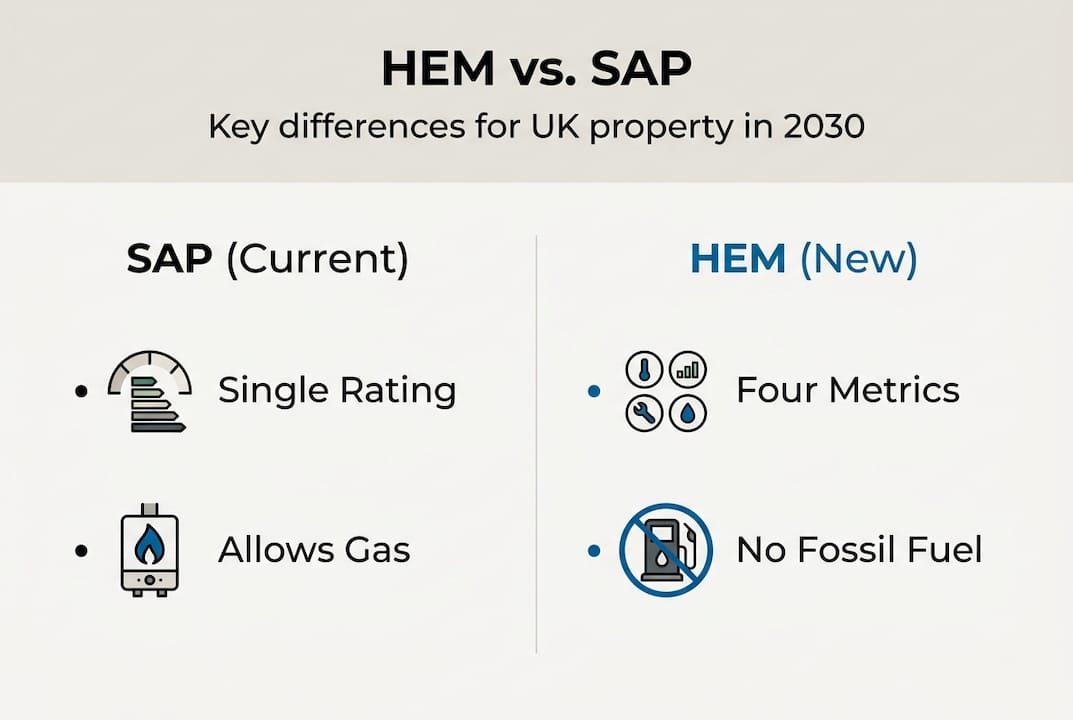
The Home Energy Model is not simply a new version of SAP. It is a fundamentally different approach to measuring how a building performs. Where SAP produced a single headline rating, HEM introduces four distinct metrics that together give a far more detailed picture.
The four core HEM EPC metrics are:
- Fabric performance (based on Fabric Energy Efficiency, or FEE, measuring heat demand)
- Heating system rating (how clean and efficient the heating source is)
- Smart readiness (whether the property can respond to smart grid signals)
- Estimated energy running cost (the practical affordability metric for tenants)
One critical point stands out: fossil fuel heating systems cannot achieve a C rating under the heating system metric. A gas boiler, however efficient, will be capped at D for that metric. This is a deliberate policy signal, pushing landlords towards heat pumps and other low-carbon alternatives.
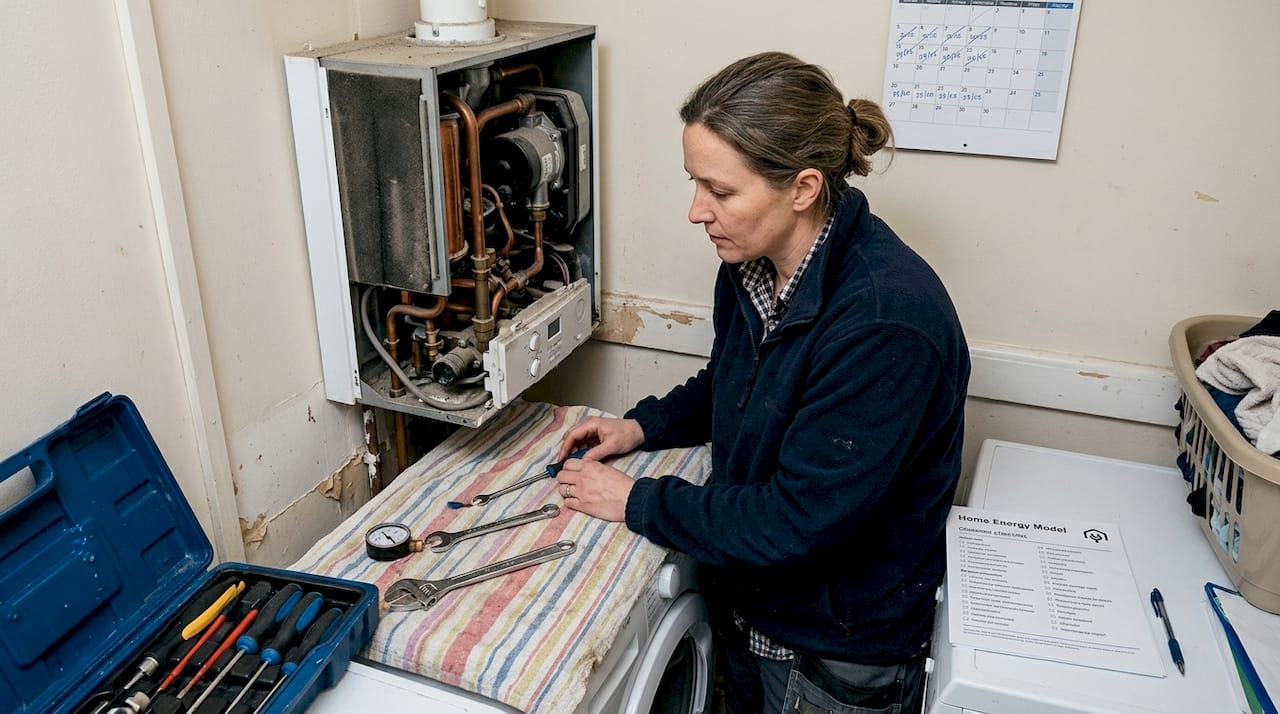
The assessment process itself is also more rigorous. A HEM assessment is expected to take around one hour and forty minutes, compared to roughly twenty minutes for a SAP-based EPC. Assessors will need more detailed information about the property’s fabric, systems, and controls.
| Feature | SAP (current) | HEM (new) |
|---|---|---|
| Single headline rating | Yes | No (four metrics) |
| Fossil fuel heating cap | No | Yes (capped at D) |
| Assessment time | ~20 minutes | ~1h 40 minutes |
| Fabric performance metric | Limited | Central (FEE-based) |
| Smart readiness included | No | Yes |
| Centralised platform | No | Yes |
For a fuller HEM and SAP assessment comparison, the differences in methodology are significant for planning purposes. Understanding the HEM impact on UK properties helps landlords see which improvements will genuinely move the needle.
Pro Tip: Book a HEM EPC assessment as early as possible after the 2026 launch. The detailed results will identify exactly which measures are needed, allowing for planned, cost-effective improvements rather than rushed last-minute spending.
Now we understand the new assessment method, it is essential to untangle what landlords are expected to do when it comes to compliance.
Landlord obligations, exemptions, and enforcement under MEES
Compliance with the updated MEES regime involves clear financial obligations. Landlords must invest up to £10,000 per property to achieve the required EPC rating. For properties valued under £100,000, the cap is set at 10% of the property’s value instead. Importantly, qualifying improvement costs incurred from October 2025 onwards count towards this cap.
Legacy EPC C certificates issued under SAP remain valid until their expiry date. New HEM-based rules apply from October 2029 for new tenancies, with full enforcement from October 2030.
| Requirement | Detail |
|---|---|
| Target rating | EPC C (HEM-based metrics) |
| Compliance deadline | 1 October 2030 |
| Spend cap | £10,000 per property |
| Low-value property cap | 10% of value (under £100k) |
| Costs counted from | October 2025 |
| Maximum fine | £30,000 |
Not every property will be able to reach EPC C, and the government has expanded exemption categories to reflect this. Exemptions are registered on the PRS Exemptions Register and are enforced by local authorities.
Valid exemption grounds include:
- Solid wall insulation unsuitability (where installation is not technically feasible or appropriate)
- Affordability or low-value property (where the spend cap adjustment applies)
- Devaluation (where improvements would reduce property value by more than 5%)
- Cost cap (where the landlord has spent up to £10,000 but the property still cannot reach EPC C)
Most exemptions are valid for between five and ten years. Local authorities enforce MEES, and fines can reach £30,000 for non-compliance. Understanding the full EPC exemption criteria is essential before assuming a property qualifies. For those managing properties in the capital, the London landlord EPC rules carry additional considerations.
Pro Tip: Register any valid exemption promptly and retain all supporting documentation, including quotes, surveys, and correspondence. Local authorities can request evidence, and incomplete records may invalidate an exemption.
With obligations and routes to exemption clarified, the logical next step is how to get the best building performance and compliance value from your investment.
Practical steps: Maximising your property’s energy efficiency
The mean cost to achieve EPC C for a private rented property is £7,040, according to the 2024 English Housing Survey. That figure is within the £10,000 spend cap for most landlords, but it requires spending that money wisely. The biggest efficiency gains almost always come from fabric improvements first.
A step-wise approach to improvement planning works best:
- Commission a HEM EPC as soon as assessments are available post-2026 to establish a baseline across all four metrics
- Address loft and cavity wall insulation as a priority, since these deliver the greatest reductions in heat demand
- Improve draught-proofing around windows, doors, and floors
- Upgrade heating controls with smart thermostats and zone controls to improve smart readiness
- Consider heating system replacement if a gas boiler is the primary barrier to achieving EPC C on the heating metric
- Explore solar PV if self-use potential is high, as HEM rewards on-site renewable generation
As fabric-first improvement guidance confirms, HEM also rewards low flow temperature settings and correctly sized heat pumps, making system commissioning as important as system selection.
Several financial support mechanisms are available to reduce the cost burden:
- ECO4 scheme for eligible low-income or fuel-poor households
- Boiler Upgrade Scheme (BUS) grants for heat pump installation
- 0% VAT on energy efficiency measures until 2027
- Tax deductibility of qualifying improvement costs against rental income
For a structured approach to prioritising energy upgrades, a clear plan will always outperform reactive spending. An early energy assessment for property improvement gives landlords the information needed to sequence improvements logically and avoid wasted expenditure.
Understanding practical steps is vital, but perspective helps cut through the overwhelm. Here is a grounded view based on experience.
A property expert’s perspective: What most landlords get wrong about energy policy compliance
The most common mistake is treating energy compliance as a box-ticking exercise rather than a property investment decision. Many landlords focus on the minimum required to pass the current standard, only to find themselves spending again when the rules tighten.
The second error is ignoring building fabric. Landlords often gravitate towards visible upgrades, new boilers or smart controls, while leaving draughty floors and uninsulated walls untouched. HEM’s fabric performance metric makes this approach genuinely costly. A property with poor fabric will struggle to reach EPC C regardless of what heating system is installed.
The centralised HEM platform actually works in landlords’ favour. Consistent assessments mean fewer disputes and clearer improvement pathways. Landlords also retain flexibility in choosing which secondary metric to prioritise, giving room to plan strategically rather than reactively.
Early assessment and honest planning, supported by resources on benefits of energy modelling, will always deliver better outcomes than waiting for deadlines to force action. The landlords who engage now will spend less and stress less.
Next steps: Enhance your property’s energy performance with expert support
Navigating the shift to HEM-based EPCs does not need to be complicated. homeenergymodel.co.uk provides clear, practical guidance on everything from understanding home energy model types to planning targeted improvements for compliance. Whether you are assessing a single rental property or managing a portfolio, the site’s resources are built to support informed decisions at every stage. Explore the full HEM guide for UK properties to understand exactly how the new methodology applies to your properties, and take the first step towards confident, cost-effective compliance before the 2030 deadline.

Frequently asked questions
What are the new EPC requirements for landlords in 2026?
Landlords must achieve EPC C under the new HEM-based metrics by 1 October 2030, with stricter standards applied to both fabric performance and heating system efficiency.
How much do landlords need to spend to comply with MEES?
The spend cap is £10,000 per property, or 10% of the property’s value for homes worth less than £100,000, with eligible costs counted from October 2025.
What counts as an exemption from the energy efficiency rules?
Valid exemptions include solid wall insulation unsuitability, low-value property adjustments, proven devaluation of more than 5%, and reaching the spend cap without achieving EPC C, with most exemptions lasting five to ten years.
What practical steps should property owners take now?
Begin with a HEM EPC assessment once available, prioritise fabric upgrades such as loft and cavity insulation, and maintain thorough records of all improvement costs and exemption evidence.