

TL;DR:
- A building’s carbon footprint includes operational and embodied emissions, making whole-life assessments essential. UK regulations and market demands increasingly require detailed reporting to support compliance, planning, and investment decisions. Using appropriate methods like HEM or WLCA helps property professionals reduce emissions and improve decision-making.
A property’s carbon footprint is the total greenhouse gas emissions attributable to that building across its lifetime, measured in kilograms of CO2 equivalent (kgCO2e). For UK landlords and property professionals, this breaks into three categories:
- Operational carbon: emissions from energy used to heat, cool, light and power a building during occupation
- Embodied carbon: emissions from materials, construction, maintenance and end-of-life (modules A1–A5, B and C under whole-life carbon frameworks)
- Whole-life carbon (WLC): the sum of both, expressed across the full building lifecycle
TL;DR for UK landlords: Measuring your building’s carbon footprint is no longer optional. Energy Performance Certificates (EPCs), the Home Energy Model (HEM) replacing SAP, and Minimum Energy Efficiency Standards (MEES) all connect directly to how your property’s emissions are calculated and reported. Start by collecting 12 months of energy bills and basic fabric or specification data.
Table of Contents
- What counts in a building’s carbon footprint?
- Why does your property’s carbon footprint matter in the UK?
- How are carbon footprints measured for buildings?
- How to calculate your property’s carbon footprint: a step-by-step checklist
- How long do assessments take and what do they cost?
- Practical ways to reduce your property’s carbon footprint
- Who to hire and how to use the results
- Key takeaways
- The case for treating carbon footprints as a management tool, not a compliance box
- How Homeenergymodel can support your carbon assessment
- Authoritative UK sources and standards
What counts in a building’s carbon footprint?
Operational carbon covers regulated energy (heating, cooling, ventilation, lighting) and unregulated energy (plug loads, small power). As the electricity grid decarbonises, operational emissions per kWh fall, which is why whole-life carbon assessment is increasingly important: embodied carbon from materials and construction does not shrink with grid improvements.
Whole life carbon assessment (WLCA) captures operational and embodied emissions from material sourcing, manufacture, installation, maintenance and demolition. Module D, which covers benefits beyond the system boundary such as material reuse, is reported separately rather than added to the total.
The standard unit is kgCO2e, with larger projects often reported in tCO2e. Normalising to kgCO2e/m² GIA (gross internal area) or annualised kgCO2e/yr allows fair comparison between buildings of different sizes and lifespans. RICS guidance recommends normalising to kgCO2e/m² over a reference study period, commonly 60 years.
| Building element | Primarily affects | Notes |
|---|---|---|
| Gas boiler / heat pump | Operational carbon | Fuel type and efficiency are the key variables |
| Insulation and wall type | Both | Fabric reduces operational demand; manufacturing adds embodied carbon |
| Windows and glazing | Both | U-value affects operational; frame material affects embodied |
| Concrete frame or structure | Embodied carbon | High upfront carbon; long service life amortises it |
| MEP systems (plant, pipework) | Embodied carbon | Often 20–30% of upfront carbon and frequently underestimated |
Why does your property’s carbon footprint matter in the UK?
The built environment is directly responsible for 25% of UK carbon emissions, and around 80% of the buildings that will exist in 2050 are already standing today. That context shapes the regulatory and commercial pressure landlords now face.
Regulatory drivers:
- MEES: From 2025, the government’s proposed trajectory requires private rented sector properties to meet higher EPC standards, with landlords required to install fabric measures and low-carbon heating systems to reduce emissions
- EPCs and HEM: The Home Energy Model replaces SAP as the UK’s primary methodology for assessing building energy performance, underpinning future EPC ratings and planning consents
- London planning: Local planning authorities, including the Greater London Authority, require WLC assessments using BS EN 15978:2011, with benchmarks and design actions reported
Market and investor pressures:
- Institutional investors and property funds increasingly require transparent carbon reporting aligned with sustainable finance standards
- Tenants, particularly corporate occupiers, are prioritising low-carbon buildings in leasing decisions
- RICS and UKGBC both position WLCA as the expected standard for consistent, investor-grade reporting
Understanding energy efficiency obligations is the first step toward meeting these requirements.
How are carbon footprints measured for buildings?
Different situations call for different methods. The table below sets out the main approaches.
| Method | What is included | Timescale | Data required | Complexity | Typical cost/time | Best use case |
|---|---|---|---|---|---|---|
| Operational calculator | Energy bills only | Annual | 12 months of bills | Low | Hours to days | Rapid screening, tenant engagement |
| EPC / asset rating | Regulated operational energy | Annual | Building fabric, heating system, floor area | Low–medium | Days | MEES compliance, lettings |
| HEM-compliant model | Regulated and unregulated operational energy | Annual | Full fabric, MEP specs, occupancy | Medium–high | Days to weeks | Compliance modelling, planning, EPCs |
| RICS WLCA | Operational + embodied (A–C modules) | Lifecycle (60 yrs typical) | As-built drawings, EPDs, MEP schedules | High | Weeks to months | Investor reporting, planning submissions, design decisions |

EPCs currently capture only regulated operational energy. HEM, which replaces SAP, provides a more detailed operational picture and underpins future EPC ratings. For whole-life thinking, a RICS WLCA is required. Industry bodies argue for moving away from operational-only metrics as grid decarbonisation reduces the relative weight of operational emissions over time.
How to calculate your property’s carbon footprint: a step-by-step checklist
Data to collect first:
- Energy bills covering 12–36 months (electricity, gas, oil or other fuels)
- Heating system type and fuel, plus approximate age and efficiency rating
- Building floor area (GIA in m²) and basic plans or drawings
- Fabric specifications: wall type, insulation levels, window U-values, roof construction
- Details of any major recent works or planned refurbishment
- Occupancy assumptions and operating hours (for commercial properties)
- Planned building lifespan (needed for WLCA reference period)
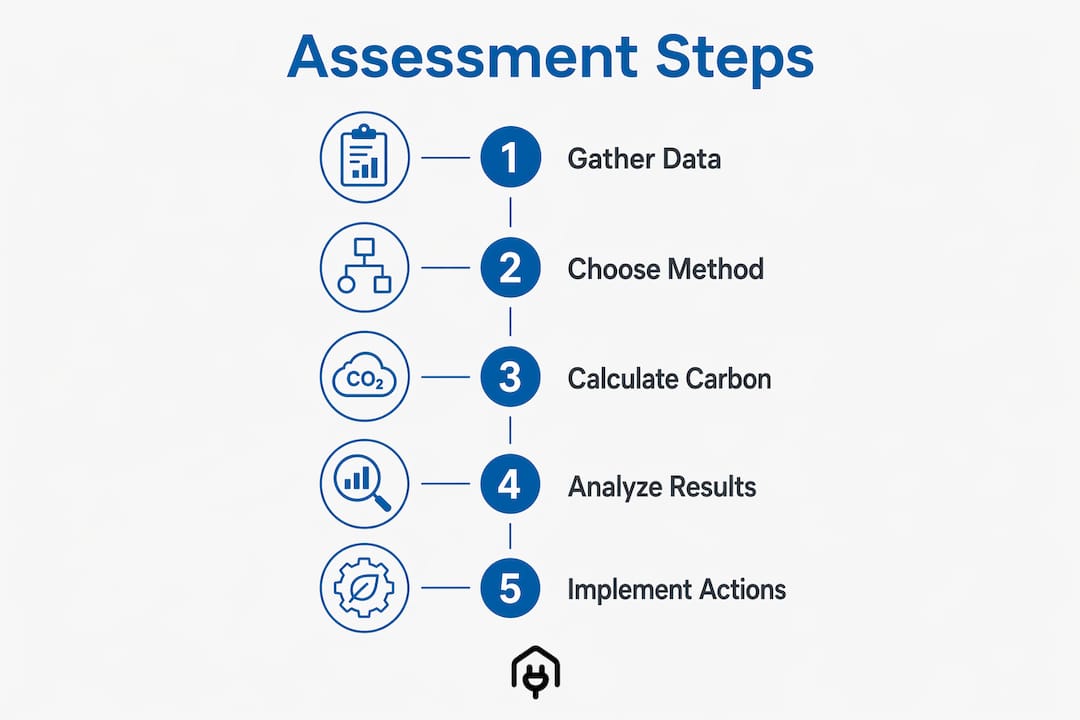
Step-by-step procedure:
- Run a quick operational estimate using 12 months of bills and BEIS/government emissions factors to convert kWh to kgCO2e
- Gather fabric and MEP data from as-built drawings, O&M manuals or a site survey
- Choose the appropriate method: HEM for compliance-level modelling and EPC purposes; RICS WLCA for whole-life or investor reporting
- Commission a qualified assessor or energy model specialist, or model in-house if the team has the capability
- Normalise results to kgCO2e/m²/yr and compare against published benchmarks
Pro Tip: When using default emissions factors rather than product-specific Environmental Product Declarations (EPDs), always disclose this in your report. Data hierarchy guidance advises prioritising EPDs, then industry averages, with generic defaults only at early design stages.
How long do assessments take and what do they cost?
Time and cost vary considerably depending on scope and data availability.
A rapid operational estimate based on bills takes hours to a couple of days. Compliance-level modelling using HEM or a detailed asset model typically takes days to a few weeks, depending on the complexity of the building’s fabric and MEP systems. A full RICS WLCA, covering all lifecycle modules with verified data, can take several weeks to several months for larger or more complex assets.
Cost drivers include: asset size and complexity, availability of as-built drawings and EPDs, the number of unique MEP plant items requiring individual modelling, and whether the assessment is design-stage (where assumptions are needed) or as-built (where verified data is available).
Pro Tip: Request phased quotes: a screening estimate first, then a detailed model, then verification or third-party review. This avoids committing to full WLCA fees before confirming the data is available to support it.
Practical ways to reduce your property’s carbon footprint
Operational measures tend to deliver the fastest payback and should be prioritised where cost-effective:
- Improve fabric performance: cavity wall insulation, loft insulation, and draught-proofing reduce heating demand directly
- Upgrade heating controls and move towards heat decarbonisation (heat pumps, district heat connections)
- Switch to LED lighting and install smart metering to identify waste, supported by practical advice on managing self-generated energy to optimise your home’s energy use
- Engage tenants on practical low-carbon measures and behavioural changes
For embodied carbon, the most effective strategy is retaining and refurbishing existing fabric rather than demolishing and rebuilding. UKGBC notes that embodied carbon represents a material share of the sector’s emissions and needs mainstream measurement. When new materials are unavoidable, specify products with verified EPDs and choose lower-carbon alternatives such as timber frames over concrete where structurally appropriate.
Avoid perverse trade-offs: adding heavy insulation with high embodied carbon to a building with low heating demand may not reduce whole-life carbon overall. Carbon offsets should be treated as a last resort, used only after all feasible reduction measures have been implemented and transparently reported.
Pro Tip: Normalise embodied-carbon investment decisions using annualised WLCA outcomes (kgCO2e/m²/yr). This lets you compare the carbon cost of a new material against the operational savings it delivers over the building’s reference period, on a like-for-like basis.
Who to hire and how to use the results
The right specialist depends on the assessment type needed:
- EPC assessors (domestic or commercial): accredited assessors for MEES compliance and lettings. Check accreditation with a recognised scheme. Homeenergymodel provides guidance on what an EPC assessor does and how to select one.
- RICS chartered surveyors or WLCA consultants: for whole-life carbon assessments, planning submissions and investor reporting
- HEM energy model specialists: for compliance-level modelling, Future Homes Standard submissions and detailed EPC work
When briefing any supplier, ask:
- Which standard does the assessment follow (RICS WLCA, BS EN 15978:2011)?
- What data hierarchy will be applied, and how will defaults be disclosed?
- Will EPDs be used, and for which elements?
- What deliverables are included (normalised kgCO2e/m²/yr, assumptions register, benchmarks)?
The outputs of a carbon footprint assessment are most valuable when they are tied to a decision. For MEES compliance, the EPC rating and improvement pathway matter most. For a London planning submission, the WLC figure against GLA benchmarks is required. For an investor report, normalised whole-life figures aligned with RICS standards and UKGBC guidance carry the most weight. Commissioning an assessment without knowing which decision it will inform is the most common reason results sit unused.
Key takeaways
A building’s carbon footprint covers both operational and embodied emissions; measuring only operational energy through an EPC misses a material share of the total impact, particularly as the grid decarbonises.
| Point | Details |
|---|---|
| Two categories to measure | Operational carbon (energy in use) and embodied carbon (materials, construction, end-of-life) together form whole-life carbon. |
| Start with bills and fabric data | Collect 12–36 months of energy bills, floor area, heating system details and fabric specs before commissioning any assessment. |
| Match method to purpose | Use HEM for compliance and EPC work; commission a RICS WLCA for planning submissions, investor reporting or whole-life decisions. |
| Embodied carbon needs EPDs | Default figures are acceptable at early stages but must be disclosed; use manufacturer EPDs wherever available. |
| Homeenergymodel supports the process | Homeenergymodel provides HEM modelling, EPC assessment and guidance on WLCA to help landlords and property professionals meet UK compliance requirements. |
The case for treating carbon footprints as a management tool, not a compliance box
The conversation in UK property has shifted. A few years ago, carbon reporting was largely a planning requirement or an investor relations exercise. Now, with HEM replacing SAP, MEES tightening, and London already requiring WLC submissions, the question is not whether to measure a building’s carbon footprint but how accurately and how often.
What concerns me about current practice is the tendency to treat a carbon assessment as a one-time document rather than a live management input. The RICS WLCA standard, the UKGBC’s Net Zero Whole Life Carbon Roadmap, and the government’s investor factsheets on heat and buildings all point in the same direction: carbon data should inform procurement, refurbishment sequencing and asset disposal decisions, not just satisfy a planning condition. Landlords who use normalised kgCO2e/m²/yr figures to compare retrofit options are making better capital allocation decisions, full stop.
The HEM transition is an opportunity to build that discipline into standard practice. Properties assessed under HEM will produce richer, more comparable data than SAP ever allowed. The landlords who invest in understanding that data now will be better placed when the next round of regulatory tightening arrives.
How Homeenergymodel can support your carbon assessment
Homeenergymodel works with UK landlords, property owners and building professionals on HEM-compliant energy modelling, domestic and commercial EPC assessments, and guidance on WLCA scope and procurement. Whether the need is a straightforward EPC for a lettings compliance check or a detailed energy model to support a planning submission, the team can advise on the right approach and connect clients with qualified assessors.
For landlords considering a full WLCA, Homeenergymodel can help scope the assessment, identify data gaps early, and explain what deliverables to expect. To discuss requirements or request a quote, visit the types of home energy models page or get in touch directly.
Authoritative UK sources and standards
| Source | What it is useful for |
|---|---|
| RICS Whole Life Carbon Standard (consultation) | Scope, module terminology, data hierarchy and normalisation for WLCA |
| UKGBC Net Zero Whole Life Carbon Roadmap | Sector pathway to 2050, benchmarks and policy context |
| London Planning Guidance — WLCA template | Planning submission requirements, BS EN 15978:2011 methodology, GLA benchmarks |
| CCC Buildings Sector Summary | Scale of building emissions, heating decarbonisation priorities |
| Government investor factsheet: heat and buildings | Investor-aligned disclosure requirements and government policy direction |
| UKGBC — Embodied carbon: improving your modelling and reporting | Practical guidance on embodied carbon measurement and reporting standards |