

TL;DR:
- EPCM is a project delivery model where owners keep direct contracts with suppliers, while an EPCM firm provides management services. It offers cost transparency and flexibility but shifts project risk and compliance responsibilities to the owner. EPCM is ideal for complex, phased projects with strong in-house management capacity.
EPCM is defined as Engineering, Procurement, and Construction Management, a project delivery model where the owner retains direct contracts with suppliers and contractors while an EPCM firm provides design coordination, procurement management, and construction oversight as a consultancy service. This distinction matters enormously for UK property professionals and investors, particularly as energy efficiency regulations tighten and complex retrofit and renewable energy projects become standard. Unlike a turnkey EPC contract, EPCM places risk, compliance responsibility, and cost control firmly with the owner. Understanding the EPCM meaning is the first step to making informed decisions on major energy infrastructure projects.
What is EPCM and how does it differ from EPC?
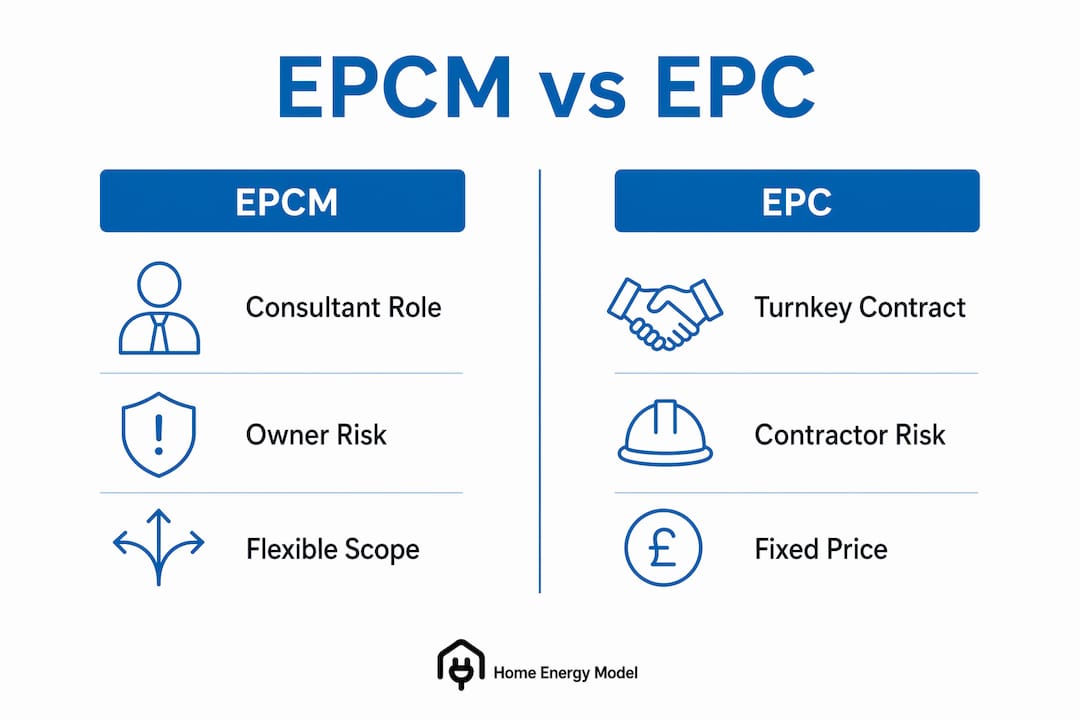
EPCM stands for Engineering, Procurement, and Construction Management. The EPCM contractor acts as a consultant and project manager, not as a builder taking on full delivery risk. The owner signs contracts directly with equipment suppliers, specialist subcontractors, and construction firms.

This is the fundamental difference from an EPC contract. Under an EPC arrangement, a single contractor takes full responsibility for design, procurement, and construction, typically under a fixed lump sum. That contractor guarantees project performance and absorbs cost overruns. For a clear breakdown of how these two models compare, Homeenergymodel’s guide on EPC vs EPCM contracts sets out the key distinctions for a UK audience.
The IChemE ‘Blue Book’ (2023) is the first standard-form EPCM contract in the UK, and its publication reflects the growing complexity of energy infrastructure projects that require EPCM’s flexibility. That standardisation signals that EPCM is no longer a niche arrangement. It is becoming a recognised delivery route for major energy and property projects across the UK.
A critical point that many professionals miss: EPCM is a consultancy contract, not a construction contract. The EPCM firm does not guarantee project performance. That responsibility sits with the owner, who must manage individual contractor relationships and liabilities directly.
How does the EPCM model allocate risk and responsibility?
The EPCM model distributes risk in a way that is fundamentally different from turnkey delivery. The owner holds all contracts with suppliers and subcontractors. The EPCM firm coordinates those relationships but does not absorb the financial or legal consequences of contractor failure.
The EPCM contractor’s core responsibilities typically include:
- Engineering: Producing and coordinating design documentation, technical specifications, and engineering standards across all project workstreams.
- Procurement management: Tendering, evaluating, and recommending suppliers and subcontractors, while the owner signs the actual contracts.
- Construction oversight: Supervising site activities, managing schedules, and coordinating between contractors, without holding construction risk directly.
- Reporting and cost control: Providing the owner with transparent cost reporting, progress updates, and change management advice.
Because the EPCM contractor manages coordination without assuming turnkey risk, the owner gains full visibility of actual costs. There is no contractor margin built into a lump sum to cover unforeseen risks. That transparency is a genuine advantage for owners who want cost clarity on large energy projects.
The trade-off is direct exposure to contractor default, design errors, and cost overruns. Under EPC, the contractor absorbs those risks. Under EPCM, the owner does.
Pro Tip: Before signing an EPCM agreement, appoint a dedicated in-house project director with authority to make procurement decisions quickly. The EPCM model depends on fast owner-side responses to keep coordination moving.
What are the advantages and disadvantages of EPCM for energy projects?
EPCM offers genuine financial and operational advantages, but those benefits come with real trade-offs. Property investors and professionals should weigh both sides carefully before committing to this delivery model.
Advantages of EPCM
-
Direct procurement savings. Owners who procure equipment directly can save 10–30% on capital expenditure compared with lump-sum EPC contracts. That saving arises because there is no contractor mark-up on equipment and subcontract packages.
-
Flexibility for evolving scopes. Developers can start project phases while design is still in progress. This is particularly valuable for renewable energy installations and complex building retrofits, where technical requirements often change as the project develops.
-
Greater technology choice. The owner selects suppliers and equipment independently, rather than accepting whatever a turnkey contractor chooses to maximise their own margin. This matters for energy projects where technology selection directly affects long-term performance and compliance.
-
Cost transparency. All procurement costs are visible to the owner. There is no hidden contingency built into a fixed price.
-
Phased execution. EPCM suits projects that need to be delivered in stages, such as a phased domestic renewable energy upgrade across a property portfolio.
Disadvantages of EPCM
-
Increased management burden. The owner must actively manage multiple contracts simultaneously. This requires internal resource, legal capacity, and procurement expertise.
-
No single performance guarantee. Fragmented performance guarantees mean the owner must pursue individual suppliers and subcontractors when things go wrong. There is no single point of accountability.
-
Scope creep risk. EPCM fees are typically cost-plus or time-and-materials. Scope changes increase costs directly without a lump-sum cap to limit exposure.
-
Cost overrun exposure. Without a fixed price, final capital expenditure can exceed initial estimates significantly if the project scope expands or delays occur.
Pro Tip: Agree a detailed scope of services schedule with the EPCM firm before project start, and include a change management protocol that requires written owner approval for any fee-impacting variations.
How does EPCM affect UK energy efficiency compliance?
Regulatory compliance under EPCM is the owner’s direct responsibility. This is the aspect of EPCM that catches most property professionals off guard, particularly in the context of UK building regulations and energy performance requirements.
Under a turnkey EPC contract, the contractor guarantees that the completed project meets all relevant standards. Under EPCM, there is no single contractor guaranteeing regulatory compliance. The owner must ensure each subcontractor meets the applicable requirements individually.
Key compliance responsibilities that fall to the owner under EPCM include:
- Building Regulations Part L: Ensuring that energy efficiency standards are met across all construction packages, not just the primary works.
- Energy Performance Certificates (EPCs): Commissioning EPC assessments at the correct project stages and ensuring the completed building achieves the required rating.
- SAP calculations and the Home Energy Model (HEM): Coordinating energy modelling inputs across multiple contractors to produce accurate compliance documentation.
- BREEAM and other third-party standards: Managing evidence collection from multiple subcontractors to support certification submissions.
The table below summarises how compliance responsibility differs between EPC and EPCM delivery:
| Compliance area | EPC (turnkey) | EPCM |
|---|---|---|
| Building Regulations Part L | Contractor responsible | Owner responsible |
| EPC commissioning | Contractor arranges | Owner arranges |
| Energy modelling (SAP/HEM) | Contractor coordinates | Owner coordinates |
| Performance guarantee | Single contractor wrap | Fragmented by package |
| Subcontractor compliance | Contractor manages | Owner manages directly |
The practical implication is clear. Property investors using EPCM on energy upgrade projects must build compliance management into their project governance from day one. Waiting until practical completion to address EPC ratings or SAP calculations creates avoidable risk. For projects involving battery storage feasibility or other iterative energy technologies, this phased compliance approach is especially relevant.
What should investors consider before choosing EPCM?
EPCM suits owners with sufficient in-house capacity and appetite for direct project management. It does not suit owners who want to hand over a project and receive a completed building. The decision should be based on an honest assessment of internal resources and risk tolerance.
Key considerations for property professionals evaluating EPCM include:
- In-house capacity. Does the organisation have a qualified project director, procurement team, and legal resource to manage multiple contracts simultaneously? If not, the management costs of EPCM can erode the procurement savings quickly.
- Scope clarity. EPCM works best when the project scope is well defined at the outset, even if design details evolve. Vague scope definitions lead to scope creep and fee escalation.
- Change management discipline. Every scope change under a cost-plus EPCM arrangement increases cost directly. Owners must enforce a rigorous change control process to protect the budget.
- Contractor selection quality. Because the owner holds contracts with all subcontractors, the quality of the tender and selection process is critical. A weak subcontractor cannot be replaced at the EPCM firm’s cost.
- Compliance planning. Owners must plan for EPC assessments, SAP or HEM calculations, and Part L compliance documentation as separate workstreams, not as deliverables the EPCM firm will produce automatically.
EPCM is particularly well suited to phased energy upgrade programmes across property portfolios, where flexibility and direct cost control outweigh the management overhead. For single-asset projects with a fixed scope and a tight programme, a turnkey EPC contract often delivers better risk-adjusted outcomes.
Key takeaways
EPCM gives owners direct cost control and flexibility, but transfers full compliance and management responsibility away from the contractor and onto the owner.
| Point | Details |
|---|---|
| EPCM definition | Engineering, Procurement, and Construction Management: a consultancy model where the owner holds all contracts. |
| Risk allocation | The owner bears all project risk; the EPCM firm coordinates but does not guarantee performance. |
| Cost savings potential | Direct procurement can reduce capital expenditure by 10–30% compared with lump-sum EPC contracts. |
| Compliance responsibility | Under EPCM, the owner must manage EPC, SAP/HEM, and Part L compliance across all subcontractors independently. |
| Best fit | EPCM suits complex, phased, or evolving projects where the owner has strong in-house project management capacity. |
EPCM in practice: what I have seen on UK energy projects
The shift from EPC to EPCM in UK energy and property projects is real, and it is accelerating. Renewable energy installations, deep retrofit programmes, and mixed-use developments with complex building services are all driving demand for the flexibility that EPCM provides. The IChemE Blue Book arriving in 2023 was a signal, not a starting gun. Many sophisticated owners had already been using EPCM arrangements informally for years.
What surprises me most is how often property investors underestimate the compliance burden. The assumption that the EPCM firm will handle EPC ratings and energy modelling is wrong, and it is an expensive assumption to correct at practical completion. I have seen projects where SAP calculations were left uncoordinated across multiple packages, creating delays and renegotiation costs that wiped out the procurement savings entirely.
The owners who get the most from EPCM treat it as a partnership, not a delegation. They invest in strong internal project governance, appoint experienced EPCM firms with a track record in energy projects, and build compliance milestones into the programme from the start. Those who approach it as a cheaper version of EPC without accepting the associated management responsibilities tend to find the model frustrating and costly.
My honest view: EPCM is the right model for complex UK energy projects, but only for owners who are genuinely prepared to manage it. If that preparation is not in place, a well-structured EPC contract with a capable contractor will deliver better outcomes.
— Danny
How Homeenergymodel supports EPCM project compliance
Property professionals using EPCM delivery need reliable energy compliance support that works across fragmented project structures. Homeenergymodel provides guidance on the Home Energy Model and UK compliance, helping investors and developers understand how energy performance assessments fit into complex construction management arrangements. Whether a project involves phased retrofits, renewable energy integration, or new-build compliance under the Future Homes Standard, understanding energy modelling options for landlords is a practical starting point. Homeenergymodel’s resources are built for the UK property sector and cover the compliance requirements that EPCM owners must manage directly.
FAQ
What does EPCM stand for?
EPCM stands for Engineering, Procurement, and Construction Management. It is a project delivery model where the owner retains contracts with suppliers and contractors while the EPCM firm provides management and coordination services.
How is EPCM different from EPC?
Under EPC, a single contractor takes full responsibility for design, procurement, and construction under a fixed price. Under EPCM, the owner holds all contracts and bears project risk, while the EPCM firm acts as a consultant and coordinator without guaranteeing performance.
Who is responsible for EPC compliance under an EPCM contract?
The owner is responsible for ensuring all subcontractors meet UK energy efficiency and building regulations requirements. There is no single contractor providing a compliance guarantee, so EPC assessments and SAP or HEM calculations must be managed directly by the owner.
What are the main financial risks of EPCM?
EPCM fees are typically charged on a cost-plus or time-and-materials basis, meaning scope changes and delays increase costs directly without a fixed-price cap. Owners must enforce strict change control to protect the project budget.
When is EPCM the right choice for a UK property project?
EPCM suits complex, phased, or evolving projects where the owner has strong in-house project management capacity and wants direct control over procurement and costs. It is particularly well suited to renewable energy installations and large-scale retrofit programmes across property portfolios.