

TL;DR:
- Water calculations assess expected daily water use, separate from energy efficiency assessments.
- Compliance is required for new builds, conversions, and certain planning conditions, with specific water use limits.
- Early planning and accurate fixture specification are key to avoiding delays and achieving compliance.
Many property owners and landlords assume that improving hot water energy efficiency automatically satisfies water consumption rules. It does not. Energy performance certificates (EPCs) and Building Regulations Part G water calculations are entirely separate compliance frameworks, each with its own metrics, targets, and legal triggers. Understanding where one ends and the other begins is essential for anyone building, converting, or significantly refurbishing a property in 2026. This guide covers what water calculations are, how they are performed, who must comply, and how to avoid the most common pitfalls that lead to costly delays at building control.
Table of Contents
- What are water calculations and why do they matter?
- How to calculate water usage: The approved methodology
- Who must comply: New builds, conversions, and landlord obligations
- Benchmarks, best practices, and common pitfalls in water calculations
- Our take: Why smart water calculations strengthen your property strategy
- Need expert support with water or energy calculations?
- Frequently asked questions
Key Takeaways
| Point | Details |
|---|---|
| Part G is for new builds | Water calculations are legally required for new homes and conversions, not for all rental properties. |
| Standard water targets matter | Typical UK water use must not exceed 125 litres per person per day, with even stricter London targets. |
| EPC and water calculations are separate | Energy (EPC/MEES) rules focus on hot water energy use, not total water consumption. |
| Fixtures and occupancy drive results | Your water calculation depends mainly on the number of people and fixtures in the property. |
| Exceed minimums for futureproofing | Aiming below the benchmark can save money and ease future regulation hurdles. |
What are water calculations and why do they matter?
Water calculations are a formal assessment of how much water a dwelling is expected to consume daily, measured in litres per person per day (L/ppd). They are not the same as energy calculations used for EPCs or the Minimum Energy Efficiency Standard (MEES). Part G compliance under the Building Regulations is the primary legal framework governing these assessments for new homes and conversions in England and Wales.
The distinction matters considerably. MEES/EPC regulations assess how efficiently a property uses energy to heat water, not how much water flows through the taps. A property can have a highly efficient boiler and still fail a water efficiency calculation if its fixtures collectively exceed the permitted consumption volumes.
Water efficiency calculations for UK properties primarily fall under Building Regulations Part G, requiring new dwellings to demonstrate average daily water consumption of 125 L/person/day or below at national level, or 110 L/person/day or below in areas such as London and the South East where local plans impose tighter targets.
Key fact: The average UK household currently uses approximately 140 litres per person per day, which already exceeds both the national and London-specific Part G standards. Meeting compliance is not automatic.
The fixtures and systems that feed into these calculations include:
- Showers (flow rate and duration)
- Baths (capacity and frequency)
- Washbasin and kitchen taps (flow rates)
- WCs (flush volumes)
- Dishwashers and washing machines (cycle consumption)
- Greywater recycling and rainwater harvesting systems (credited as reductions)
For London water calculations, the stricter 110 L/ppd target means fixture selection and system design carry even more weight. Failing to demonstrate compliance can result in building control rejections and planning approval delays, both of which are expensive outcomes for developers and self-builders alike.
How to calculate water usage: The approved methodology
The standard tool used for compliance is the Water Efficiency Calculator for New Dwellings, set out in Appendix A of Approved Document G. The methodology uses fixture flow rates, occupancy figures, appliance cycles, and credits for greywater or rainwater reuse to produce a total daily consumption figure per person.
The process follows these steps:
- Establish occupancy based on the number of bedrooms using the formula provided in Approved Document G.
- List all water-using fixtures and appliances, including showers, taps, WCs, baths, dishwashers, and washing machines.
- Record flow rates and flush volumes from manufacturer specifications or tested values.
- Calculate daily usage per fixture by multiplying flow rate by frequency and duration per person.
- Apply credits for any greywater recycling or rainwater harvesting systems installed.
- Total the figures and divide by occupancy to reach the L/ppd result.
To make this concrete, consider a three-bedroom property with four occupants. A typical calculation might look like this:
| Fixture/appliance | Daily use per person (litres) | Compliant target |
|---|---|---|
| Shower (8 L/min, 5 min) | 40 | Yes |
| WC (4.5 L dual flush) | 18 | Yes |
| Washbasin taps | 8 | Yes |
| Kitchen tap | 12 | Yes |
| Washing machine | 12 | Yes |
| Dishwasher | 5 | Yes |
| Total | 95 L/ppd | Below 125 |
This example comfortably meets the national standard. However, swap the shower for a high-flow power shower at 15 L/min and the total rises sharply, potentially breaching compliance. Rainwater harvesting credited against WC flushing can bring the figure down, which is why system design and fixture selection matter from the earliest stage of a project.
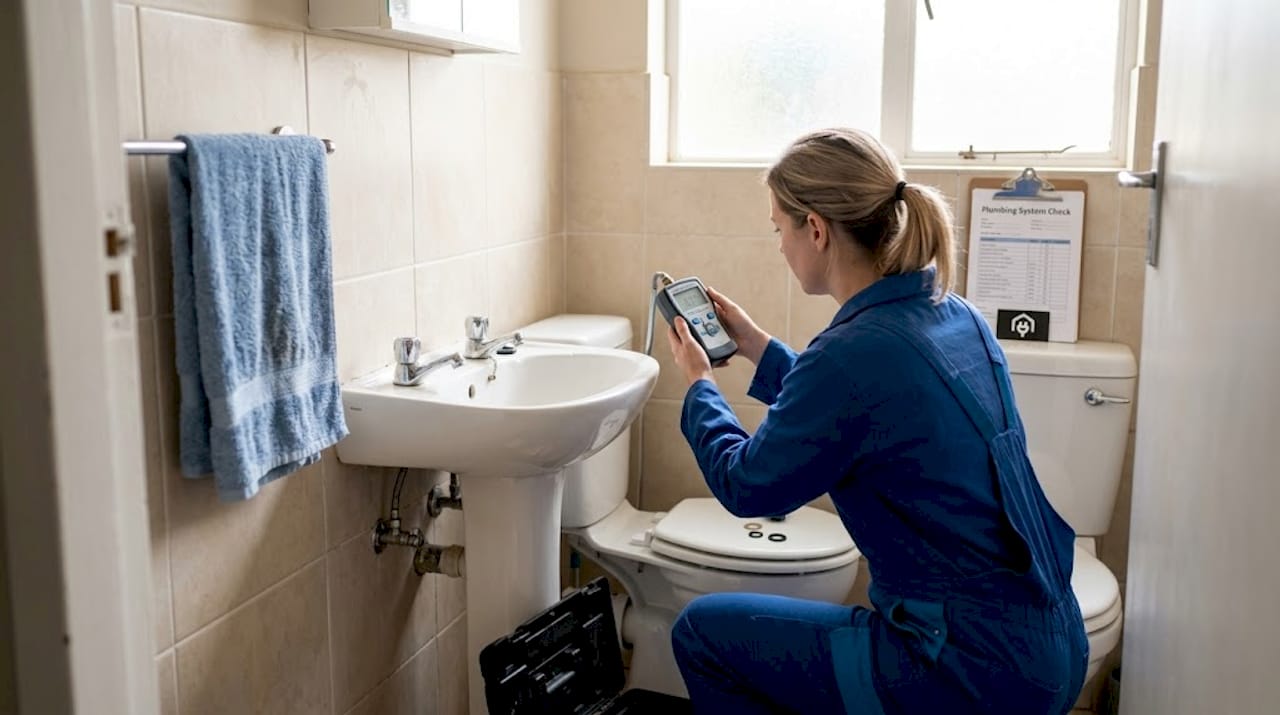
For practical steps to calculate water use specific to London projects, guidance on local authority requirements adds another layer of detail worth reviewing early. Similarly, optimising your London home for the 110 L/ppd target requires careful fixture selection from the outset.
Pro Tip: Always record the manufacturer’s stated flow rate for every fixture at the time of specification. Building control may request this documentation, and retrospective data gathering is far more time-consuming than keeping a simple specification schedule during the design phase.
Who must comply: New builds, conversions, and landlord obligations
Water calculations under Part G apply specifically to new residential builds and material changes of use, such as converting a commercial building into flats. They also apply where local planning conditions explicitly require water efficiency assessments, which is increasingly common in water-stressed regions.
Part G applies mainly to new builds and conversions; existing rental properties have no mandatory national water efficiency standard. EPC and MEES regulations only affect energy performance, not water consumption volumes. This is a critical distinction for landlords managing existing stock.
For landlords, the relevant compliance focus is the EPC and MEES framework. Landlords have no direct water calculation mandate for existing rentals, but hot water energy efficiency does influence the EPC rating, which in turn affects MEES compliance. A property must currently hold an EPC rating of at least band E to be legally let, with proposals to tighten this to band C under consideration.
The following table clarifies how standards differ across contexts:
| Standard | Applies to | Target | Enforced by |
|---|---|---|---|
| Part G (national) | New builds, conversions | ≤125 L/ppd | Building control |
| Part G (London/South East) | New builds, conversions | ≤110 L/ppd | Building control |
| EPC/MEES | All rented properties | Energy rating E or above | Local authority |
Scenarios that trigger a full water calculation include:
- New residential construction, regardless of size
- Conversion of non-residential buildings to dwellings
- Addition of a new bathroom to an existing property under certain planning conditions
- Installation of non-standard or high-flow fittings flagged by building control
- Properties where local planning requires water neutrality or efficiency statements
For landlords seeking London water use essentials and water heating guidance relevant to EPC performance, both topics intersect at the point of hot water system specification. Energy certificate updates also affect how landlords plan future upgrades to their portfolio.
Benchmarks, best practices, and common pitfalls in water calculations
Meeting the Part G standard is the legal minimum, but several recognised frameworks set higher benchmarks. BREEAM and Code for Sustainable Homes levels target 105 L/ppd and 80 L/ppd respectively, and the UK average household consumption sits at approximately 140 litres per person per day. Going below the national average is the starting point, not the end goal, for genuinely efficient properties.
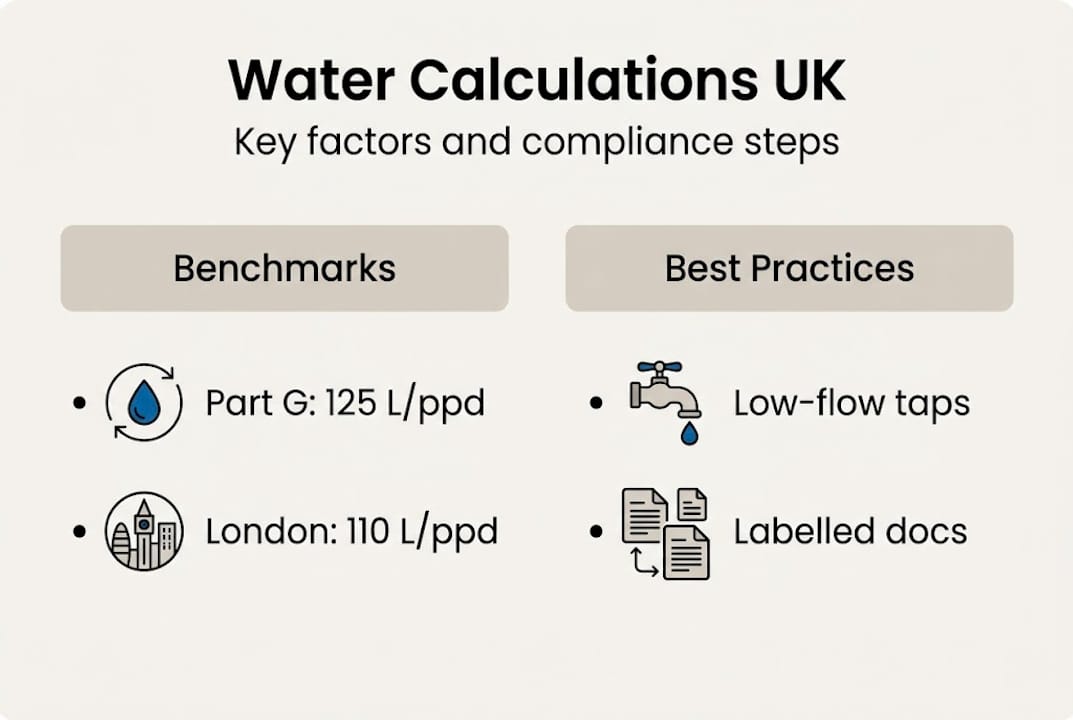
The gap between the UK average and even the basic Part G standard illustrates how much room there is for meaningful improvement. Properties built to BREEAM or Code for Sustainable Homes standards can offer measurable reductions in occupant water bills alongside stronger sustainability credentials, both of which are increasingly valued by tenants and buyers.
Common mistakes that cause calculations to fail or underperform include:
- Omitting appliances such as dishwashers or washing machines from the fixture schedule
- Using estimated flow rates rather than manufacturer-verified figures
- Forgetting to apply greywater or rainwater harvesting credits where systems are installed
- Miscalculating occupancy using bedroom counts outside the Approved Document G formula
- Using outdated fixture data from previous specifications
To futureproof a property’s water performance, consider fitting low-flow taps and showers rated at 6 L/min or below, specifying dual-flush WCs with a full flush of 4 litres or less, and installing a water meter. Water metering is optional for landlords and homeowners but provides reliable data for tracking actual consumption against the calculated figure.
For actionable practical water-saving tips that go beyond compliance, small fixture changes often deliver the greatest return relative to cost.
Pro Tip: Submit a clean, clearly labelled water calculation document alongside planning and building control applications. Assessors respond well to organised evidence packs, and having a well-prepared submission can significantly reduce back-and-forth queries that delay sign-off.
Our take: Why smart water calculations strengthen your property strategy
The most common mistake property owners make is treating water calculations as a last-minute box-ticking exercise, something to be sorted just before building control sign-off. This approach consistently produces problems: rushed fixture changes, missed credits, and documentation gaps that delay completion.
The smarter approach is to treat water efficiency exactly as you would treat energy performance. Plan it early, integrate it into the fixture specification, and align it with any planned energy upgrades. A heat pump installation, for instance, offers a natural opportunity to also specify a hot water cylinder with a secondary storage coil for solar thermal, reducing both energy and heated water demand simultaneously.
The most costly mistakes in water compliance come from last-minute, disjointed decisions. Treat water like energy: plan early, align upgrades, and document thoroughly.
For properties in London or other water-stressed areas, advanced water efficiency planning is not just about meeting the 110 L/ppd target today. It is about futureproofing against further regulatory tightening that, given the direction of UK water policy, is a credible near-term prospect.
Need expert support with water or energy calculations?
Water and energy calculations each carry their own documentation requirements, methodologies, and compliance pathways. Handling both accurately from the outset reduces risk and avoids costly revisions during building control. While the methodology is well-defined, applying it correctly across different property types and local authority requirements takes specialist knowledge.

Homeenergymodel.co.uk provides detailed guidance on energy models for landlords and a thorough breakdown of the home energy model explained, helping property owners navigate both energy and water compliance with confidence. Whether you are planning a new build, managing a rental portfolio, or preparing for upcoming regulatory changes, the right guidance makes a measurable difference to both compliance outcomes and long-term running costs.
Frequently asked questions
Do landlords have to do water calculations for all rental properties?
No. Water calculations are only required for new builds or conversions. Existing rental properties have no national mandatory water efficiency standard under Part G.
What is the standard daily water consumption limit under Building Regulations Part G?
The national standard is 125 L/ppd, but areas such as London and the South East impose a tighter limit of 110 litres per person per day through local planning requirements.
How are water calculations done for a typical house?
They use the Water Efficiency Calculator for New Dwellings, totalling consumption from all taps, showers, toilets, and appliances based on occupancy and manufacturer flow rate data.
Does water calculation affect my EPC rating?
Not directly. However, hot water energy efficiency does influence the EPC score, which is a legal requirement for rented properties under MEES.
Is water metering required by law for landlords or homeowners?
No. Water metering is optional for landlords and homeowners, but it provides a practical way to track real consumption against calculated targets.
Recommended
- Water Calculations in London: Ensuring Your Property’s Efficiency – Home Energy Model
- Understanding Water Calculations for London Properties: A Guide to Commercial Water Calculation – Home Energy Model
- Water Calculation Essentials for London Homes: Save Money and Conserve Resources – Home Energy Model
- Master water certificate calculation: UK compliance guide