

TL;DR:
- Victorian energy upgrades focus on improving insulation, ventilation, and draught-proofing to meet the EPC Band C goal by 2030. Early action, proper planning, and using breathable materials help preserve heritage features and reduce long-term costs. Grant schemes like ECO4 and the Boiler Upgrade Scheme support cost-effective retrofit investments.
Victorian energy upgrades are specialised improvements designed to raise the energy efficiency of Victorian-era properties while preserving their historic fabric. For UK landlords and property owners, these upgrades are no longer optional planning. All privately rented properties in England will likely need an EPC Band C rating for new tenancies by 2030, and over 60% of Victorian rental homes currently sit at Band D or below. The industry term for this process is “retrofit,” and understanding the distinction between a quick win and a whole-house retrofit determines both the cost and the compliance outcome. Schemes such as ECO4 and the Boiler Upgrade Scheme exist specifically to reduce the financial burden of this work.
What are the best victorian energy upgrades for UK homes?

The fabric-first approach is the recognised starting point for any Victorian retrofit. This means addressing insulation, draught-proofing, and ventilation before touching the heating system. A fabric-first retrofit lowers heat demand first, which then allows a smaller, more efficient heating system to do its job properly. Skipping this step is the single most common and costly mistake landlords make.
The table below compares the most common upgrade measures for Victorian properties.
| Measure | Typical cost | Annual saving | Timeline |
|---|---|---|---|
| Loft insulation | £400–£800 | £150–£250 | 1–2 days |
| Draught-proofing | £100–£300 | £60–£120 | 1 day |
| Internal solid wall insulation | £4,000–£13,000 | £300–£500 | 2–4 weeks |
| External solid wall insulation | £8,000–£22,000 | £300–£500 | 4–8 weeks |
| Air source heat pump | £7,000–£13,000 | Variable | 2–5 days |
| Heating controls upgrade | £150–£400 | £75–£150 | 1 day |
Loft insulation is the clearest quick win, costing £400–£800 and saving £150–£250 annually on heating bills. That payback period of three to five years makes it the first measure any assessor will recommend.
Solid wall insulation is more complex. Victorian properties were built with solid brick walls rather than the cavity walls found in post-1920s housing. This means cavity fill is not an option. Internal insulation reduces room size slightly but causes less disruption to the exterior. External insulation preserves internal space but requires planning permission in conservation areas and changes the building’s appearance.
Heat pumps work well in Victorian homes only after the fabric has been addressed. Installing a heat pump without improving insulation first leads to an oversized, inefficient system that costs more to run than the gas boiler it replaced. Combining solid wall insulation through ECO4 with a heat pump reduces upgrade costs by £15,000+ and saves £500–£900 annually on energy bills.
Pro Tip: Get an EPC assessment before committing to any measure. The recommended measures section of the certificate ranks improvements by cost-effectiveness, giving a clear, property-specific starting point.
What regulations affect Victorian rental properties?
Compliance pressure on Victorian rental stock is building quickly. The government’s proposed minimum EPC Band C requirement for new tenancies by 2030 means landlords with Band D or E properties face a firm deadline. Over 60% of private rental stock sits at Band D or below, and Victorian terraces are disproportionately represented in that figure.
The key compliance points landlords need to understand are:
- EPC Band C by 2030: New tenancies will require a minimum Band C rating. Existing tenancies are expected to follow shortly after.
- ECO4 eligibility: The Energy Company Obligation scheme (ECO4) funds insulation and heating upgrades for eligible properties. Victorian homes with solid walls often qualify.
- Boiler Upgrade Scheme: This scheme provides grants of up to £7,500 toward the cost of an air source heat pump, reducing the upfront barrier significantly.
- Non-compliance risk: Landlords who fail to meet minimum EPC standards face civil penalties. Early upgrades avoid last-minute costs and contractor availability issues.
- EPC recommended measures: The EPC certificate’s recommended measures list serves as a tailored roadmap, ranking improvements by efficiency and cost-effectiveness for that specific property.
An EPC assessment from a qualified assessor is the practical first step. The certificate identifies the current rating, the potential rating, and the specific measures needed to close the gap. For landlords managing multiple Victorian properties, this assessment provides the data needed to prioritise spending across a portfolio.
How do you protect heritage features during a retrofit?
Retrofitting a Victorian property carries genuine risk if the wrong materials are used. Using impermeable insulation materials in solid brick homes traps moisture inside the wall structure, causing rot, damp, and long-term structural damage. Victorian brickwork was designed to breathe. Modern synthetic insulation boards block that process entirely.
The key principles for heritage-safe retrofitting are:
- Use breathable materials: Lime-based plasters, wood fibre insulation boards, and hemp batts allow moisture to move through the wall without accumulating.
- Commission a heritage impact assessment: This identifies which features are protected and which interventions are permissible, particularly in conservation areas or listed buildings.
- Avoid oversizing heating systems: A whole-house, fabric-first approach delivers superior comfort and savings compared to simply fitting a larger boiler or heat pump without addressing the building envelope.
- Consult CIBSE and RICS guidance: Both bodies publish detailed retrofit standards. RICS research shows that 73% of surveyed professionals highlight retrofit complexity, underscoring the need for skilled, experienced contractors.
- Integrate controls carefully: Smart sensors and adaptive controls integrated with heating upgrades can achieve significant energy reductions without altering the character of historic rooms.
Whole-house retrofits targeting 60–80% energy reductions combine fabric improvements with low-carbon heating to avoid fossil fuel lock-in. That figure represents the upper ceiling of what is achievable in a Victorian property with full investment in both fabric and systems.
Pro Tip: Always appoint a retrofit coordinator for projects involving multiple measures. This single point of responsibility prevents the sequencing errors that cause damp, inefficiency, and wasted expenditure.
How to plan and complete Victorian energy upgrades step by step
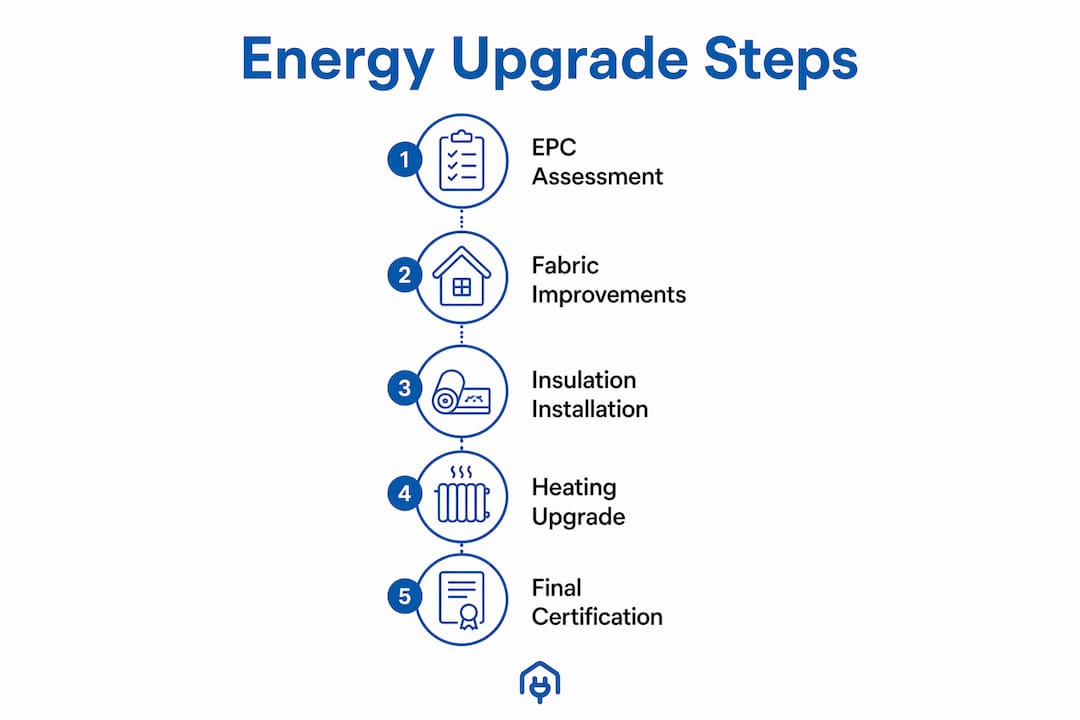
A structured plan prevents the two most common failures: doing measures in the wrong order and running out of funding mid-project. The numbered steps below reflect the order that delivers the best outcome for most Victorian properties.
- Commission an EPC assessment. This establishes the baseline rating and the specific measures needed to reach Band C. Use the recommended measures list as the primary planning document.
- Apply for available grants before spending. ECO4 and the Boiler Upgrade Scheme have application processes that take time. Starting grant applications early prevents delays to the physical work.
- Complete fabric measures first. Loft insulation and draught-proofing are the fastest and cheapest improvements. Quick wins like these take 4–8 weeks from planning to completion.
- Schedule solid wall insulation. Internal or external solid wall insulation is the most disruptive measure. A full EPC upgrade including solid wall insulation takes 12–20 weeks for a Victorian terrace.
- Upgrade the heating system last. Once the fabric is improved, the heating demand drops. A correctly sized heat pump or high-efficiency boiler then operates at peak efficiency.
- Commission a post-works EPC. A new certificate confirms the rating achieved and provides the documentation required for compliance.
| Stage | Typical duration | Estimated cost range |
|---|---|---|
| EPC assessment | 1–3 days | £60–£120 |
| Loft insulation | 1–2 days | £400–£800 |
| Draught-proofing | 1 day | £100–£300 |
| Solid wall insulation | 4–20 weeks | £4,000–£22,000 |
| Heat pump installation | 2–5 days | £7,000–£13,000 |
| Post-works EPC | 1–2 days | £60–£120 |
Coordinating multiple grants requires careful timing. ECO4 funding is allocated through energy suppliers, and the Boiler Upgrade Scheme runs through Ofgem. Both have processing times. Landlords who apply for both simultaneously and sequence the physical works accordingly can reduce total out-of-pocket costs substantially. Working with a contractor experienced in grant-funded Victorian retrofits reduces administrative friction considerably.
Key takeaways
Victorian energy upgrades require a fabric-first approach, grant coordination, and heritage-aware materials to achieve EPC Band C compliance before the 2030 deadline.
| Point | Details |
|---|---|
| Fabric first, always | Insulate and draught-proof before upgrading the heating system to avoid inefficiency. |
| 2030 EPC deadline | Over 60% of Victorian rental homes are Band D or below, making early action critical. |
| Use grant funding | ECO4 and the Boiler Upgrade Scheme can reduce upgrade costs by £15,000 or more. |
| Breathable materials matter | Impermeable insulation in solid brick walls traps moisture and causes structural damage. |
| EPC as planning tool | The recommended measures list on an EPC certificate ranks upgrades by cost-effectiveness. |
Why landlords who wait will pay the most
I have seen the same pattern repeat across the Victorian rental sector. Landlords who treat the 2030 EPC deadline as a distant problem consistently end up paying a premium. Contractors who specialise in heritage-sensitive retrofits are already booking months in advance. Grant funding windows close and reopen with tighter eligibility criteria each cycle. The landlords who acted in 2024 and 2025 secured better rates, better contractors, and better grant coverage than those who will scramble in 2029.
The other mistake I see regularly is treating Victorian upgrades as a single event rather than a phased programme. A property that needs solid wall insulation, a heat pump, and new heating controls does not need all three done simultaneously. Phasing the work over two or three years spreads the cost, allows grant applications to be timed correctly, and gives each measure time to perform before the next is added.
The EPC rating meaning is not just a compliance score. It is a direct signal of running costs to prospective tenants. Properties at Band C and above command stronger rental demand and face fewer void periods. That commercial reality makes the investment case for early upgrades straightforward, even before the regulatory obligation is considered.
The most encouraging shift I have observed is landlords beginning to see retrofit not as a cost but as a capital improvement. A Victorian terrace that reaches Band C is a more lettable, more valuable, and more resilient asset than one sitting at Band E. That framing changes the conversation entirely.
— Danny
How Homeenergymodel supports Victorian property upgrades
Homeenergymodel provides detailed guidance on EPC ratings, energy modelling, and compliance planning specifically for UK landlords and property owners. The resources on the site cover everything from understanding your current EPC score to selecting the right upgrade pathway for a Victorian property. For landlords managing a portfolio, the types of home energy models guide explains how different assessment methodologies apply to older housing stock. The energy performance guide provides a structured framework for planning upgrades that meet the incoming Band C standard. Homeenergymodel’s resources are built around the practical realities of UK compliance, not generic advice.
FAQ
What is the EPC Band C requirement for Victorian rentals?
All privately rented properties in England are expected to require a minimum EPC Band C rating for new tenancies by 2030. Victorian properties currently rated Band D or below will need targeted upgrades to comply.
How long do Victorian energy upgrades take?
Quick wins such as loft insulation and heating controls take 4–8 weeks from planning to completion. A full retrofit including solid wall insulation takes 12–20 weeks for a typical Victorian terrace.
Can I get grants for Victorian home insulation?
ECO4 funds insulation and heating upgrades for eligible properties, and the Boiler Upgrade Scheme provides grants of up to £7,500 toward heat pump installation. Victorian properties with solid walls frequently qualify for ECO4 support.
What insulation is safe for Victorian solid brick walls?
Breathable materials such as wood fibre boards, hemp batts, and lime-based plasters are the correct choice. Impermeable modern insulation traps moisture in solid brick walls and causes rot and structural damage over time.
Where do I start with planning a Victorian retrofit?
Commission an EPC assessment first. The recommended measures section of the certificate identifies the most cost-effective upgrades for that specific property and ranks them by SAP point gain per pound spent.