
The biggest gas savings in most UK homes come from three low-cost changes: lowering the boiler flow temperature, setting the thermostat and timer to match how the home is actually used, and stopping heat leaking out through gaps, windows and bare walls. None needs new equipment. Larger savings follow from upgrading an old boiler and its controls, and from insulation. How much any of this saves depends on the property, the heating system and the household, so the figures below are best read as ranges rather than promises.
This guide sets out each measure in the order that makes most sense: free adjustments first, then cheap draught and heat-loss fixes, then upgrades. Each step cites UK sources, with the safety limits that matter before any setting is changed.
TL;DR
- Lowering the boiler flow temperature from 80°C to 60°C could cut total gas use by about 9% in a home with a condensing combi boiler, according to Nesta.
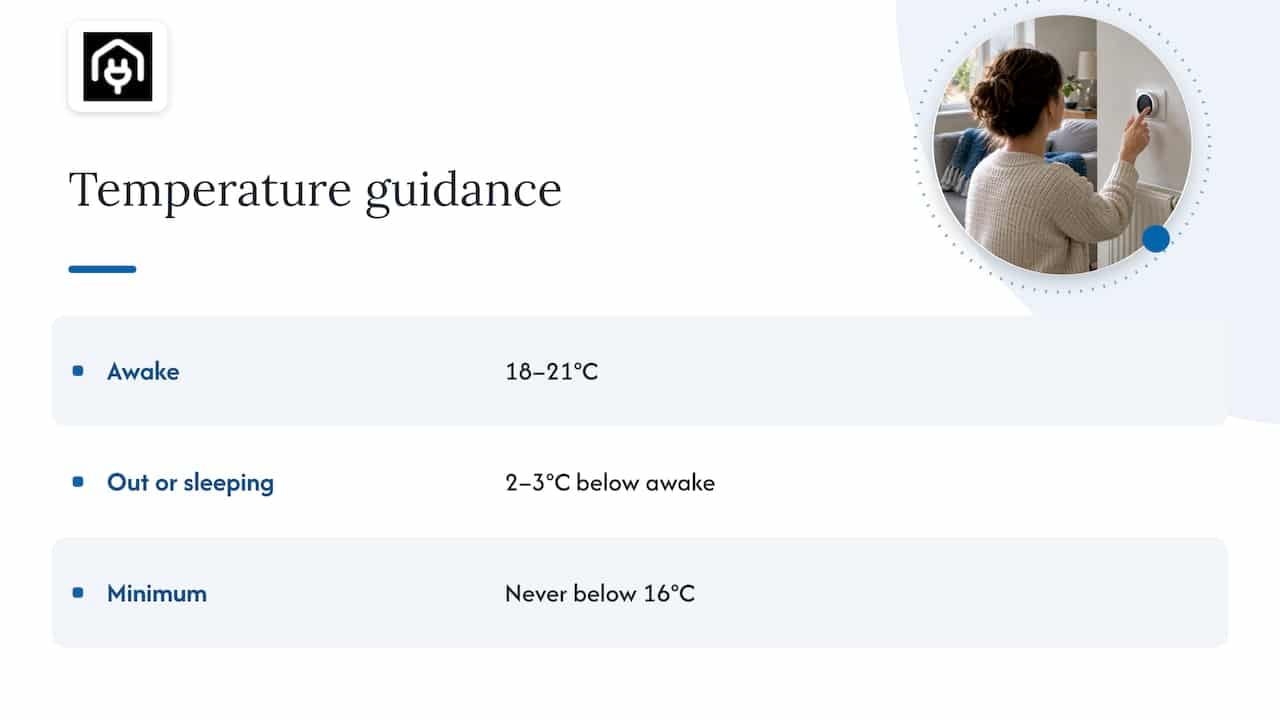
- Room thermostats work best between 18°C and 21°C, with a setback 2 to 3 degrees lower when out or asleep, and never below 16°C.
- Draught-proofing, closing curtains at night and clearing radiators cost little and reduce heat loss straight away.
- Upgrading a G-rated boiler to an A-rated one with full heating controls could save £420 a year in Great Britain, according to the Energy Saving Trust.
- Hot water cylinders should stay at 60°C or above. Cutting that setting to save gas creates a health risk.
Table of Contents
- Where the gas actually goes
- Step 1: Lower the boiler flow temperature
- Step 2: Set the thermostat and timer to match real use
- Step 3: Stop heat escaping
- Step 4: Upgrade when the old system is the problem
- What to check before changing anything
- A realistic order of action
- Perspective
- Find out where your home loses heat
- FAQ
- Sources
Where the gas actually goes
For most homes with a gas boiler, space heating is the largest share of gas use, with hot water and cooking making up the rest. Nesta’s boiler work assumes space heating accounts for around 75% of total gas consumption, which is why heating settings have such a visible effect on the bill (Nesta, 2022).
This shapes the order of action. Anything that reduces the heat the home needs, or makes the boiler produce that heat more efficiently, acts on the largest part of the bill. Ofgem notes that potential savings vary significantly with building type, heating system and personal usage, so a flat in a terrace and a detached house with solid walls will not see the same result from the same change (Ofgem).
For a wider view of the whole energy bill, not only gas, see the guide to what works for saving on energy bills in UK homes.
Step 1: Lower the boiler flow temperature
The flow temperature is the temperature of the water the boiler sends to the radiators. Many boilers are installed with it set high, often 75°C to 80°C. A condensing boiler only recovers extra heat from its exhaust gases when the water returning to it is cool enough, and a lower flow setting allows that to happen more often.
What the evidence says
- Nesta estimated that households with condensing combi boilers could reduce total annual gas consumption by about 9% by moving from 80°C to 60°C, and about 12% by moving to 55°C, assuming space heating is 75% of gas use (Nesta, 2022).
- Nesta also reports that many homes can be heated effectively at a flow temperature of 55°C or below.
- A later Nesta study found that month-specific recommendations led to a statistically significant fall in daily gas use without harming thermal comfort: 60°C in winter, 55°C in early spring and late autumn, and 50°C in mid-spring and mid-autumn (Nesta, 2023).
- Smart Energy GB explains that condensing combi boilers are most efficient when set between 55°C and 60°C, because that range puts the boiler into condensing mode (Smart Energy GB).
The aim is not to make the home cooler. The aim is to let the boiler run in condensing mode, so the same warmth costs less gas. Some guidance puts the saving from lowering both boiler dials at 10% to 20%, a wider range than Nesta’s modelled figure, which reflects how much depends on the starting setting (East London NHS Foundation Trust, 2024).
A simple seasonal routine
| Time of year | Suggested flow temperature |
|---|---|
| Winter | 60°C |
| Early spring and late autumn | 55°C |
| Mid-spring and mid-autumn | 50°C |
These are the settings used in the Nesta trial. Change one step at a time and give the home a few days to show whether it still reaches temperature. If rooms warm up too slowly, Nesta found that bringing the heating on 15 to 30 minutes earlier keeps the savings without losing comfort (Nesta, 2022).
Two cautions apply. First, the advice is written for condensing boilers; an older non-condensing model gains less. Second, a system with a hot water cylinder or a combi boiler with separate hot water dial should be adjusted by reading the manufacturer’s manual. If the controls are unclear, a Gas Safe registered engineer can adjust them in minutes during a service.
Step 2: Set the thermostat and timer to match real use
The second saving comes from not heating rooms to a higher temperature, or for longer, than the household needs.
Temperature
Citizens Advice recommends a comfortable temperature between 18°C and 21°C when awake, and a setback temperature 2 to 3 degrees lower when out or sleeping, but never below 16°C. It also points out that turning the thermostat higher does not heat a home faster, it only uses more energy (Citizens Advice).
That 16°C floor matters. Below it, the risk of damp and illness rises, and anyone with a health condition should ask a healthcare professional what temperature their home needs. Cost-cutting should never override this.
Timing
If the right timings are unclear, the Centre for Sustainable Energy suggests setting the heating to come on 30 minutes before the home is needed and go off 30 minutes before it stops being needed. This roughly matches the average time a home takes to heat up and cool down (Centre for Sustainable Energy).
A practical way to apply this:
- Note the real routine for a week: when the household wakes, leaves, returns and goes to bed.
- Set the first heating period to start 30 minutes before waking and finish 30 minutes before leaving.
- Set the evening period to start 30 minutes before returning and finish 30 minutes before bed.
- Adjust by 15 minutes either way, depending on how quickly rooms warm up.
- Review at the change of season, since warm-up times shorten as outdoor temperatures rise.
A well-insulated home warms up faster and holds heat longer, so its heating periods can be shorter (Centre for Sustainable Energy). That is a reason to treat insulation and scheduling as one job. Households thinking about electric systems alongside their heating, for example solar or charging at home, can look at home electrification technologies to see how scheduling and demand fit together.
Step 3: Stop heat escaping
With the boiler and controls set sensibly, the next target is the heat the home loses. Ofgem lists several low-cost measures: draught-proofing around windows and doors, window film on single glazing, closing curtains at night, and insulating a hot water tank (Ofgem).
Draught-proofing
Gaps around door frames, letterboxes, keyholes, loft hatches and floorboards let warm air out and cold air in. Self-adhesive strips and brush seals are cheap and can be fitted without tools. Keep trickle vents, extractor fans and any flues for gas appliances clear: these are there for ventilation and combustion safety, and sealing them is not a saving worth making.

Curtains and radiators
Closing curtains at night helps stop warm air escaping through glass (Ofgem). The reverse applies to radiators: curtains hanging over them, or sofas pushed against them, trap the heat in the wrong place. Guidance from the East London NHS Foundation Trust advises keeping furniture at least 15 to 30 cm (6 to 12 inches) away from radiators, and says this could save up to 10% on heating bills (ELFT, 2024). Treat that as an upper estimate rather than a typical figure.
For how radiators emit heat and why placement matters, the guide on how radiators work explains the basics, written for landlords but equally useful for owner-occupiers.
Hot water cylinders
Insulating the cylinder and its pipework reduces standing heat loss. The temperature setting needs care. Citizens Advice and the Centre for Sustainable Energy both advise keeping stored hot water at 60°C, which prevents harmful bacteria such as legionella from growing while avoiding the waste of overheating (Citizens Advice; Centre for Sustainable Energy). Do not turn it lower to save gas.
Insulation
Loft, cavity wall and floor insulation reduce the heat the home needs in the first place, and they make every other measure in this guide work harder. The checklist in 7 essential home insulation tips for UK property owners covers where to start and what to prioritise.
Step 4: Upgrade when the old system is the problem
Settings can only do so much with a boiler that is old and inefficient. The Energy Saving Trust estimates that upgrading a G-rated boiler to an A-rated boiler with full heating controls could save £420 in Great Britain and £440 in Northern Ireland (Energy Saving Trust). The saving depends on the home and the fuel price at the time, so it is a guide to scale, not a quote.
Full heating controls usually means a room thermostat, a programmer or timer, and thermostatic radiator valves, ideally with zoning in larger homes. Where the existing boiler is fairly modern, better controls alone can be a more affordable first step than replacement.
Longer term, a heat pump uses electricity far more efficiently than a boiler uses gas. Smart Energy GB-style comparisons point out that heat pumps can be three to four times more efficient, although gas often costs less per unit, so the running-cost result depends on tariffs and the home’s insulation. This is why fabric improvements usually come before any change of heating system.
What to check before changing anything
Before adjusting settings, a few checks avoid false economies:
- Health and vulnerability. Older people, infants and anyone with a medical condition may need a warmer home than the minimum. Ask a GP or other healthcare professional when unsure.
- Hot water temperature. Keep cylinders at 60°C.
- Damp and mould. A home kept very cold is prone to condensation. If damp is already present, find the cause rather than just reducing heating.
- Boiler type. Instructions differ between combi boilers, system boilers and those with a cylinder. Follow the manual or ask an engineer.
- Source quality. Citizens Advice cautions against taking heating advice from social media or forums, as unofficial tips may be unsafe or ineffective. Stick to bodies such as Ofgem, the Energy Saving Trust, Nesta and Citizens Advice.
Tenants should also check what they are permitted to change. Controls in a rented property may belong to the landlord, and landlords can find more in 7 effective ways to cut heating costs for UK landlords.
A realistic order of action
| Step | Typical cost | Effort | What it acts on |
|---|---|---|---|
| Lower flow temperature | Free | Minutes | Boiler efficiency |
| Reset thermostat and timer | Free | An evening | Hours and temperature of heating |
| Clear radiators, close curtains | Free | Daily habit | Heat distribution and loss |
| Draught-proofing | Low | A weekend | Air leakage |
| Cylinder insulation | Low | A few hours | Standing losses |
| Loft and wall insulation | Moderate to high | Professional job | Whole-house heat demand |
| Boiler and controls upgrade | High | Professional job | System efficiency |
Work down the table. The first three rows cost nothing, and the savings from them can be tracked on the next few bills or meter readings. Read the meter weekly before and after each change, so the effect of one change is not mixed up with the effect of another or with the weather.
For a longer list that covers the cold months in particular, see 8 essential winter home energy tips for UK property owners, and for another practical walk-through, how to reduce your gas bill.
Perspective
Most advice on gas heating stops at settings. Settings matter, and the flow temperature and timer changes above are the right place to begin. But the home itself decides how far they can go. A property that loses heat quickly will always need a lot of gas, whatever the dial says.
That is why we look at the building as a whole. An Energy Performance Certificate shows where a property stands and lists the recommended improvements in a consistent format. For landlords and owners planning work, it turns a vague sense that the house is draughty into a prioritised list. For new builds and major refurbishments, the SAP calculations and energy statements we support show how a design performs before the work starts, so heating is sized for the building rather than guessed.
Our advice is simple. Make the free changes this week. Then get the property assessed, so that insulation, controls and boiler decisions are made on evidence about the building, in the right order.
Danny
Find out where your home loses heat
An EPC records a property’s energy performance and lists the improvements likely to make the biggest difference, which makes it a sensible starting point for deciding what to spend on. Homeenergymodel can connect owners, landlords and developers with assessors for a domestic EPC through a quote request. For commercial premises, the equivalent is a commercial EPC. Prices are set by the assessors and are given on request, not published on the site.
FAQ
What is the best temperature for heating a home?
Citizens Advice suggests 18°C to 21°C in the rooms in use, with a setback 2 to 3 degrees lower when out or asleep. The temperature should not go below 16°C. Anyone with a health condition should ask a healthcare professional what their home needs.
Does turning the thermostat up make a home heat faster?
No. According to Citizens Advice, a higher thermostat setting does not heat a home faster, it only uses more energy. If rooms warm up slowly, set the timer to start 15 to 30 minutes earlier instead.
How much can lowering the boiler flow temperature save?
Nesta’s modelling suggests about 9% off total gas use for a condensing combi boiler going from 80°C to 60°C, and about 12% at 55°C. Other guidance quotes 10% to 20%. Actual savings depend on the boiler, the home and how it is used.
Is it worth replacing an old boiler to save on gas?
It can be. The Energy Saving Trust estimates £420 a year in Great Britain from replacing a G-rated boiler with an A-rated one with full controls. Check the age and rating of the current boiler, and compare the upgrade cost with that saving. An EPC can show which improvements are worth doing first.
Is it safe to turn down the hot water temperature to save gas?
Not below 60°C for a hot water cylinder. That temperature stops harmful bacteria, including legionella, from growing. Savings are better found in insulating the cylinder and pipework.
Sources
- Money Saving Boiler Challenge: supporting evidence, Nesta (2022)
- The impact of boiler optimisation on gas consumption and household comfort, Nesta (2023)
- Change combi boiler settings to save money, Smart Energy GB
- Save money heating your home, Citizens Advice
- Gas and oil central heating controls, Centre for Sustainable Energy
- Heating systems, Energy Saving Trust
- Warm home hacks, East London NHS Foundation Trust (2024)