
HVAC stands for heating, ventilation and air conditioning, and its job is simple to state even though the engineering behind it isn’t: it moves heat and air around a building to control temperature, humidity and indoor air quality. Three functions, working together, define how HVACs work in practice — heating adds warmth, ventilation exchanges stale air for fresh, and air conditioning removes heat and moisture when things get too warm.
Two standards shape how this happens in UK homes:
- Approved Document Part F sets minimum ventilation rates to stop condensation and damp.
- MVHR (mechanical ventilation with heat recovery) is increasingly the default for airtight new builds, recovering heat that would otherwise be wasted.
For a fuller look at how these rules affect compliance and Energy Performance Certificates, Homeenergymodel’s guidance on the Home Energy Model is worth bookmarking.
Key Takeaways
HVAC systems work by moving heat and air through interconnected components, and ventilation quality, not heating capacity alone, determines whether a home stays comfortable and compliant.
| Point | Details |
|---|---|
| HVAC moves heat, not cold | Air conditioning removes heat and moisture rather than generating cold air. |
| Reversing valve enables dual use | Heat pumps use the refrigeration cycle in reverse to both heat and cool a home. |
| MVHR recovers most extract heat | Well-designed MVHR systems can recover roughly 70–90% of heat from extracted air. |
| Sizing errors cause common faults | Oversized units short cycle; undersized units run constantly without reaching target temperature. |
| Commissioning proves compliance | Recorded airflow measurements support Part F compliance and future troubleshooting. |
| Use the $5,000 rule with caveats | Multiply age by repair cost, but check warranty status and refrigerant availability first. |
If you’re planning a heating or ventilation upgrade and need to understand how it affects compliance or your EPC rating, Homeenergymodel’s guide on improving building energy performance walks through what an assessment covers and how to get one arranged.
Table of Contents
- HVAC system basics: the components and how air moves through them
- The refrigeration cycle: how air conditioning actually works
- Heating methods: boilers, heat pumps and electric systems compared
- Ventilation types and what Part F requires
- Controls, sizing and the maintenance schedule that keeps it all running
- Common HVAC faults and the repair-or-replace decision
- Where to go for UK-specific HVAC compliance guidance
- Why ventilation, not the boiler, decides whether a home actually feels right
- Sources
HVAC system basics: the components and how air moves through them
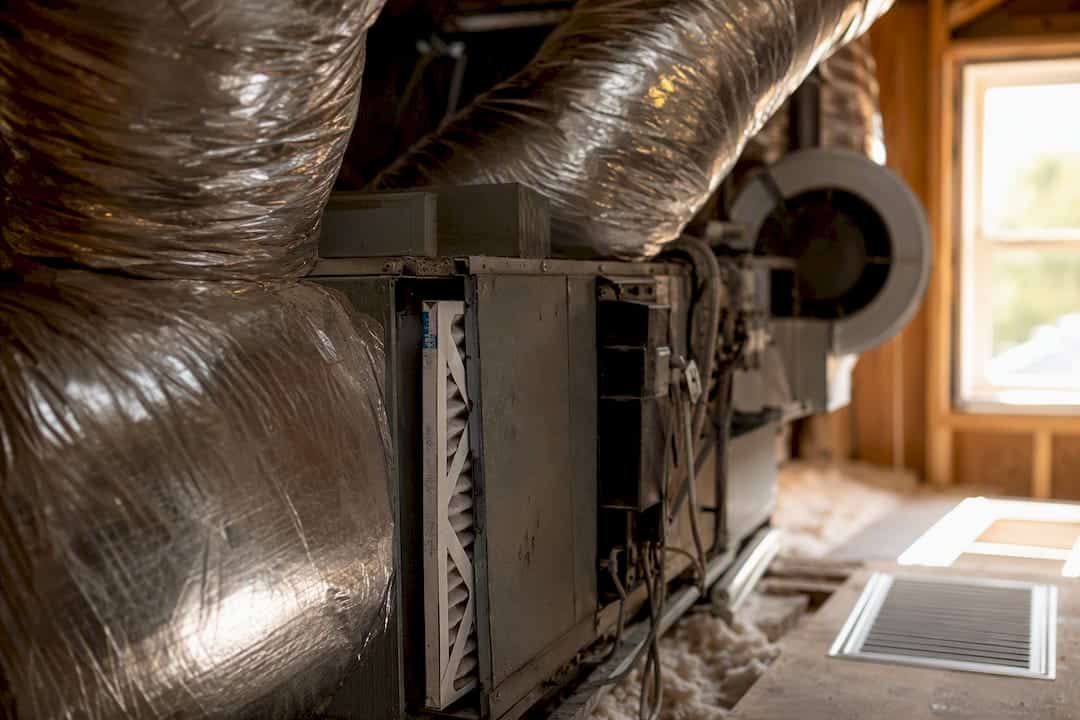
Every HVAC system, however it is configured, relies on a handful of core parts. The thermostat senses temperature and tells the system when to start and stop. The air handler contains the fan and often the indoor coil, pushing air through the ductwork. Ducts carry that air to and from rooms. The evaporator coil absorbs heat from indoor air during cooling, while the compressor and condenser coil (usually outdoors) do the work of rejecting that heat outside. Filters sit in the return path, catching dust and allergens before air reaches the coil.
The air path itself follows a predictable loop:
- Room air is drawn into a return grille.
- It passes through the filter, removing particulates.
- It crosses the coil, where heat is added or removed.
- The fan pushes conditioned air back out through supply vents.
Worth noting: a system that isn’t purely refrigerant-based (an electric heater plus an extract fan, for instance) still counts as HVAC under UK usage, even though “air conditioning” strictly refers to the cooling and dehumidification element, not the whole system.
Pro Tip: Frost building up on a coil, a rattling fan, or vents that barely breathe are rarely random faults. They almost always point back to one of these components, which makes diagnosis far quicker if you know the map.
The refrigeration cycle: how air conditioning actually works
Air conditioning doesn’t manufacture cold. It moves heat from inside your home to outside, and understanding that one fact explains almost every quirk of how HVACs work.
The cycle runs in four repeating stages:
- Evaporation — liquid refrigerant absorbs heat from indoor air and turns to vapour at the evaporator coil.
- Compression — the compressor squeezes that vapour, raising its pressure and temperature.
- Condensation — the hot vapour releases heat to the outdoor air at the condenser coil and turns back to liquid.
- Expansion — the refrigerant passes through an expansion valve, dropping in pressure before starting the cycle again.
This is exactly how a heat pump’s refrigeration cycle operates, and it’s why cooling always pulls moisture out of the air as a side effect. A heat pump uses the same four stages but adds a reversing valve, which swaps the direction of refrigerant flow so the indoor coil absorbs heat from outside air (even cold air still holds usable heat) and releases it indoors. That single valve is the difference between a system that only cools and one that heats and cools from the same hardware, and it’s central to why heat pumps are being positioned as a genuine alternative to gas boilers.
Heating methods: boilers, heat pumps and electric systems compared
Not every home heats the same way, and the method chosen affects how the rest of the HVAC system integrates. Understanding HVAC components means recognising that heating and distribution are separate jobs.
- Boilers heat water in a “wet system,” pushing it through pipes to radiators or underfloor loops. Efficient, familiar, but reliant on gas or oil in most existing installations.
- Air-source heat pumps extract heat from outdoor air and can serve either radiators, underfloor heating or, in air-to-air form, distribute warmth directly through ducted air like a conventional HVAC unit.
- Ground-source heat pumps use buried loops for a more stable heat source, at higher installation cost.
- Electric resistance heaters convert electricity directly to heat, simple but typically the least efficient per unit of energy used.
Distribution matters as much as generation: underfloor heating suits the lower flow temperatures a heat pump produces, while high-temperature radiators sized for a boiler may need upsizing if you switch. Homeenergymodel’s guide to air source heating efficiency covers this trade-off in more depth, and background on emitter compatibility sits in the home heating systems guide.
Ventilation types and what Part F requires
Ventilation is the part of HVAC system basics that homes most often get wrong, and it’s usually the missing piece when condensation, musty smells or mould show up despite a perfectly good heating system. Adding warmth without correcting airflow tends to make damp problems worse, not better, because warm indoor air simply holds more moisture until it hits a cold surface.
| Ventilation type | How it works | Best suited to |
|---|---|---|
| Natural (trickle vents, openable windows) | Passive air exchange through gaps and vents | Older, less airtight homes |
| Intermittent extract fans | Fans in bathrooms/kitchens run on demand | Spot moisture control, low cost |
| Continuous MEV (mechanical extract ventilation) | Constant low-level extract from wet rooms | Moderately airtight homes |
| MVHR (mechanical ventilation with heat recovery) | Extracts stale air, recovers its heat, supplies fresh warmed air | Airtight, well-insulated new builds and deep retrofits |
Approved Document F sets the minimum extract and background ventilation rates behind each of these approaches, and it’s the reference point any installer or assessor will work from. MVHR earns its premium price tag because it can recover up to around 70–90% of the heat that would otherwise be extracted straight outdoors, though it demands more from you in return: regular filter and core maintenance and correct commissioning to hit its rated performance. For a wider international comparison of recovery ventilation approaches, ClimatePro’s guide to energy recovery ventilation is a useful reference point.
Pro Tip: If you’re retrofitting MVHR into an existing home, get airflow rates measured and recorded at commissioning. Without that paperwork, you can’t prove the system meets Part F, and you’ve no baseline to check against if performance drops later.
Controls, sizing and the maintenance schedule that keeps it all running
A room thermostat sets the target temperature; a programmable or smart thermostat adds scheduling; thermostatic radiator valves (TRVs) let you zone individual rooms without touching the main controller. Simple zoning, even just TRVs on rarely used rooms, cuts waste without a full system redesign.
Sizing is where good systems go wrong quietly. An oversized unit short cycles, switching on and off too often, which wastes energy and leaves humidity uncontrolled. An undersized one runs almost constantly and still struggles on the coldest days. Either symptom is a strong signal to request a proper heat-loss or heat-gain assessment before assuming the equipment itself is faulty, since poor sizing and neglected maintenance are the two most common root causes of underperformance.
A workable maintenance rhythm:
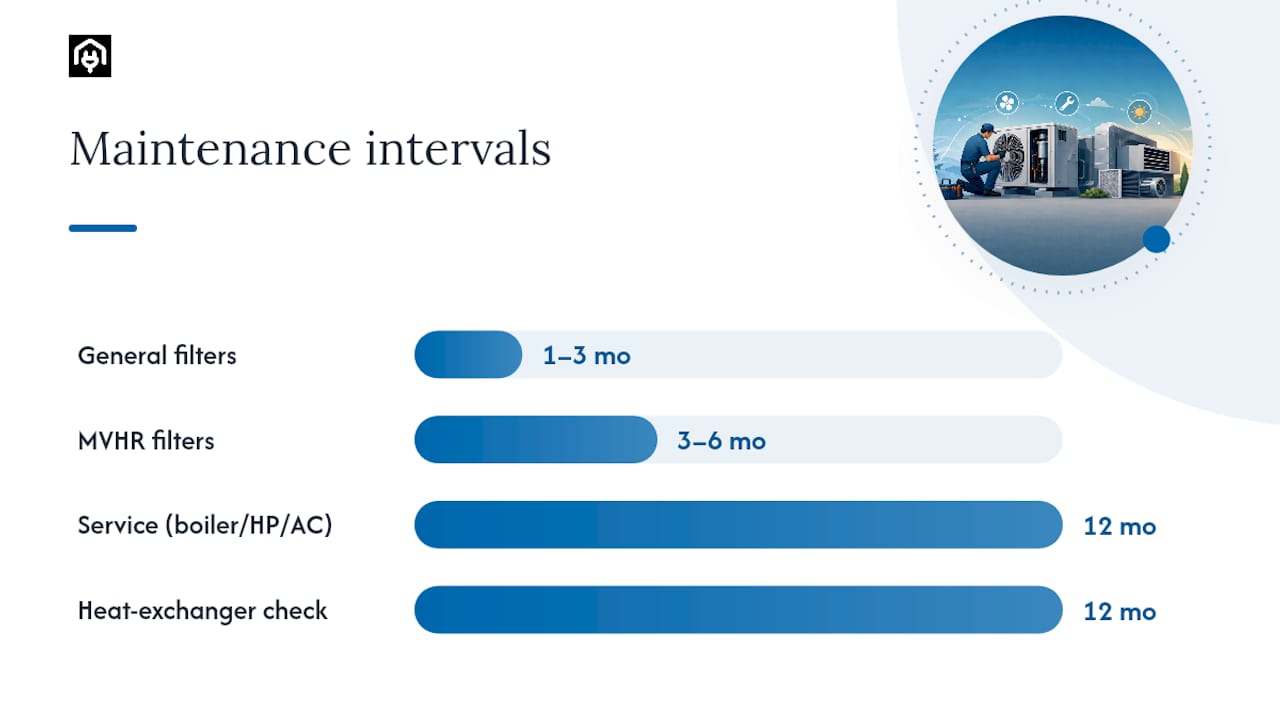
- Replace or wash filters every one to three months, depending on use.
- Book annual servicing for boilers, heat pumps and air conditioning units.
- Clean MVHR filters roughly every three to six months and check the heat exchanger core annually.
- Keep commissioning and service records together. Good documentation frequently improves comfort and efficiency more than replacing equipment outright, and it eases compliance checks at sale or letting.
Pro Tip: Set a phone reminder tied to the season, not the calendar year. Filters clog faster in high pollen months and during heavy heating use, so a fixed “every January” schedule often misses the point it should be catching.
Common HVAC faults and the repair-or-replace decision
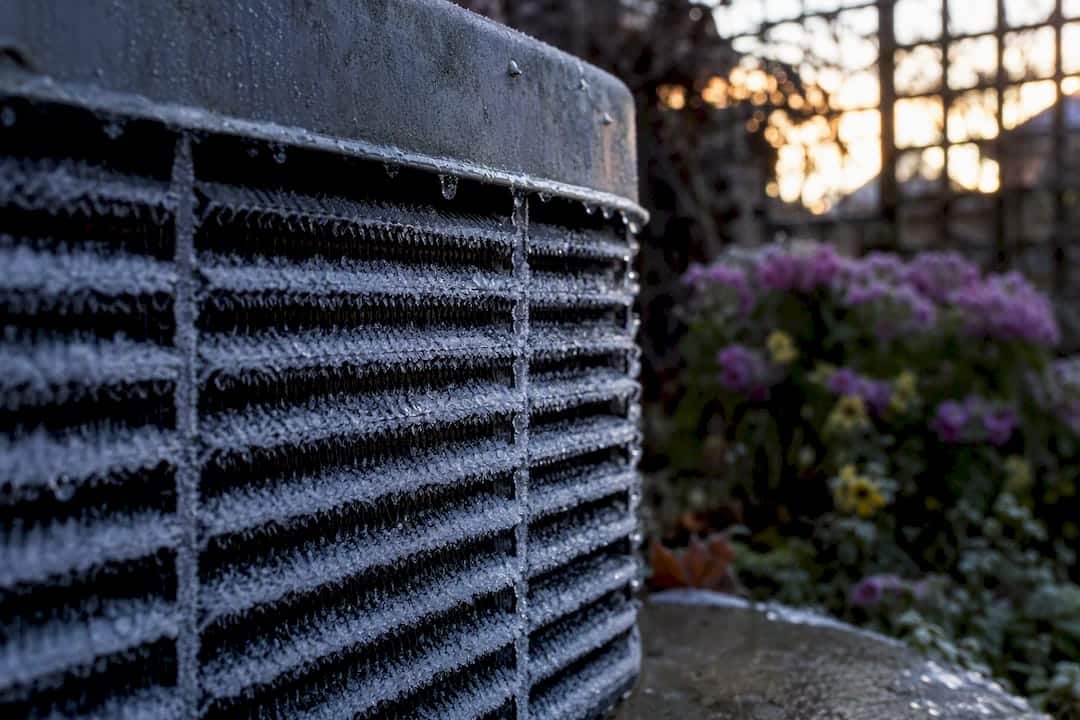
No cooling, weak airflow, strange noises and visible refrigerant leaks are the faults homeowners report most. If you smell refrigerant or see ice on outdoor pipework, switch the system off and call an accredited technician rather than investigating further yourself.
For the repair-versus-replace decision, many engineers use the $5,000 rule: multiply the unit’s age in years by the estimated repair cost, and if the result exceeds $5,000, replacement usually makes more financial sense. A 12-year-old system needing a £450 repair (5,400) tips towards replacement; a 3-year-old system with the same repair (1,350) doesn’t. It’s an informal industry heuristic, not a regulation, and it ignores two things that materially change the maths: whether the unit is still under warranty, and whether its refrigerant type is being phased out, which can make even a cheap repair impossible to source parts for.
Where to go for UK-specific HVAC compliance guidance
Getting the physics right is only half the job. UK homeowners and landlords also need to satisfy Part F, document commissioning, and understand how ventilation and heating choices feed into an EPC rating. Homeenergymodel’s guides on heat recovery fans and ventilation system efficiency translate the standards into practical choices, whether you’re specifying MVHR in a retrofit or checking what a heat pump swap means for your EPC.
Commissioning records are worth treating as an asset, not paperwork to file and forget. They matter at sale, at mortgage valuation, and whenever a technician needs a baseline to diagnose against later.
Why ventilation, not the boiler, decides whether a home actually feels right
Homeowners fixate on heating output because it’s the visible number on a boiler or heat pump spec sheet. That’s the wrong priority. Ventilation is what actually determines whether a warm home also feels stale, damp or stuffy, and it’s the part of the system most likely to be under specified in older properties chasing a quick heating upgrade.
The conventional advice, “get a bigger or newer heat source,” often treats a symptom rather than a cause. A well sized heat pump paired with inadequate extract ventilation will still leave condensation on cold surfaces, because warm air holds moisture until it meets something cooler. Fix ventilation first, and heating performance frequently improves as a side effect, not the other way round.
If you take one thing from this: prioritise commissioning. A system installed correctly but never measured and recorded is a guess dressed up as an installation. Ask for airflow figures. Ask for a heat-loss calculation before agreeing to any new unit’s size. That single habit, more than any brand of equipment, is what separates homes that stay comfortable from ones that need constant tinkering.
— Danny
Sources
- Gov
- Heat pumps (Energy Saving Trust)
- How a heat pump works (Goodman)
- What is the $5,000 rule? (CBS News)