

Whether a holiday let needs an Energy Performance Certificate (EPC) depends on where the property is and how it is let. In England and Wales, a holiday let needs one only when it meets a three-part test on length of stay, months let and who pays the energy bills. In Scotland, short-term lets generally need one. Our domestic EPC service covers the assessment itself, so once you know you need a certificate, booking a domestic EPC is the next step.
TL;DR
- England and Wales: a holiday let needs an EPC when guests stay under 31 days, the property is let for at least 4 months in any 12, and guests pay the energy costs.
- Holiday accommodation let for less than 4 months a year, or under a licence to occupy, does not need one.
- Scotland: short-term lets need a valid EPC, with a fine of at least £500 for failing to have one.
- No minimum EPC rating applies to short-term holiday lets in England and Wales at present, but the government plans to require an EPC for all short-term rentals.
- An EPC lasts 10 years, must come from an accredited assessor and costs the owner a fee that varies by property.
Table of Contents
- The England and Wales test
- Exemptions that apply in England and Wales
- Do Airbnb and other short-term lets need an EPC?
- Scotland: short-term lets need an EPC
- Northern Ireland
- Is there a minimum rating for holiday lets?
- What is changing in England and Wales
- Getting a holiday let EPC
- Book your holiday let EPC through us
- Our view
- FAQ
- Sources
The England and Wales test
GOV.UK says you do not need an EPC for holiday accommodation rented out for less than 4 months a year, or let under a licence to occupy. A licence to occupy gives permission to use a property for a set purpose, without the rights a tenant has.
The official guide to EPCs for dwellings sets out when a holiday let does need a certificate. All three conditions must apply:
- The property is let for holidays for less than 31 days per tenant.
- It is let for at least 4 months in any 12-month period.
- The occupier pays the energy costs.
The guide also refers to HMRC’s furnished holiday let definition: available for commercial letting for at least 210 days, let for at least 105 days, and no more than 155 days of longer-term occupation. The furnished holiday let tax regime was abolished from April 2025, even though the EPC guidance still refers to it. In practice, work from the three-part test above, and if your letting pattern is borderline, ask an assessor to confirm your position before you market the property.
Worked example
A two-bedroom cottage in Cornwall is let by the week from April to October, about seven months, to guests who pay for their own electricity through a meter or an inclusive rate. Stays are under 31 days, the property is let for more than 4 months, and the occupier bears the energy cost. This cottage needs an EPC. A second home let for six weeks each summer and used by the family the rest of the year falls under the less-than-4-months exemption.
Exemptions that apply in England and Wales
The same guide lists the main exemptions:
- Qualifying residential buildings used less than 4 months a year.
- Individual rooms, because a room is not a building designed for separate use. The whole building still needs an EPC if it is let.
- Listed buildings where the required works would unacceptably alter their character.
- Temporary buildings used for two years or less.
- Detached buildings under 50m².
Owners of listed or protected buildings should read our EPC exemption guide before assuming an exemption holds. The government has said it intends to remove exemptions for heritage properties in future reform, so a listed holiday cottage may need a certificate once the new rules take effect.
Do Airbnb and other short-term lets need an EPC?
The rules look at how the property is let, not the booking platform. An entire home advertised on Airbnb or a similar site is treated like any other holiday let and follows the three-part test above in England and Wales. A single room in a house you live in is not a building in its own right, so it does not need one. In Scotland, booking a whole property for a short stay requires an EPC.
GOV.UK’s guidance on letting a self-catering holiday home in England tells hosts to check whether they need an EPC. It also notes that a mandatory national registration scheme for short-term lets is expected to begin in March 2027, so the property will be on an official record.
Scotland: short-term lets need an EPC
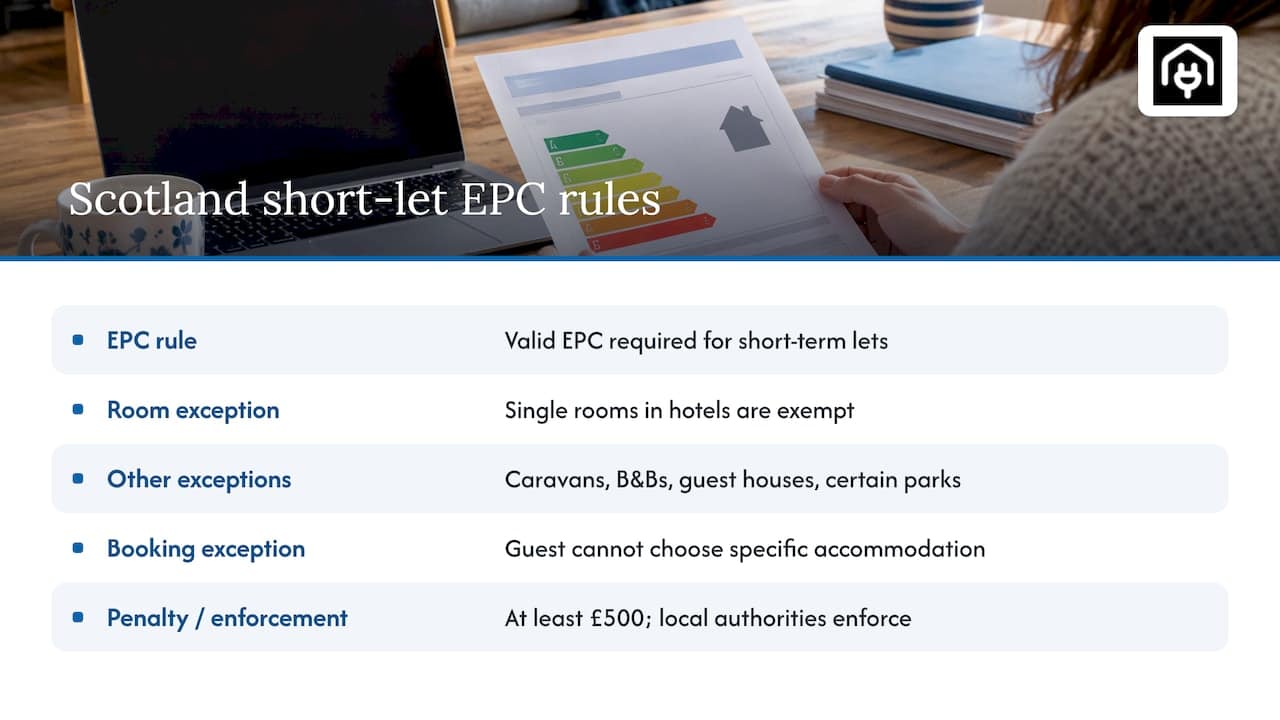
Scotland is different. The Scottish Government’s guide says short-term lets such as holiday accommodation must provide a valid EPC, and the 2008 regulations contain no general holiday-let exemption. Exceptions include a single room in a building such as a hotel, caravan holiday homes, bed and breakfast, guest house accommodation, certain holiday parks, and bookings where the guest cannot choose specific accommodation when booking.
mygov.scot says you could face a fine of at least £500 if you do not get an EPC when you need one. Local authorities enforce the rules.
The 2028 change in Scotland
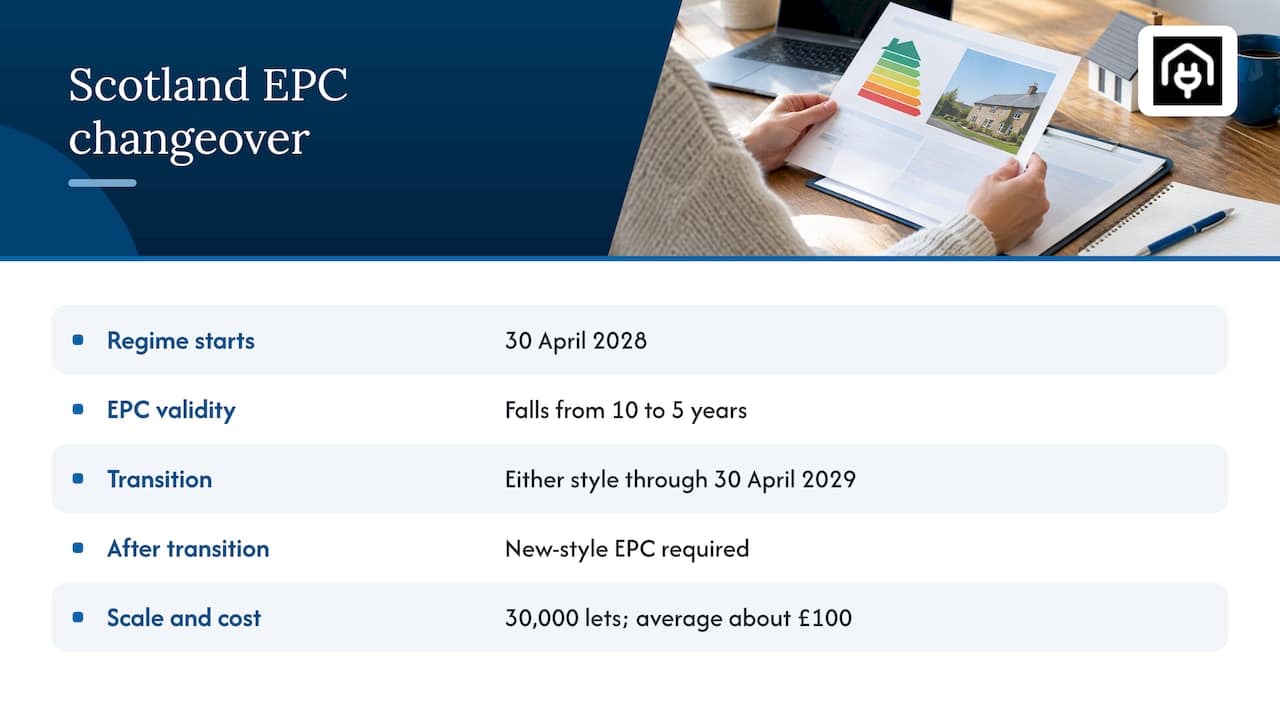
Scotland’s new EPC regime comes into force on 30 April 2028 and cuts EPC validity from 10 years to 5. Short-term lets get a one-year transition: between 30 April 2028 and 30 April 2029 they can use either an old-style or a new-style certificate, and after 30 April 2029 only new-style EPCs are valid for short-term lets. The Scottish Government’s impact assessment estimates about 30,000 short-term lets will need a new-style certificate, and puts the average EPC cost at around £100 per property. The year of grace exists because holiday lets are continuously advertised and not every host could be certified on day one.
Northern Ireland
The Department of Finance says an EPC must be obtained before a building is marketed for sale or rent. Its list of exemptions does not include a holiday-let or less-than-4-months exemption. Rooms in hotels and boarding houses are not classed as dwellings and are excluded.
Is there a minimum rating for holiday lets?
Not at present in England and Wales. The government’s January 2026 response confirms that short-term lets are not subject to the private rented sector minimum standards, including the higher C-equivalent standard due by 1 October 2030, though the position remains under review. The band E minimum applies to properties let on assured, regulated or domestic agricultural tenancies. Scotland has no minimum in force, and its draft standard proposes to exclude short-term holiday lets.
The government gave two reasons: guests are not at risk of fuel poverty in the way private tenants are, and fuel poverty is the priority ahead of 2030. Owners should still treat the rating as a marketing and running-cost matter, because it is stated on every advert.
What is changing in England and Wales
The government’s partial response on EPC reform, published in January 2026, says it intends to:
- require a valid EPC for short-term rental properties whoever pays the energy bills;
- require an EPC at the point of marketing rather than at sale or let;
- remove exemptions for heritage properties.
These proposals are subject to parliamentary approval and are not yet law. Pinsent Masons notes that whether an EPC is needed at all times a property is let was left for the final response. Owners who already hold a valid certificate will be best placed when the rules settle.
Getting a holiday let EPC
GOV.UK says you can check for an existing certificate online or pay an accredited assessor for a new one. It gives a rating from A to G and is valid for 10 years in England and Wales.
- Check for an existing EPC. If the property was sold or let in the last decade, a valid certificate may already exist.
- Book an accredited assessor. In England and Wales the certificate must come from an assessor in a government-approved accreditation scheme. Our guide to hiring a qualified EPC assessor explains what to look for.
- Prepare the property. Have to hand the boiler details, insulation information, glazing type and any recent upgrades. Boiler paperwork matters, and the Gas Safe certification guide explains what homeowners should know about gas appliances.
- Obtain it before marketing. Owners must use all reasonable efforts to have the certificate within 7 days of marketing starting, up to 28 days in total.
- State the rating in adverts and give a copy to guests who book. The energy rating must appear in commercial adverts, with a fixed penalty of £200 per advert for failing to comply.
Our page on how to book an EPC covers the steps for landlords and owners in more detail.
Book your holiday let EPC through us
We offer domestic EPC assessments, and you can request a quote online for your property. If you also run a commercial-style site such as a holiday park with a reception building, the commercial EPC service is available too. For owners who want to understand the certificate first, our guide to the EPC rating bands explains A to G.

Start on the domestic EPC page and send your property details.
Our view
Holiday let owners often treat the EPC as paperwork to be done at the last minute. We see it differently. The rules are moving in one direction: Scotland already requires certificates for short-term lets, and the government’s stated intention for England and Wales is to require one for every short-term rental.
An owner who commissions a certificate now has a document valid for 10 years in England and Wales and an early view of the property’s energy performance. That is useful for adverts, for running costs and for any decision on insulation, heating or glazing upgrades.
Our approach is to give owners clear, regulation-focused guidance, and to connect them with assessors through a simple online quote request for EPCs, TM44 inspections and energy reports.
Danny
FAQ
Do I need an EPC for a holiday let in England and Wales?
Yes, if guests stay under 31 days, the property is let for at least 4 months in a 12-month period and guests pay the energy costs. Holiday accommodation let for less than 4 months a year, or under a licence to occupy, does not need one.
Do Airbnb listings need an EPC?
An entire property listed on a platform follows the same rules as any other holiday let. A single room in a home you live in does not need one in England and Wales, because a room is not a separate building.
How long does a holiday let EPC last?
In England and Wales it is valid for 10 years. Scotland’s new regime from 30 April 2028 cuts validity to 5 years.
What happens if I do not have one in Scotland?
You could face a fine of at least £500. Local authorities enforce the rules, and short-term lets will need a new-style certificate by 30 April 2029.
Sources
- Selling a home: Energy Performance Certificates, GOV.UK
- A guide to Energy Performance Certificates for the marketing, sale and let of dwellings, GOV.UK
- Letting out a self-catering holiday home in England, GOV.UK
- Short term lets, EPC guide, gov.scot
- EPCs are changing, gov.scot
- Business and Regulatory Impact Assessment, gov.scot
- When you need an EPC, mygov.scot
- EPC FAQ, Department of Finance Northern Ireland
- Improving the energy performance of privately rented homes, government response
- Reforms to the Energy Performance of Buildings regime, partial government response
- EPC reforms and MEES for private-rented property confirmed, Pinsent Masons
- Do holiday lets need an EPC? The rules in each UK nation