
Conserving electricity at home comes down to three steps, taken in order: stop wasting power through habits, fix the cheap leaks such as old bulbs and standby loads, then invest in the systems that use the most energy. Heating and hot water make up over half of a typical UK energy bill, so the biggest gains sit there. Lighting, appliances and smart tariffs follow. This guide sets out what each step involves, what it can save, and where to start.
TL;DR
- Start with free changes: switch off standby, shorten showers, wash at lower temperatures and use fewer, fuller loads.
- Replace remaining halogen bulbs with LEDs, which use about 80% less electricity for the same light.
- Measure first. A smart meter display or app shows where power goes, and government estimates put the typical reduction at 2.8% of electricity use.
- Heating and hot water are the largest cost, so controls, boiler settings and insulation matter more than any single gadget.
- Unsure which upgrades suit a property? An EPC lists recommendations with estimated costs and savings.
Table of Contents
- Why the unit price makes small savings worthwhile
- Work in the right order
- Free habits that cut electricity use
- Low-cost fixes worth doing this year
- Measure it: smart meters and tariffs
- Bigger upgrades: where the money is
- Our perspective
- When a professional assessment helps
- A 30-day plan
- FAQ
- Sources
Why the unit price makes small savings worthwhile
Every kilowatt hour (kWh) not used is money kept. Under the Ofgem price cap from 1 October to 31 December 2026, the average electricity unit rate is 26.32 pence per kWh, with a standing charge of 54.83 pence a day for Direct Debit customers in England, Scotland and Wales. The same page notes there is no VAT on electricity from 1 October 2026 to 31 March 2027.
The standing charge is paid regardless of use, so only the unit rate responds to saving. At 26.32p, a device drawing 100 watts for 10 hours uses one kWh and costs about 26p. Run every day for a year, that is roughly £96. The arithmetic is simple, and it is a quick way to judge whether a habit is worth changing. Actual tariffs vary by supplier and region, so check the unit rate on a current bill.
A useful rule: multiply the watts of a device by the hours it runs, divide by 1,000, then multiply by the unit rate. Appliance labels or manuals normally give the wattage.
Work in the right order
Ofgem and Energy Saving Trust guidance points to a hierarchy of action: free behavioural changes first, low-cost improvements second, and long-term capital investment last. The order matters because free changes pay back immediately and show how much further a household needs to go.
| Stage | Examples | Typical cost | Payback |
|---|---|---|---|
| Free habits | Standby, shower length, kettle, wash settings | £0 | Immediate |
| Low-cost fixes | LED bulbs, draught-proofing, tap aerators, cylinder jacket | Low | Months to a few years |
| Capital upgrades | Boiler, heat pump, insulation, glazing | Higher | Years |
The sections below follow the same order.
Free habits that cut electricity use
Switch off standby
Almost every appliance left on standby draws a small, constant load. Energy Saving Trust estimates that switching appliances off at the plug saves about £45 a year in Great Britain and £55 in Northern Ireland. Televisions, games consoles, chargers, printers and microwaves are the usual culprits.
A caution applies. Some equipment needs power to keep working, and satellite and digital TV recorders must stay plugged in to hold their recording schedules. Check the instruction manual before switching anything off at the wall. Smart speakers and smart heating controls also need a constant connection, and Ofgem notes that standby-saver gadgets are less suited to smart devices for that reason.
A practical approach is to group the entertainment devices on one extension lead with a switch, and switch it off when the room is empty.
Boil only what is needed
Kettles are used many times a day. Energy Saving Trust puts the saving from filling a kettle with only the water needed at £6 a year in Great Britain and £12 in Northern Ireland. It is a modest figure, but it costs nothing and takes no effort once it becomes habit.
Wash smarter
The same Energy Saving Trust list recommends using fewer, colder washes and avoiding the tumble dryer where possible. In practice:
- Run washing machines and dishwashers only when full.
- Use a lower temperature setting for everyday loads.
- Dry clothes on a rack or line when the weather allows.
- Spend less time in the shower, which also reduces the energy used to heat water.
An electric tumble dryer is among the most power-hungry appliances in a typical home, so cutting its use is usually the largest single appliance saving. Where a dryer is essential, clear the filter after each load so it works efficiently.
Use daylight and switch off lights
Turning lights off when leaving a room is one of the most repeated tips in UK advice, and it still works. Arranging desks and worktops near windows reduces the need for artificial light during the day. Closing curtains at dusk also helps keep heat in, which reduces heating demand.
Low-cost fixes worth doing this year
Swap halogen bulbs for LEDs
LEDs are the most efficient common bulb type. Energy Saving Trust says LEDs use 80% less electricity than halogen lights for equivalent brightness, and last up to 20 times longer in many cases. Replacing the remaining halogen spotlights in a home could save around £45 a year in Great Britain and £55 in Northern Ireland, the same source states.
Start with the lights used most: the kitchen, living room and hallway. Spotlights in kitchens and bathrooms often number a dozen or more, so these rooms usually deliver the biggest gain. Check the base type (GU10 and MR16 are common for spotlights) and dimmer compatibility before buying.
Lower the combi boiler flow temperature
Heating is usually gas in the UK, but the controls are electrical and the principle of cutting waste is the same. Government guidance suggests reducing a combi boiler flow temperature to 60C, as many boilers are set too high, which can make them more efficient. That page groups it among three tips that could save around £100 a year. Boiler settings differ, so follow the manufacturer’s instructions or ask a heating engineer if unsure.
Use heating controls properly
Energy Saving Trust experts say that using controls such as thermostats and thermostatic radiator valves (TRVs) is often more accessible and effective than replacing the system straight away. A timer set to match when people are actually at home, a room thermostat set sensibly and TRVs in rooms used less often all prevent paying to heat empty space.
For homes with electric heating, the same logic applies with more force, because every wasted hour is paid at the electricity unit rate rather than the gas rate.
Draught-proof and insulate the basics
Draught-proofing is regularly described as one of the easiest and cheapest ways to save energy. Seal gaps around doors, letterboxes and floorboards, and fit a jacket to the hot water cylinder if there is one. Energy Saving Trust also lists fitting a tap aerator and topping up cylinder insulation among its quick tips.
For a wider view of low-cost measures, the guide to energy saving steps for UK homes sets them out in a sensible sequence.
Measure it: smart meters and tariffs
Saving what cannot be seen is guesswork. Smart meters record energy use every 30 minutes, and that detail can be viewed on an in-home display or a supplier app. It exposes overnight base loads, the fridge-freezer cycle, and the evening peak when everything runs at once. Monthly estimated bills hide all of this.
Government estimates indicate that using a smart meter display can typically reduce a household’s electricity use by 2.8% and gas use by 2%. The meter itself does not save energy. The behaviour it prompts does.
Smart meters also enable time-of-use tariffs. Under these, running a dishwasher or washing machine in off-peak hours costs less, and the same government campaign notes it also reduces pressure on the national grid at peak times. A time-of-use tariff only suits households that can genuinely move their use, so compare the peak and off-peak rates against current usage patterns before switching. Suppliers install smart meters as part of a national programme, and Ofgem explains how to request one on its smart meter page.
A simple home audit
- Read the meter at the same time on two consecutive mornings to get a daily figure.
- Switch off everything that can be switched off and note the overnight load on the display.
- Turn on one appliance at a time and watch the reading change.
- Rank devices by cost and tackle the top three.
This takes less than an hour and often reveals an old freezer, a dehumidifier or a forgotten heater running far longer than expected.
Bigger upgrades: where the money is
Heating and hot water account for over half of a typical UK household’s energy costs, so capital spending belongs there. Energy Saving Trust estimates that replacing a G-rated boiler with an A-rated one with full heating controls could save about £420 a year in Great Britain and £440 in Northern Ireland. Insulation, glazing and low-carbon heating are the other major options, and each suits different properties.
In England and Wales, owners can get recommendations for home improvements from the government service, with an estimate for each measure. An Energy Performance Certificate gives a similar list, which is why it is a good starting document for any improvement plan. The page on EPC energy saving tips shows how to read those recommendations, and the guide to how to improve energy efficiency in UK homes covers the bigger measures in more depth.
Which changes suit which household?
| Household | Best first move | Why |
|---|---|---|
| Renter | Standby, LEDs, washing habits, draught-proof strips | No landlord permission needed |
| Owner-occupier with older boiler | Controls, flow temperature, then boiler quote | Heating is over half of bills |
| Home with electric heating | Timers, zoning, insulation | Electricity costs more per kWh |
| Landlord | EPC recommendations | Rating and tenant bills both matter |
Our perspective
We spend our time on the technical side of home energy: EPCs, SAP calculations and the incoming Home Energy Model, the government methodology designed to replace SAP for assessing a building’s energy performance. That vantage point shapes how we read household energy advice.
Most lists of tips treat every action as equal. They are not. A switched-off phone charger and a loft with no insulation both appear in the same “top ten”, yet they sit orders of magnitude apart in what they save. Behaviour matters, and it is the right place to start because it is free. But the fabric of the building and the heating system set the ceiling on what behaviour can achieve. A household that turns every light off and still loses heat through a draughty roof will see little change in its bill.
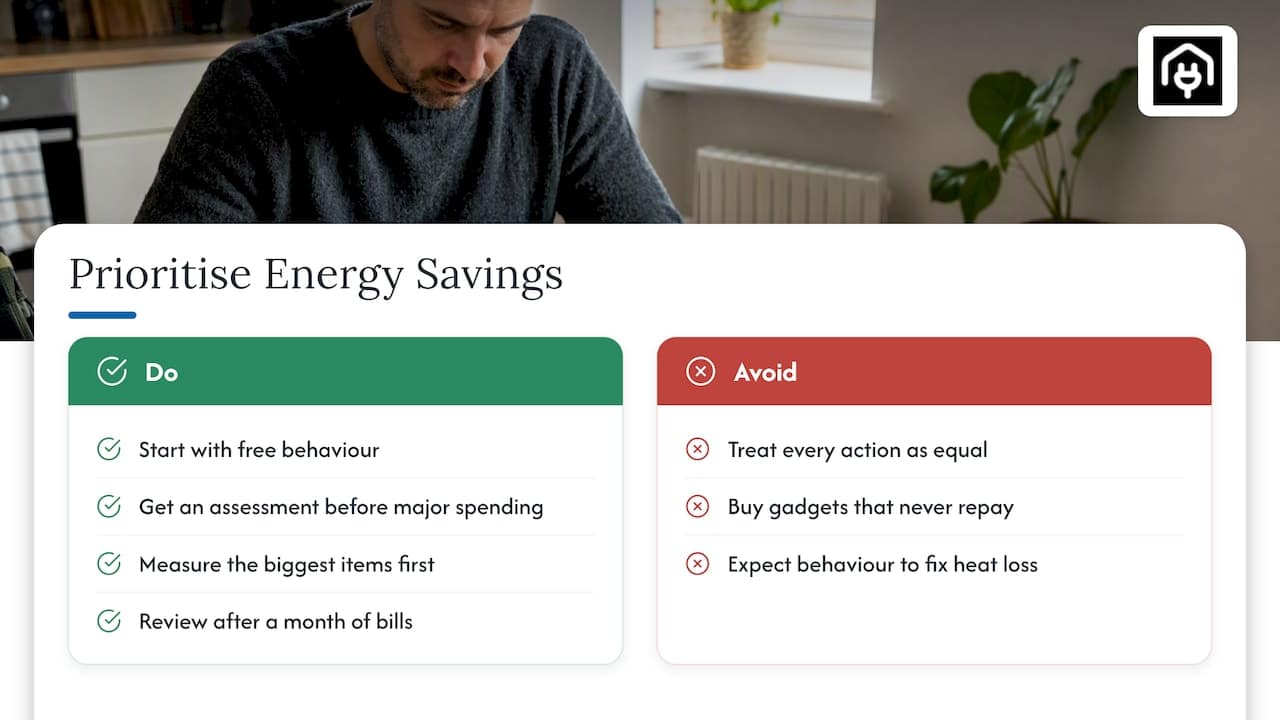
That is why we point people to an assessment before large spending. An EPC records how a property performs and lists measures in a sensible order, with estimated costs and savings. For landlords and investors, it also shows where a property stands against minimum standards. For homeowners, it turns a vague wish to use less electricity into a short, prioritised list.
We would also say this plainly: not every saving is worth chasing. If a gadget costs more than it will save in its lifetime, skip it. Measure first, act on the biggest items, and review after a month of bills or smart meter readings.
— Danny
When a professional assessment helps
Habits and small fixes need no expert. Larger decisions do. A domestic EPC from an accredited assessor gives a documented baseline and a list of recommendations before any money is spent on insulation or heating. Landlords, sellers and buyers often need one anyway.
Homeenergymodel.co.uk helps property owners request quotes for a domestic Energy Performance Certificate, and for commercial EPCs where a business premises is involved. Businesses with air conditioning can also request a TM44 inspection, which looks at the efficiency of cooling systems, a major electricity load in many commercial buildings. Those planning new builds can find guidance on SAP calculations. Prices are not published, so the quote form is the way to get a figure for a specific property.
For a wider look at bills, the guides to reducing home energy use and saving money on utilities go further than this article on electricity alone.
A 30-day plan
Week 1: measure. Request or check the smart meter display, note the daily kWh and the overnight base load, and list the devices left on standby.
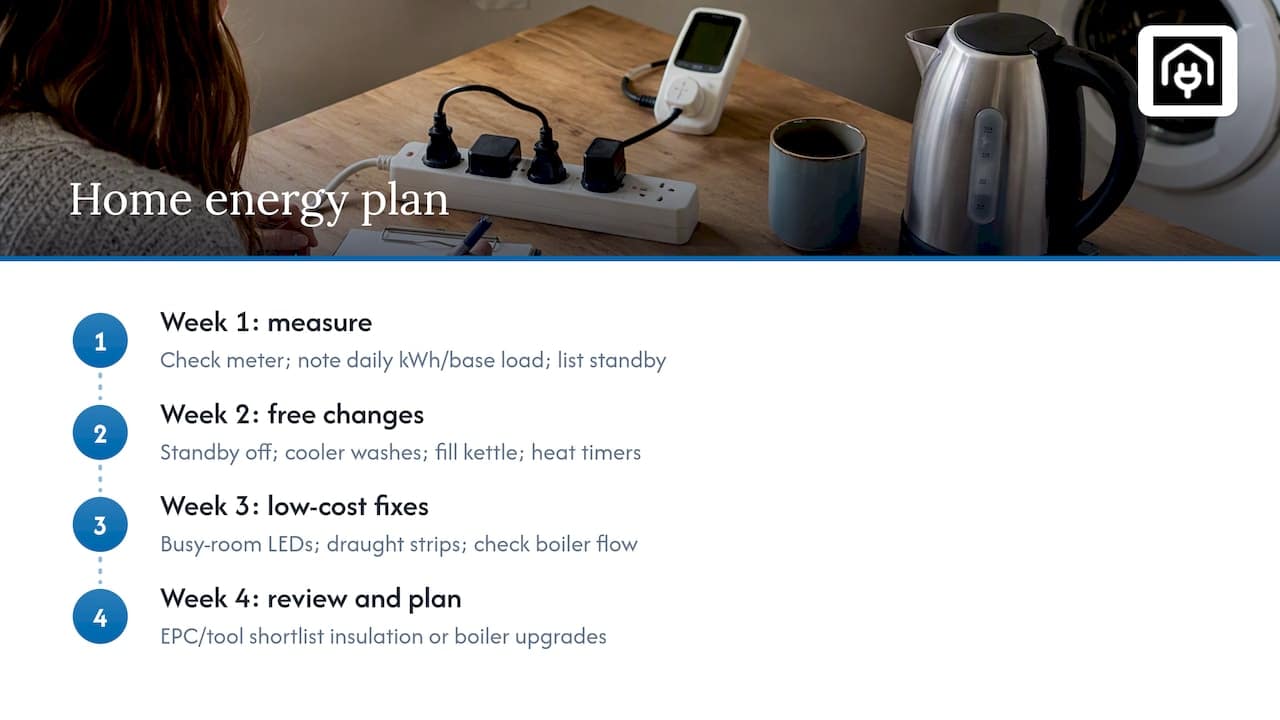
Week 2: free changes. Switch off standby where manuals allow, set washing machines to lower temperatures, fill the kettle to need, and set heating timers to real occupancy.
Week 3: low-cost fixes. Replace halogen spotlights with LEDs in the busiest rooms, add draught strips, and check the boiler flow temperature setting.
Week 4: review and plan. Compare the daily kWh with week one. If heating dominates, get an EPC or use the government improvement tool to shortlist insulation or boiler upgrades.
None of these steps needs specialist knowledge, and each one makes the next decision easier. Results vary by household size, home type and tariff, so treat published savings figures as estimates rather than guarantees.
FAQ
What uses the most electricity in a home?
In most UK homes, heating and hot water are the largest cost, over half of a typical energy bill. Where heating is gas, the biggest electricity users are usually cooking, laundry, refrigeration, lighting and electronics. Homes with electric heating or hot water will see those dominate. A smart meter display helps identify the main loads.
Is it worth unplugging appliances?
For most devices, yes. Energy Saving Trust estimates about £45 a year in Great Britain from switching appliances off at the wall. Leave plugged in anything that needs power to keep its settings or schedules, such as a TV recorder, and check the manual if unsure.
Do smart meters really reduce bills?
They help indirectly. Government estimates suggest a typical 2.8% reduction in electricity use when households use the display, because the readings make waste visible. They also allow time-of-use tariffs, which can lower costs for those who shift appliance use to off-peak hours.
What is the quickest way to cut electricity use?
Switching off standby, using fewer and colder washes, and replacing halogen spotlights with LEDs are the fastest changes. All three cost little or nothing, and the lighting swap alone could save around £45 a year for a home still using halogen spotlights. Larger gains follow from heating controls and insulation.
Sources
- Energy price cap unit rates and standing charges, Ofgem
- Save money on your energy bill, Ofgem
- Get a smart meter, Ofgem
- Heating systems, Energy Saving Trust
- Quick tips to save energy at home, Energy Saving Trust
- Top 10 energy saving actions for your home, Energy Saving Trust
- Energy saving light bulbs and lighting, Energy Saving Trust
- Energy at home, Energy Saving Trust
- Energy efficient home campaign, GOV.UK
- Save energy in your home, Clean Energy campaign
- Find ways to save energy in your home, GOV.UK