

TL;DR:
- Many UK homes lose heat through invisible gaps caused by high air permeability, leading to increased energy costs. Measuring this property via blower door tests helps property owners improve efficiency, comfort, and compliance with regulations. Addressing air permeability alongside proper ventilation and insulation is essential for lasting building performance improvements.
Even the most recently built UK homes can be losing heat through gaps that are invisible to the naked eye. Air leakage is one of the leading causes of wasted energy in residential properties, yet it remains one of the least understood factors among homeowners and property managers. Many assume that a well-insulated property is automatically well-sealed. That assumption costs money. Understanding air permeability and how it is measured gives property owners a practical basis for reducing bills, improving comfort, and staying compliant with evolving UK building regulations.
Table of Contents
- What is air permeability and why does it matter?
- How air permeability is measured in UK homes
- Air permeability and its impact on home energy efficiency
- UK standards and regulations: Meeting air permeability requirements
- Why many UK homes still miss air permeability goals — and how to do better
- Take the next step: Assess and improve your property’s air permeability
- Frequently asked questions
Key Takeaways
| Point | Details |
|---|---|
| Air permeability defined | It measures the rate of air leakage through a building’s envelope, critically impacting energy efficiency. |
| Testing methods | The blower door test provides a standard, reliable measure of air permeability in UK homes. |
| Efficiency and regulation | Controlling air permeability lowers heat loss, saves money, and ensures compliance with UK building regulations. |
| Action steps | Improving airtightness and proper ventilation can dramatically increase comfort and property value. |
What is air permeability and why does it matter?
Air permeability is a precise, measurable property of a building’s envelope. It quantifies the rate at which air passes unintentionally through the walls, floors, roof, windows, and joints of a structure under a standard pressure difference. In the UK, it is expressed in cubic metres of air per hour, per square metre of building envelope, at a pressure of 50 Pascals (m³/h·m² at 50 Pa). The lower the number, the tighter and more energy-efficient the building.
It is easy to confuse air permeability with related terms, so here is a clear breakdown:
- Air permeability: A measurable rate of uncontrolled air leakage across the building fabric, expressed as m³/h·m² at 50 Pa. This is the value used for regulatory compliance in the UK.
- Airtightness: A broader term describing how well a building resists unwanted airflow overall. It is the goal; air permeability is the metric used to assess how close a building gets to that goal.
- Air leakage: The actual physical movement of air through gaps, cracks, and poorly sealed junctions in the building fabric. Air leakage is the problem; air permeability measures its severity.
Understanding the distinction matters because air tightness and energy savings are directly linked. Every unit of uncontrolled air that escapes a heated home carries warmth with it, forcing heating systems to work harder and longer. Poor air permeability also contributes to cold spots, draughts, condensation, and damp, all of which reduce occupant comfort and can lead to structural damage over time.
Key standard: In the UK, Approved Document L of the Building Regulations sets maximum permissible air permeability for new dwellings at 8 m³/h·m² at 50 Pa. Many energy-efficient and Passivhaus-standard homes aim for figures well below 1 m³/h·m² at 50 Pa.
The connection between air permeability, energy costs, and regulation makes this metric one of the most actionable measures available to property owners and managers.
How air permeability is measured in UK homes
The standard method for measuring air permeability in buildings is the fan pressurisation test, commonly known as the blower door test. This method is internationally recognised and is the required approach under UK building regulations for new construction.
Here is how the process works, step by step:
- Prepare the property. Close all external windows and doors. Seal intentional openings such as trickle vents, open fireplaces, and mechanical ventilation inlets. The property should be in its normal occupied state otherwise, with internal doors open.
- Install the blower door. A calibrated fan unit is fitted into an external doorframe using a temporary airtight panel. The fan connects to a pressure control unit and a digital measuring device.
- Depressurise the building. The fan extracts air from the property, creating a controlled pressure difference of 50 Pascals between inside and outside. This simulates the effect of wind pressure on the building fabric.
- Measure the airflow. The volume of air per hour required to maintain the 50 Pa difference is recorded. This figure is then divided by the total internal surface area of the building envelope to give the air permeability value in m³/h·m² at 50 Pa.
- Repeat in pressurisation mode. The fan reverses to pressurise the building, and measurements are taken again. Results from both modes are averaged for a reliable final figure.
- Record and report. The result is submitted as part of the Building Regulations compliance package for new builds or used to inform retrofit decisions for existing properties.
Typical UK air permeability results by building type and age:
| Building type | Typical air permeability (m³/h·m² at 50 Pa) | Performance rating |
|---|---|---|
| Pre-1919 solid wall terraced house | 15 to 25 | Poor |
| 1960s to 1980s cavity wall semi-detached | 8 to 15 | Below average |
| Post-2006 new-build detached | 5 to 8 | Average to compliant |
| Modern energy-efficient new build | 2 to 5 | Good |
| Passivhaus certified property | Below 0.6 | Excellent |
These figures illustrate that building age is a strong indicator of air permeability, though it is not the only one. Construction quality, materials, and maintenance all play a significant role. Understanding air changes per hour alongside m³/h·m² figures helps build a fuller picture of how air moves through a property.
Pro Tip: Before commissioning an air permeability test, walk the property and temporarily seal any obvious gaps around pipework, cables, and letterboxes. This low-cost preparation can make a meaningful difference to your test result and costs very little to carry out.
Knowing your current result is also the first step in assessing home energy loss across the full building fabric, which forms the basis of any meaningful energy improvement plan.
Air permeability and its impact on home energy efficiency
Once a property’s air permeability value is known, its impact on day-to-day running costs becomes easier to quantify. High air permeability is not simply an abstract building physics concern. It translates directly into money leaving the property through gaps that most occupants never see.
Poor air permeability affects properties in several significant ways:
- Increased heating demand. Every cubic metre of warm air that leaks out is replaced by cold external air that must be heated. This continuous cycle adds directly to gas or electricity consumption.
- Cold draughts and discomfort. Uncontrolled air movement creates cold spots near floors, windows, and external walls, reducing comfort even when the thermostat is set high.
- Condensation and damp. Warm, moist air escaping through gaps in the fabric can condense inside wall cavities or roof spaces, leading to mould growth and structural deterioration.
- Reduced effectiveness of insulation. Even well-specified insulation underperforms when air can bypass it through gaps. Air permeability and insulation must work together to deliver meaningful energy savings.
- Lower EPC rating. Air leakage directly affects the calculated energy performance of a property. A high permeability value will reduce the energy efficiency benefits achievable and pull down the EPC band.
- Higher carbon emissions. Greater fuel consumption means a larger carbon footprint per household, which matters increasingly as net zero targets shape UK policy and property valuations.
The relationship between fresh air and efficiency is also worth highlighting. Reducing air permeability does not mean eliminating all air movement. Controlled ventilation through mechanical systems or well-placed trickle vents is essential for indoor air quality. The key distinction is between controlled air movement and uncontrolled air leakage. One supports health; the other wastes energy.
Pro Tip: When improving airtightness, always pair the work with a review of ventilation provision. Sealing a property without adequate controlled ventilation can trap moisture and pollutants indoors. Good home energy saving tips always treat airtightness and ventilation as complementary, not competing, priorities.
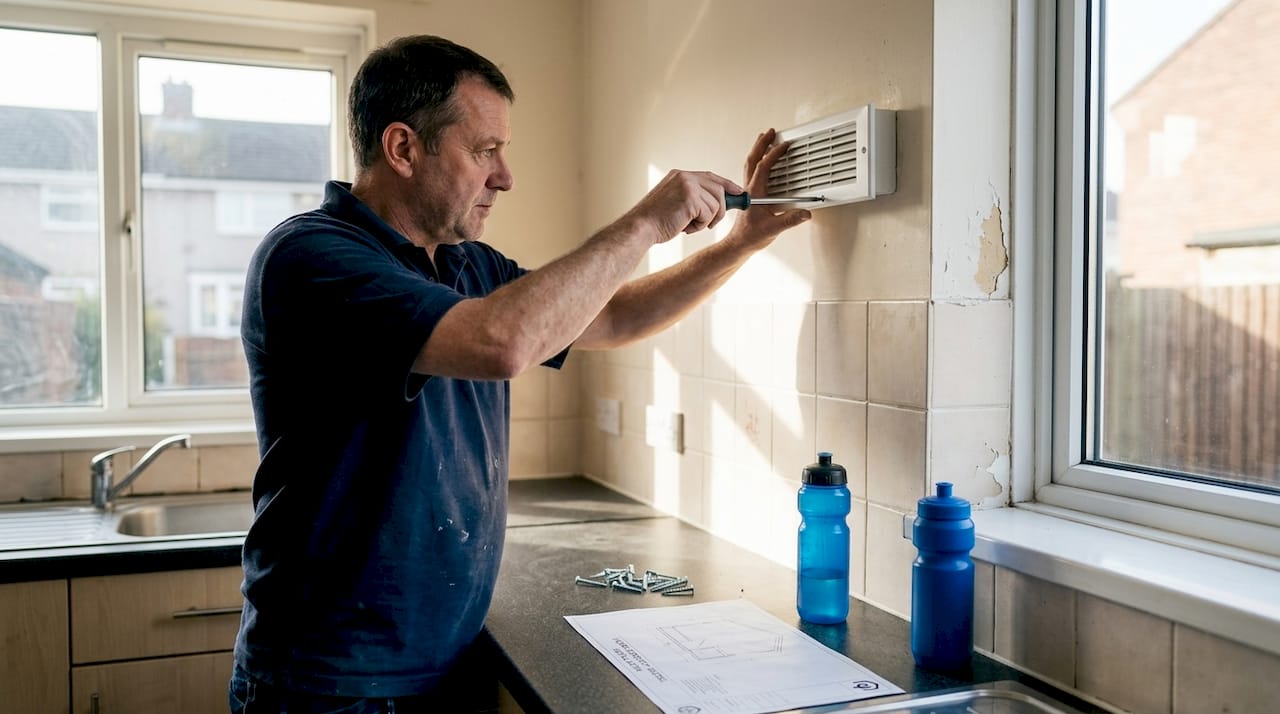
The role of air permeability in building performance is now well-established in UK energy modelling. SAP calculations, which currently underpin EPC ratings, include air permeability as an input variable. The upcoming Home Energy Model (HEM) is expected to treat this metric with even greater precision, making accurate, tested values more important than ever for compliance and property valuation.
UK standards and regulations: Meeting air permeability requirements
Air permeability is not simply a performance aspiration in the UK. It is a compliance metric embedded in building regulations. Approved Document L (ADL), which covers the conservation of fuel and power, sets mandatory requirements for new dwellings and major renovations.
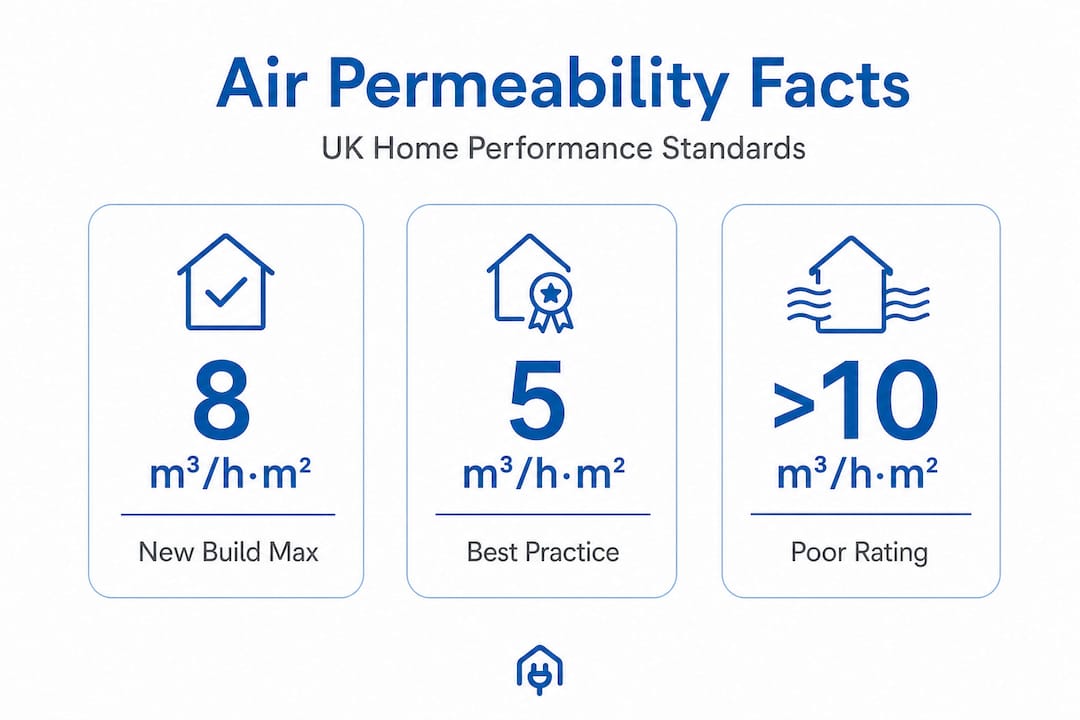
Under current Part L regulations, the maximum permissible air permeability for new residential buildings is 8 m³/h·m² at 50 Pa. However, the notional building used in compliance calculations is modelled at 5 m³/h·m² at 50 Pa, meaning that a developer targeting compliance at the minimum threshold will likely fall short of the efficiency standards assumed in the energy model. This creates a practical gap between regulatory minimums and genuine performance.
Comparison of air permeability levels under UK regulations:
| Standard or target | Air permeability (m³/h·m² at 50 Pa) | Context |
|---|---|---|
| Part L maximum (new dwellings) | 8.0 | Legal maximum for new builds |
| Part L notional building | 5.0 | Model used to calculate compliance target |
| Good practice target | 3.0 | Recommended for energy-efficient new builds |
| Future Homes Standard expectation | 1.5 to 3.0 | Anticipated requirement from 2025 onwards |
| Passivhaus standard | 0.6 or below | High-performance benchmark |
Property managers and owners need to take specific steps to ensure compliance and maximise performance:
- Commission an air permeability test from an accredited tester before completion of any new build or major refurbishment.
- Review the building’s known leakage paths, including service penetrations, party walls, loft hatches, and window frames, early in the construction or renovation process.
- Understand how air permeability feeds into EPC calculations and affects the property’s energy rating.
- Stay informed about the building envelope rules that govern landlord obligations, particularly as the Future Homes Standard raises the bar for new properties.
- Check whether any planned letting activity triggers compliance with MEES EPC regulations, which require a minimum EPC band E for rented properties, with band C on the horizon.
Aiming well below the regulatory maximum is a sound long-term investment. Properties with lower air permeability values command higher EPC ratings, attract energy-conscious tenants, and are better positioned as regulatory thresholds tighten in the years ahead.
Why many UK homes still miss air permeability goals — and how to do better
The most common mistake property owners make is treating air permeability as a problem to solve at the end of a project. Airtightness detailing gets left to the final stages of construction or renovation, by which point the opportunities to seal critical junctions within the building structure have already passed. This is where the gap between regulatory minimum and real-world performance originates.
Conventional wisdom tends to focus on visible gaps. Draught-proofing letterboxes, fitting chimney balloons, and sealing obvious cracks around windows are all worthwhile measures. But the most significant air leakage pathways in most UK homes are invisible during normal occupancy. They occur at the junction between the floor and external walls, around service penetrations through the airtight layer, at loft hatch perimeters, and along party walls in terraced and semi-detached properties. Addressing only what can be seen will not move the dial significantly on the test result.
Older properties present a particular challenge and a particular opportunity. A pre-1919 solid wall Victorian terrace might test at 20 m³/h·m² at 50 Pa or worse. Reducing that to 8 m³/h·m² through targeted fabric improvements delivers a proportionally larger energy saving than taking a new build from 5 to 3 m³/h·m². The efficiency gain for older stock can be dramatic, but it requires a tailored strategy rather than a generic approach. Understanding thermal bridging and energy loss alongside air permeability is essential in these cases, because the two issues often occur at the same junctions and require integrated solutions.
The lesson from properties that consistently achieve strong air permeability results is that success comes from treating the building as a system. Insulation, airtightness, ventilation, and thermal bridging all interact. Improving one without considering the others can produce unintended consequences, such as condensation in walls or poor indoor air quality. A whole-fabric approach, supported by proper testing and professional advice, is the only reliable route to lasting improvement.
Take the next step: Assess and improve your property’s air permeability
Understanding air permeability is the foundation for meaningful action. The next practical step is to obtain a professional assessment that quantifies where a property currently sits and what improvements would have the greatest impact on energy performance, comfort, and compliance.
Homeenergymodel.co.uk offers detailed resources to help property owners and managers take informed decisions. Explore home energy models for landlords to understand how air permeability feeds into broader energy assessments. A structured home energy assessment provides the full picture of a property’s performance, identifying the specific measures that will deliver the best return. For landlords and investors operating in London, guidance on EPC certificates explains how air permeability influences ratings and what that means for rental compliance. Taking these steps now positions any property ahead of tightening standards rather than scrambling to catch up.
Frequently asked questions
What is considered a good air permeability result for a UK home?
A result of 5 m³/h·m² or lower at 50 Pa is considered good performance for most new-build homes under UK standards, with high-performance properties targeting 3 m³/h·m² or below.
How does air permeability affect my energy bills?
Higher air permeability means more heat lost through leakage, which forces heating systems to work harder and results in higher gas or electricity bills throughout the year.
Do older UK properties always have higher air permeability?
Older homes do tend to have higher air permeability values than modern builds, but targeted fabric improvements such as draught-proofing, repointing, and junction sealing can significantly reduce leakage rates.
How is air permeability different to airtightness?
Air permeability is a specific, measurable metric expressed in m³/h·m² at 50 Pa, while airtightness is the broader term for how well a building resists unwanted airflow as a whole.
Is there a single test for air permeability?
Yes, the blower door test (also called the fan pressurisation test) is the standard, accredited method used across the UK to measure air permeability in residential and commercial buildings.