
An air conditioning energy assessment in England and Wales is a TM44 inspection: a legally required check, carried out by an accredited energy assessor, on every air conditioning system with an effective rated output of more than 12kW. It must be repeated at intervals of no more than five years, and the person who controls the system is responsible for arranging it. It is not an EPC, although the two are often confused. Our TM44 inspection service lets owners, landlords and managers request a quote for the inspection online.
TL;DR
- Systems with an effective rated output above 12kW need an inspection, including several smaller units under one person’s control that add up to more than 12kW.
- The inspection must be repeated at intervals not exceeding five years, and the first one is due within five years of a system being put into service.
- The “relevant person” who controls the system (usually the owner, sometimes the occupier or a facilities manager) must arrange it and keep the report.
- Failing to hold a valid report carries a £300 penalty, and the report itself sets out efficiency findings and cost-effective improvements.
- A TM44 inspection assesses the cooling system. An EPC rates the building. Many commercial properties need both.
Table of Contents
- What an air conditioning energy assessment is
- TM44 inspection or EPC: what is the difference?
- Which systems and buildings need an inspection
- Who is responsible for arranging it
- How often, and when the next one is due
- What the inspection covers
- Preparing for the inspection
- The penalty and what to do with the recommendations
- Our perspective
- Request your TM44 inspection
- FAQ
- Sources
What an air conditioning energy assessment is
The assessment exists because cooling systems quietly waste energy when they are oversized, badly controlled or poorly maintained. The UK’s requirement for regular inspection came from the EU Energy Performance of Buildings Directive, and it remains in force in England and Wales through the Energy Performance of Buildings Regulations 2012.
The working standard is CIBSE TM44, the technical guidance on air conditioning inspections published by the Chartered Institution of Building Services Engineers. CIBSE describes TM44 (2012) as the principal guidance for inspecting systems over 12kW. It concentrates on refrigerant-based cooling, with some guidance also applying to passive cooling such as cooled decks or aquifer systems.
In practice, the terms “air conditioning energy assessment”, “air conditioning inspection”, “ACEI” and “TM44 inspection” all describe the same thing.
TM44 inspection or EPC: what is the difference?
The two are separate documents with different subjects.
| TM44 air conditioning inspection | Energy Performance Certificate | |
|---|---|---|
| Subject | The air conditioning system | The building as a whole |
| Output | Inspection certificate and report with recommendations | A rating from A to G with recommendations |
| Trigger | System over 12kW in operation | Sale, letting or construction |
| Repeat | At intervals not exceeding five years | Valid for ten years |
A commercial building with a large cooling system can need both. If you are also dealing with the building rating, see our commercial EPC service. Homeowners with a single small split unit in a bedroom will usually fall below the threshold, so the rest of this guide is aimed mainly at offices, retail units, hotels, healthcare sites, server rooms and mixed-use buildings.
Which systems and buildings need an inspection
The test is the effective rated output of the system, not the size of the building. GOV.UK’s guide to air conditioning inspections (updated 5 November 2026) says every system with an effective rated output of more than 12kW needs inspection. It also confirms that:
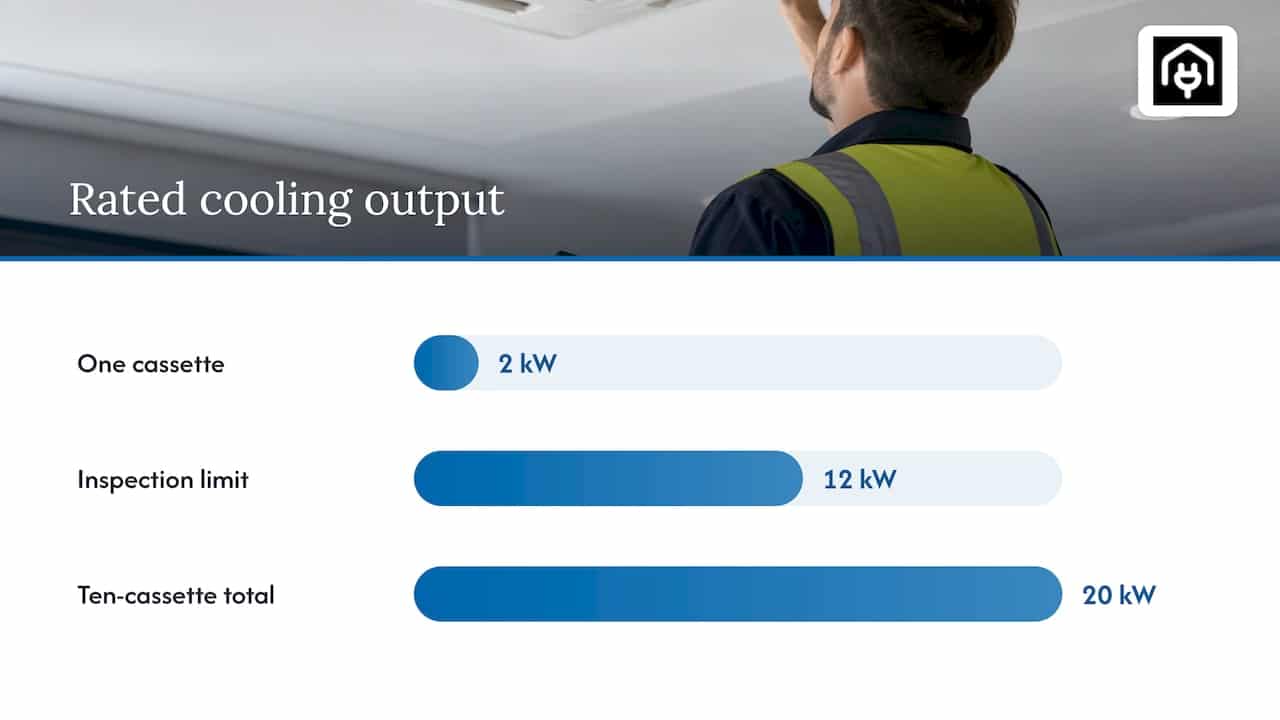
- Several smaller units under one person’s control are added together. Ten 2kW cassettes in one office floor count as a 20kW system.
- There is no exemption for cooling that is not for comfort, so process cooling is caught as well.
That covers the obvious comfort cooling in offices and shops. It also covers specialist equipment, such as computer room air conditioning units that keep server rooms within temperature limits, where the combined output regularly passes the 12kW line.
If you are unsure of your output, the nameplate data on outdoor and indoor units, or the maintenance records, give the rated cooling capacity in kW. An assessor can total the figures across a site.
Who is responsible for arranging it
The duty falls on the “relevant person”: whoever controls the operation of the system. According to GOV.UK this is usually the building owner. It can be the occupier where the lease puts full repairing responsibility on the tenant, or a facilities manager where the contract hands over control.
Three practical points follow:
- Landlords and occupiers keep a parallel duty. Contracting out the day-to-day work to a managing agent does not remove the responsibility.
- The report has to be kept. The relevant person must hold the most recent report and pass it on to whoever takes over control of the system.
- A change of operator starts a clock. If a new operator has not received a report, the system must be inspected within three months of them taking control, per the same GOV.UK guide.
For portfolios, the Better Buildings Partnership’s guidance notes that the asset manager is often the accountable body, while arranging inspections property by property usually sits with the property manager or a contracted facilities manager. Put the name of the responsible party in writing in the management agreement, and add the inspection date to the compliance calendar.
How often, and when the next one is due
Under regulation 18 of the Energy Performance of Buildings (England and Wales) Regulations 2012, inspections must happen at regular intervals not exceeding five years. The rules for the first inspection depend on when the system went in:
- Systems first put into service on or after 1 January 2008: the first inspection is due within five years of commissioning.
- Older systems over 250kW were due by 4 January 2009.
- Older systems over 12kW were due by 4 January 2011.
In all cases, the next inspection is counted from the previous report, so a diary entry set at the time of each inspection is the simplest safeguard. The date on the current report is the one to work from.
What the inspection covers
The assessor visits the site and carries out a visual assessment of the system, and examines the equipment and the controls. GOV.UK’s guidance lists the areas assessed as:
- refrigeration and heat exchange
- air moving systems
- controls
- documentation
- maintenance
The inspection applies to the accessible parts of the system, a limit introduced by the 2015 amendment to the regulations. Plant behind sealed ceilings or in locked rooms should therefore be made accessible on the day.
What the report contains
Regulation 19 sets out what the written report has to include. The report assesses the efficiency of the system and its size compared with the cooling requirement of the building. It gives advice on cost-effective improvements, replacement and alternative solutions. Since the 2020 amendment it must also consider how well the system can optimise its performance under typical operating conditions, according to the amended regulations.
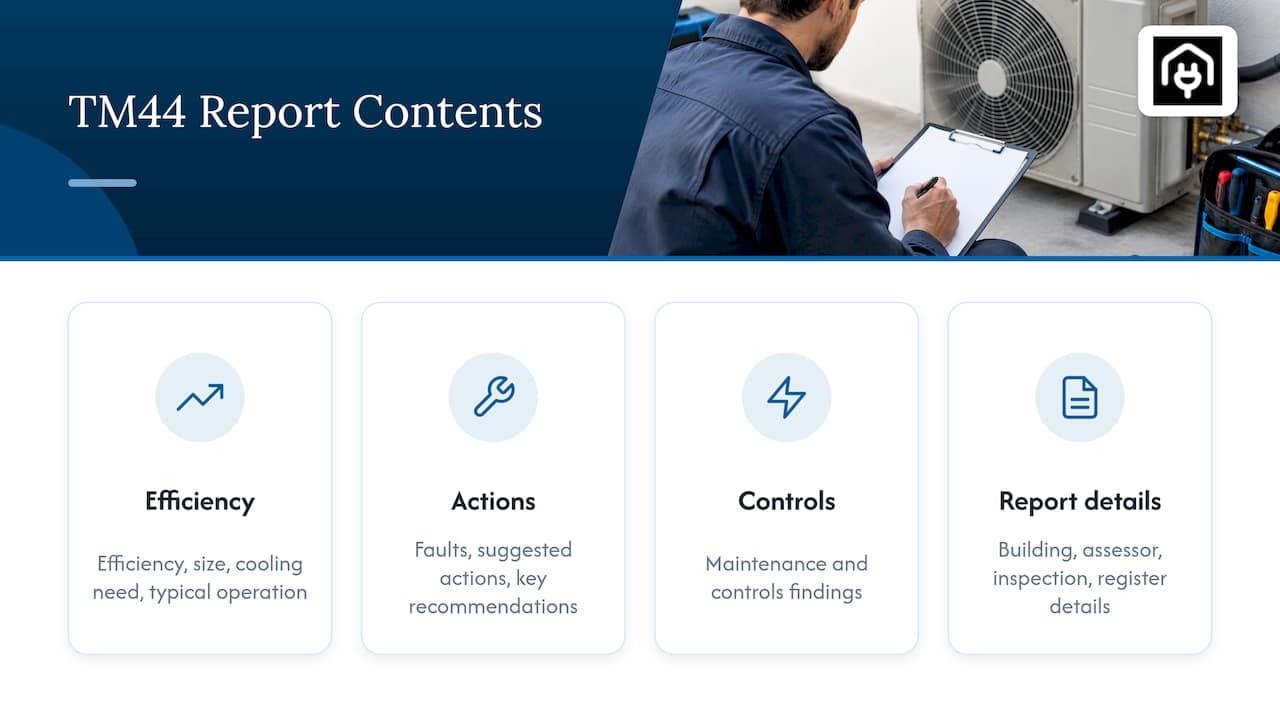
The GOV.UK guide adds the practical contents: likely efficiency, faults and suggested actions, maintenance and controls findings, key recommendations, and the building, assessor, inspection and register details. The assessor issues a certificate and the report, and GOV.UK’s inspection page notes that the fee is set by the assessor and varies.
Preparing for the inspection
The quality of the report depends heavily on what is available on the day. A short preparation list saves time and avoids a second visit:
- Gather the rated capacities. Nameplate details or commissioning documents for each indoor and outdoor unit.
- Collect maintenance records. Service sheets, refrigerant leak checks and filter cleaning logs. Documentation and maintenance are assessed items.
- Provide access. Plant rooms, roof areas and ceiling voids that the assessor needs to see, so the accessible parts of the system can all be examined.
- Note how the system is actually run. Set points, operating hours, any zoning or overrides. Since the 2020 change, the report looks at real operating conditions, so controls matter more than the original design intent.
- Pass on previous reports. An earlier report shows which recommendations were acted on.
Temperature set points and operating hours are often where the biggest savings sit. Overheating problems are a related issue: if your building gets too warm even with cooling in place, our guide to addressing overheating with TM52 standards explains the assessment method used for that.
The penalty and what to do with the recommendations
The penalty for failing to have an inspection report is fixed in the regulations. GOV.UK’s guide (updated 5 November 2026) gives it as £300. Because the duty runs from the date the inspection falls due, a missed date is a compliance failure whether or not the system is working well.
The larger cost is usually not the penalty but the energy the system uses. The report’s recommendations are there to help you decide what to do first. A sensible order is:
- Controls and set points. These are usually the lowest cost changes.
- Maintenance. Clean coils and filters, and sort out refrigerant leaks.
- Cooling load. Check whether heat gains from lighting, equipment or glazing can be reduced.
- Replacement. Where the report finds a system oversized or inefficient, plan replacement against the cost-effective advice it gives.
For new buildings and major refits, the cooling decisions are made earlier in the design. Our dynamic simulation modelling service looks at how a building behaves through the year, which informs how much cooling it needs in the first place.
Our perspective
Most of the TM44 questions we see in this field come down to one thing: people treat the inspection as a form to file rather than as a review of the system. The regulations say the report must consider efficiency, sizing against the cooling load, cost-effective improvements and how the plant is run in typical conditions. Read that way, the report is a short, structured list of where the money goes.
Our approach is to keep the compliance side simple. Know the 12kW threshold, know who the relevant person is, hold the current report and diarise the five-year date. Then use the findings. A landlord with several buildings gains most from a single schedule of due dates and one set of reports to compare.
We built homeenergymodel.co.uk around practical, regulation-focused guidance for both new construction and retrofits, and the quote request forms for TM44 inspections, commercial and domestic EPCs and Home Energy Model reports follow from that. One request is the starting point for your assessment.
Danny
Request your TM44 inspection
If you have a system above 12kW, a change of tenant or operator, or a report that is approaching its five-year date, our TM44 inspections page is the place to start. You send the details of the building and its cooling equipment through the online form and ask for a quote for the inspection.

If the building also needs an energy rating, you can ask for a commercial EPC in the same enquiry, so that both documents are in place together.
FAQ
Does a small split air conditioning unit need a TM44 inspection?
Only if the effective rated output of the system is above 12kW. A single small unit will normally fall below it. However, several units under one person’s control are added together, so a floor or building with many small units may cross the threshold.
Is a TM44 inspection the same as an EPC?
No. A TM44 inspection is a report on an air conditioning system, repeated at intervals of up to five years. An EPC rates the energy performance of a building and is needed when it is built, sold or let. A commercial building can need both.
Who pays for the inspection, the landlord or the tenant?
The legal duty sits with the relevant person who controls the operation of the system. That is usually the owner, but it can be the occupier under a full repairing lease or a facilities manager where the contract gives them control. Who bears the cost between the parties depends on the lease or contract terms, so check these before booking.
What happens if a new tenant takes over the system?
The report should be passed to whoever takes control. If the new operator has not received one, GOV.UK says the system must be inspected within three months of the change of control.
Sources
- Air conditioning inspections for buildings: a guide (GOV.UK)
- Get your air conditioning system inspected (GOV.UK)
- The Energy Performance of Buildings (England and Wales) Regulations 2012, Part 4 (legislation.gov.uk)
- TM44: Inspection of Air Conditioning Systems (CIBSE)
- GN 4.3: Air conditioning inspections (Better Buildings Partnership)