
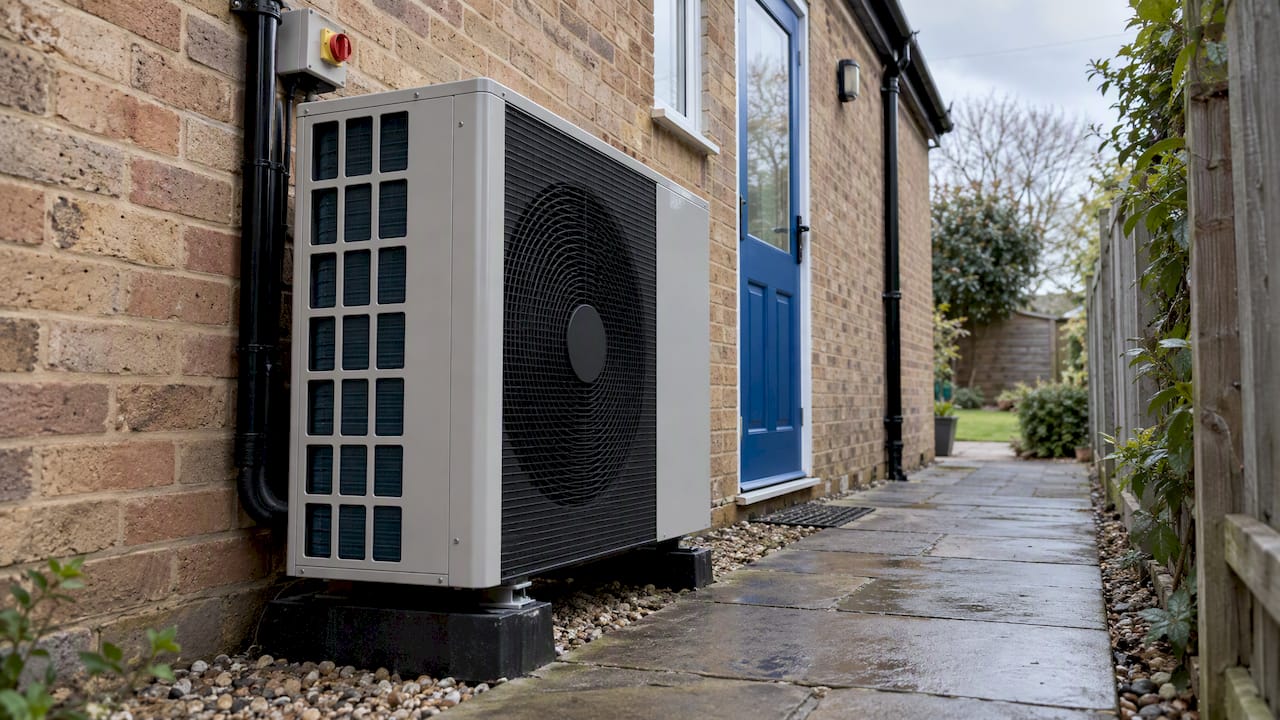
The main advantages of heat pumps are efficiency, lower carbon emissions, protection from fossil fuel price spikes, and one system that can heat a home, supply hot water and, in some models, cool it. A heat pump moves heat rather than burning fuel, so it delivers several units of heat for each unit of electricity. The gains are real, but they depend on the property, the design of the system and the price of electricity. This guide sets out each advantage, the conditions that decide whether it applies, and how a heat pump fits with EPC ratings and UK building standards.
TL;DR
- A heat pump typically delivers around four units of heat per unit of electricity, so it is three to five times more efficient than a gas boiler.
- Switching from fossil fuel heating cuts greenhouse gas emissions, and the benefit grows as the electricity grid decarbonises.
- In England and Wales, the Boiler Upgrade Scheme offers grants of up to £7,500 towards an air source or ground source heat pump.
- Savings depend on insulation, system design and the electricity-to-gas price ratio. Fabric improvements usually come first.
- An EPC assessment shows how a property currently performs and where a heat pump would fit in an upgrade plan.
Table of Contents
- How a heat pump delivers more heat than the electricity it uses
- Advantage 1: High efficiency compared with boilers
- Advantage 2: Lower running costs, with conditions
- Advantage 3: Protection from fossil fuel price spikes
- Advantage 4: Lower greenhouse gas emissions
- Advantage 5: Heating, cooling and hot water from one system
- Advantage 6: Steady, low-temperature comfort
- Advantage 7: Government grant support
- Advantage 8: Low maintenance
- How cold weather affects the advantages
- Do heat pumps improve an EPC rating?
- Heat pumps compared with other heating types
- Is a heat pump right for your property?
- Perspective: what we see on UK properties
- Get an assessment before you specify
- FAQ
- Sources
How a heat pump delivers more heat than the electricity it uses
A heat pump uses a refrigerant cycle to transfer heat from outdoors into the home in winter. Because it moves existing heat instead of generating it, it needs far less energy than a conventional electric or gas system to do the same job.
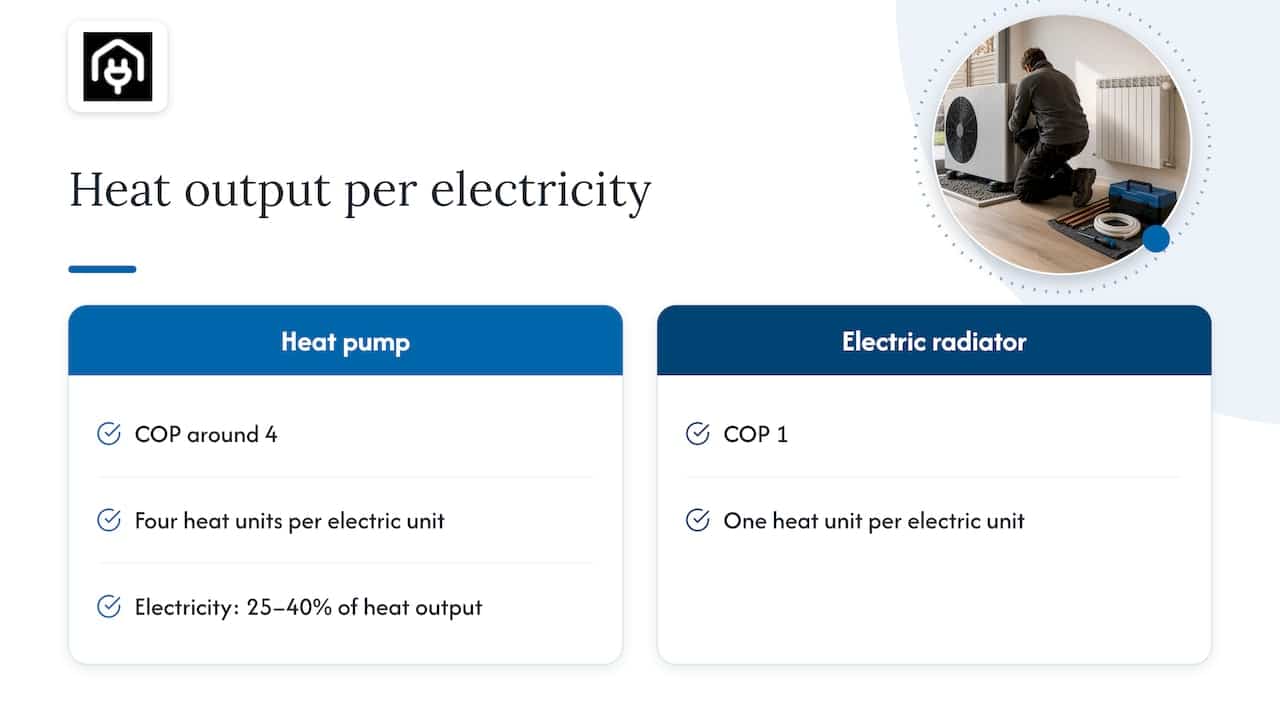
The measure used is the coefficient of performance (COP). The International Energy Agency notes that a typical household heat pump has a COP of around four, meaning the heat output is four times the electrical energy used. An electric radiator, by comparison, returns one unit of heat for one unit of electricity.
Air, ground and water source systems all draw on naturally occurring heat. Ireland’s sustainable energy authority states that they typically use electricity equal to 25% to 40% of the heat output. That figure is the root of nearly every other advantage below.
The same guide stresses that careful design, installation and operation are what secure efficiency and reliability. A well-chosen heat pump, correctly sized, is a different proposition from a poorly specified one.
Advantage 1: High efficiency compared with boilers
The IEA reports that heat pumps now on the market are three to five times more energy efficient than natural gas boilers. This is the main technical argument for them.
For UK homes with poor insulation the picture is still strong. IEA analysis finds that, in the United Kingdom, replacing a 92% efficient gas boiler with a high-efficiency heat pump gives 60 to 70% energy savings in a solid-walled house with no insulation. That is energy saved, not necessarily money saved, which brings the discussion to cost.
Advantage 2: Lower running costs, with conditions
Heat pumps can lower energy spending. The IEA estimates average annual savings from USD 300 in the United States to USD 900 in Europe. Those are averages across regions and fuels, not a UK promise.
The size of the saving in a given home depends on three things.
- The fuel being replaced. Savings are generally largest against oil, LPG and direct electric heating, and smaller against mains gas, which is cheap per unit in Great Britain.
- The electricity-to-gas price ratio. The European Commission’s Joint Research Centre notes that the economics depend on local climate, system design and the electricity-to-fuel tariff ratio. A higher ratio reduces the advantage of a heat pump.
- The heat demand of the building. The IEA finds that improving a home’s efficiency rating by two grades can halve heating demand, which directly shrinks the bill whatever the heating system.
For a practical look at every lever on a household bill, including tariffs, controls and insulation, see the guide to reducing home energy bills in UK homes.
A worked comparison of the logic
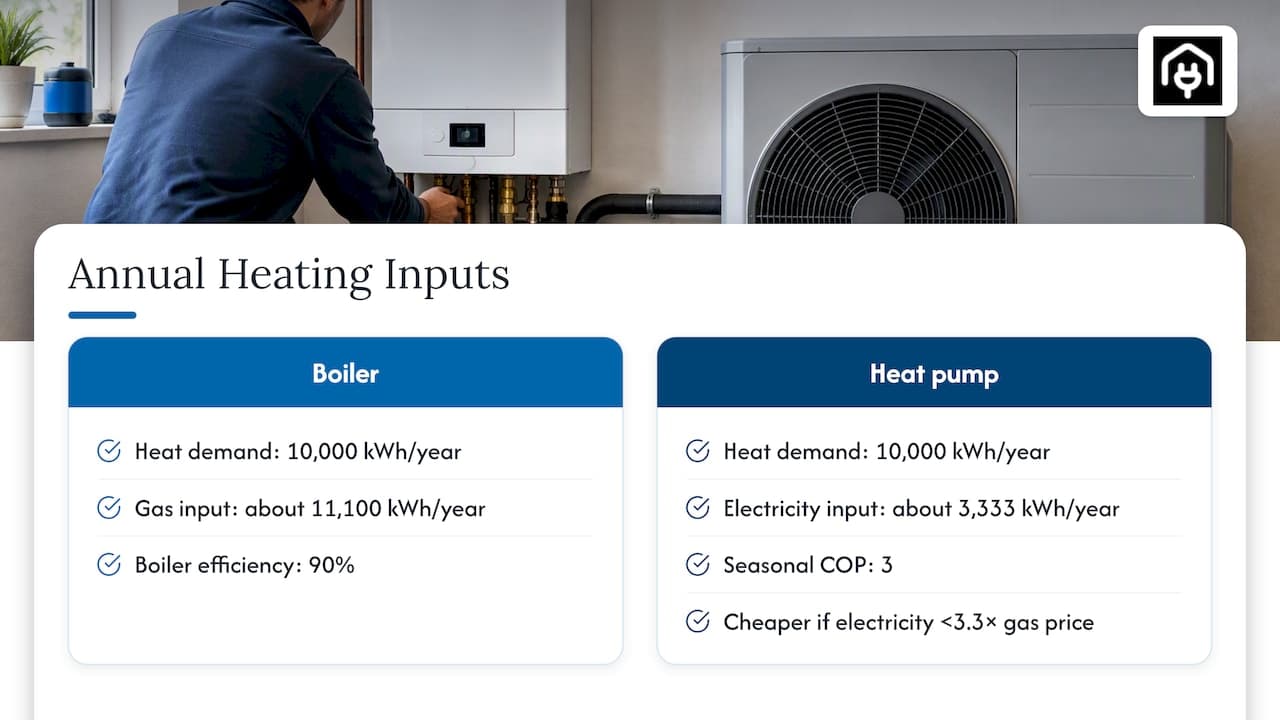
Take a home needing 10,000 kWh of heat a year. A boiler that is 90% efficient burns about 11,100 kWh of gas. A heat pump with an average seasonal COP of 3 uses about 3,333 kWh of electricity. Whether the heat pump is cheaper then depends on whether a unit of electricity costs less than about 3.3 times a unit of gas. Current unit rates change with the Ofgem price cap each quarter, so check the latest figures before running the sum for a specific property. The calculation is illustrative, not a forecast.
Advantage 3: Protection from fossil fuel price spikes
The IEA notes that installing a heat pump can reduce a household’s exposure to fossil fuel price spikes. A home that uses less delivered energy for the same warmth is less sensitive to swings in wholesale gas, oil or LPG markets. Homes off the gas grid that rely on oil or LPG tend to see this benefit most clearly, because they buy fuel at market prices and often in bulk.
This does not remove price risk altogether. Electricity prices in Great Britain are still influenced by gas prices, so the protection is partial. Time-of-use tariffs and a well-controlled system can improve the position further.
Advantage 4: Lower greenhouse gas emissions
Heat pumps reduce emissions by shifting heating demand to electricity, which can be generated from low-carbon sources. The IEA finds that even with an emissions-intensive electricity mix, switching from a fossil fuel boiler cuts emissions by at least 20%, and by up to 80% where electricity is cleaner.
The benefit increases over time. As more wind, solar and nuclear power feeds the grid, the same heat pump becomes cleaner without any change at the property. A gas boiler cannot do this. For owners planning a decade or more ahead, that is a strong argument.
For new-build and major refurbishment projects, this matters for compliance as well. Heat pumps are central to the pathway for meeting UK home standards, including the Future Homes Standard direction of travel.
Advantage 5: Heating, cooling and hot water from one system
Heat pumps are fully reversible, so they can provide year-round climate control by heating in winter and cooling in summer. Air-to-air units are the most common cooling-capable type. Most UK air-to-water systems are installed for heating and hot water, with cooling an optional feature on certain models, so confirm this with the installer if summer comfort matters.
This is increasingly relevant as summers get hotter. Overheating is a design issue in well-insulated homes, and it is assessed separately in standards such as TM59 for residential buildings.
If a property has air conditioning of any kind above the size threshold, a legal inspection regime may apply. Details are in the guide to TM44 inspections for air conditioning systems.
Advantage 6: Steady, low-temperature comfort
A heat pump runs best delivering heat at a lower flow temperature for long periods. Rooms stay at a steady temperature without the on-off cycling typical of a boiler. Radiators feel warm rather than hot. For many households this is the most noticeable day-to-day change.
The flip side is that the system needs a home that holds heat. If a house feels cold with a heat pump, the usual causes are radiators too small for the lower flow temperature, a system sized without a proper heat-loss calculation, poor controls or a leaky building fabric. These are design faults rather than limits of the technology, which is why specification matters.
Advantage 7: Government grant support
In England and Wales the Boiler Upgrade Scheme provides upfront grants of up to £7,500 off the cost and installation of an air source or ground source heat pump. The scheme covers homes and small and medium non-domestic buildings, and the official listing shows it running to the end of 2029. Grant levels and eligibility rules can change, so check the official page before committing. Scotland and Northern Ireland have separate support arrangements.
The grant is paid to the installer and deducted from the customer’s bill, which reduces the upfront cost barrier. Upfront cost remains the main disadvantage of heat pumps, so the grant is a central part of the financial case.
Advantage 8: Low maintenance
Heat pumps need little upkeep. The US Environmental Protection Agency advises checking or changing filters as needed and booking an annual service by a professional technician. UK installers generally recommend a yearly service to keep the warranty valid and the efficiency high. There is no flue to inspect and no combustion, which also removes the carbon monoxide risk linked to gas appliances.
How cold weather affects the advantages
Heat pumps do work in cold UK winters, but efficiency falls as the outdoor temperature drops. A 2024 study of air-to-air heat pumps in Toulouse found that they reduce heating energy consumption, while efficiency decreases as external temperatures fall. The seasonal figure, not the best-case COP, is what sets the annual running cost.
Three design choices protect against this:
- A heat loss calculation for each room, so the unit is sized correctly.
- Emitters (radiators or underfloor loops) chosen for low flow temperatures.
- Controls set up for weather compensation, which holds the flow temperature as low as the weather allows.
Do heat pumps improve an EPC rating?
Often, but not automatically. An EPC is calculated from a model of the building fabric, the heating system and fuel costs. A poor fabric limits the score whatever heating is fitted, and because electricity costs more per unit than gas, a cost-based rating may not give a heat pump full credit for its efficiency. For this reason, insulation and draught-proofing frequently deliver a larger EPC gain per pound than a heat pump.
The better approach is to look at the property as a whole. The EPC rating guide explains how bands are set and what each recommendation does, and the overview of EPCs for UK property owners covers validity and when a certificate is needed. Methodologies are also changing, with the Home Energy Model due to replace SAP for new homes, so the way heat pumps are credited is likely to evolve.
Landlords have a particular interest, because minimum energy efficiency rules affect lettable properties. The guide to heat pumps for UK landlords sets out the options.
Heat pumps compared with other heating types
| Factor | Heat pump | Gas boiler | Direct electric heating |
|---|---|---|---|
| Delivered heat per unit of energy | Around 3 to 5 units | Below 1 unit (about 0.9) | 1 unit |
| On-site emissions | None | Yes | None |
| Benefit from a cleaner grid | Yes | No | Yes |
| Cooling option | Some models | No | No |
| Upfront cost | Highest, grant available in England and Wales | Lower | Lowest |
| Best suited to | Insulated homes, off-gas homes | Homes on mains gas with low budgets | Very small or little-used spaces |
For wider context on how each system performs, the guide to the most efficient way to heat a house and the overview of home heating systems and energy efficiency compare the main options. For the air source type specifically, see air source heating and UK home efficiency.
Is a heat pump right for your property?
A heat pump is most likely to pay off when most of these apply:
- The home is currently heated by oil, LPG or direct electricity.
- Loft, wall and floor insulation are in place or planned.
- There is outdoor space for an air source unit, or land for ground loops.
- The hot water cylinder and emitters can be upgraded where needed.
- The owner plans to stay long enough to recover the upfront cost.
If several of these are missing, fabric measures and controls usually give better value first. An energy assessment lays out the order of work and avoids buying a unit that is too large or too small.
Perspective: what we see on UK properties
We look at heat pumps through the numbers that assessments produce. The strongest cases we see combine a fabric that has already been improved with a system sized from a real heat loss calculation. The weakest are installations chosen before anyone measured the property.
For new homes and major renovations, we expect heat pumps to become the default, as regulations move towards low-carbon heating. For existing homes, we advise treating the heat pump as one step in a sequence: assess, insulate, then specify the system. Owners who start with an EPC and a clear list of recommendations tend to make cheaper, better-ordered decisions than those who start with a quote for equipment.
We also encourage landlords and developers to record the evidence. Design assumptions, commissioning data and updated certificates make later compliance checks simpler.
— Danny
Get an assessment before you specify
An up-to-date certificate shows where heat is lost and what upgrades would change the rating. Request a quote for a domestic EPC, or for new builds and conversions, a SAP calculation. Commercial owners can use the commercial EPC service. Quotes are free to request through the site and are supplied by qualified assessors.
FAQ
What is the biggest advantage of a heat pump?
Efficiency. A typical household heat pump produces about four units of heat for each unit of electricity, which is why it uses far less energy than a boiler. Lower emissions and reduced exposure to fuel price swings follow from that.
Will a heat pump definitely cut my bills?
Not in every case. Savings are most likely when replacing oil, LPG or direct electric heating, and when the home is well insulated. Against mains gas the result depends on the electricity-to-gas price ratio and on how well the system is designed.
Do heat pumps work in cold UK winters?
Yes, but efficiency drops as outdoor temperatures fall. Correct sizing, low-temperature emitters and weather-compensating controls keep the system performing through winter.
Can I get a grant for a heat pump?
In England and Wales, the Boiler Upgrade Scheme offers up to £7,500 towards an air source or ground source heat pump for eligible properties. Check the official government page for current rules, and look at the separate schemes available in Scotland and Northern Ireland.
Will a heat pump raise my EPC rating?
It can, but the fabric of the building has a strong influence on the score. Insulation often adds more to the rating than the heating change alone, so an assessment of the whole property is the best starting point.
Sources
- IEA, The Future of Heat Pumps: Executive Summary
- IEA, How a heat pump works
- IEA, Does a heat pump work in a house with poor insulation?
- ENERGY STAR, How does a heat pump work?
- SEAI, Heat Pumps Technology Guide
- European Commission JRC, factors affecting heat pump economics
- Natural Resources Canada, Heating and cooling with a heat pump
- PMC, Energy and environmental impacts of air-to-air heat pumps
- US EPA, Heat Pumps
- GOV.UK, Boiler Upgrade Scheme