

The U-factor, or U-value, measures how quickly heat passes through a window, expressed in watts per square metre per degree Kelvin (W/m²K). The lower the number, the better the window insulates. For UK compliance and EPC evidence, we always ask suppliers for the whole-window Uw rather than a centre-pane figure, since this is what Approved Document L expects to see.
TL;DR:
- Whole-window U-values are industry standard for UK compliance, while centre-pane figures can be misleading if not accompanied by component data.
- Calculated Uw considers glass, frame, and edge effects, and must be verified through proper testing or standard-sized calculations.
- Upgrading from single to triple glazing, using low-E coatings and warm-edge spacers, can significantly reduce Uw, but installation quality remains critical.
- A U-value of 0.24 for windows is extremely low and likely inaccurate unless it’s a typo—confirm whether it’s for Uw or Ug and request supporting documentation.
- Buyers should demand certified, documented U-values, including component values and test reports, to ensure compliance and realistic performance in practice.
Table of Contents
- Centre-pane versus whole-window U-values: what the numbers mean
- How U-values are measured and calculated
- What counts as a good U-factor in UK homes
- What changes the U-factor and where the real gains sit
- Turning U-factor into a buying checklist
- U-factor alongside solar gain and daylight ratings
- How U-values feed into EPCs, SAP and the Home Energy Model
- Why the U-factor conversation misses the point for most buyers
- Verifying your windows: how we support compliance
- FAQ
- Sources
Centre-pane versus whole-window U-values: what the numbers mean
A U-value describes the rate of heat transfer through a material. Thermal transmittance, measured in W/m²K, tells you how many watts of heat escape through each square metre of window for every degree Kelvin of temperature difference between inside and outside. A window with a U-value of 1.0 loses heat twice as fast as one rated at 0.5, so a lower figure always means better insulation and lower heat loss.
Three distinct values sit inside that single number. Ug is the centre-pane value, measuring only the glass in the middle of the unit, away from the frame and edge seals. Uf is the frame value, which varies enormously between timber, aluminium, PVC-U and composite designs. Uw is the whole-window value, combining Ug, Uf and the linear thermal transmittance at the glass edge (ψg) across the full window area.
Manufacturers often quote the centre-pane Ug because it tends to be the most flattering figure, since it ignores frame losses and edge effects entirely. Industry guidance from the British Woodworking Federation is clear that whole-window U-values are what compliance and performance claims should rest on, and that centre-pane figures are acceptable only in narrow conservation circumstances. Buyers who compare products using Ug alone risk choosing a window that performs worse once fitted than the headline number suggests.
How U-values are measured and calculated
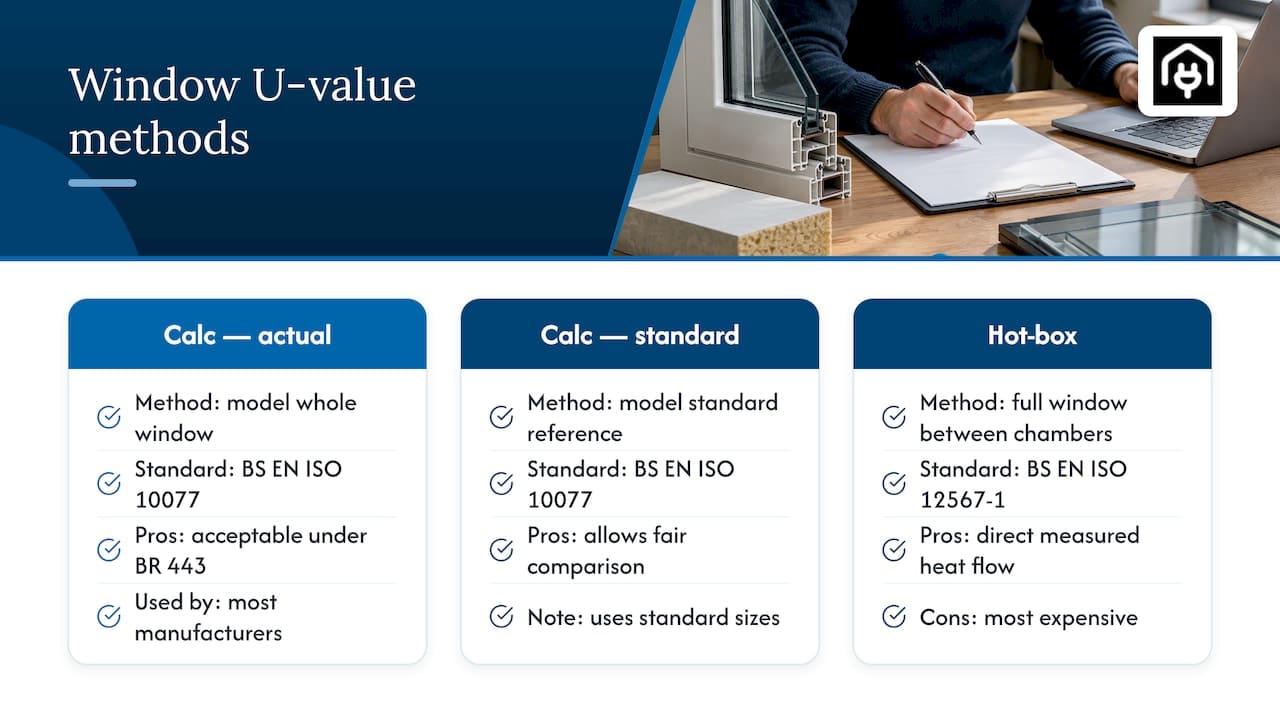
Two broad approaches produce a U-value: physical testing and calculation. Hot-box testing, carried out to BS EN ISO 12567-1, places a complete window between two controlled chambers and measures the actual heat flow through it under steady-state conditions. It is the most direct method but is also the most expensive, so most manufacturers rely on calculation instead.
Calculated U-values follow BS EN ISO 10077, which models the glazing, frame and spacer performance separately and combines them mathematically. The BRE’s BR 443 conventions set out which approach is acceptable for UK compliance: a calculation for the actual window size, a calculation based on a standard reference window size, or a measured hot-box result. Standard sizes exist so that products of different proportions can be compared fairly, since a small window with a thick frame performs differently to a large one with the same frame section.
The underlying formula for Uw is an area-weighted sum: the glazed area multiplied by Ug, plus the frame area multiplied by Uf, plus the glazing perimeter multiplied by the linear thermal transmittance ψg, all divided by the total window area. Technical data sheets from the Glass and Glazing Federation set out this calculation in detail, including simplified methods and the simulation approaches used to derive Uf and ψ values for certified data.
One practical note worth flagging: U-value testing conventions distinguish between vertical and horizontal installation planes, since heat flow behaves differently in a rooflight than in a standard vertical window. Always check that the figure quoted matches the orientation the product will actually be installed in, not a generic vertical default.
What counts as a good U-factor in UK homes
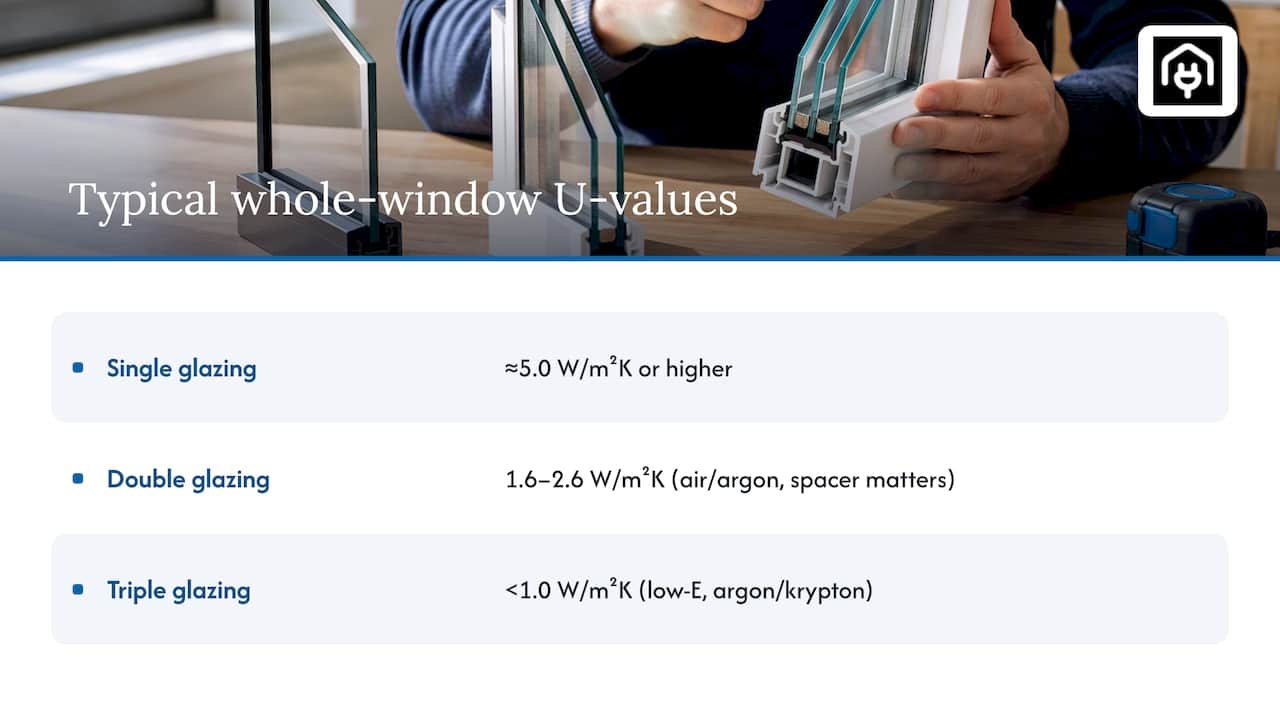
Context matters more than a single number. Older single glazing typically sits around 5.0 W/m²K or higher, standard double glazing with an air-filled cavity often falls between 2.6 and 1.6 W/m²K depending on gas fill and spacer type, and triple glazing with low-E coatings and argon or krypton fill can reach below 1.0 W/m²K at the whole-window level. These are broad bands rather than fixed figures, since cavity width, coating quality and frame design all shift the result.
Asking whether 0.24 is a good U-factor only makes sense with units attached. A centre-pane Ug of around 1.0 W/m²K is strong for double glazing, while a value as low as 0.24 would be unusually good even for high-performance triple glazing and is more typical of an insulated wall element than a glazed unit. If a supplier quotes a figure that low for a window, check carefully whether it is a whole-window Uw, a centre-pane Ug, or a typo, and ask for the supporting calculation.
Approved Document L sets limiting U-values for windows in dwellings and states that whole-window figures should normally be used for compliance checking, with example maximum values listed in its tables alongside routes for calculation or testing. Window Energy Rating bands, maintained by the window industry, give a further A to G style rating that factors in more than U-value alone, which we cover below.
What changes the U-factor and where the real gains sit
Buyers often assume glass alone decides performance, but several components interact to set the final Uw.
- Number of panes and coatings: moving from single to double to triple glazing, combined with low-emissivity coatings, lowers Ug directly.
- Gas fill: argon-filled cavities outperform air, and krypton goes further still, particularly in narrower cavity widths common in retrofit and heritage glazing.
- Spacer bar type: warm-edge spacers made from composite or stainless steel reduce edge heat loss (ψg) compared with traditional aluminium spacers, which conduct heat readily at the glass perimeter.
- Frame material and proportion: timber, PVC-U, aluminium with thermal breaks and composite frames each carry different Uf values, and the proportion of frame to glass in a given window changes how much that frame value drags down the overall Uw.
- Installation quality: seals, air leakage and fitting accuracy determine whether the installed performance matches the laboratory or calculated figure at all.
A window with excellent centre-pane glass can still underperform if the frame is poorly insulated or the spacer bar is a cheap aluminium type, since frame proportion and edge losses often decide whether a product meets a target Uw. Small specification changes, such as switching to a warm-edge spacer or argon fill, can improve whole-window performance meaningfully without altering how the window looks.
Turning U-factor into a buying checklist
Specifying windows on U-value alone is not enough without the paperwork to back the claim. We recommend treating every quote as incomplete until it includes the following.
- Ask for the Uw (whole-window), not just Ug, and ask whether it was tested or calculated.
- Request the component values: Ug, Uf and ψg, plus the Window Energy Rating band if available.
- Insist on a Declaration of Performance (DoP) and any factory test certificates referencing BS EN ISO or BR 443 methods.
- Check the calculation notes state which standard window size or actual size was used.
- For listed or conservation properties unable to meet limiting U-values, discuss secondary glazing or a bespoke professional calculation with Building Control before ordering.
Pro Tip: Keep factory-applied labels on the glass until after your Building Control inspection, and get any verbal claims from a supplier confirmed in writing, since both become useful evidence if a certificate or inspection is later queried.
For a fuller walk-through of these questions, our guide on verifying window U-values sets out exactly what to ask and when.
U-factor alongside solar gain and daylight ratings
U-value only tells part of the story. Solar Heat Gain Coefficient (SHGC), sometimes called G-value, measures how much solar energy passes through the glass, which matters for rooms that gain unwanted heat in summer or benefit from passive solar warmth in winter. A low U-value window with a high G-value can overheat a south-facing room even as it cuts winter heat loss.
Visible transmittance measures how much daylight passes through, which affects comfort and the need for artificial lighting. Window Energy Rating (WER) brings U-value, G-value and air leakage together into a single band, giving a fuller picture than U-value alone, as BWF guidance explains.
As a rule of thumb, prioritise low U-values and higher solar gain on north-facing elevations where heat loss dominates, and balance low U-values with controlled solar gain on south-facing rooms to avoid summer overheating. Our guide to energy efficient window types covers how to match glazing specification to orientation and room use.
How U-values feed into EPCs, SAP and the Home Energy Model
Window Uw and Ug values are direct inputs into SAP calculations and the forthcoming Home Energy Model methodology, both of which feed the energy rating shown on an Energy Performance Certificate. An assessor who cannot verify the glazing specification will default to a conservative, often worse, assumption, which can pull a property’s rating down unfairly. Government guidance on EPCs confirms that energy-saving measures and accurate evidence matter directly to the certificate a property receives.
In practice, this means keeping factory labels in place, retaining supplier DoPs and test or calculation reports, and having that evidence ready for the assessor or Building Control at the point of inspection. Services such as domestic and commercial EPCs, SAP and energy model calculations, SBEM assessments and dynamic simulation modelling depend on accurate window data to produce a defensible result rather than a conservative estimate.
Why the U-factor conversation misses the point for most buyers
Most advice on U-values stops at “lower is better” and leaves buyers comparing centre-pane figures that do not reflect what gets fitted to the house. That is the single biggest gap we see: a strong Ug sold alongside a weak frame or a cheap spacer bar, with no whole-window figure offered unless asked for directly.
The judgement we would draw from the regulatory detail is that documentation matters as much as the number itself. A Uw of 1.4 W/m²K backed by a BR 443 calculation and a Declaration of Performance is worth more at Building Control and EPC stage than a lower figure with no paper trail behind it. Homeowners should prioritise getting that evidence in writing before placing an order, not after a query arises.
Conventional buying guides also underweight installation. A well-specified window fitted with poor seals or inaccurate reveals will not deliver its calculated Uw in practice, and no amount of glazing specification fixes that afterwards.
— Danny
Verifying your windows: how we support compliance
Choosing a window with the right U-value is only half the job. Proving it to Building Control, an EPC assessor or a planning officer is where many homeowners and developers get stuck, and that is the gap our services are built to close.
- Domestic EPC assessments that use your actual glazing specification rather than default assumptions.
- Commercial EPC certificates for non-domestic buildings and mixed-use developments.
- SAP and Home Energy Model calculations for new dwellings and extensions where U-values feed directly into the compliance model.
- SBEM calculations and dynamic simulation modelling for commercial projects.
- Energy statements for planning where glazing specification needs to be justified to a local authority.
If you need an accurate calculation, a certificate, or help assembling the evidence a supplier’s U-value claim needs, request a quote for a domestic EPC and we will take it from there.
FAQ
Is SHGC the same as U-factor?
No, they measure different things. U-factor measures how much heat conducts through the window due to a temperature difference, while SHGC (Solar Heat Gain Coefficient) measures how much solar radiation passes through the glass, so a window needs both figures assessed together for a full picture.
What is a good energy rating for windows?
Window Energy Ratings run on an A to G style band that combines U-value, solar gain and air leakage into one score, with higher bands indicating better overall performance, as described in BWF guidance. A higher band is generally preferable, though the right choice also depends on the room’s orientation and purpose.
What is the typical U-factor for double glazing windows?
Standard double glazing with an air-filled cavity typically sits in the range of roughly 1.6 to 2.6 W/m²K at the whole-window level, depending on cavity width, gas fill and spacer type. Argon-filled units with low-E coatings and warm-edge spacers tend to sit at the lower, better-performing end of that range.
Is .24 a good U-factor for windows?
A U-value of 0.24 W/m²K would be unusually low for a window and is more typical of an insulated wall or roof element rather than glazing. If a supplier quotes this figure for a window, confirm whether it refers to a whole-window Uw, a centre-pane Ug, or has been transcribed incorrectly, and ask for the supporting calculation referencing BR 443 or BS EN ISO methods.
Sources
- Approved Document L: Conservation of fuel and power, Volume 1: Dwellings
- British Woodworking Federation — Product energy performance toolkit
- GGF: Window and Door System U-values: Provision of Certified Data (Data Sheet 2.2)
- Gov