
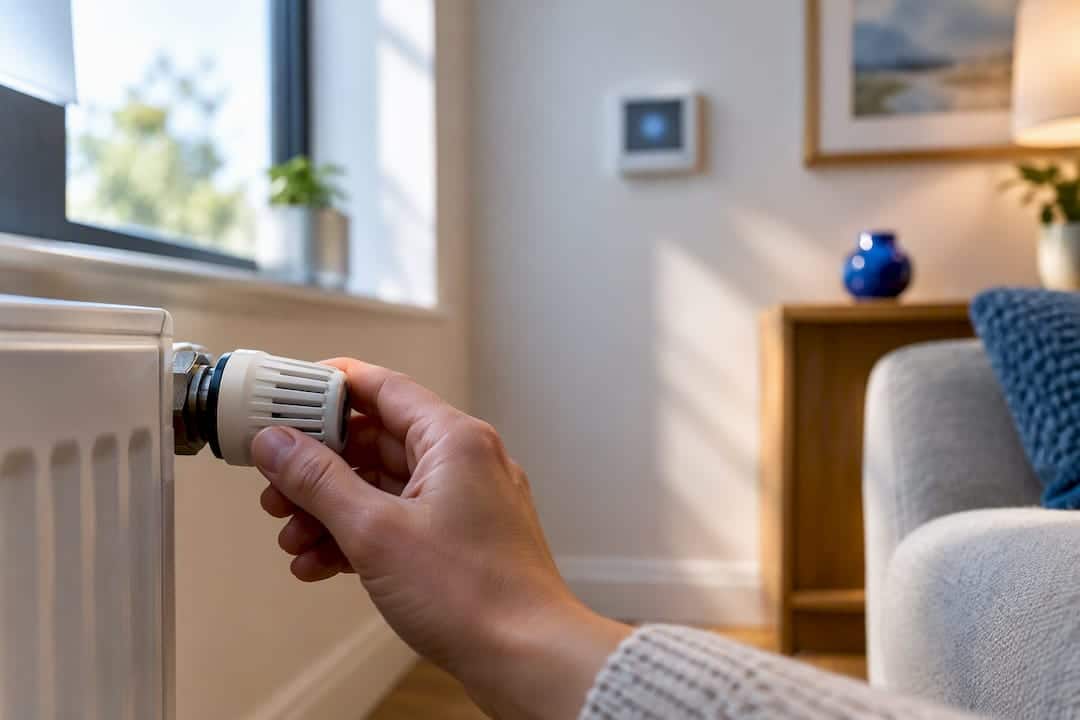
A thermostatic radiator valve (TRV) senses the air in a room and automatically throttles the radiator’s hot-water flow so the room holds the temperature you set. It controls a single radiator rather than the whole heating system. It works alongside, not instead of, the central room thermostat that switches the boiler on and off.
TL;DR:
- TRVs only control individual radiators and cannot signal the boiler to turn off once the desired room temperature is reached.
- Installing TRVs on a radiator in the same room as the central thermostat can cause inaccurate temperature readings and ineffective heating control.
- Mid-range settings on TRVs (around 3 to 4) generally maintain comfortable indoor temperatures close to 20°C without speeding up heating.
- Proper siting of TRVs requires clear space around the valve and avoiding covers that trap heat, which can cause the valve to malfunction.
- Combining TRVs with a programmer and central thermostat can save around £30 to £110 annually on energy bills.
Table of Contents
- What a TRV is and its role in a wet heating system
- How TRVs work: liquid, wax, gas and electronic mechanisms
- TRVs and the room thermostat: who truly controls the boiler?
- What the TRV numbers mean and how to pick a setting
- Siting TRVs correctly and the mistakes that stop them working
- Smart TRVs and why heat pumps need a different approach
- Maintenance and quick troubleshooting for homeowners
- Savings and the building-regulation context for UK homeowners
- An adviser’s view on getting TRVs right
- How Home Energy Model can help with EPCs and controls advice
- Sources
- FAQ
What a TRV is and its role in a wet heating system
A thermostatic radiator valve has two parts. The valve head contains the sensor and the numbered dial while the valve body sits on the pipework and physically restricts water flow. Together they replace one of the two manual valves normally found on a radiator.
A few points help place the TRV correctly among the other controls found on a typical UK heating system:
- The lockshield valve stays hidden under a cap and is set once, at installation, to balance flow between radiators.
- The room thermostat, usually mounted on a wall in a hallway or living room, controls the boiler’s on/off cycle for the whole property.
- A radiator plumbed as the system’s bypass, or one sharing a room with the main thermostat, is often left without a TRV, as explained in the radiator operation guide.
How TRVs work: liquid, wax, gas and electronic mechanisms
Every mechanical TRV runs the same basic loop. A sensor inside the valve head expands or contracts as the room air changes temperature, and that movement pushes or releases a spindle that opens or closes the valve body. Warmer air expands the sensor, closes the valve and cuts flow to the radiator, according to heating control guidance from the University of Strathclyde. As the room cools, the sensor contracts and the valve reopens.
The mechanisms differ in what fills that sensor:
- Liquid-filled TRVs use a wax or liquid capsule that reacts quickly to temperature changes and tends to be the most consistent for everyday domestic use.
- Wax-based TRVs work on the same expansion principle but generally react a little more slowly than liquid-filled versions.
- Gas or bellow-type TRVs use a sealed gas capsule connected to the valve head by a capillary tube, useful where the sensor needs to sit away from the valve body itself.
- Electronic and smart TRVs replace the mechanical sensor with a digital thermostat and motorised actuator, giving finer setpoint control but needing batteries or mains power.
All mechanical TRVs react slowly by design: a sudden drought or a brief blast of sunlight will not cause an instant, dramatic response, which is a feature rather than a fault. Directional sensitivity matters too. Some valve heads are unsuitable for horizontal pipework because rising heat from the pipe itself can trick the sensor.
Pro Tip: Give a TRV a few hours to settle after any adjustment. Judging it after five minutes will only tempt you into overcorrecting.
TRVs and the room thermostat: who truly controls the boiler?
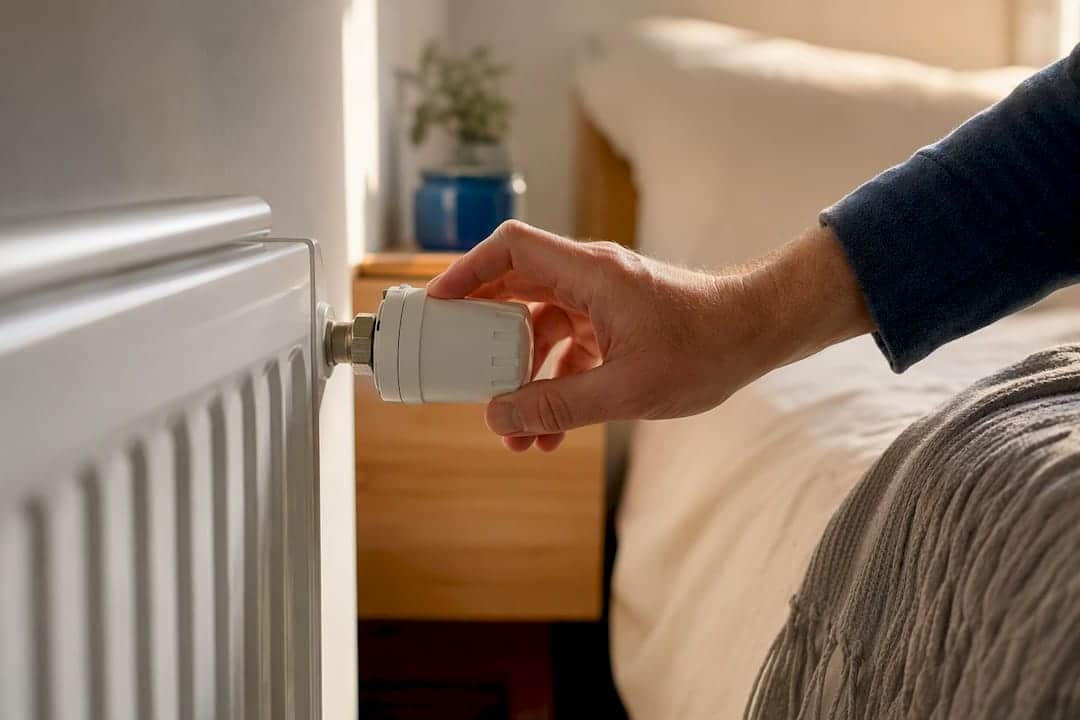
The room thermostat is the master control. It tells the boiler when to fire based on the temperature in whichever room it sits, while TRVs only ever manage the radiators they are fitted to, according to Which?.
This division of labour matters for one specific reason: boiler interlock. Building regulations expect the boiler to stop firing once the target temperature is reached somewhere in the property, and TRVs cannot provide that signal on their own, as set out in the BEAMA installer factsheet.
- Never fit a TRV to the radiator in the same room as the central thermostat.
- Fit a manual valve there instead, or leave the radiator fully open, so the thermostat reads the room’s true temperature.
- Read more on pairing these controls correctly in this thermostat usage guide.
What the TRV numbers mean and how to pick a setting
The numbers on a TRV dial are rough temperature markers, not speed controls. According to Strathclyde’s heating guidance, setting 1 sits around 10°C, and setting 3 corresponds to roughly 20°C, a comfortable living-room temperature for most households. Turning a valve to 5 heats the room to a higher final temperature; it does not make the radiator warm up any faster.
A useful habit before fiddling with settings: start at mid-range and leave it for a few days before nudging it up or down, since BEAMA notes that TRVs react slowly and immediate adjustment can mislead you into over-correcting.
- A living room used most evenings often suits setting 3 or 4.
- Bedrooms are generally more comfortable a notch or two cooler.
- A spare room or landing can sit on the frost-protection or star setting, which keeps pipes from freezing without heating the space properly.
Siting TRVs correctly and the mistakes that stop them working
A TRV can only respond to the air actually reaching its sensor. Hiding it behind curtains, inside a cabinet, or beneath shelving traps warm air around the valve head, which then closes the radiator prematurely and leaves the room cold, according to the BEAMA householder factsheet.
- Keep at least a hand’s width of clear space around the valve head.
- Avoid decorative radiator covers that box in the heat near the sensor.
- Where more than half the radiators in a property carry TRVs, fit an automatic bypass valve to protect the pump and maintain minimum flow, as Tower Hamlets Council’s guidance recommends.
Pro Tip: Never close every TRV in the house to zero hoping to save money. Without somewhere for water to circulate, the boiler and pump can suffer.
Smart TRVs and why heat pumps need a different approach
Smart TRVs add app control, room-by-room schedules, precise degree-by-degree setpoints, open-window detection and the ability to group radiators into zones. For most gas-boiler homes, they make fine-tuning simpler than turning a dial and guessing.
Heat pumps are a different case. Carbon Trust guidance points out that weather compensation and correctly commissioned flow temperatures should do the main work of controlling comfort, because using TRVs as crude on/off limiters can push the system towards higher flow temperatures and undercut the efficiency that low-temperature heat pumps are designed to deliver.
- Pair smart TRVs with a smart thermostat or weather-compensation controller rather than relying on them alone.
- See the weather compensation guide for how flow temperature and outdoor sensing work together.
- Read more on integration in the smart thermostat explainer.
Maintenance and quick troubleshooting for homeowners
Cold radiators, a stuck dial or a valve that whistles are the usual warning signs. A short checklist covers most cases before calling an engineer:
- Check the pin under the valve head is not stuck. Removing the head and gently tapping or moving the pin often frees it.
- Confirm the head is seated squarely on the valve body, since a loose fit stops the sensor reading the room correctly.
- Leave the lockshield alone. It has already been balanced against the other radiators, and changing it can unbalance the whole system.
Swapping a faulty head is a straightforward DIY job. Persistent leaks, a valve body that will not open at all, or uneven heating across several rooms point to a wider commissioning issue, covered in this heating system guide.
Savings and the building-regulation context for UK homeowners
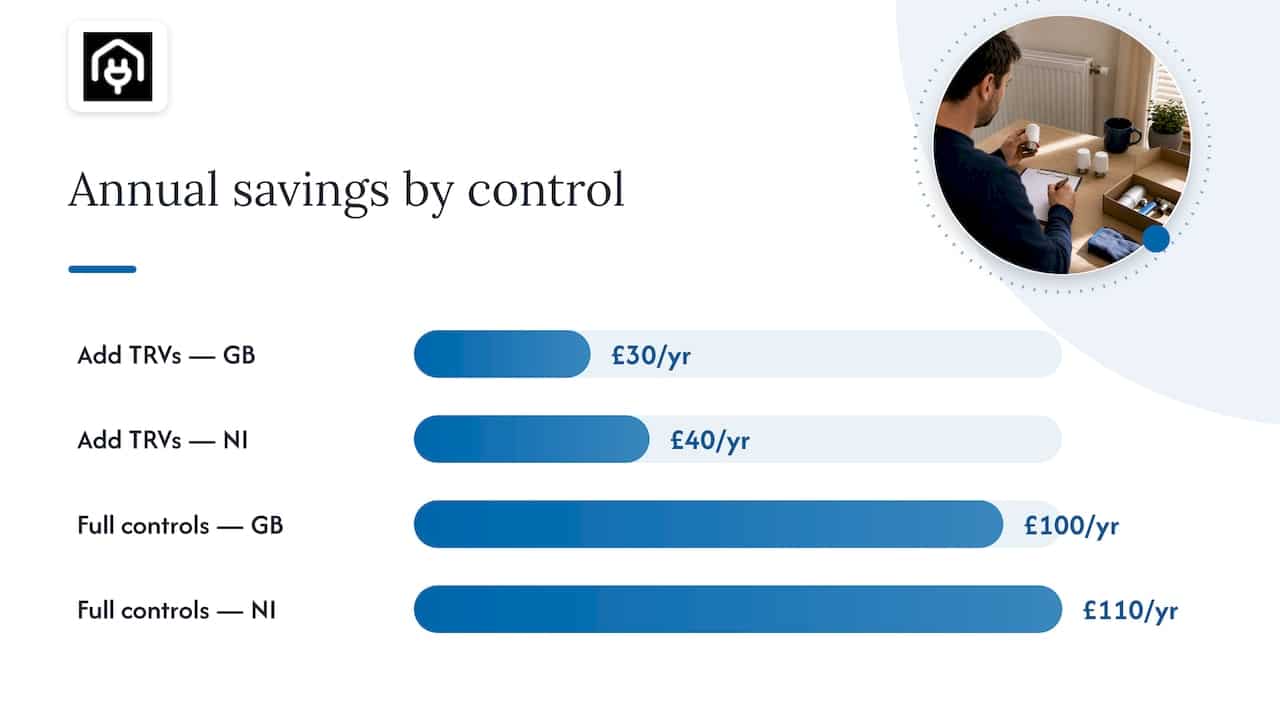
Adding TRVs to a system that already has a programmer and room thermostat can save around £30 a year in Great Britain and £40 in Northern Ireland, and a complete set of controls, meaning programmer, room thermostat and TRVs together, can save around £100 a year in GB and £110 in Northern Ireland, according to Strathclyde’s heating control guidance.
These savings come from three sources working together rather than any single control:
- Stopping rooms overheating once they reach their setpoint.
- Letting TRVs harness free heat gains from sunlight, cooking or a room full of people, as Baxi’s guidance describes.
- Pairing TRVs with a programmer and room thermostat rather than treating them as a stand-alone fix.
Building regulations require thermostatic room controls whenever a boiler is replaced, and TRVs are the usual practical way to meet that requirement on an existing radiator system, though they do not by themselves satisfy the boiler interlock rule that also has to be met, per the BEAMA installer factsheet.
An adviser’s view on getting TRVs right
Three checks take less than an afternoon: confirm nothing blocks the sensors, make sure no TRV shares a room with the central thermostat, and try mid-range settings for a few days before judging them. If rooms still heat unevenly after that, the fault usually sits in how the controls were commissioned rather than in the valves themselves, and a proper controls audit is worth more than another new TRV.
— Danny
How Home Energy Model can help with EPCs and controls advice
Inconsistent heating often shows up as a flag during an energy assessment, and it is exactly the kind of detail a Domestic Energy Performance Certificate picks up alongside the property’s wider insulation and controls setup. Some providers offer Domestic EPCs, SAP calculations, and energy statements for planning, and the assessment process may include a look at how heating controls, including TRVs, room thermostats and boiler interlock, are actually working together in the property.
For homeowners weighing up whether inconsistent room temperatures point to a controls problem or something bigger, a Domestic EPC is a practical starting point, giving a documented picture of the property’s heating performance alongside the certificate itself.
Sources
- Heating control guidance — University of Strathclyde
- TRV factsheet for installers — BEAMA
- Radiator thermostat guidance — Tower Hamlets Council
- Avoid this radiator mistake that can increase your bills — Which?
FAQ
What should radiator thermostats be set at?
Most living rooms are comfortable on setting 3 or 4, which corresponds to roughly 20°C, while bedrooms and less-used rooms often suit a notch or two lower. Start mid-range and adjust by one setting every few days rather than jumping straight to the highest number.
What temperature is 3 on a radiator?
Setting 3 corresponds to approximately 20°C on most TRV dials, according to Strathclyde’s heating control guidance. The exact figure varies slightly between manufacturers, so treat it as a starting point rather than an exact reading.
Can I put a TRV on all radiators?
Not quite: the radiator sharing a room with the central room thermostat should keep a manual valve or stay fully open, so the thermostat can read the room’s genuine temperature. Fitting TRVs to every other radiator is standard practice, though a system with TRVs on more than half its radiators usually needs an automatic bypass valve to protect the pump.
What is the problem with thermostatic radiator valves?
TRVs react slowly and can give a false reading if the sensor is blocked by curtains, furniture or a radiator cover, leaving a room colder than intended. They also cannot provide boiler interlock on their own, so a property still needs a central room thermostat working alongside them to control the boiler correctly.